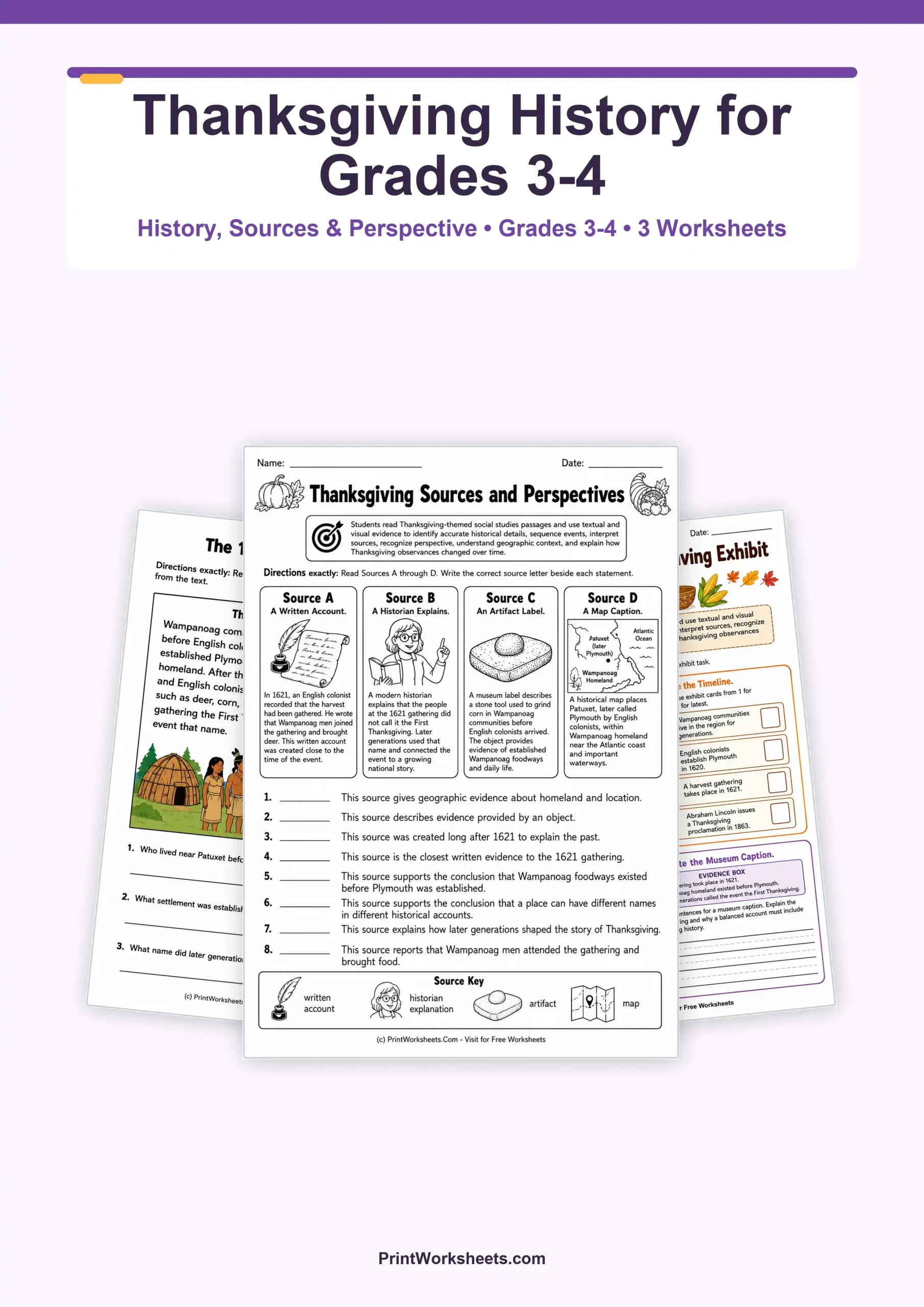
These Thanksgiving social studies passages give third- and fourth-grade students a history-centered way to read, question, compare evidence, and explain what they learn. Across three printable activities, students study Wampanoag connections to Patuxet, the English settlement at Plymouth, the 1621 harvest gathering, different types of historical sources, chronology, geography, perspective, and evidence-based writing. Instead of treating Thanksgiving as a single isolated story, the set asks students to notice how historians use texts, artifacts, maps, and later interpretations to build a fuller account of the past.
Thanksgiving social studies passages that build historical thinking
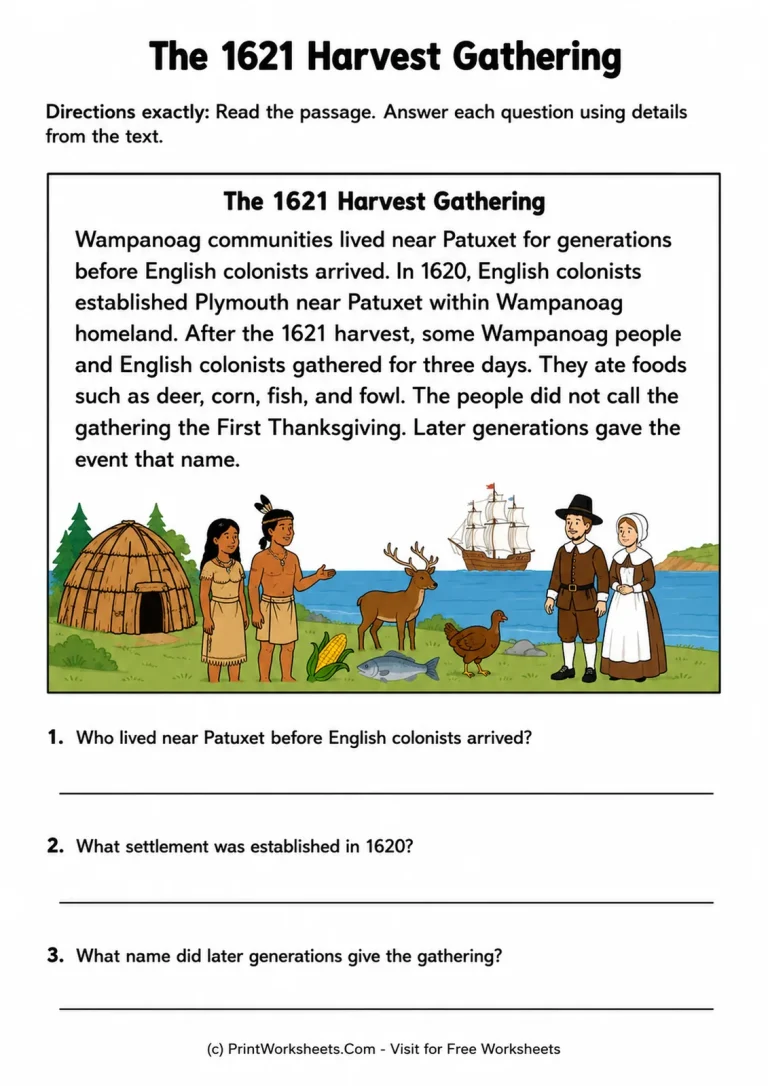
The first activity, The 1621 Harvest Gathering, begins with a focused historical reading. Students learn that Wampanoag communities lived near Patuxet before English colonists arrived and that Plymouth was established nearby in 1620. The passage then describes the gathering that followed the 1621 harvest, including details such as its three-day duration and foods including deer, corn, fish, and fowl. Three short-answer questions direct students back to the text to identify who lived near Patuxet, which settlement was established in 1620, and what later generations came to call the gathering.
This page works well as an entry point because students must retrieve precise information before they move into more complex historical analysis. Teachers can ask students to underline the sentence that supports each response, turning a straightforward comprehension task into early practice with citing textual evidence.
Compare written accounts, historians, artifacts, and maps
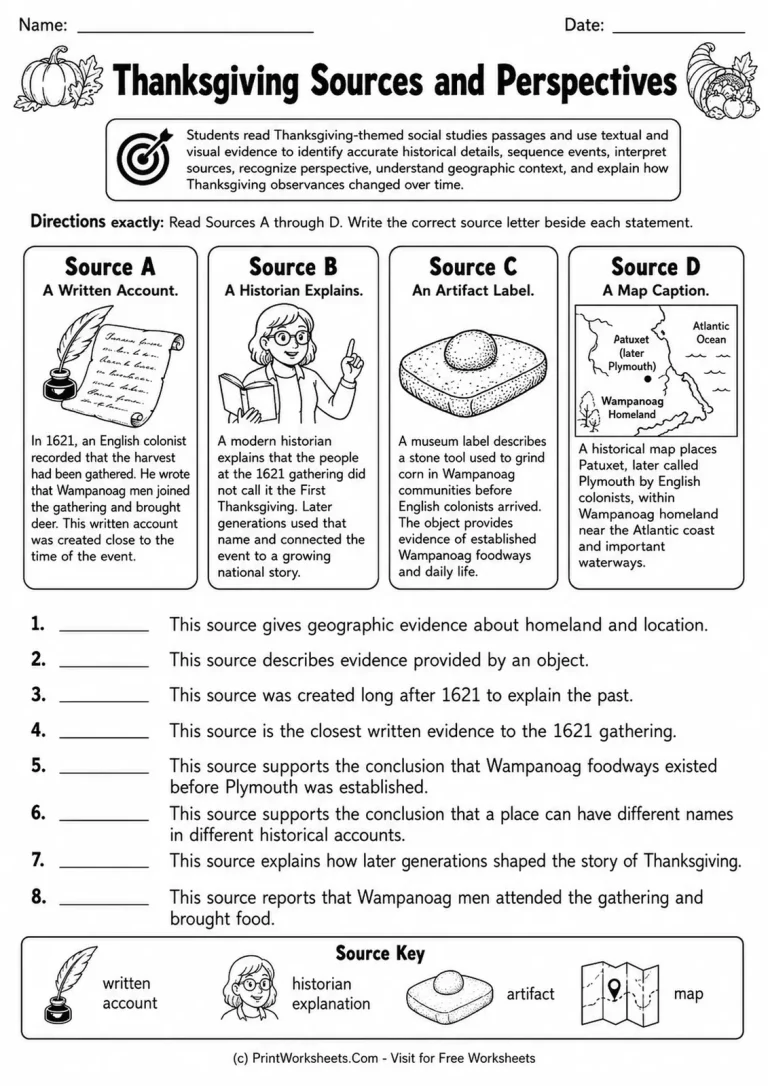
The second activity, Thanksgiving Sources and Perspectives, shifts the emphasis from reading one passage to examining how historical information is presented. Students work with four source types: a written account, a modern historian explanation, an artifact label, and a historical map caption. They match eight statements to the source that best supports each one.
The task gives students repeated practice distinguishing evidence about geography, objects, chronology, perspective, and Wampanoag history. It is especially useful for introducing the idea that different sources answer different historical questions. A map may clarify location, an artifact can reveal material culture, and a historian may explain context or interpretation that is not visible in an object alone. Before students begin independently, teachers can model one statement and ask, ‘Which source would be most useful for proving this claim, and why?’
Move from comprehension to chronology, perspective, and evidence
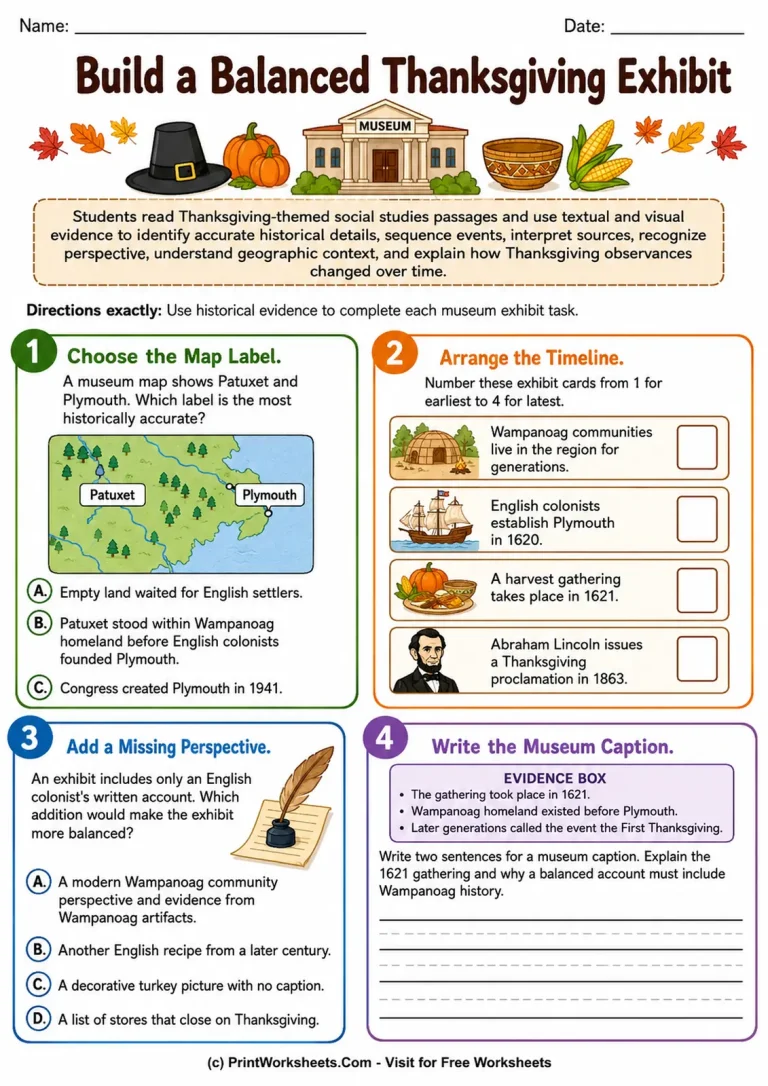
The final activity, Build a Balanced Thanksgiving Exhibit, asks students to apply what they have learned rather than simply recall facts. Students choose an accurate interpretation of a Patuxet and Plymouth map, arrange four historical events in chronological order, decide what addition would make an exhibit more balanced, and write a two-sentence museum caption using information from an evidence box.
This combination makes the page useful for social studies instruction because several disciplinary skills appear in one connected task. Students have to interpret geographic context, place events in sequence, recognize why Wampanoag perspectives matter to a balanced historical presentation, and turn supplied evidence into concise explanatory writing. The museum-exhibit format also gives the writing a clear audience and purpose.
Ways to use the worksheets in Grades 3 and 4
For a whole-class lesson, begin with the harvest-gathering passage and create a short timeline on the board using Patuxet, Plymouth in 1620, and the 1621 gathering. On a second day, use the source-comparison page in pairs so students can explain why each statement belongs with a particular source. Finish with the exhibit task as independent practice or a social studies assessment.
For students who need support, provide sentence frames such as ‘Source __ is useful because it shows __’ or ‘This perspective makes the exhibit more balanced because __.’ Stronger readers can extend the work by explaining which two sources they would combine to answer a historical question and what each source contributes. Another extension is to have students expand the two-sentence museum caption into a short exhibit label that includes one geographic fact, one chronological fact, and one statement about perspective.
Use evidence to discuss a more complete Thanksgiving history
These worksheets are designed to help students move beyond memorizing names and dates. By reading about Wampanoag communities, Patuxet, Plymouth, and the 1621 harvest gathering while also comparing sources and considering perspective, students practice the habits used in real historical inquiry. The sequence can support a Thanksgiving unit, a primary-and-secondary-source introduction, a lesson on chronology, or a broader Grade 3-4 discussion about how evidence shapes the stories museums and textbooks tell about the past.