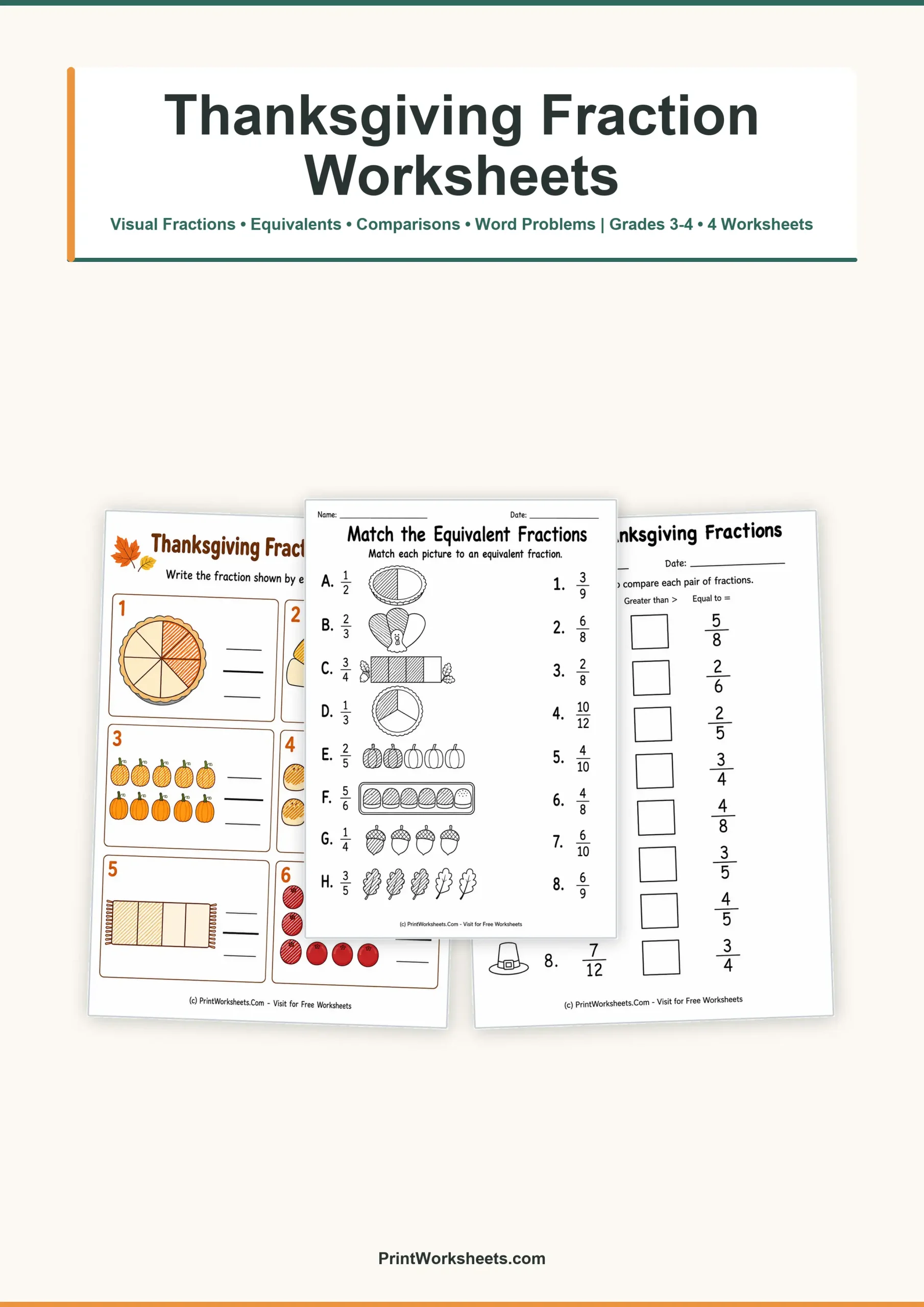
These Thanksgiving fraction worksheets give 3rd and 4th grade students a four-page path from reading fractions in pictures to solving fraction problems in context. The activities begin with shaded seasonal models, move into equivalent fractions and comparison symbols, and finish with Thanksgiving word problems that ask students to apply what they know. That sequence makes the set useful for a short holiday math unit, independent practice, centers, homework, or a structured review before Thanksgiving break.
Thanksgiving Fraction Worksheets That Build Skills Step by Step
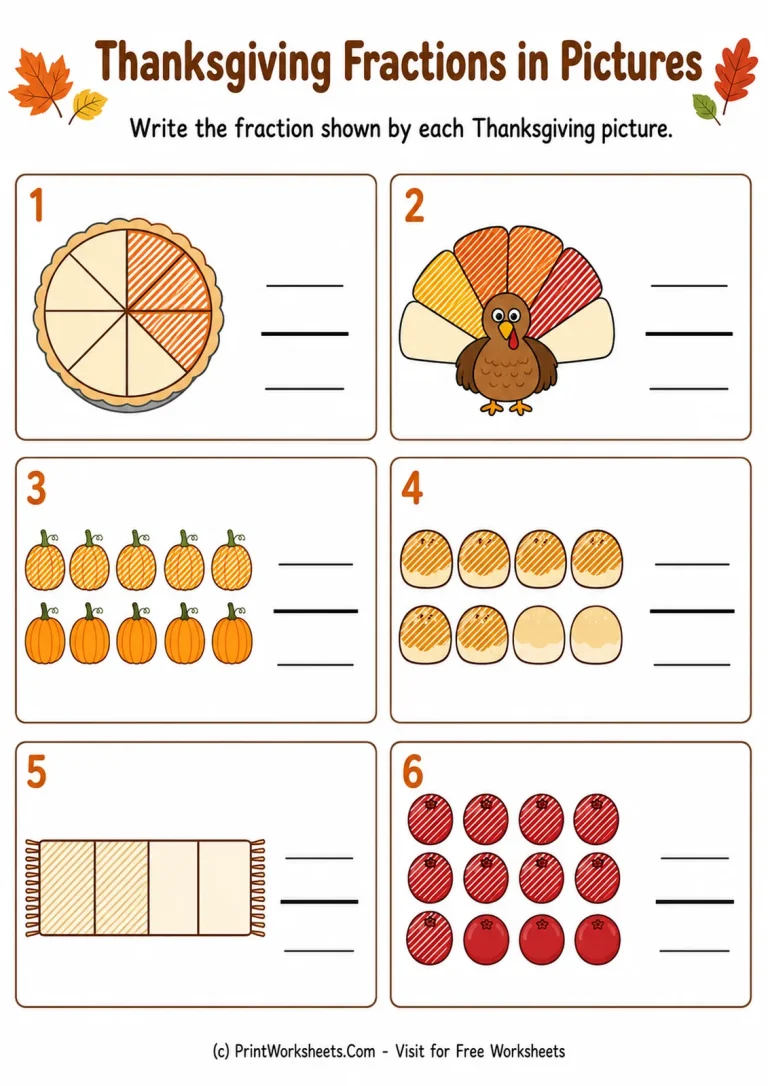
The first worksheet, Thanksgiving Fractions in Pictures, keeps the mathematics concrete. Students study six Thanksgiving-themed pictures and write the fraction represented by the shaded parts or selected objects. The visual models include a pie, turkey feathers, pumpkins, divided shapes, and groups of seasonal objects. Because students must count both the selected amount and the total amount, the page reinforces the meaning of numerator and denominator rather than asking learners to work only with abstract notation.
This page works especially well as a warm-up for students who still benefit from visual fraction models. Teachers can ask students to explain what the numerator counts and what the denominator counts before writing each fraction. A quick extension is to have students identify whether any resulting fractions could be simplified.
Practice Equivalent Fractions Through Matching
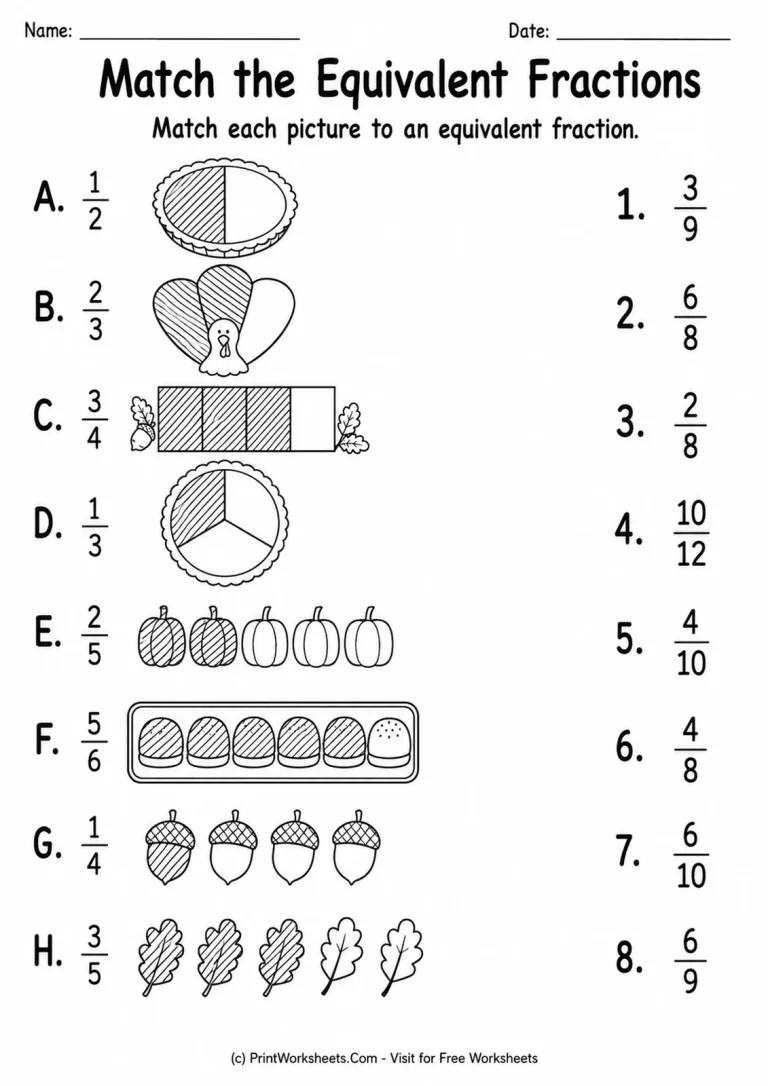
The second worksheet shifts from visual identification to equivalent fraction reasoning. Students match eight fractions labeled A-H with equivalent choices on the opposite side. The set includes familiar relationships such as 1/2 and 4/8, 3/4 and 6/8, and 5/6 and 10/12. Other pairs require students to notice multiplication patterns in both the numerator and denominator.
This matching format gives students repeated practice without turning the page into a long list of calculations. Encourage learners to justify each match by stating the factor used to create the equivalent fraction. For example, they can explain that multiplying both parts of 1/2 by 4 produces 4/8. Students who are ready for a challenge can write another equivalent fraction for each matched pair.
Compare Fractions With <, >, and =
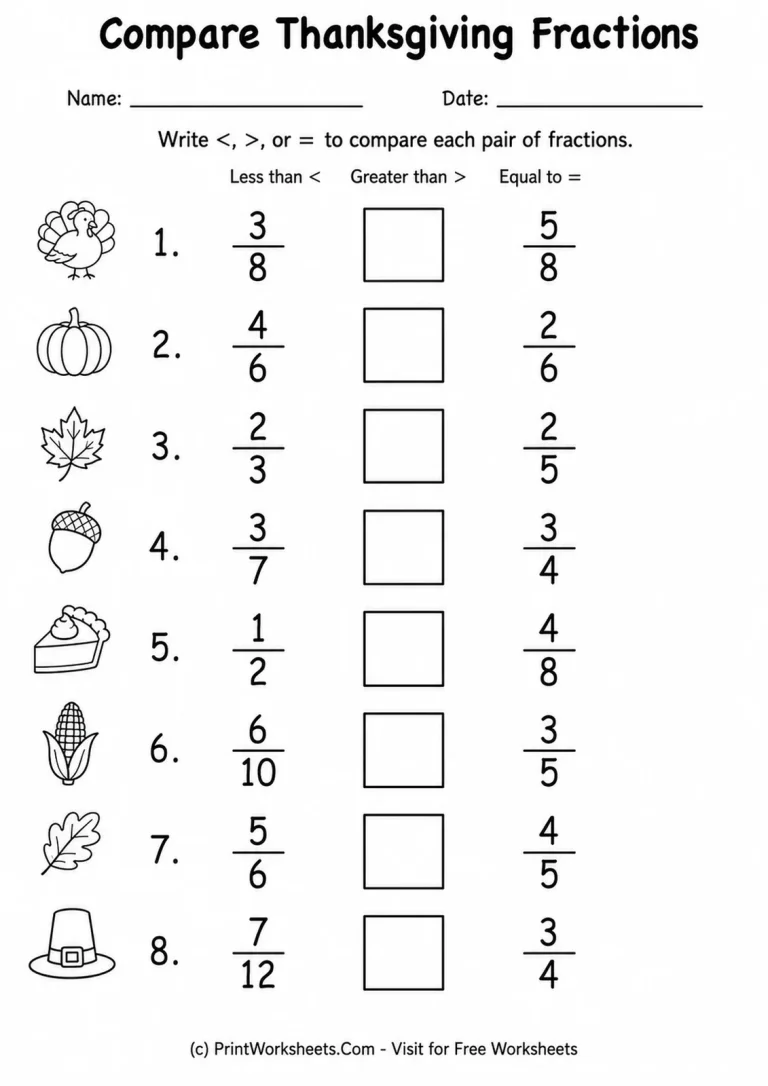
The third worksheet asks students to compare eight fraction pairs using <, >, or =. The problems intentionally mix several types of comparisons. Some fractions share a denominator, some share a numerator, some are equivalent, and others have different numerators and denominators. Examples such as 1/2 compared with 4/8 and 6/10 compared with 3/5 make equality part of the practice rather than limiting the page to greater-than and less-than decisions.
For classroom use, ask students to name the strategy they used beside selected problems. They might compare equal denominators, reason from benchmark fractions such as one-half, create equivalent fractions, or use a visual model on scrap paper. This turns a symbol-writing exercise into a discussion about efficient fraction strategies.
Apply Fraction Skills in Thanksgiving Word Problems
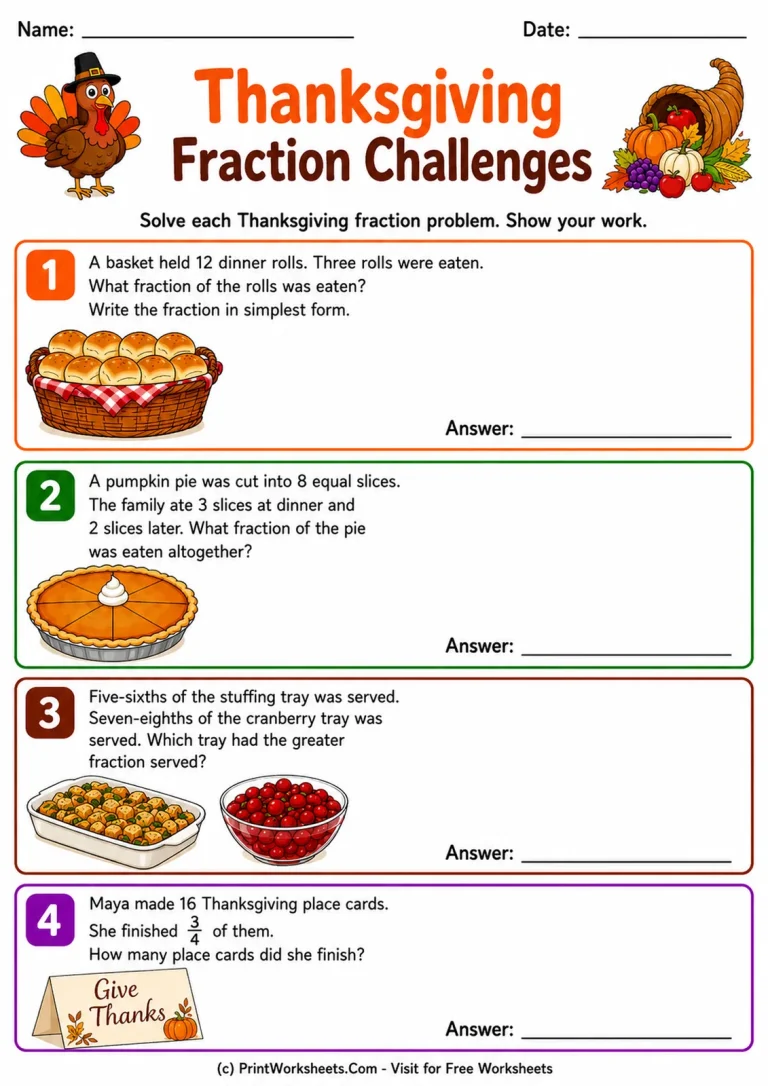
The final page, Thanksgiving Fraction Challenges, puts the earlier skills into short story problems. One problem describes 3 of 12 dinner rolls being eaten and asks students to simplify the fraction. Another uses an eight-slice pie and asks students to determine the total fraction eaten. Students also compare 5/6 with 7/8 and calculate 3/4 of a group of 16 cards.
These four problems add variety because students must decide what operation or fraction idea the situation requires. The dinner-roll task connects a part-to-whole fraction with simplification. The pie problem uses a familiar equal-parts model. The comparison problem checks reasoning with unlike denominators, while the card problem asks students to find a fractional part of a whole number.
Ways to Use the Four-Page Set
For a full lesson sequence, use the picture-fraction page first, the equivalent-fraction matching page second, the comparison page third, and the word-problem page as the final application. The same pages can also be separated across math centers. One group can work with visual fractions while another practices equivalence or comparison strategies.
For differentiation, students who need more support can draw fraction bars or circles beside the symbolic problems. Students who are ready for extension can simplify every possible fraction, generate additional equivalent fractions, or write a new Thanksgiving word problem using a fraction such as 2/3, 3/4, or 5/6.
A simple exit ticket can ask students to create one fraction equivalent to 1/2, compare two teacher-selected fractions, and explain how they know which is greater. After completing all four worksheets, students will have practiced recognizing fractions, building equivalence, comparing values, simplifying a fraction, and finding a fractional part of a set within one coherent Thanksgiving math theme.