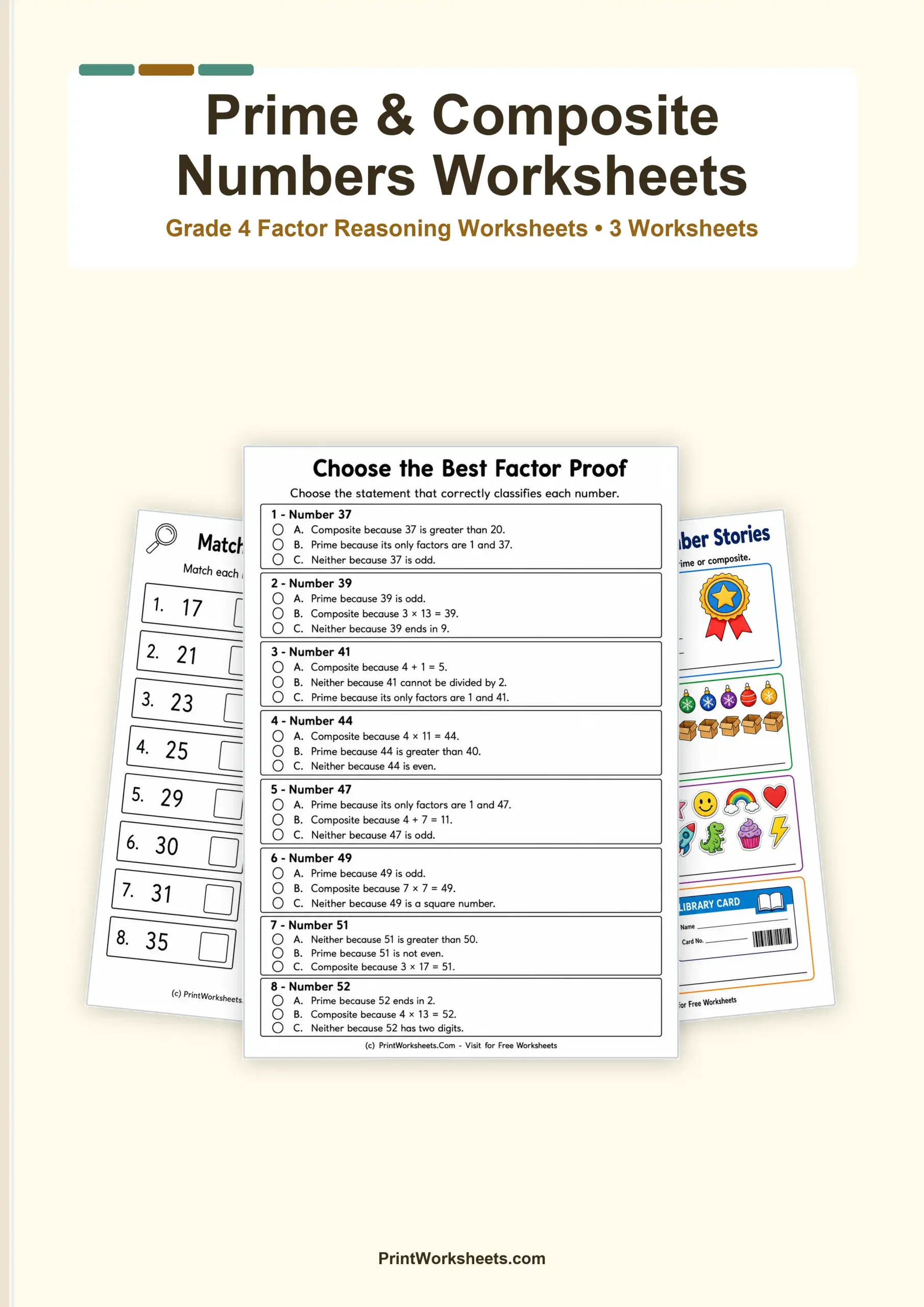
These prime and composite numbers worksheets give fourth graders practice using factors as evidence instead of relying on guesses, number size, or whether a number looks familiar. Across three printable activities, students match numbers to factor clues, choose the strongest mathematical proof, and apply factor reasoning to short real-world stories. The progression is useful for lessons in which students already know basic multiplication facts and are beginning to explain why a number is prime or composite.
Prime and composite numbers through factor evidence
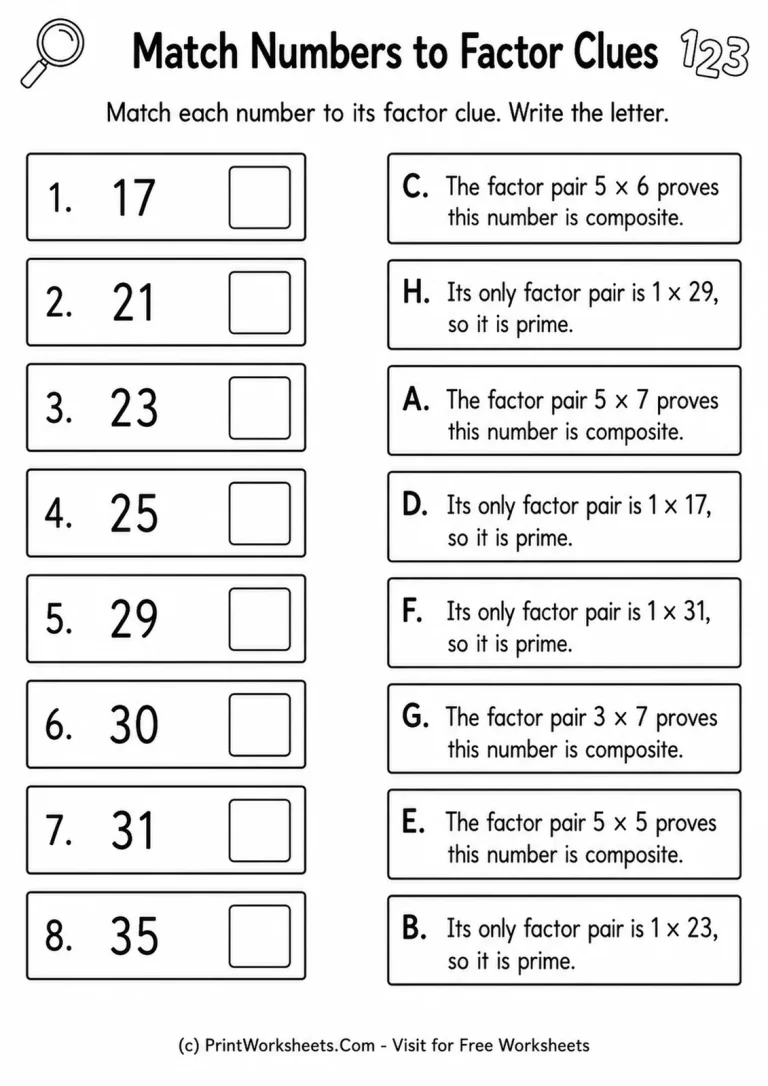
The first worksheet, Match Numbers to Factor Clues, asks students to connect eight numbers with eight factor descriptions. The set includes 17, 21, 23, 25, 29, 30, 31, and 35. Some clues show that a number has only the factor pair 1 and itself, while others provide a multiplication pair that proves the number is composite. For example, 30 can be connected to 5 × 6 and 35 to 5 × 7. Prime numbers such as 17, 23, 29, and 31 are identified through the absence of additional whole-number factor pairs.
This matching format encourages students to look for mathematical evidence before naming a category. It can work well as independent practice, a small-group activity, or a quick check after a lesson on factors and factor pairs. Because several prime and composite examples appear together, students have repeated opportunities to compare how the evidence changes from one number to another.
Choosing the best factor proof
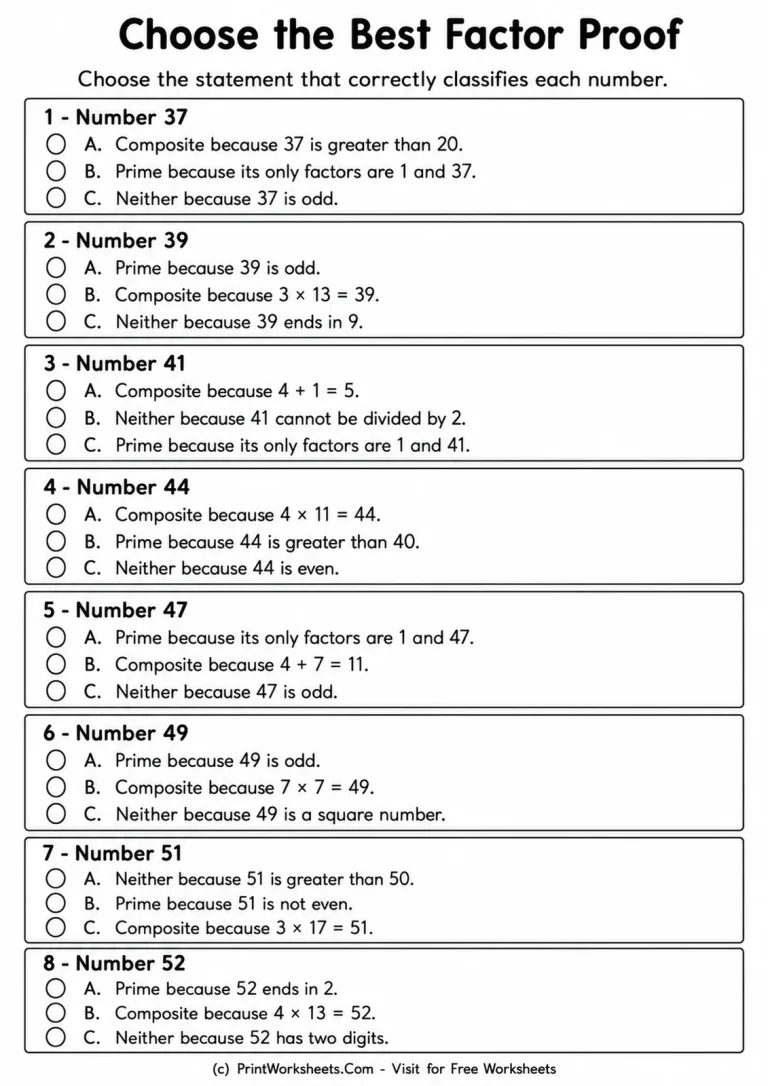
The second worksheet moves from matching to reasoning. In Choose the Best Factor Proof, students work with 37, 39, 41, 44, 47, 49, 51, and 52. Each multiple-choice item asks them to recognize a valid factor-based explanation and distinguish it from weaker statements that do not actually prove whether a number is prime or composite.
The composite examples provide clear factor relationships, including 39 = 3 × 13, 44 = 4 × 11, 49 = 7 × 7, 51 = 3 × 17, and 52 = 4 × 13. This is especially helpful for students who may incorrectly think that all odd numbers are prime or that larger numbers are automatically composite. Instead of memorizing isolated classifications, students must connect each decision to a factor relationship.
Why factor pairs matter in Grade 4
Factor pairs give students a concrete way to justify their thinking. A composite number can be written as a product of whole numbers other than 1 and itself, while a prime number has exactly two positive factors. Seeing and using these relationships helps students build a stronger foundation for later work with multiplication patterns, divisibility, common factors, fractions, and number structure.
Teachers can also use the multiple-choice page for discussion. Asking students to explain why a tempting wrong answer is insufficient can reveal misconceptions that may not appear on a simple prime-or-composite sorting activity. Parents using the worksheets at home can encourage the same habit by asking, “What factor pair proves your answer?”
Applying prime and composite reasoning in number stories
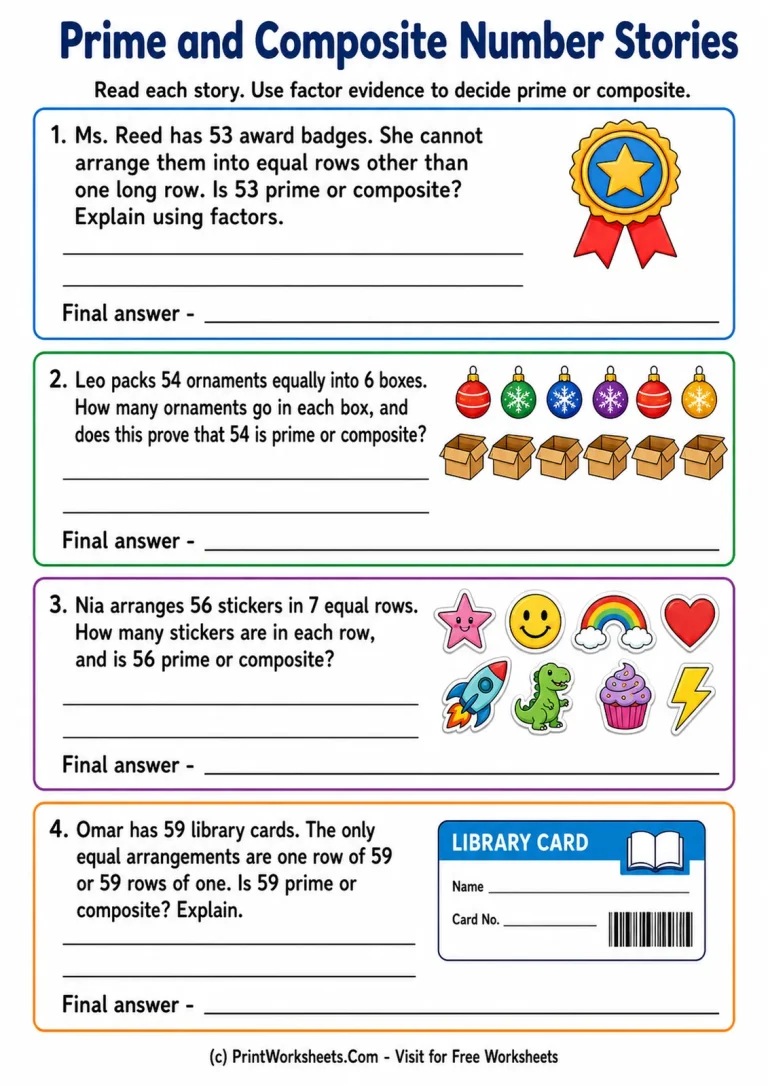
The final worksheet, Prime and Composite Number Stories, places factor thinking into four short contexts. Students consider 53 award badges, 54 decorations, 56 stickers, and 59 library cards. Rather than only circling prime or composite, they think about whether the objects can be arranged into equal groups and then explain the factor relationship that supports the conclusion.
The numbers 53 and 59 provide prime examples because they cannot be arranged into equal whole-number groups using factor pairs other than 1 and the number itself. The quantities 54 and 56 provide composite examples with additional possible arrangements. This page is a useful bridge from symbolic factor work to explanation because students must interpret a situation, test possible groupings, and communicate a final mathematical decision.
A compact printable set for practice and review
Together, these three Grade 4 worksheets move from recognizing factor evidence to evaluating reasoning and then using that reasoning in context. That structure makes the set flexible enough for a short factors unit, math centers, homework, intervention practice, or review before a broader assessment. Students encounter both prime and composite numbers repeatedly, but the task changes on each page so the work does not become simple repetition.
For best results, encourage students to write or say the factor pair behind each composite classification and to explain why a prime number has no additional whole-number factor pair. The goal is not only to identify the correct label, but to make the factor evidence visible. These printable activities provide a focused way to strengthen that reasoning while giving fourth graders varied practice with numbers they can analyze using multiplication knowledge.