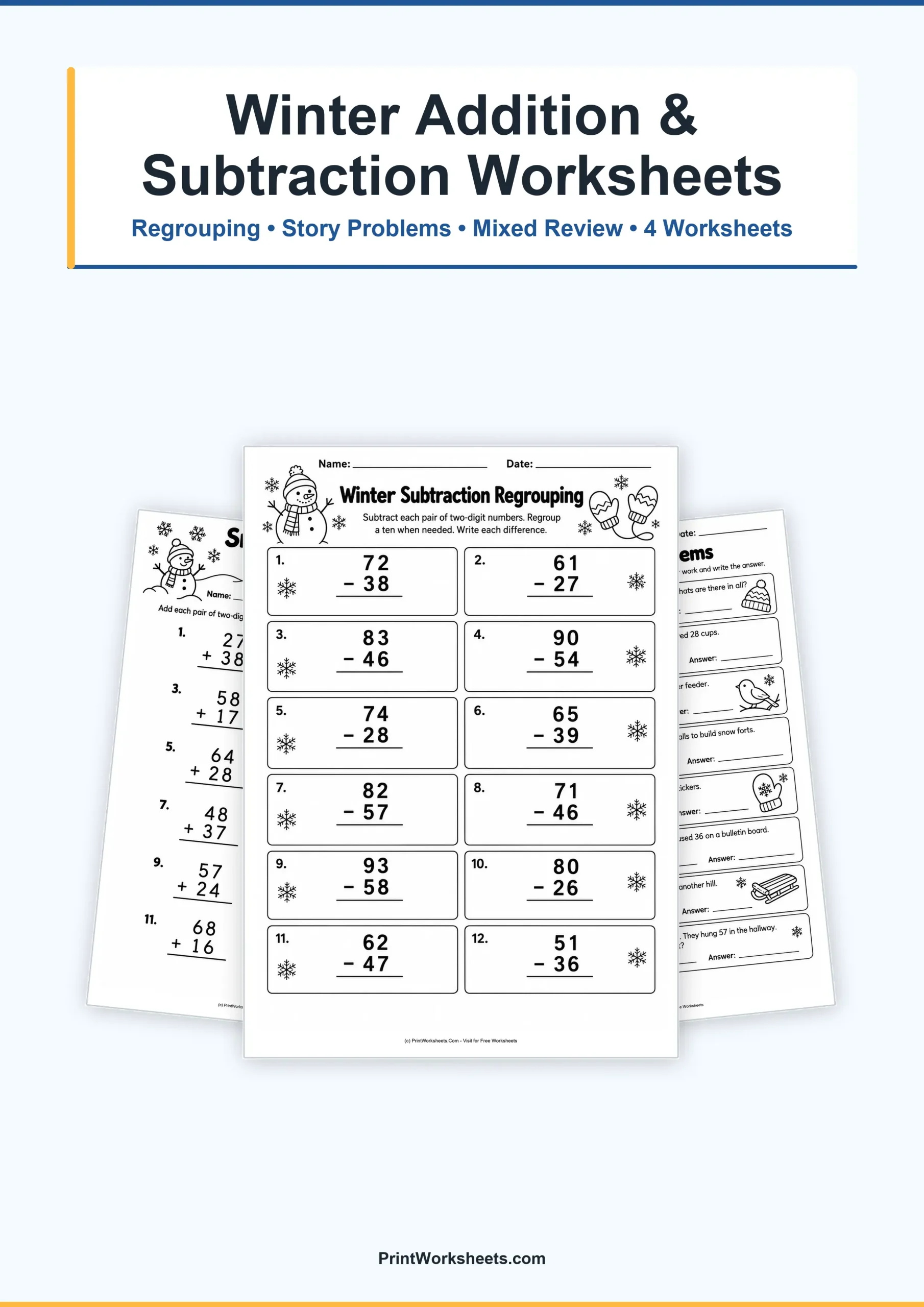
These winter addition and subtraction worksheets give students several ways to practice two-digit computation with regrouping while keeping the work connected to a familiar seasonal theme. Across four printable pages, learners move from straightforward vertical equations to mixed story problems and multiple-choice review. The set is especially useful for students who already understand basic place value and are ready to strengthen accuracy with carrying and borrowing.
Winter Addition and Subtraction Practice With Regrouping
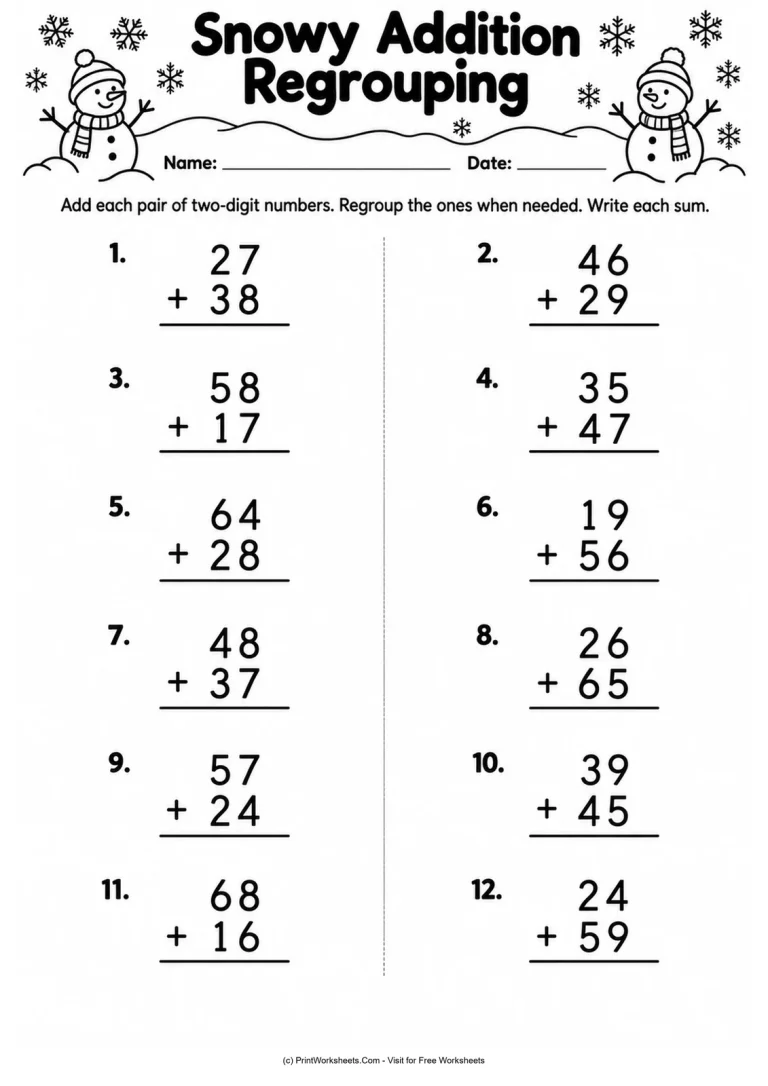
The first two worksheets separate the core skills so students can focus on one operation at a time. The Snowy Addition Regrouping page includes 12 two-digit addition problems. Every problem requires students to add the ones first and regroup when needed before completing the tens column. Examples such as 27 + 38, 64 + 28, and 48 + 37 give repeated practice with carrying into the tens place without adding unnecessary distractions.
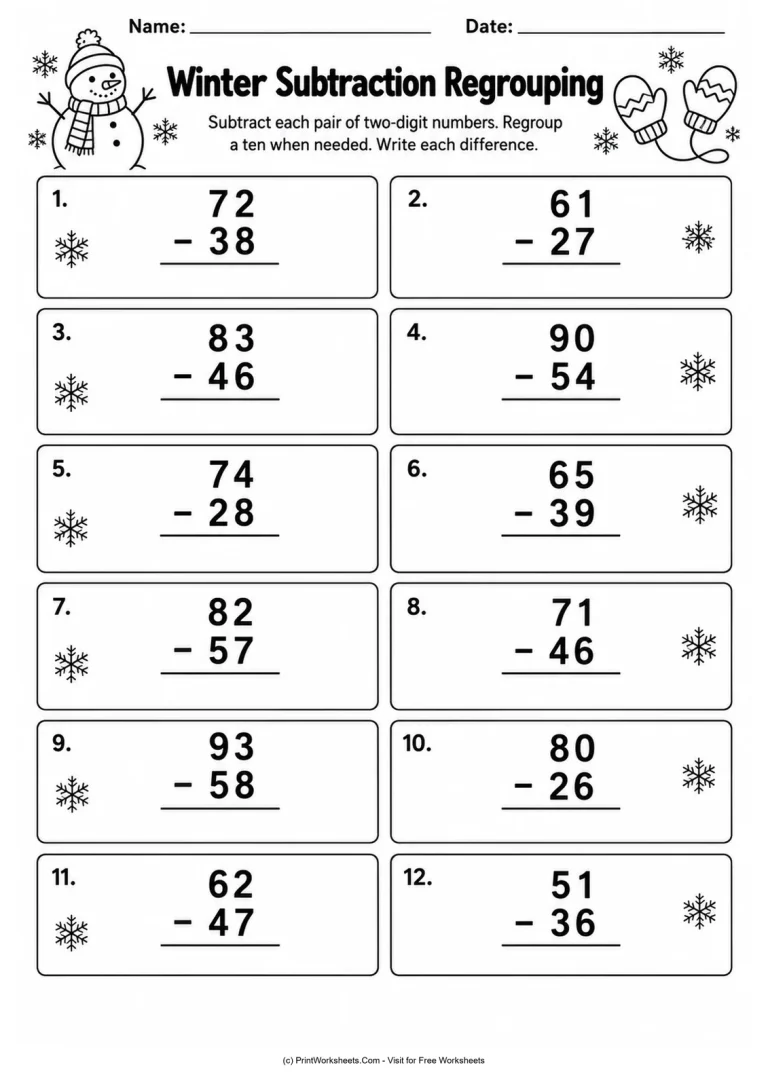
The Winter Subtraction Regrouping page follows with 12 two-digit subtraction problems. Students work through equations such as 72 – 38, 83 – 46, and 90 – 54, regrouping one ten when the ones digit in the top number is too small. Because the problems are shown vertically, the page works well for reinforcing correct place-value alignment as well as subtraction accuracy.
Students who need an easier seasonal warm-up can also use these winter addition worksheets for kindergarten or the matching winter subtraction worksheets for kindergarten before moving into two-digit regrouping.
Mixed Winter Story Problems
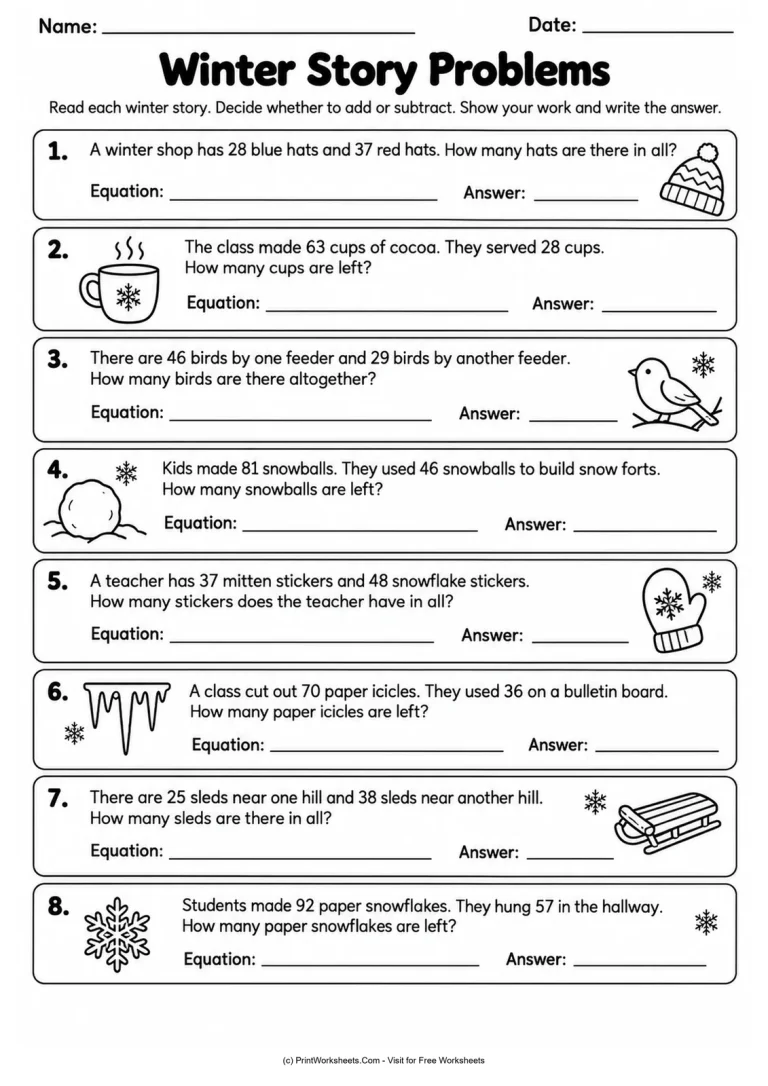
The third worksheet asks students to decide whether each winter situation requires addition or subtraction. Eight story problems use contexts such as winter hats, cups of cocoa, birds at feeders, snowballs, mitten and snowflake stickers, paper icicles, sleds, and paper snowflakes. Instead of being told which operation to use, students must read the situation, choose the correct operation, write an equation, and record the answer.
This page adds an important reasoning step to the set. A student may be able to calculate 46 + 29 correctly when the equation is already written, but a word problem requires that same student to recognize that two groups are being combined. Likewise, situations involving objects that were used or removed require subtraction. Teachers can use the equation line to quickly see whether an incorrect final answer came from choosing the wrong operation or from a calculation mistake.
For additional practice focused specifically on this format, try the double digit addition and subtraction word problems with regrouping.
A Multiple-Choice Winter Math Check
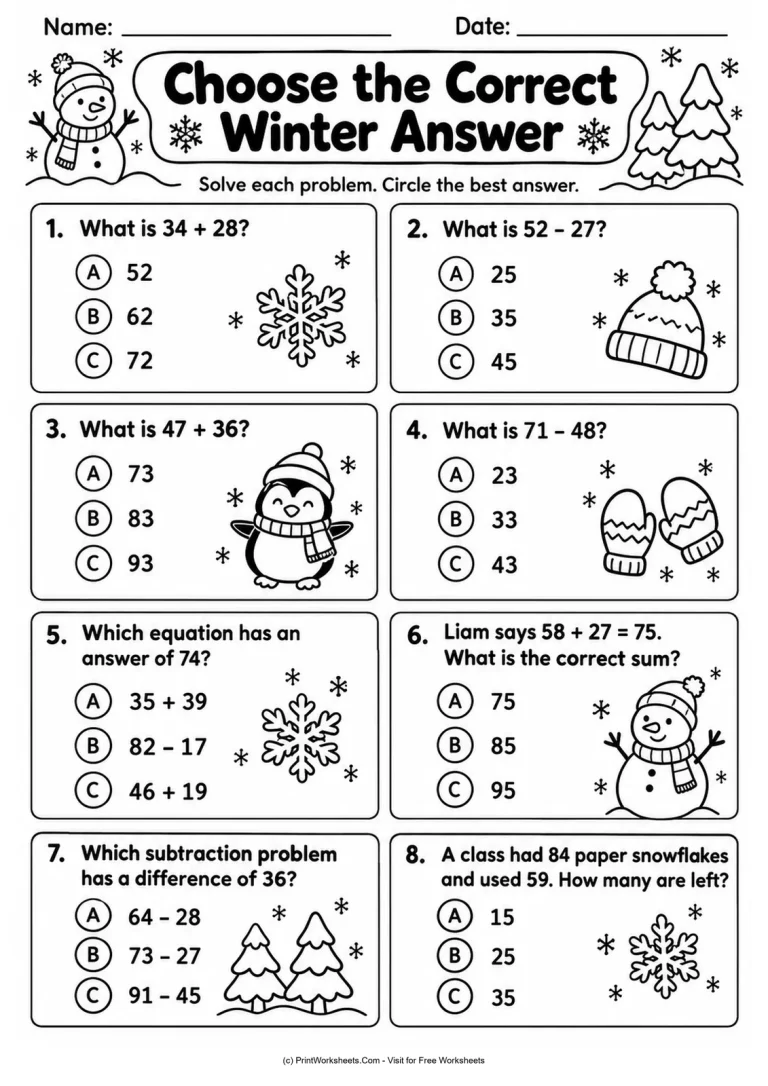
The final page works well as a short review or informal assessment. Students solve eight mixed questions and circle the best answer. Some items ask for a direct sum or difference, while others require students to identify an equation with a given result, correct an incorrect sum, or solve a short subtraction situation. This variation checks more than routine computation because students must pay attention to both the operation and the meaning of the answer choices.
For example, one problem asks students to find 34 + 28 from three possible answers, while another asks which equation equals 74. A separate item presents the statement 58 + 27 = 75 and asks students to identify the correct sum. These formats are useful for catching common regrouping errors and for encouraging students to verify their work rather than selecting the first plausible number.
Ways to Use These Winter Math Worksheets
The four pages can be used together as a short winter math sequence or separately according to student need. Start with the addition page, continue with subtraction, then move to the story problems once students are comfortable with the mechanics of regrouping. The multiple-choice page can finish the sequence as an independent review, exit activity, homework page, or small-group check.
The black-and-white snowmen, mittens, snowflakes, birds, sleds, and other winter illustrations add seasonal interest while leaving the mathematics easy to read. Because the set combines focused computation with application and review, it gives teachers and parents a practical way to revisit two-digit addition and subtraction during winter without relying on four pages of the same exercise format.