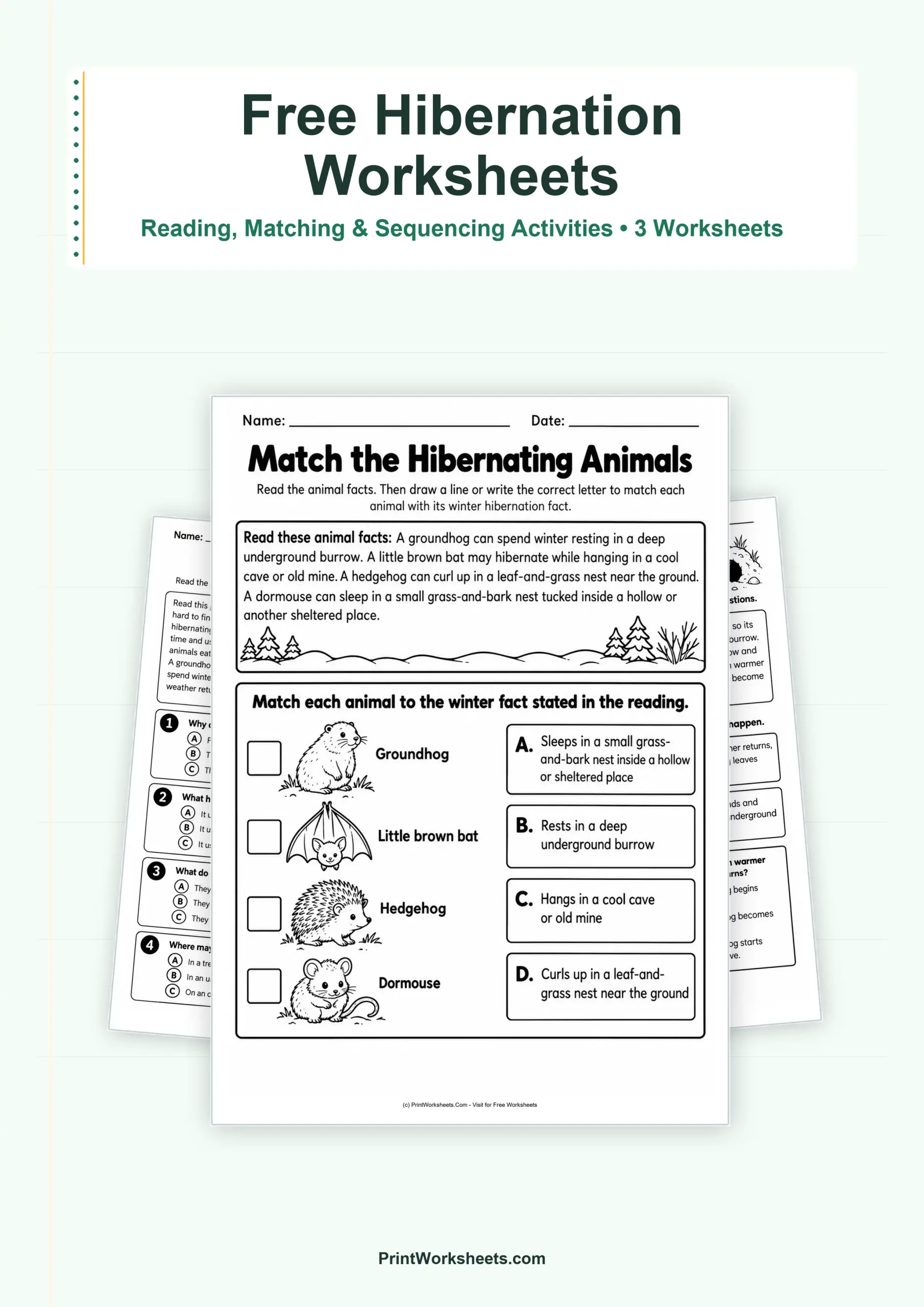
These free hibernation worksheets help elementary students learn why some animals rest through winter, how they prepare before cold weather arrives, and where different animals may shelter. The three printable activities combine short informational reading with multiple-choice questions, matching, and sequencing, so students practice science vocabulary and reading comprehension at the same time.
Hibernation Worksheets for Reading and Science Practice
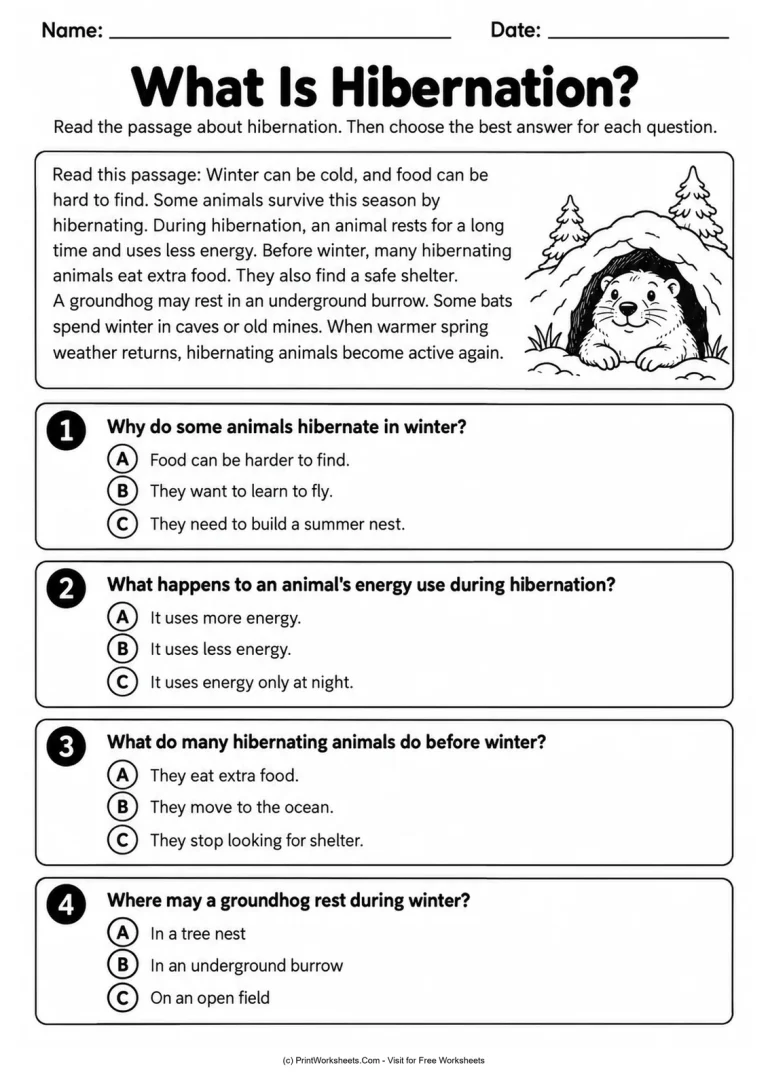
The first worksheet, What Is Hibernation?, introduces the main idea in a short, accessible passage. Students read that winter can make food harder to find and that hibernating animals use less energy while resting for a long time. The passage also explains that many animals eat extra food before winter and look for a safe shelter. Groundhogs and bats are used as concrete examples, giving children facts they can immediately apply to four multiple-choice questions.
The questions stay closely tied to the passage. Students identify why some animals hibernate, what happens to their energy use, what many animals do before winter, and where a groundhog may rest. This makes the page useful for practicing careful rereading and locating explicit details rather than guessing from pictures alone.
Compare Hibernating Animals and Their Winter Shelters
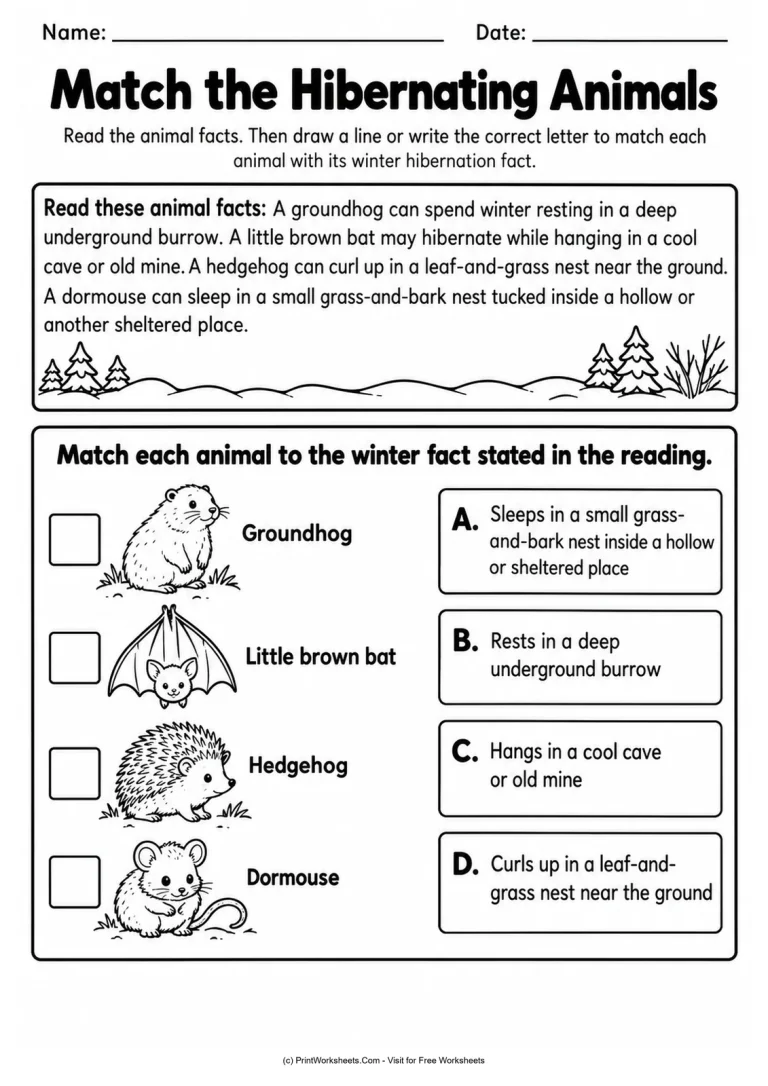
The second worksheet expands the topic from a single definition to four specific animals: a groundhog, little brown bat, hedgehog, and dormouse. A short fact section explains that a groundhog may rest in a deep underground burrow, a little brown bat may hang in a cool cave or old mine, a hedgehog may curl up in a leaf-and-grass nest near the ground, and a dormouse may sleep in a small grass-and-bark nest inside a hollow or another sheltered place.
Students then match each animal with the correct winter fact. Because the four descriptions are different, the activity encourages children to compare details and connect each animal with its particular shelter or behavior. The illustrated animal labels also make the task approachable for students who benefit from strong visual support while reading.
Sequence a Groundhog’s Winter Preparation
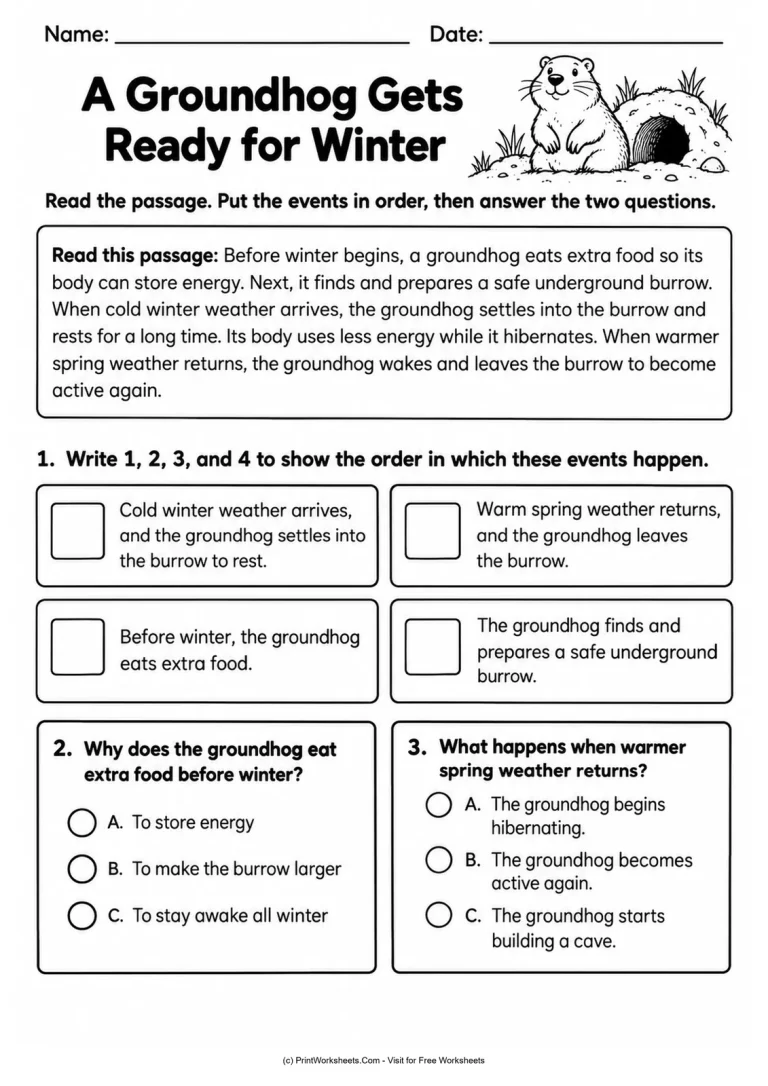
The third worksheet, A Groundhog Gets Ready for Winter, turns the same science topic into a sequencing task. Students read how a groundhog eats extra food so its body can store energy, finds and prepares an underground burrow, settles into the burrow when cold weather arrives, uses less energy while hibernating, and becomes active again when warmer spring weather returns.
After reading, students number four events in the correct order. They also answer two multiple-choice questions about why the groundhog eats extra food and what happens when spring returns. This page is especially useful for connecting chronological order words and cause-and-effect thinking with a simple seasonal science concept.
Skills Practiced Across the Printable Set
Together, the three pages give students repeated exposure to the same core ideas without repeating the same task. Children work on identifying key details, matching facts to animals, putting events in sequence, recognizing cause and effect, and using information from a passage to choose a supported answer. The science content reinforces that hibernation is connected with conserving energy, finding shelter, preparing before winter, and returning to activity in spring.
This set fits naturally into a winter animals unit, an elementary science center, reading-comprehension practice, homeschool work, or a seasonal literacy station. Teachers can use the pages in order, beginning with the basic definition of hibernation, moving to comparisons among several animals, and finishing with the groundhog life-event sequence.
Pair It With More Animals in Winter Practice
For a broader look at seasonal animal behavior, pair this set with our animals in winter worksheets. The broader collection works well alongside these hibernation-focused pages when students are studying how animals respond to cold weather in different ways.
Print the three activities as a short mini-unit or choose individual pages to match the skill you want to reinforce. The combination of factual reading, animal matching, and chronological sequencing gives students several ways to show what they understand about hibernation.