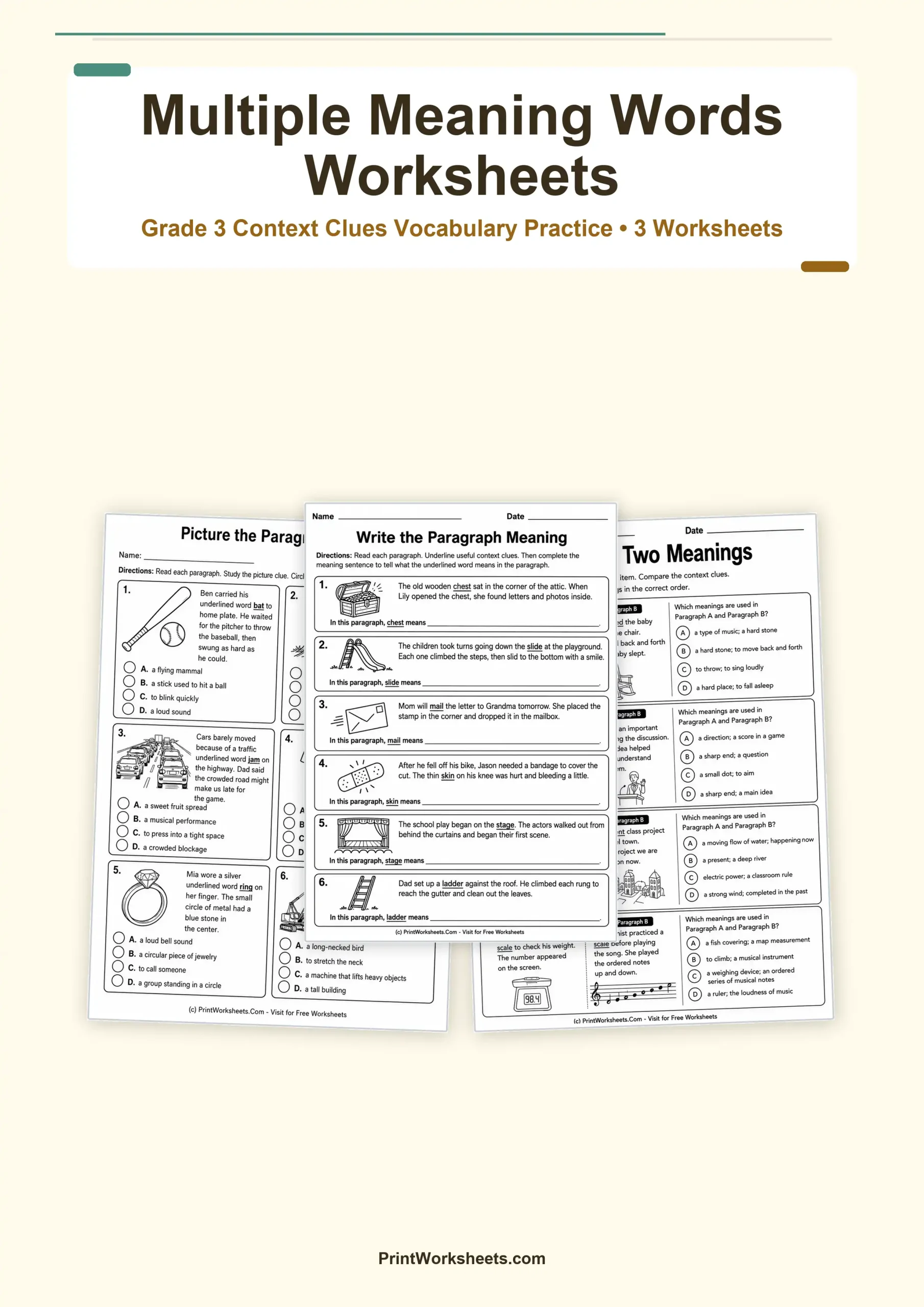

These multiple meaning words worksheets give third graders repeated practice deciding what a familiar word means inside a short paragraph. Instead of matching isolated definitions, students use sentence details, surrounding ideas, and simple illustrations to work out the intended meaning. Across three printable practice pages, the activities move from supported multiple-choice questions to written explanations and finally to comparing the same word across two different contexts.
Multiple Meaning Words Worksheets for Paragraph Practice
The first activity, Picture the Paragraph Meaning, combines short reading passages with picture clues. Students determine the intended meanings of bat, bark, jam, light, ring, and crane, then select from four possible answers. The contexts make the distinctions concrete. For example, bat appears in a baseball situation rather than referring to the animal, while bark is used for the rough outer covering of a tree. This format is useful when students are ready to move beyond picture-only vocabulary work but still benefit from visual support while reading.
The page also gives students a practical reason to reread. A familiar word may seem easy at first, but its correct meaning depends on the rest of the paragraph. Students have to notice what is happening, connect the picture with the text, and reject definitions that do not fit the situation. That combination supports careful vocabulary reasoning rather than simple memorization.
Writing Word Meanings from Context
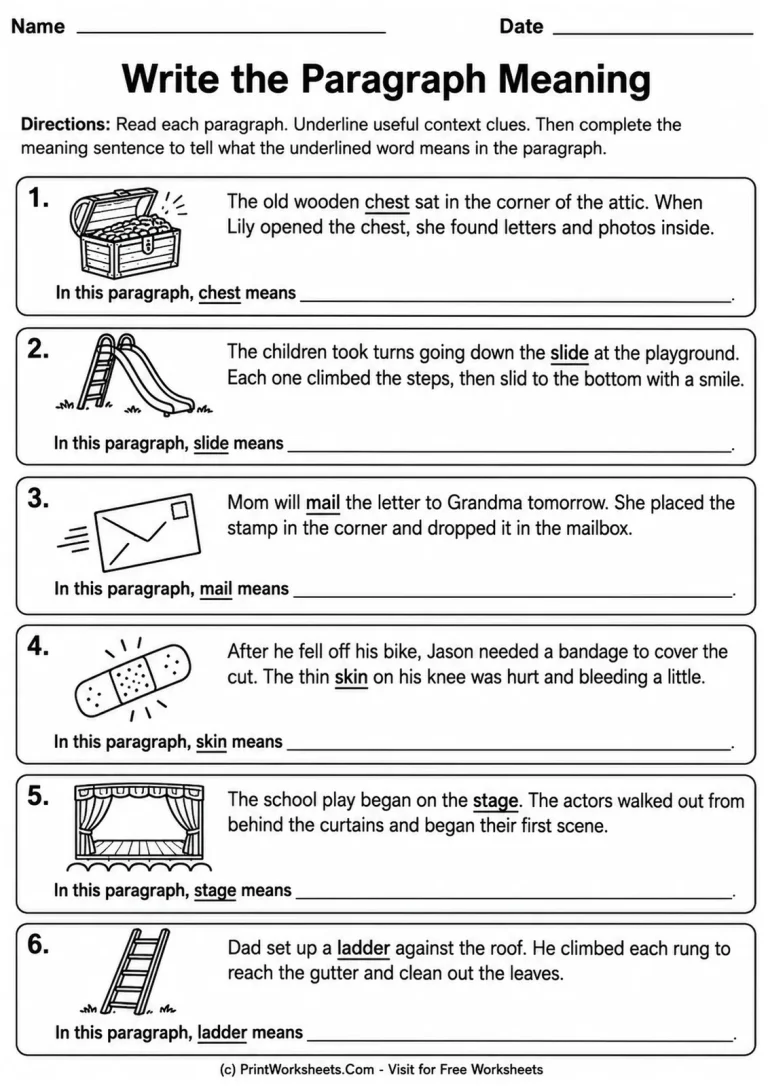
Write the Paragraph Meaning increases the level of independence. Students read six short paragraphs featuring chest, slide, mail, skin, stage, and ladder. Instead of choosing from prepared definitions, they complete a response that explains what each target word means in that particular passage. A simple black-and-white illustration accompanies each paragraph, but students still need to express the meaning in their own words.
This open-response format works well after students have practiced selecting meanings because it reveals whether they can explain the contextual meaning clearly. Teachers can ask students to underline a phrase in the paragraph that helped them decide, then compare different acceptable ways of wording the same meaning. The goal is not to memorize one exact definition sentence. Students should be able to show that they understand how the surrounding text determines which meaning makes sense.
Compare the Same Word in Two Paragraphs
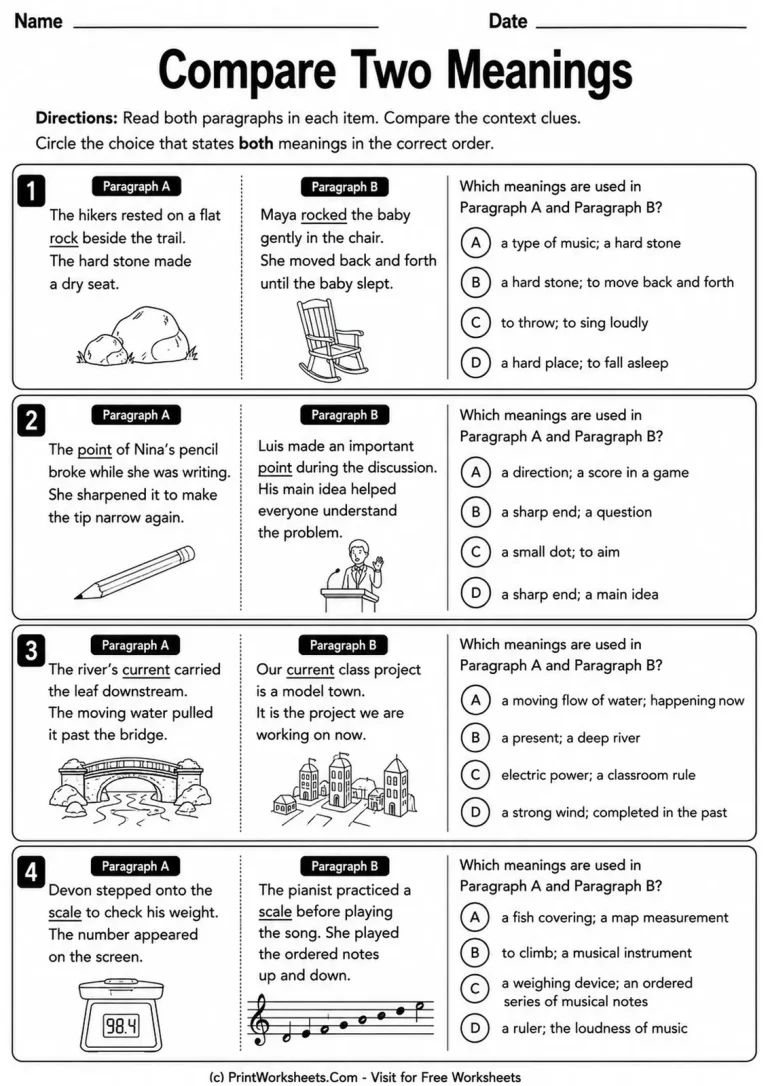
The Compare Two Meanings activity asks students to examine rock, point, current, and scale in paired paragraphs. Each target word appears in two different contexts, and students choose the option that gives both meanings in the correct order. This makes the contrast between meanings especially visible because students encounter the same spelling twice while the surrounding information changes.
For Grade 3 readers, this comparison task is an important step toward flexible vocabulary knowledge. Students learn that recognizing a word is not enough. They must pay attention to how it functions in the passage. Having two examples side by side also creates a natural opportunity for discussion: students can identify which clue in the first paragraph suggests one meaning and which clue in the second paragraph signals another.
Teaching Ideas for Grade 3 Vocabulary Practice
These pages can be used as a short vocabulary lesson, independent literacy-center work, partner practice, or targeted review. For students who need more support, read the paragraph aloud and ask them to describe what is happening before they consider the target word. They can circle a picture clue or underline one sentence detail that supports their choice. Students who are ready for greater independence can complete the paragraph first and explain their evidence afterward.
For differentiation, have developing readers discuss two possible meanings orally before writing. More confident students can create an additional sentence that uses the same target word with a different meaning. Another extension is to make a two-column chart labeled Meaning 1 and Meaning 2 and add examples for words such as rock, point, current, or scale.
Quick Checks and Extension Ideas
A simple exit ticket can use one familiar multiple-meaning word in a new paragraph and ask students to write its meaning plus the clue that helped them decide. Another option is to give students two short sentences using the same word differently and ask them to explain how the context changes the definition. These quick checks show whether students are transferring the skill rather than relying on the examples they already practiced.
The three-page progression makes this set especially useful for moving from supported recognition to independent vocabulary reasoning. Students first choose a meaning with visual help, then explain meanings themselves, and finally compare two contextual uses of one word. That sequence keeps the focus on a central Grade 3 vocabulary habit: reading beyond the target word and using the entire paragraph to decide what it means.