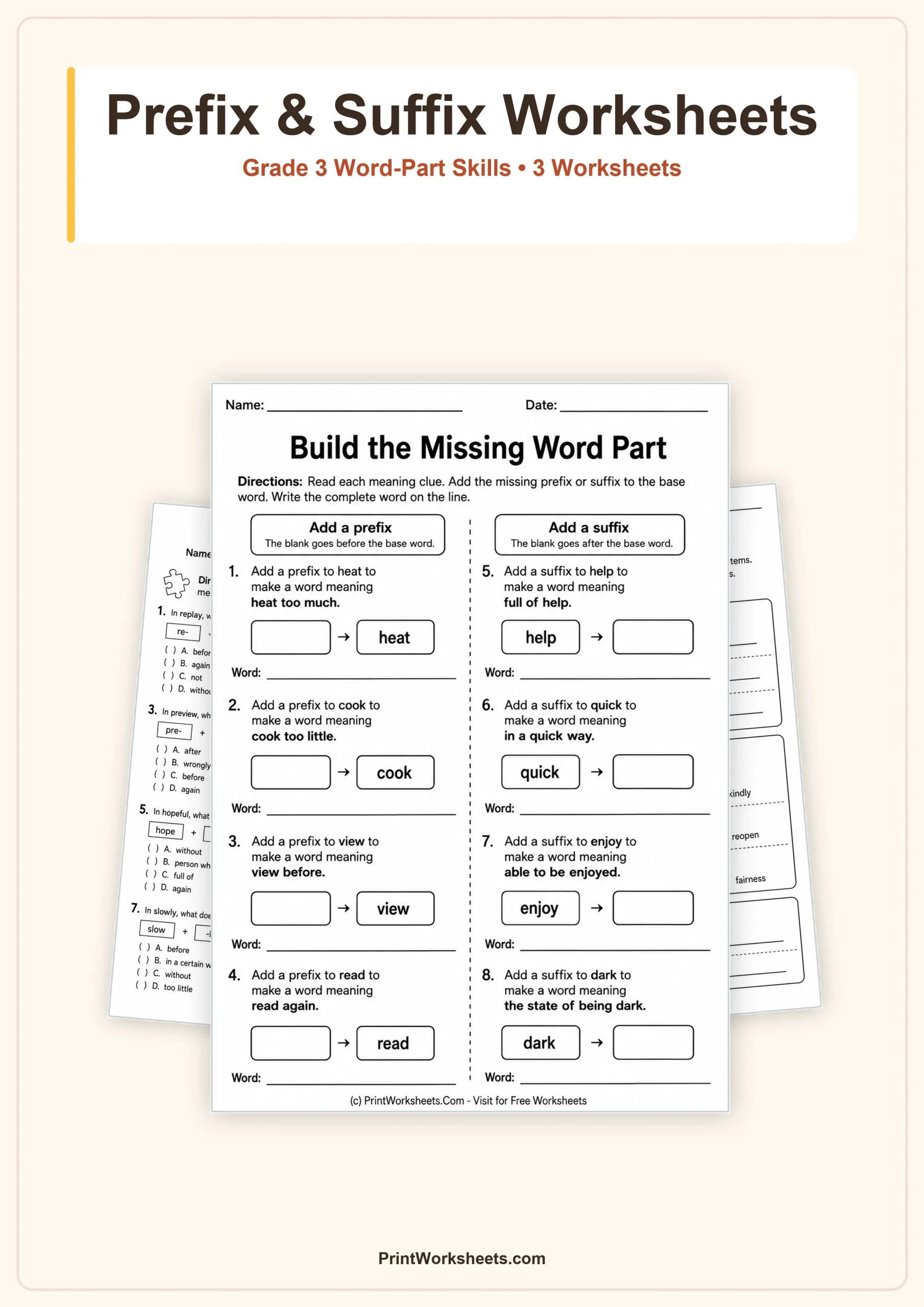
These prefix and suffix worksheets give third graders structured practice with the meanings of common word parts and show how those parts change a base word. Across the printable set, students identify what an affix means, add the correct prefix or suffix from a meaning clue, and apply the same knowledge in a mixed review. The activities use familiar examples such as replay, unhappy, preview, helpful, quickly, enjoyable, and darkness so students can focus on how word parts contribute meaning rather than decoding unusually difficult vocabulary.
Practice Prefix and Suffix Meanings in Grade 3
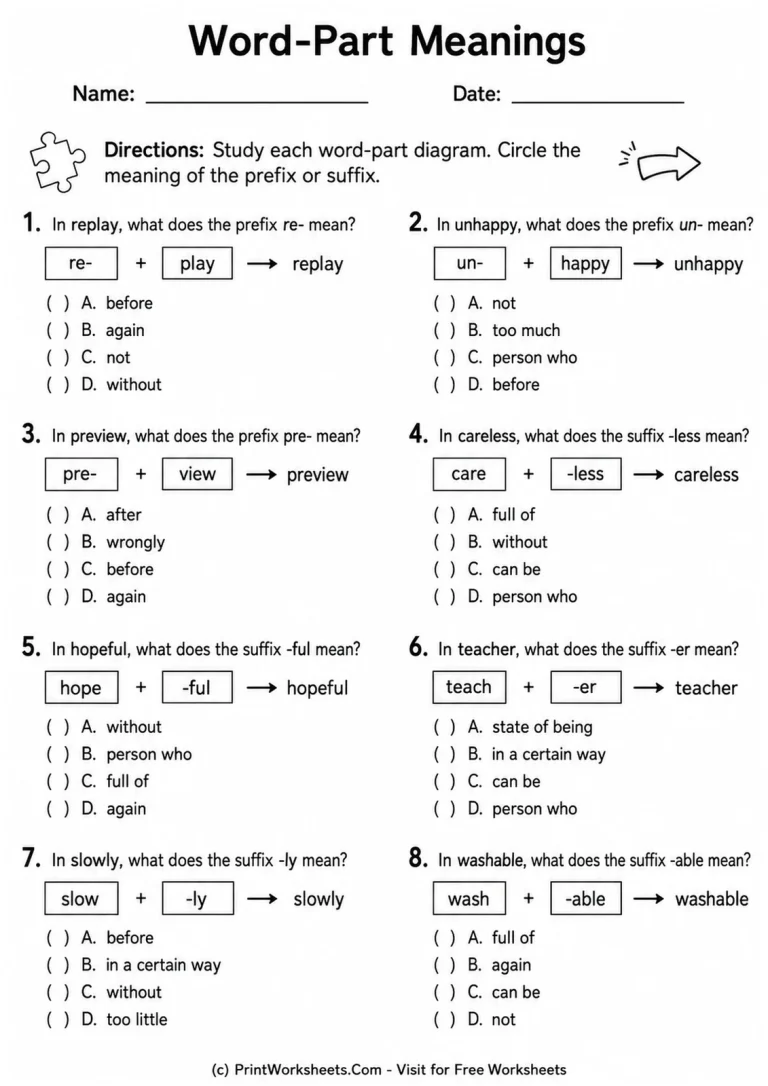
The first worksheet, Word-Part Meanings, provides direct practice with affix meaning identification. Students work through eight multiple-choice questions using words such as replay, unhappy, preview, careless, hopeful, teacher, slowly, and washable. Each item highlights the relationship between the base word and the added word part, helping learners connect prefixes and suffixes with predictable changes in meaning.
This page includes frequently encountered prefixes such as re-, un-, and pre-, along with suffixes including -less, -ful, -er, -ly, and -able. Because students select meanings rather than simply circle the affix, the task encourages them to think about what the word part contributes. For example, recognizing re- as meaning again or un- as expressing not or an opposite idea helps students move from memorizing vocabulary toward using morphology as a reading strategy.
Build Words from Meaning Clues
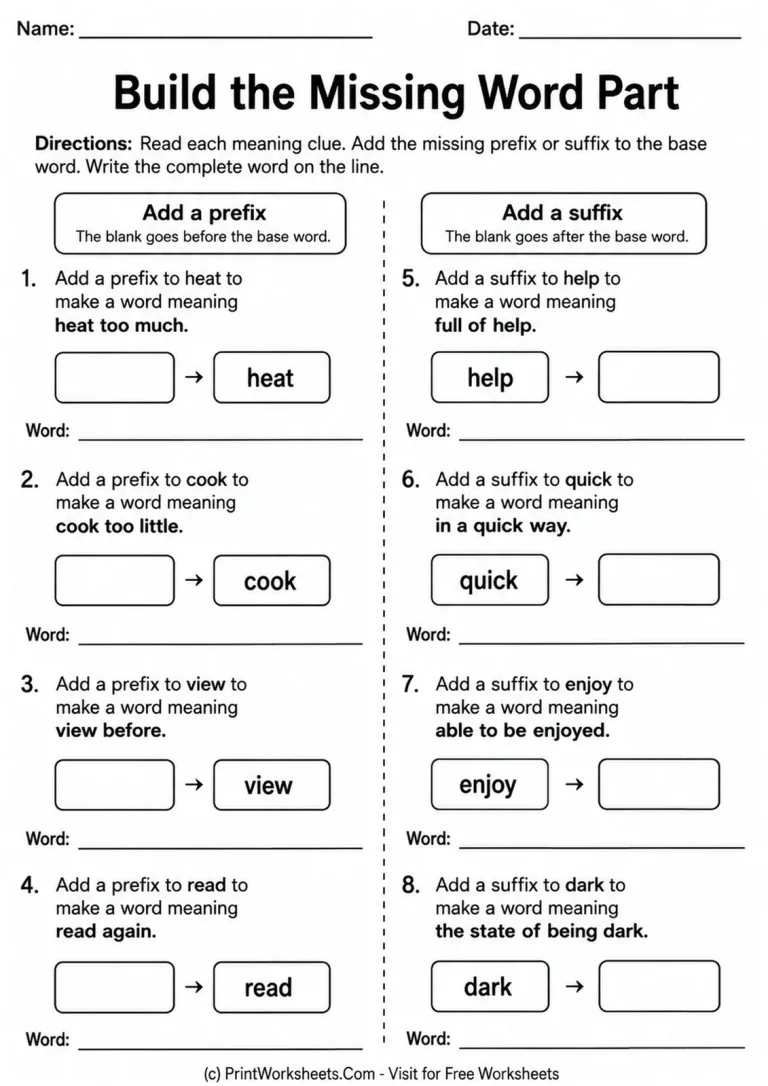
The Build the Missing Word Part worksheet shifts the work from recognition to production. Students begin with base words and use short meaning clues to decide which prefix or suffix is needed. The prefix section includes roots such as heat, cook, view, and read. Students form words including overheat, undercook, preview, and reread by matching the intended meaning to the correct beginning word part.
The second half applies the same reasoning to suffixes. Base words such as help, quick, enjoy, and dark become helpful, quickly, enjoyable, and darkness. This makes the activity especially useful after a short lesson because students must generate the completed word instead of choosing it from several options. Teachers can ask students to underline the base word, circle the affix, and explain the meaning change aloud for an additional morphology routine.
Use the Affix Meaning Challenge as a Review
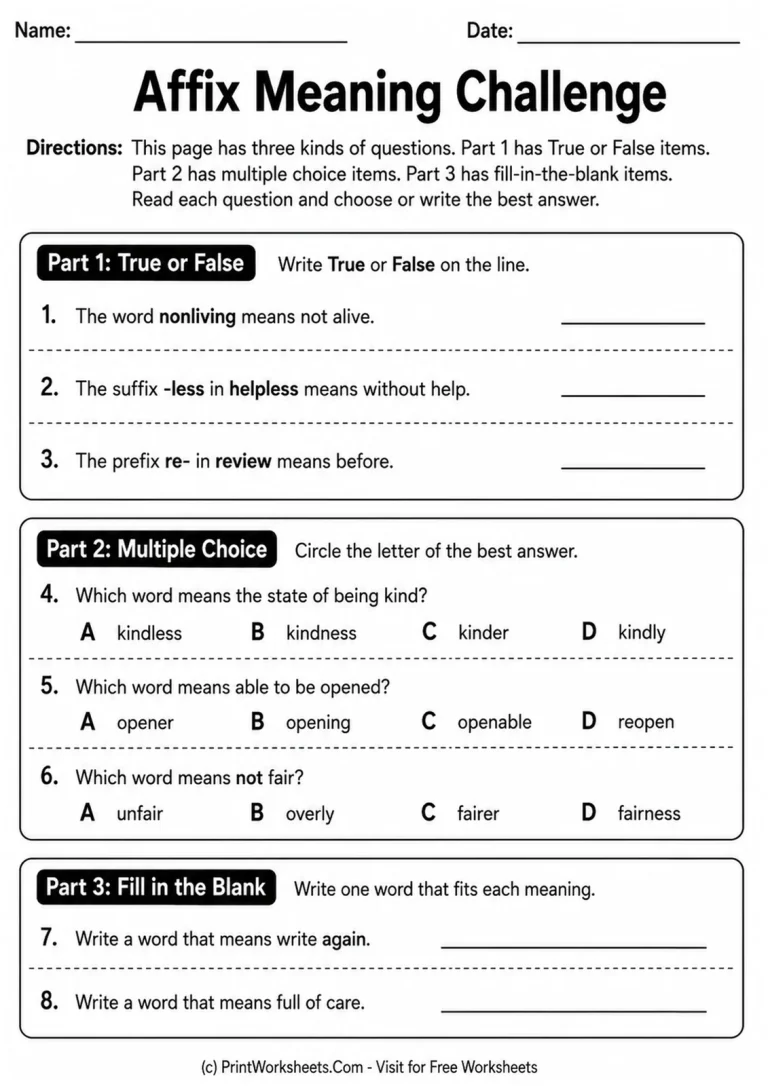
The final worksheet broadens the format with true-or-false, multiple-choice, and fill-in-the-blank questions. It reviews word parts such as non-, -less, re-, -ness, -able, un-, and -ful. Changing question formats requires students to retrieve the same type of knowledge in different ways, making the page useful as an independent review, small-group check, or brief end-of-lesson assessment.
A practical sequence is to use the multiple-choice page first, follow with the word-building activity, and finish with the mixed challenge. This progression moves students from identifying affix meanings to constructing words and then applying their knowledge without relying on one repeated task format. The three pages can also be used separately when a class needs targeted practice rather than a full sequence.
Teaching Ideas for Prefixes and Suffixes
Before students begin, review the idea that a prefix comes before a base word and a suffix comes after it. Keep the focus on meaning. Instead of asking only, “What is the prefix?” ask, “What does this word part tell you about the whole word?” With replay, students can connect re- with doing something again. With careless, they can explain how -less changes care into the idea of being without care. With washable, they can connect -able with something that can be washed.
For extra support, create two small reference columns labeled Prefixes and Suffixes and record the affixes students encounter. Students who need more scaffolding can say the base word first, identify the added part, and then explain the new meaning orally before writing an answer. More confident students can write an original sentence with one of the completed words or generate another example that uses the same affix.
Differentiation, Extension, and Exit Tickets
For small-group instruction, choose four words at a time and have students physically separate each word into its base and affix. For extension work, invite students to compare two words that share an affix, such as helpful and hopeful, and explain what remains consistent about -ful. Students can also create new examples with re-, un-, pre-, -less, -ly, or -able and trade them with a partner to solve.
A quick exit ticket can include three prompts: define one prefix, define one suffix, and build a new word from a base word plus a meaning clue. This makes it easy to see whether a student can identify an affix, explain its meaning, and transfer that knowledge to word formation. Used together, these Grade 3 prefix and suffix worksheets provide a compact progression from guided recognition to independent application.