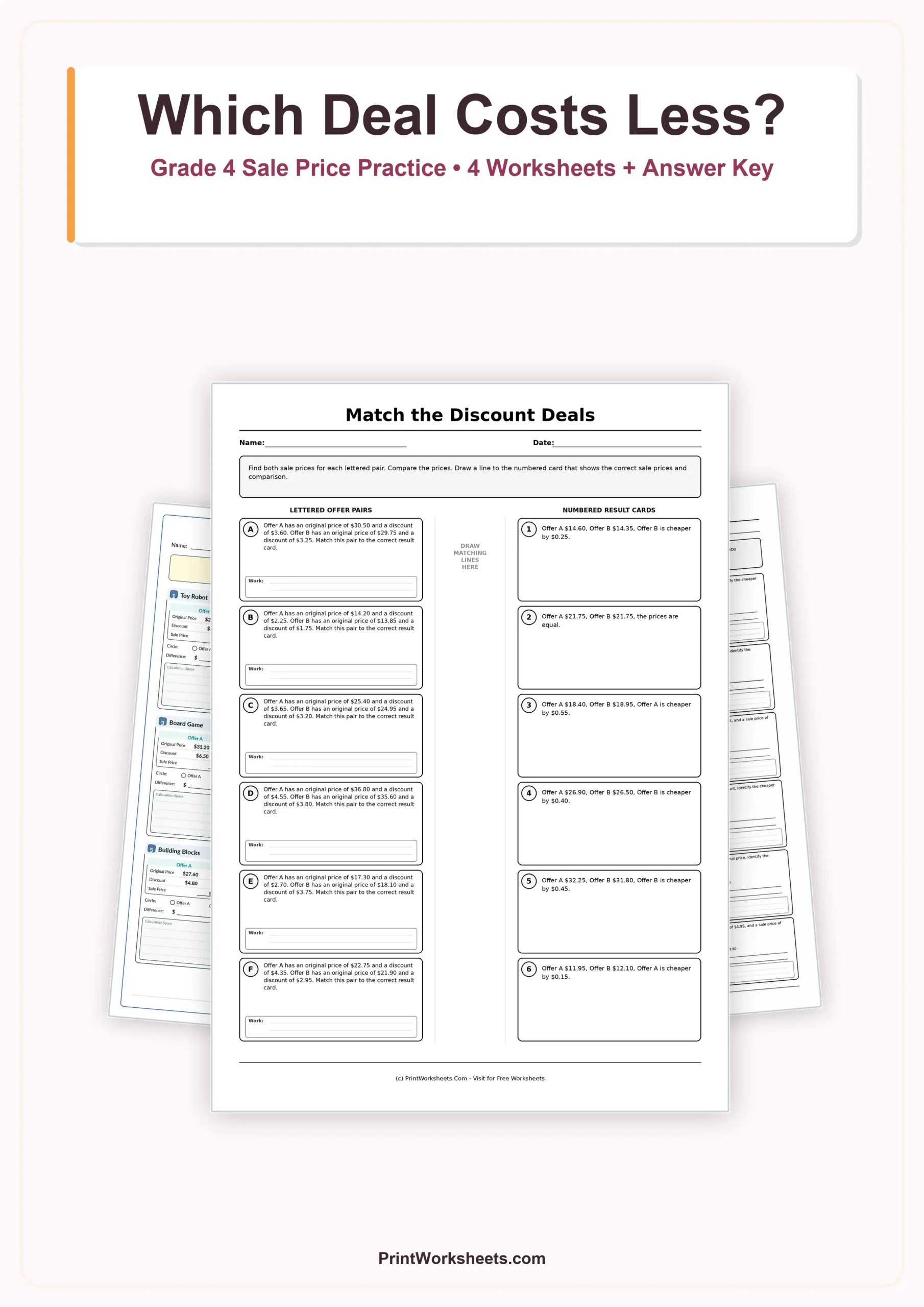

These price comparison worksheets give fourth-grade students a focused way to practice finding sale prices, comparing two offers, and explaining how much better one deal is than another. Across four student pages, learners subtract fixed-dollar discounts from original prices, compare final costs, solve missing-value money equations, and work through multi-step shopping situations. The sequence keeps the arithmetic concrete while asking students to make a clear choice between Offer A, Offer B, or an equal result.
Practice price comparison with discounts
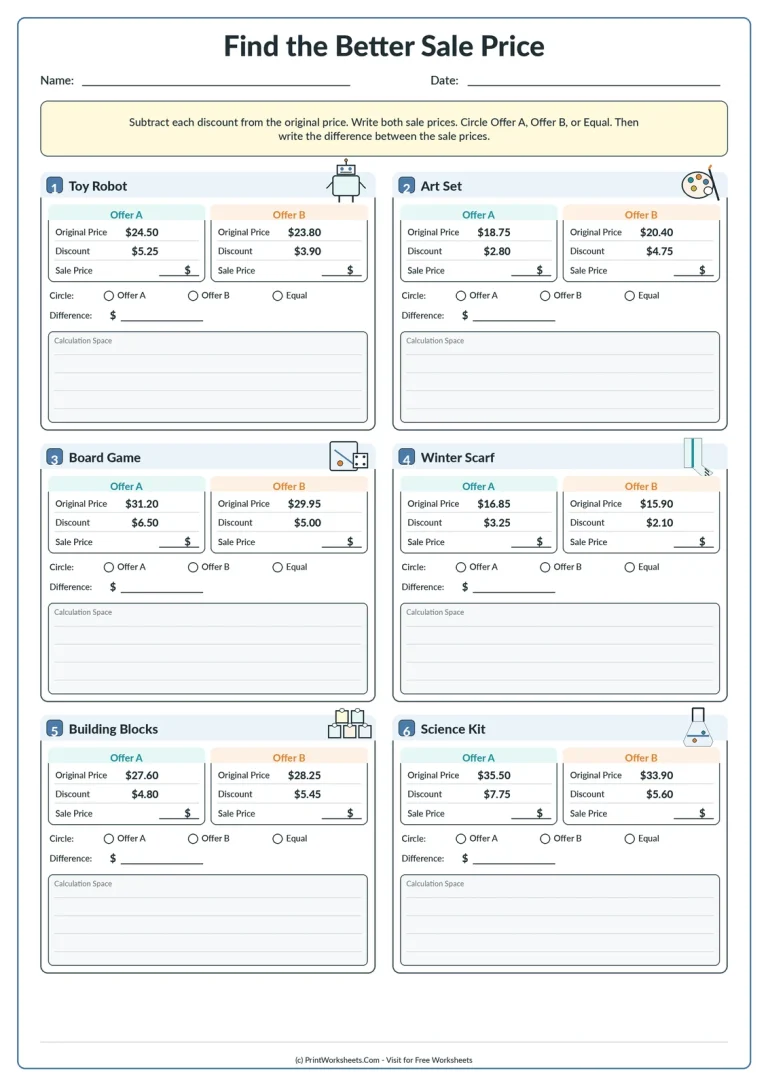
The first worksheet, “Find the Better Sale Price,” uses six familiar products: a toy robot, art set, board game, winter scarf, building blocks, and science kit. Each item presents two original prices and two discounts. Students calculate both sale prices, circle the better offer, and write the difference between the final prices. The page also includes an equal-price case, which is useful because students cannot simply assume that one offer must always win.
This format supports careful decimal subtraction with dollars and cents while reinforcing comparison language. Students must keep the original price, discount, sale price, and final difference organized. The repeated structure makes the page appropriate for independent practice, partner checking, or a short lesson on how discounts change the price a shopper actually pays.
Move from calculation to matching and missing values
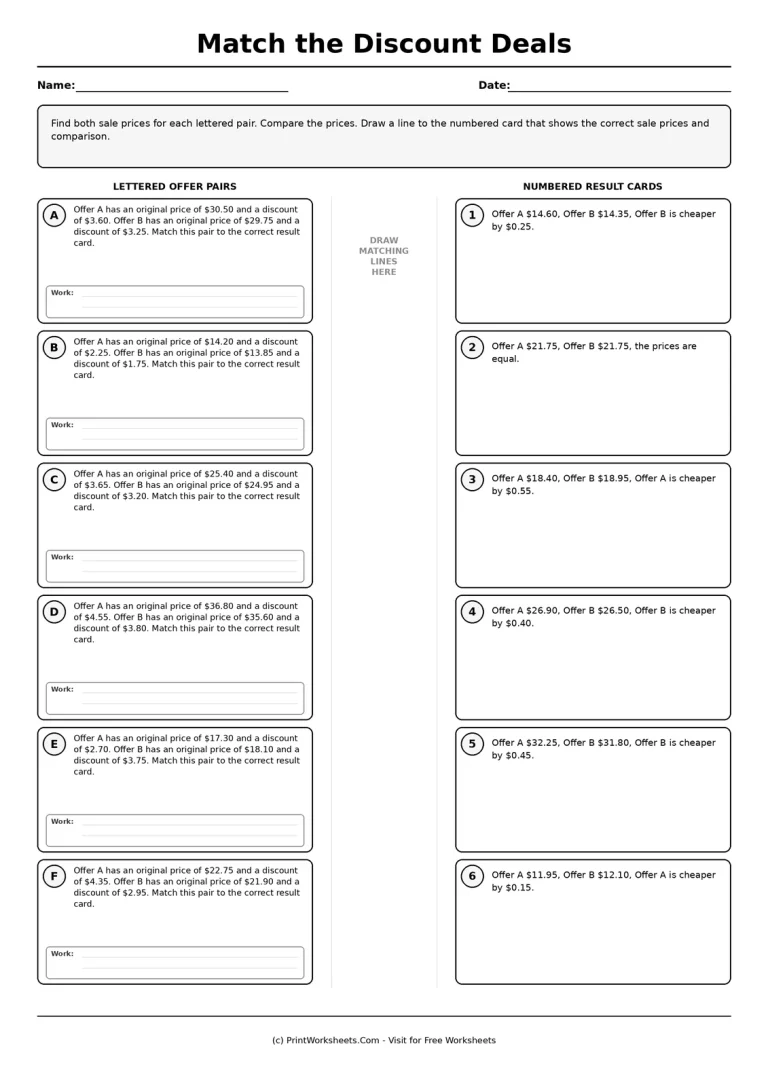
The second page, “Match the Discount Deals,” changes the task without changing the core skill. Six lettered offer pairs must be matched to six numbered result cards. Students first find both sale prices, then compare them and locate the card with the exact pair of answers. Because each result card includes the two sale prices and the amount of the difference, students have to calculate accurately before drawing a match. One pair produces equal sale prices, adding another check on whether students are reading the results rather than guessing from the original prices.
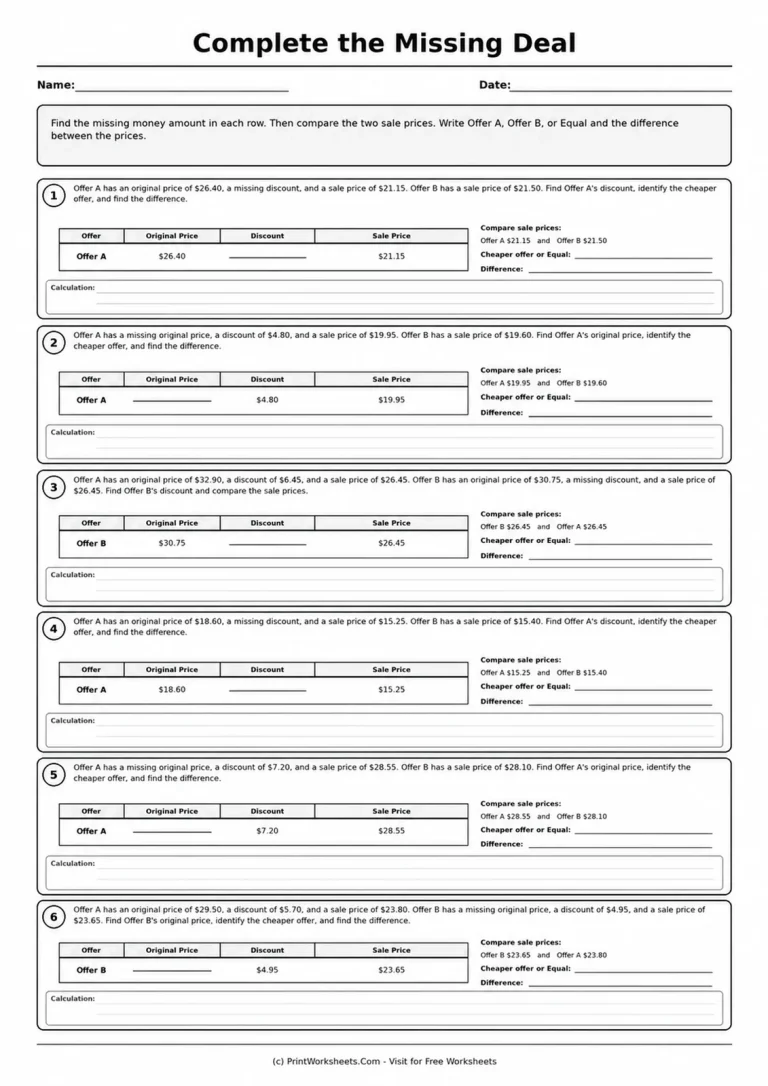
The third page, “Complete the Missing Deal,” increases the reasoning demand. Instead of always giving the original price and discount, some problems hide the discount and others hide the original price. Students use the relationship original price minus discount equals sale price to recover the missing amount. After that, they still compare the two sale prices and find the difference. This makes the worksheet set more than a routine subtraction packet; it adds inverse thinking and missing-number reasoning in a money context.
Multi-step shopping problems for Grade 4
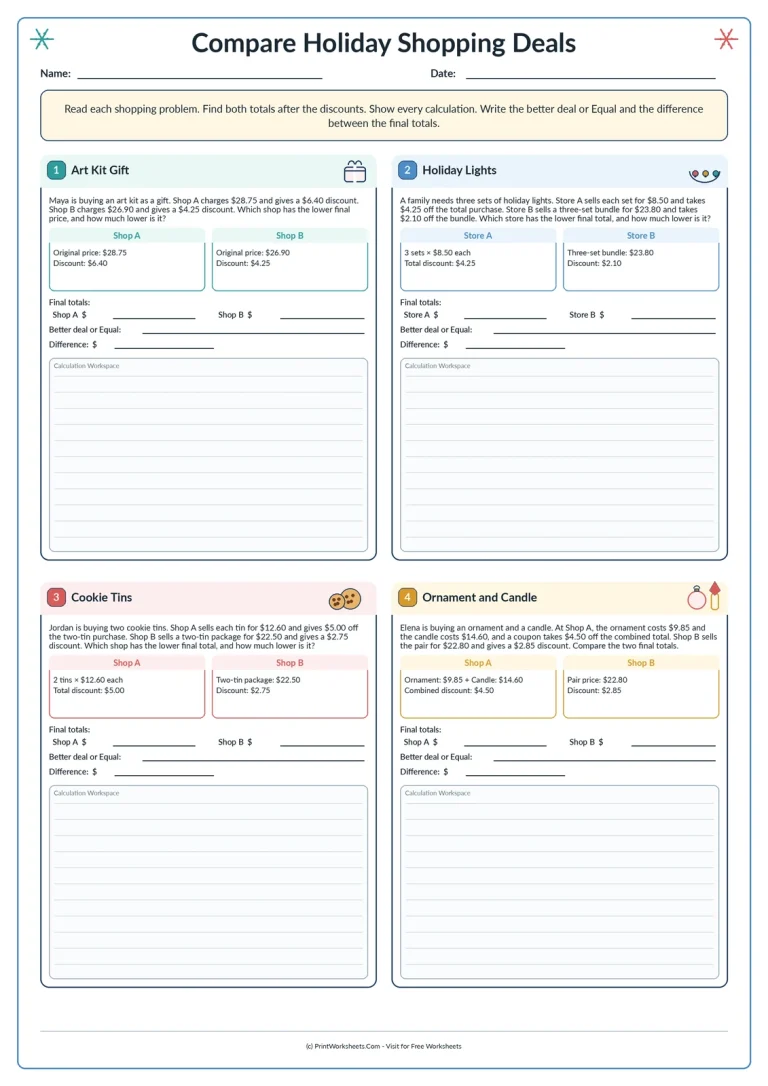
The fourth worksheet applies the same ideas to short holiday shopping scenarios. Students compare an art kit gift, holiday lights, cookie tins, and an ornament-and-candle purchase. Some situations require an extra step before the discount can be applied. For example, students calculate the cost of three sets of lights or two cookie tins before subtracting the stated discount. Another problem combines two item prices before taking a discount from the total. These examples help students connect sale-price calculations to realistic shopping choices while practicing order and accuracy across multiple steps.
The set contains both “better deal” outcomes and equal-price outcomes. That variety is instructionally useful because students must base each decision on their calculations. They also write the exact dollar difference, which encourages them to compare final totals rather than stop after finding two sale prices.
Ways to use these Grade 4 money worksheets
Teachers can use the pages in sequence over several lessons or select individual sheets for review. Page 1 works well for direct practice with sale-price subtraction. Page 2 is suited to a math center because the matching format gives students a different way to verify their work. Page 3 is a strong choice for students ready to solve for a missing original price or discount. Page 4 can be used for classwork, homework, or a small-group lesson on multi-step money problems.
For differentiation, let students who need support write each subtraction vertically in the provided workspace and label the original price, discount, and sale price before comparing offers. Students who are ready for an extension can explain why two different discounts can still produce equal sale prices, or create a new pair of offers that end with the same final cost. A quick exit ticket can ask students to invent two original prices and discounts, calculate the final prices, and state which offer is cheaper and by how much.
Answer key for efficient checking
A complete answer key covers all four student pages. It lists the sale prices, matching-card results, missing values, better offers, equal cases, and price differences. This makes the set convenient for classroom correction, independent practice, or parent-supported review at home.
Together, these worksheets build a clear progression from straightforward discount subtraction to comparison, missing-value reasoning, and multi-step shopping decisions. They are especially useful when students need practice combining decimal money calculations with the practical question shoppers ask most often: which deal actually costs less?