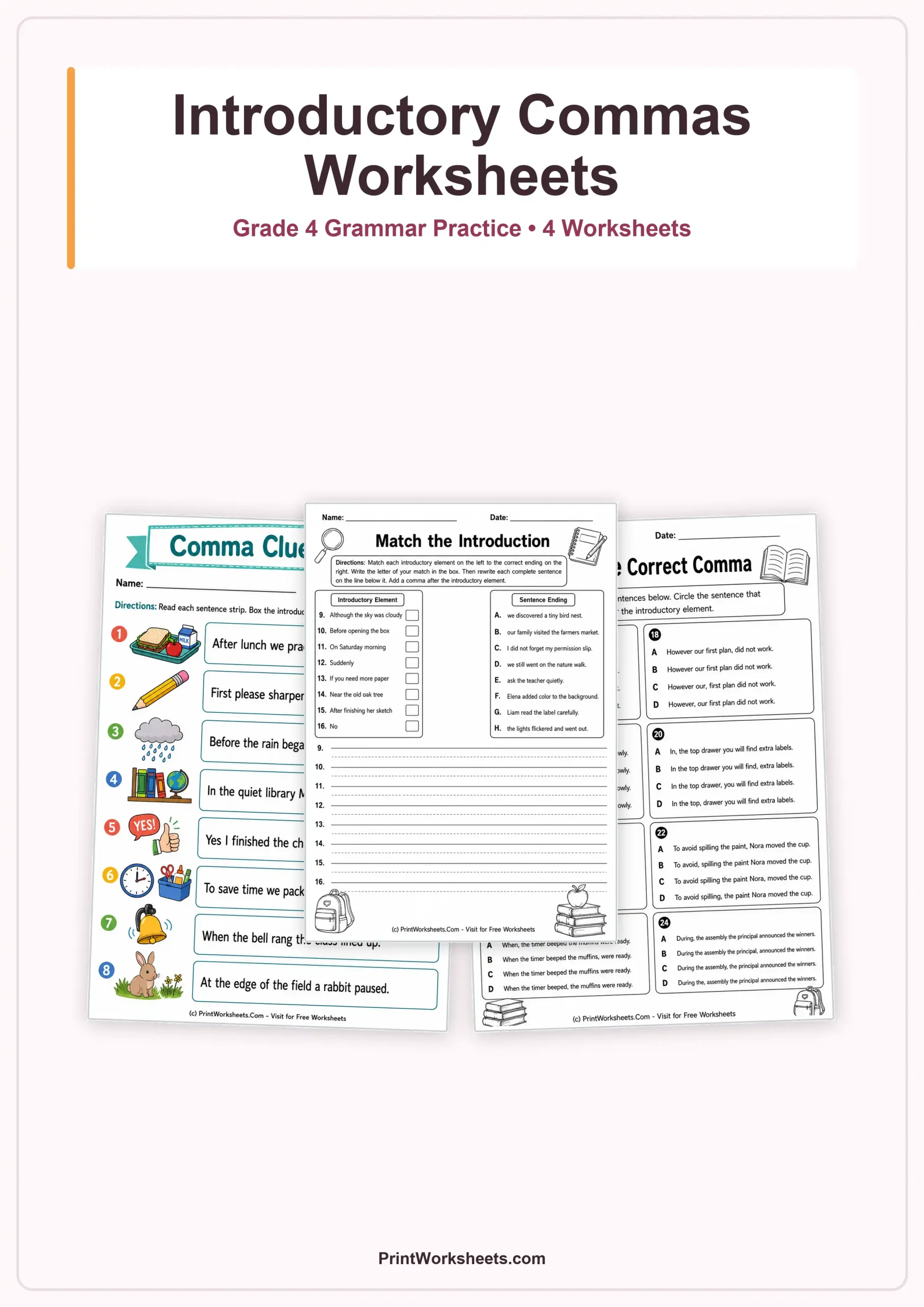
These Grade 4 worksheets focus on commas after introductory elements, giving students repeated practice with the sentence openings that often need a comma before the main part of the sentence begins. Across four printable activities, learners identify introductory words, phrases, and clauses, add missing commas, compare punctuation choices, rewrite complete sentences, and classify the type of introduction they see. The sequence moves from guided recognition to more independent editing, making the set useful for direct instruction, classwork, review, or homework.
Practice Commas After Introductory Elements
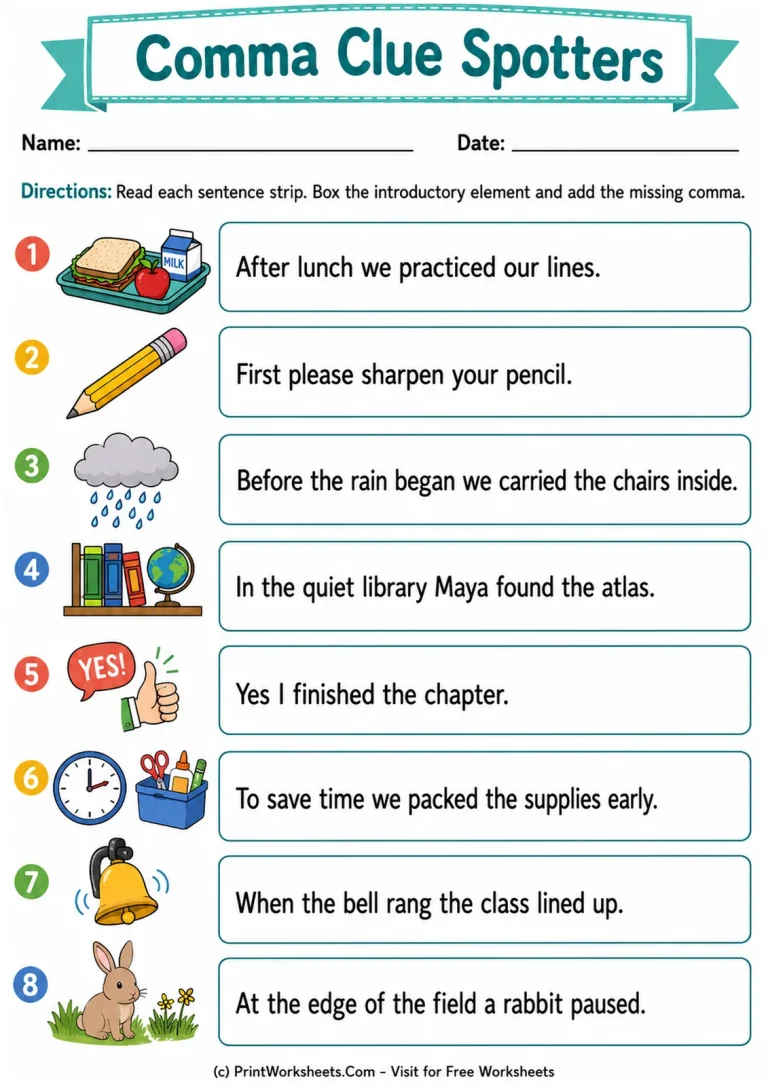
The first worksheet, Comma Clue Spotters, begins with eight short sentence tasks. Students read each sentence, box the introductory element, and insert the missing comma. The examples include several kinds of openings so students learn that the rule is not limited to one sentence pattern. Introductions such as After lunch, First, Yes, Before the rain began, and When the bell rang let students compare single introductory words with longer phrases and clauses.
This first step keeps the attention on two connected questions: where does the introductory element end, and where should the comma go? Because students must identify the opening before adding punctuation, the activity encourages them to notice sentence structure instead of placing commas by guesswork.
Match Sentence Openings and Rewrite Them Correctly
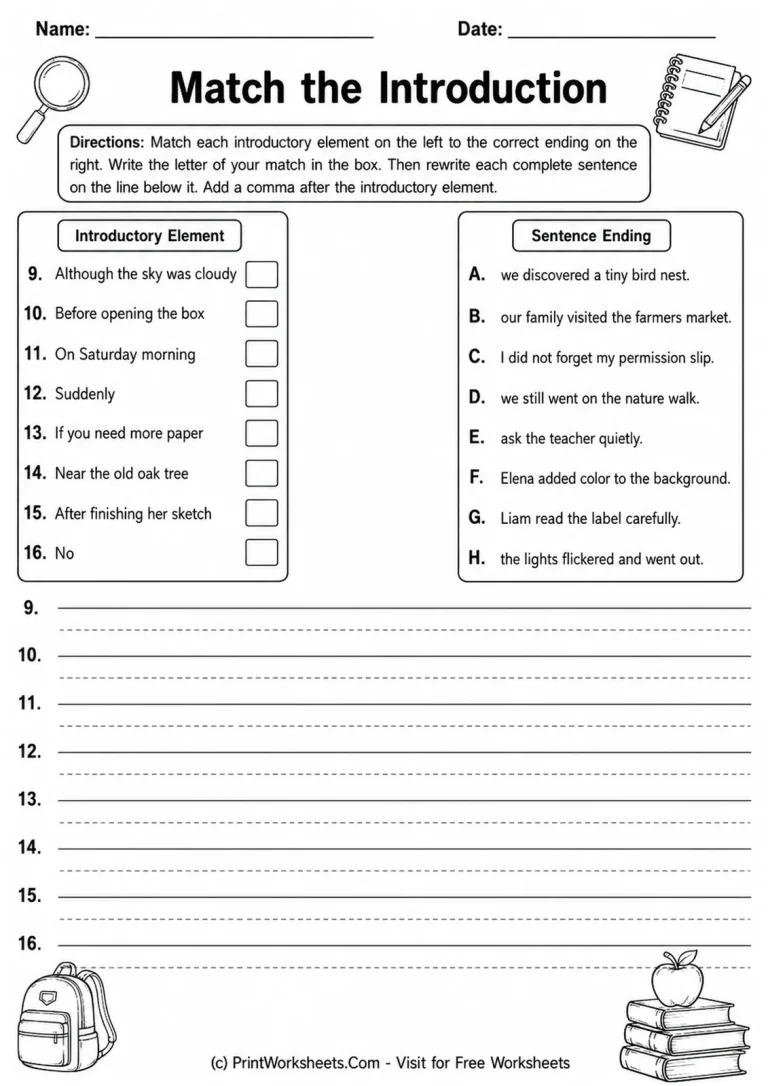
The second worksheet, Match the Introduction, extends the skill through a matching activity. Items 9–16 provide eight introductory elements and eight sentence endings. Students determine which parts belong together, record the matching letter, and then rewrite each completed sentence with a comma after the introductory element.
This format adds meaning and sentence construction to the punctuation practice. Students cannot simply look for a visual clue; they need to decide which introduction logically connects with each sentence ending. Rewriting the completed sentences then gives them another opportunity to apply the comma rule in context. It is a useful bridge between basic identification and more independent editing.
Compare Correct and Incorrect Comma Placement
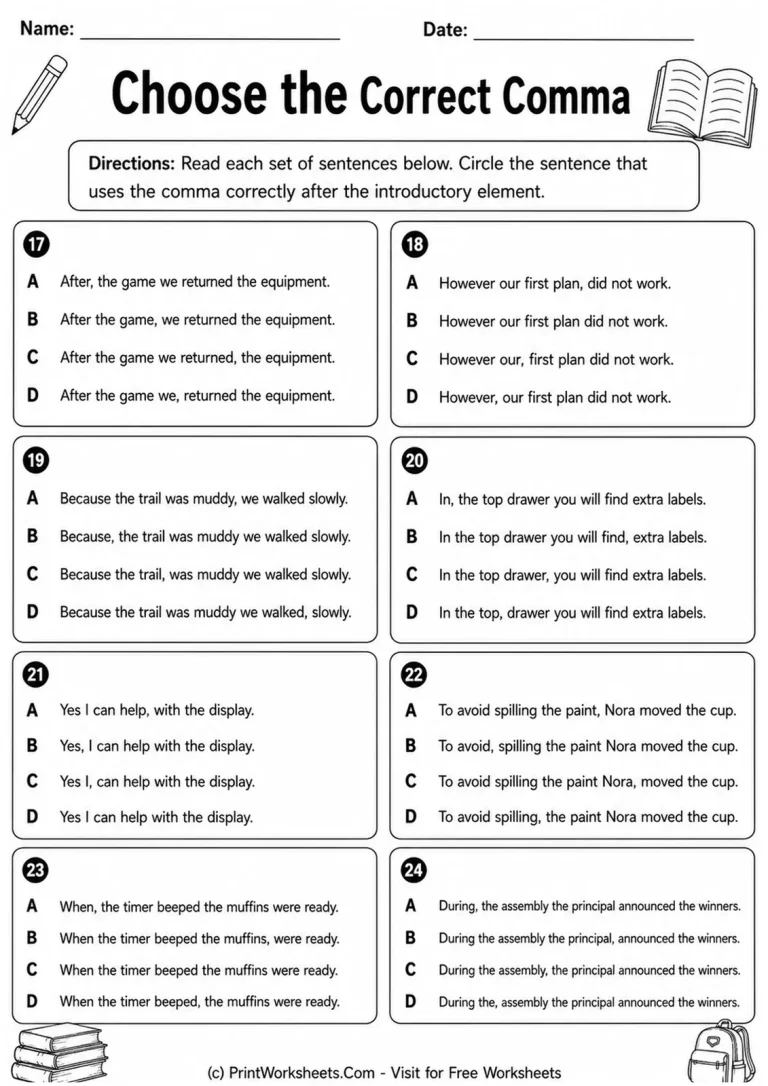
In Choose the Correct Comma, students work through items 17–24 in a four-option multiple-choice format. Each item shows different punctuation versions of the same sentence, and students choose the version that correctly places the comma after the introductory word, phrase, or clause.
The contrasts are especially helpful for students who need to see why punctuation placement matters. Instead of only producing an answer, learners compare correct and incorrect possibilities side by side. The worksheet includes introductions built with structures such as Because and When, along with introductory phrases, giving fourth graders practice recognizing where the opening section ends before the main clause begins.
Move from Punctuation Practice to Sentence Editing
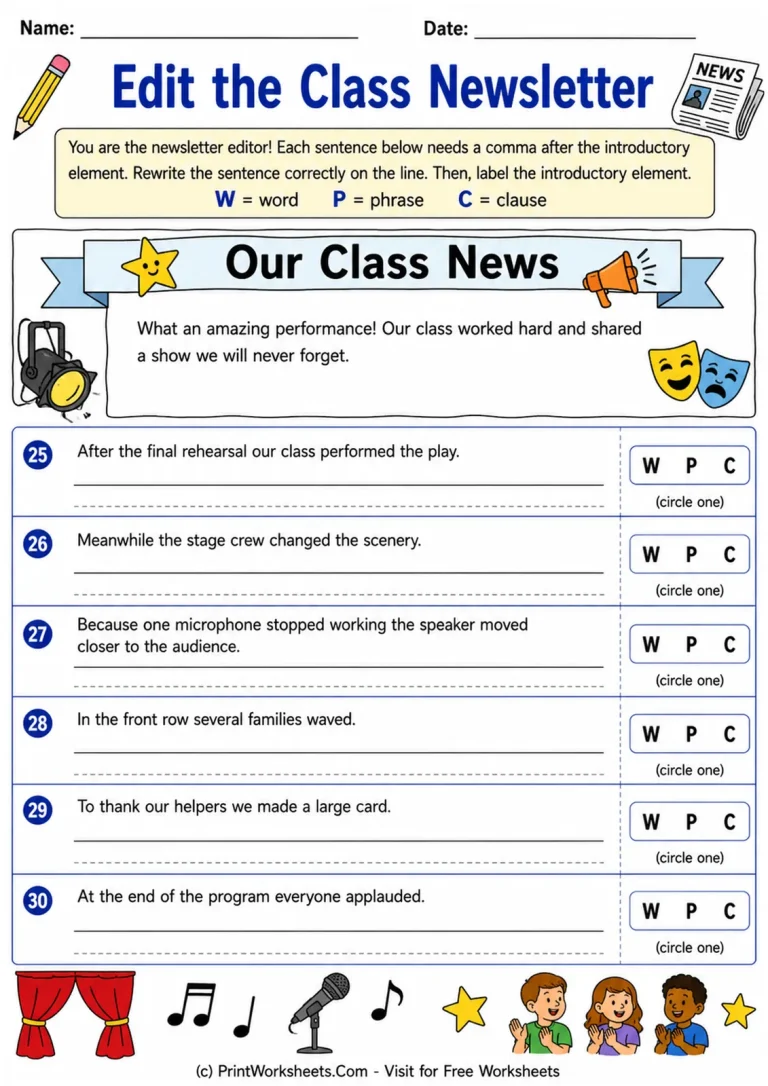
The final worksheet, Edit the Class Newsletter, turns students into editors. For items 25–30, they rewrite sentences with the missing comma and then classify the introductory element as W for word, P for phrase, or C for clause. The class performance and newsletter theme gives the activity a practical editing context while keeping the grammar target clear.
This final classification step adds depth to the set. Students are not only asked to fix punctuation; they also identify what kind of introductory structure they are punctuating. Examples across the set include introductory prepositional phrases such as In the top drawer and During the assembly, as well as shorter introductory words and longer dependent clauses. That variety helps students recognize the same comma rule across different sentence forms.
Ways to Use These Grade 4 Grammar Worksheets
The four activities can be taught in order as a short punctuation sequence or used individually for targeted review. Teachers might begin with the identification page during a mini-lesson, assign the matching page for partner or independent practice, use the multiple-choice page as a quick check for understanding, and finish with the newsletter editing page as a more independent application task.
Parents and tutors can also use the pages to reinforce the rule in manageable steps. Since the set includes identification, rewriting, selection, editing, and classification, students encounter the same grammar concept from several directions rather than repeating one worksheet format. By the end of the sequence, learners have practiced finding introductory elements, placing commas accurately, and distinguishing whether a sentence begins with a word, phrase, or clause.