What does the zero in 90 mean? Why is 52 different from 25? These snowman place value worksheets turn those small but important questions into four printable activities for students building confidence with two-digit numbers. Children work with tens and ones, connect place-value descriptions to digits, compare values, and read a simple snowman number table. The cheerful winter illustrations provide a playful setting for focused math practice without getting in the way of writing answers.
What’s Included in These Snowman Place Value Worksheets?
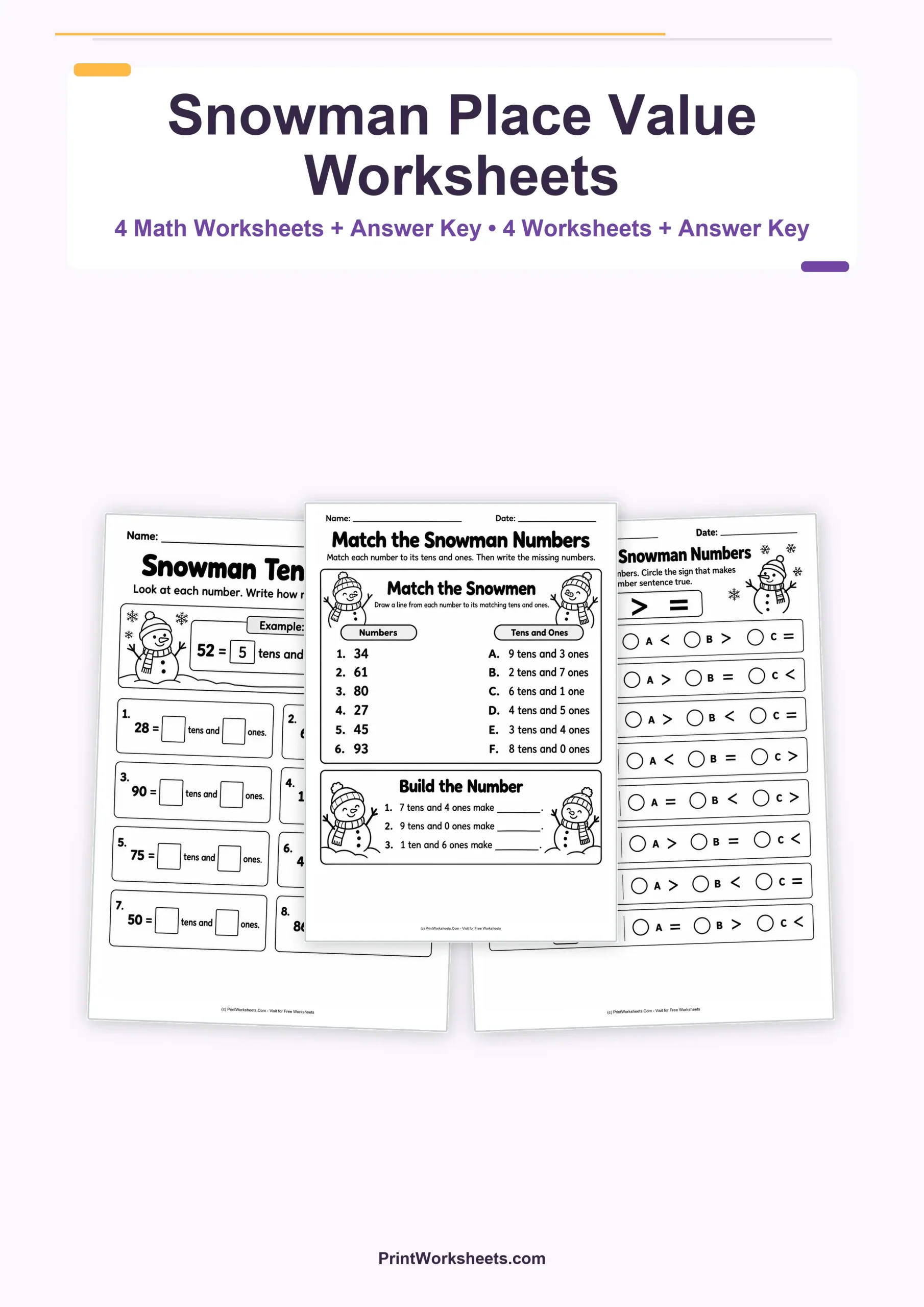
The printable set contains four black-and-white student worksheets and a separate teacher answer key. Tasks move from identifying tens and ones to applying place value in comparisons and number clues. Each student page has a name and date line, clear directions, and spaces for responses. Because the activities use numbers below 100, they are particularly helpful for first-grade place value practice and second-grade review or reinforcement.
Page 1: Snowman Tens and Ones
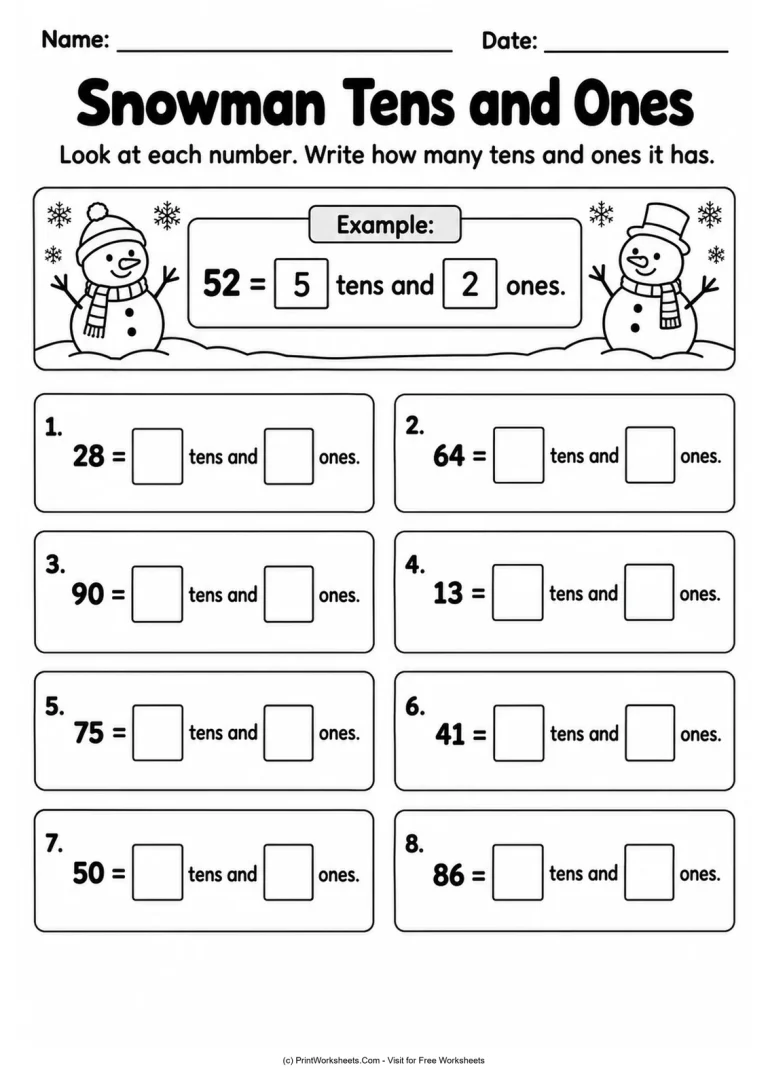
Students begin with a worked example: 52 has 5 tens and 2 ones. They then complete eight problems, writing the tens and ones in separate boxes for numbers including 28, 64, 90, and 13. The inclusion of 90 and 50 gives children practice recognizing that a number can have zero ones. This page helps teachers see whether students understand what each digit represents instead of simply recognizing or reading the whole number.
Page 2: Match the Snowman Numbers
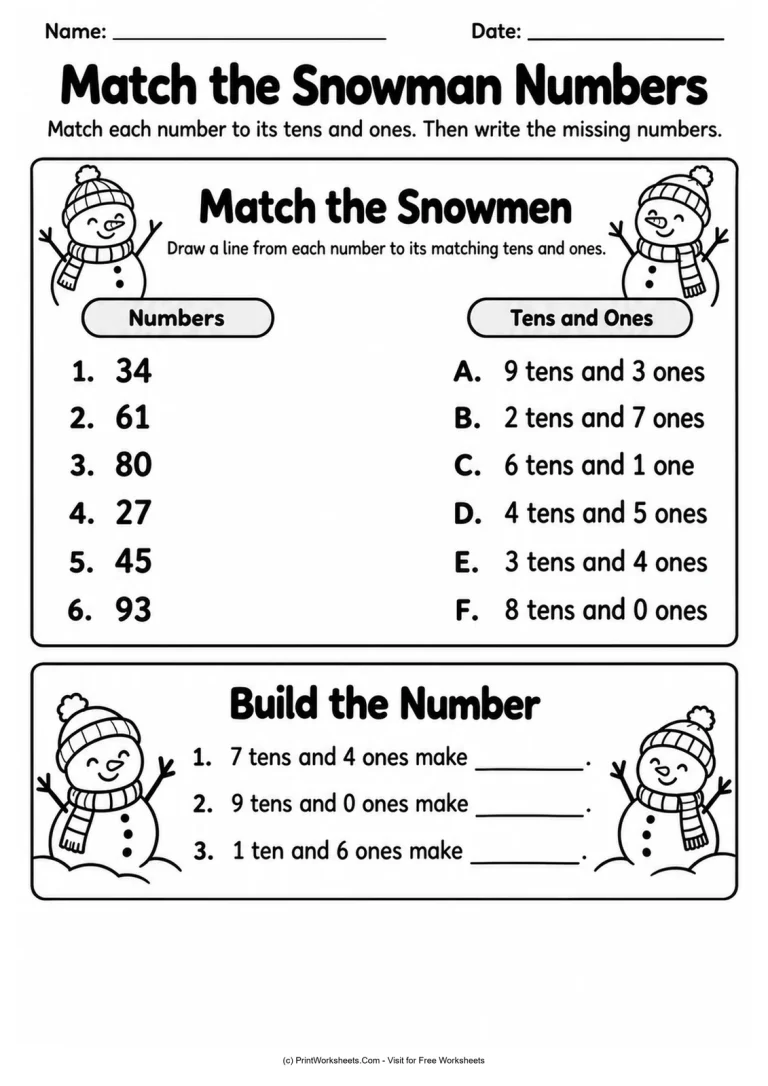
A two-column matching activity asks children to connect six numbers with their tens-and-ones descriptions. For example, 34 belongs with 3 tens and 4 ones. The answer choices appear in mixed order, so students must read each description rather than rely on row position. A second section reverses the task: children build numerals from clues, including 7 tens and 4 ones, 9 tens and 0 ones, and 1 ten and 6 ones. Practicing both directions reinforces the connection between digit positions and number values.
Page 3: Compare the Snowman Numbers
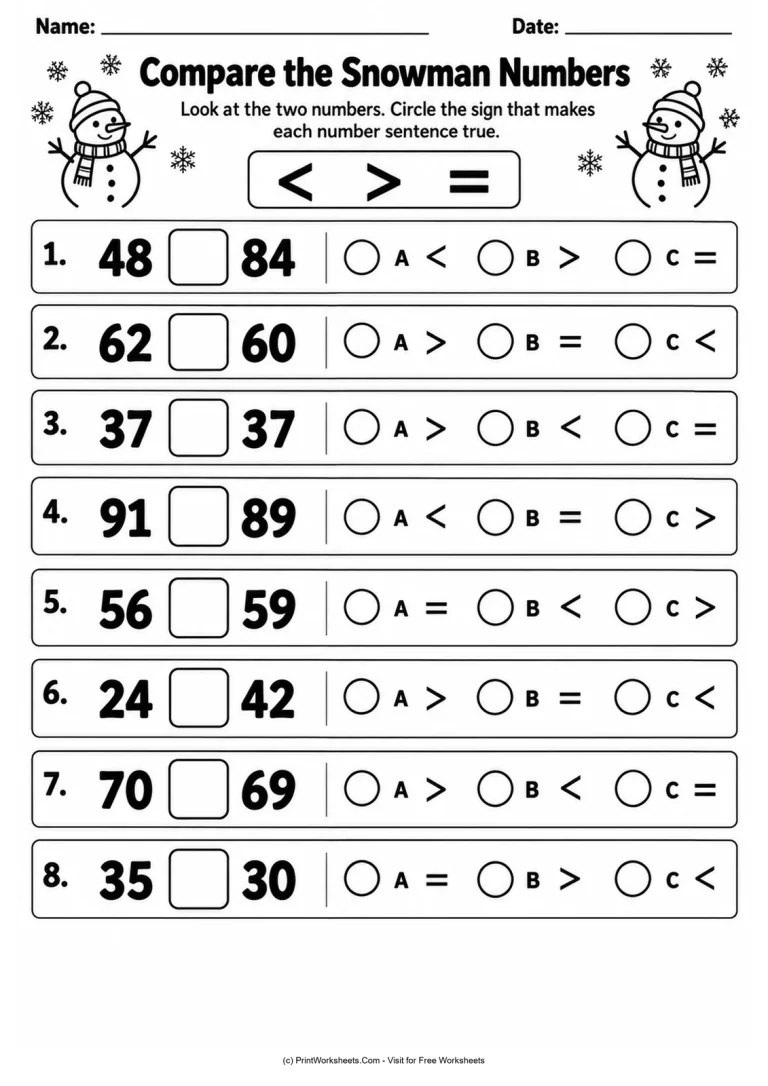
Students determine the correct comparison sign for eight pairs of two-digit numbers. Each row presents two numbers, a blank space between them, and three multiple-choice possibilities using less than, greater than, or equal to. They compare pairs such as 48 and 84, 62 and 60, and 37 and 37. The variety is intentional: children must compare tens first, examine ones when the tens digits match, and recognize equal values. This activity offers a natural bridge from identifying place value to using it for mathematical decisions.
Page 4: Snowman Place Value Detectives
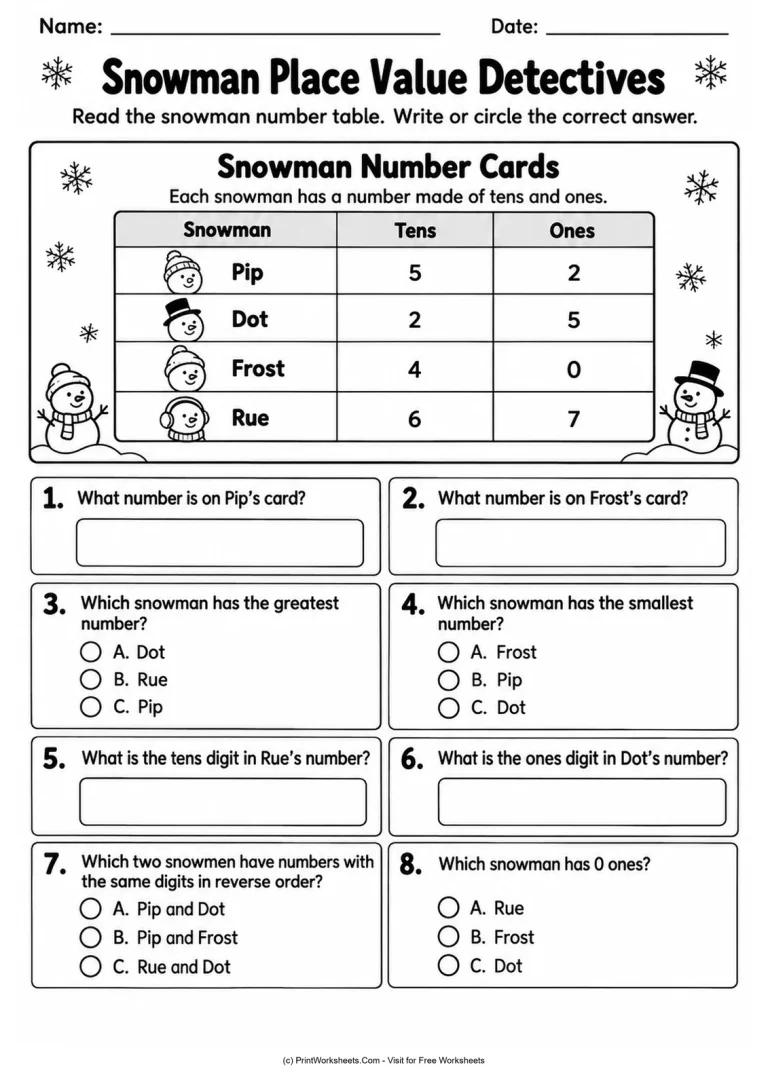
The final student worksheet features four named snowmen and their number cards. Pip has 5 tens and 2 ones, Dot has 2 tens and 5 ones, Frost has 4 tens and 0 ones, and Rue has 6 tens and 7 ones. A table presents the information, followed by eight questions. Students identify represented numbers, find the greatest and smallest values, locate particular digits, recognize reversed digits, and identify a number containing zero ones. The detective format brings several previously practiced skills together in one meaningful table-reading activity.
Teaching Tens and Ones with a Snowman Theme
For a short teaching sequence, model a two-digit number with base-ten blocks before students begin the first worksheet. Ask children to express the number as tens and ones: for example, 64 means 6 tens and 4 ones. Keep a place-value chart nearby for students who need a visual reminder. During the matching activity, encourage them to point to each digit while reading the description, then check that the number of tens and ones agrees with their choice.
When comparing numbers, ask students to explain their reasoning aloud: ‘The tens are the same, so I compared the ones.’ The detective worksheet works especially well as an independent exit task or a partner discussion. Recognizing Pip and Dot as 52 and 25 highlights the important idea that changing digit order changes the number’s value. Students may color the snowman illustrations after completing their math, although the activities require no color printing.
Printing, Practice, and the Teacher Answer Key
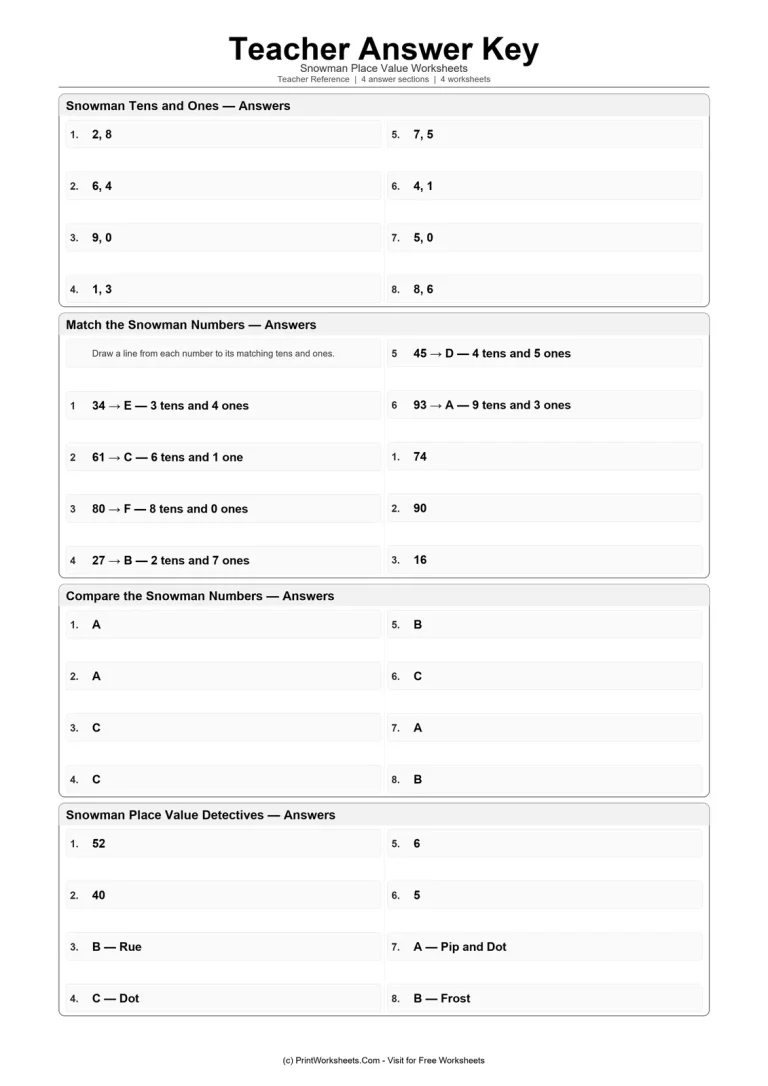
Print all four student pages as a complete practice packet, or choose individual worksheets to target a particular learning need. Use Page 1 for identifying tens and ones, Page 2 for translating between number forms, Page 3 for comparing values, and Page 4 for applying several skills using a table. The separate teacher answer key provides solutions for every activity, including matching letters and multiple-choice answers, making independent work easier to check at home or in the classroom.
For students who need support, complete the first example together and let them represent numbers using blocks or quick drawings before recording answers. For students ready for an extension, ask how changing one digit would make a number larger or smaller. They can also invent their own snowman number cards with tens and ones for a classmate to decode. Whether used in a winter math center, a small-group lesson, independent practice, or homework, the set gives students several ways to demonstrate a growing understanding of two-digit place value.