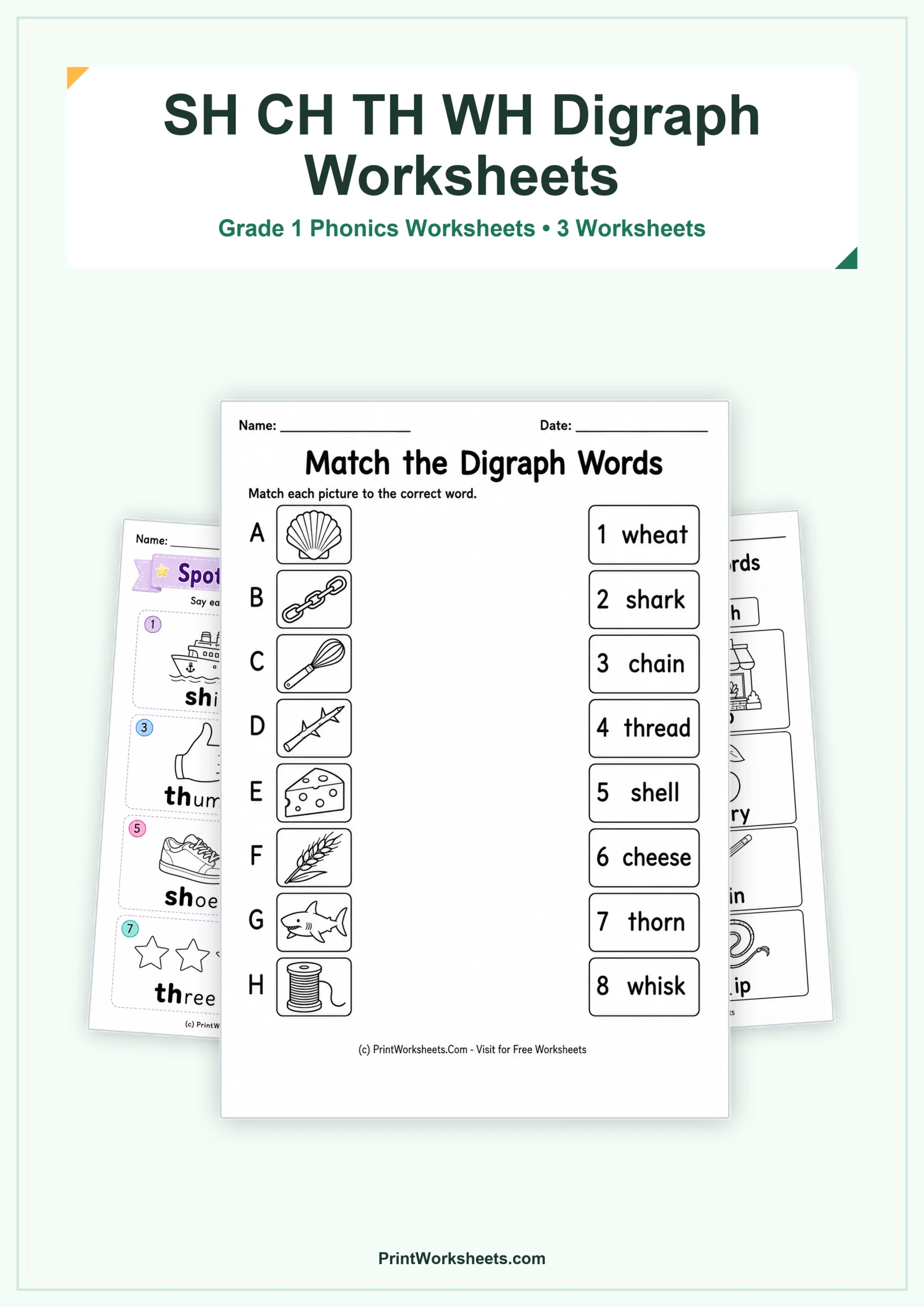
These beginning digraph worksheets give first graders focused practice with sh, ch, th, and wh at the start of familiar words. Across three printable activities, children identify the opening letter pair they hear, connect pictures with correctly spelled words, and complete words by writing the missing beginning digraph. The sequence moves from recognition to guided matching and then to independent written recall, making the set useful for phonics lessons, literacy centers, review work, or extra practice at home.
Beginning Digraph Worksheets for SH, CH, TH, and WH
Beginning digraphs can be challenging because two letters work together to represent a single sound or closely connected sound pattern. These worksheets keep the focus narrow by practicing only four common Grade 1 digraphs: sh, ch, th, and wh. Familiar picture vocabulary helps students concentrate on the sound at the beginning of each word instead of decoding an unfamiliar concept at the same time.
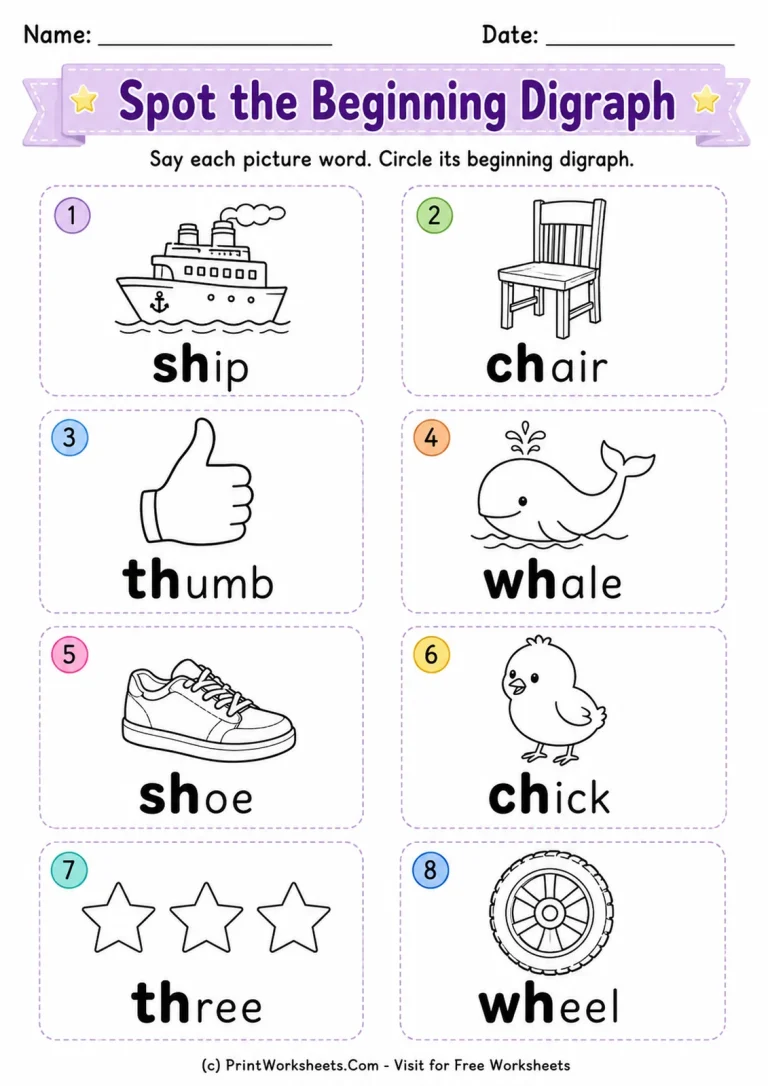
The first worksheet, Spot the Beginning Digraph, asks students to say each pictured word and circle its opening digraph. The examples include ship, chair, thumb, whale, shoe, chick, three, and wheel. Each target digraph appears twice, so students receive balanced practice rather than seeing one sound much more often than the others. This page works especially well as an introduction because the response is simple: listen to the beginning sound, look at the available letter pair, and identify the correct digraph.
Move from Sound Recognition to Word Matching
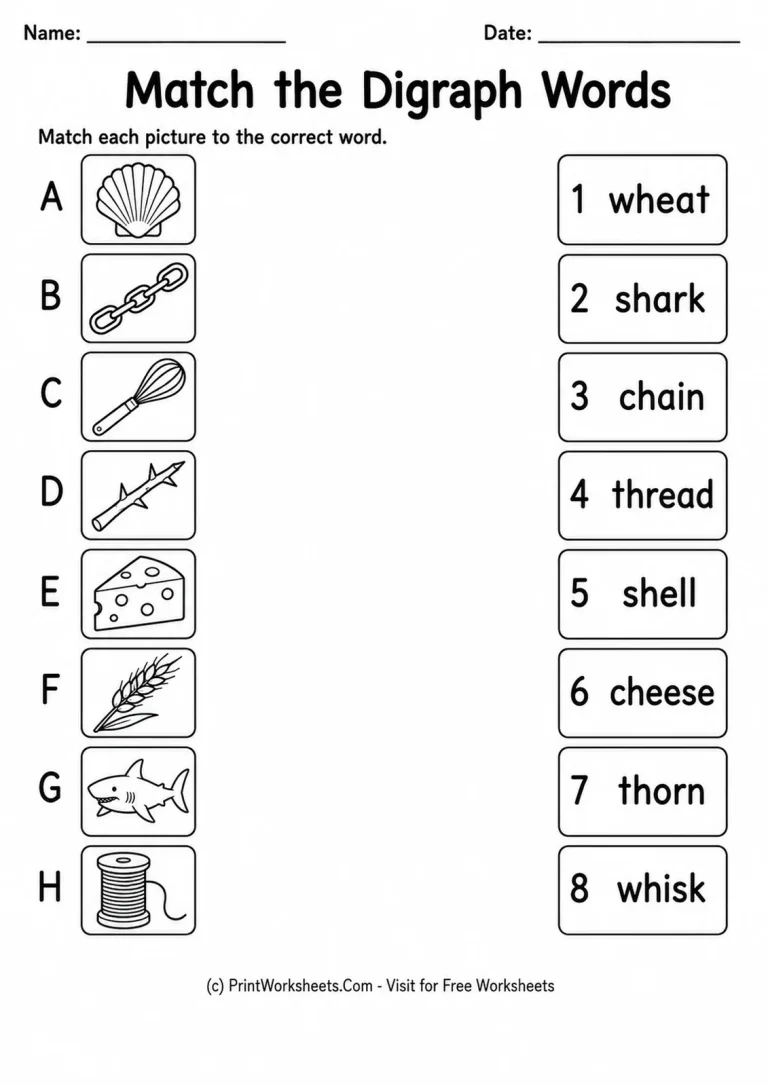
The second activity, Match the Digraph Words, changes the task from circling to picture-to-word matching. Students work with eight new vocabulary examples: shell, chain, whisk, thorn, cheese, wheat, shark, and thread. Each picture has one clear match in the word bank, encouraging children to pay attention to both the opening digraph and the rest of the printed word.
This matching format adds an important reading step. A student may recognize that a picture begins with /sh/, for example, but still needs to locate the full written word that represents it. That combination of picture support, sound awareness, and print recognition helps strengthen the connection between spoken language and written phonics patterns. Teachers can also ask students to read each matched word aloud after completing the page for an extra decoding check.
Practice Writing the Missing Beginning Digraph
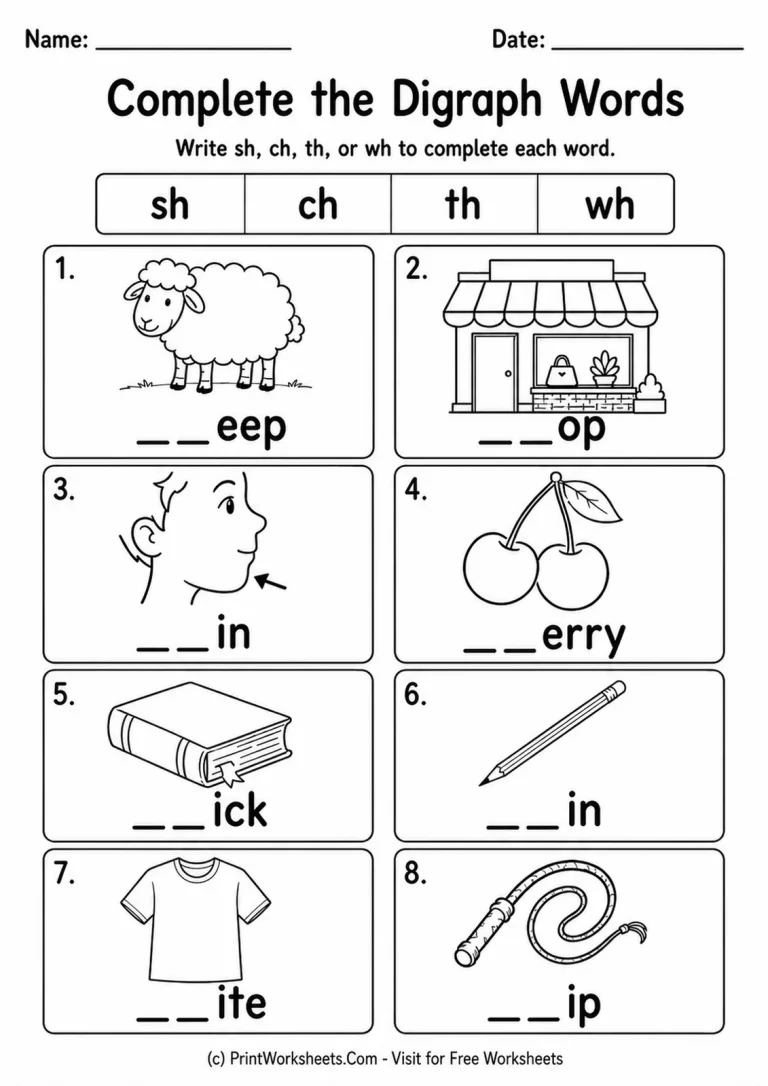
The final worksheet, Complete the Digraph Words, gives students a visible reference row with sh, ch, th, and wh and asks them to write the correct pair at the beginning of each incomplete word. The pictured targets are sheep, shop, chin, cherry, thick, thin, white, and whip. Because students must produce the missing letters rather than simply select or match an answer, this activity provides a stronger check of whether they can recall the spelling pattern independently.
The vocabulary also gives children repeated exposure to each digraph in different words. They can compare sheep with shop, chin with cherry, thick with thin, and white with whip. These pairs make it easier to notice that the same beginning letter combination can appear before different vowels and still preserve the target digraph pattern.
Ways to Use These Grade 1 Phonics Pages
The three worksheets can be used in order as a short phonics sequence. Begin by modeling each digraph sound and having students repeat a few example words. Next, use the identification page for quick guided practice. The matching worksheet can follow during independent work or a literacy center, while the completion page can serve as a final practice activity because it requires students to supply the missing digraph themselves.
For small-group instruction, a teacher can point to each picture before students write and ask, “What sound do you hear first?” Students who need more support can say the word slowly and choose from the four displayed digraphs. Students who are ready for an extension can write another word beginning with the same digraph beside selected items or sort completed words into sh, ch, th, and wh groups.
Parents can use the same progression at home without needing a long lesson. Say the picture word together, emphasize its first sound, and ask the child which two letters create that beginning. By revisiting the same four patterns through identification, matching, and writing, children get repeated phonics practice without repeating the exact same task. The result is a compact Grade 1 set designed to build confidence with common beginning digraphs in both reading and spelling.