These capital letters worksheets give first grade students focused practice with the places where uppercase letters matter most in early sentence writing. Across four printable pages, children work with sentence beginnings, names of people and pets, days of the week, and the pronoun I. The activities move from quick recognition to careful rewriting, so students do more than spot a capital letter—they learn when and why it belongs in a sentence.
Practice with Capital Letters Worksheets for Grade 1
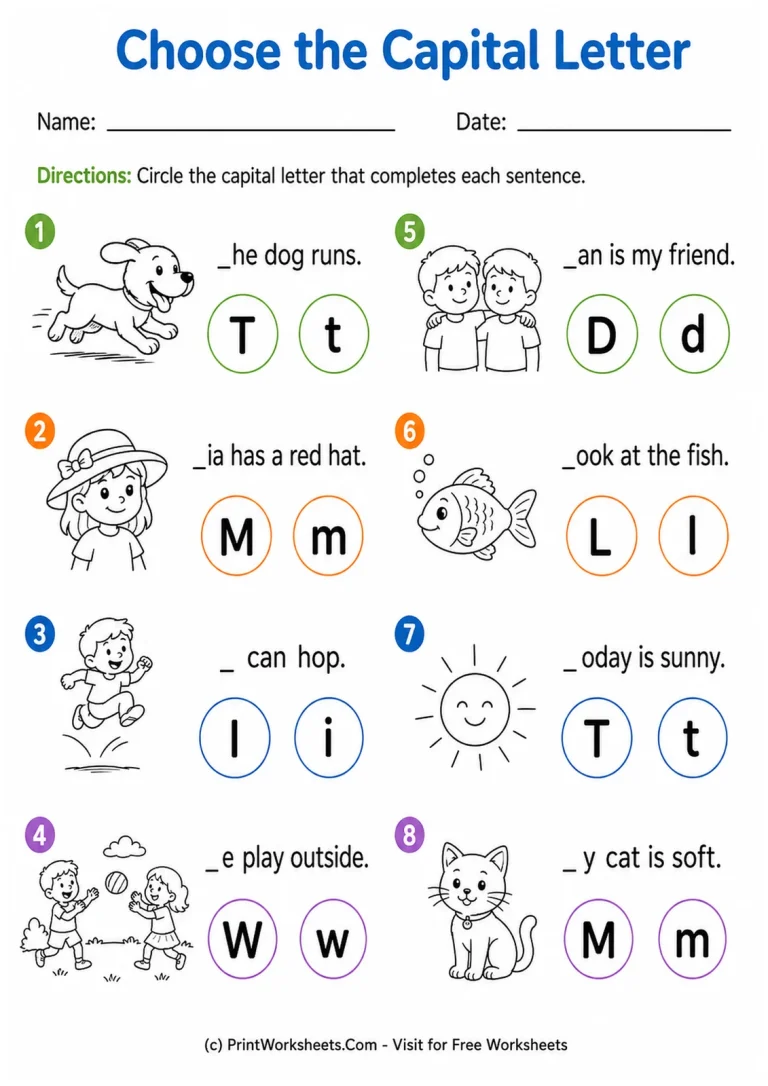
The first worksheet begins with a simple choice task that is well suited to young learners. Eight short sentences are missing their first letter, and students choose between an uppercase and lowercase version to complete each sentence correctly. Familiar subjects such as a dog, a fish, the weather, friends, and a cat keep the reading load light while the grammar target stays clear. Names such as Mia and Dan also help children notice that capitals can appear for more than one reason.
This opening page is useful for students who are just beginning to connect the visual form of an uppercase letter with its job at the start of a sentence. Because each item gives only two letter choices, children can focus closely on the capitalization rule without being distracted by a difficult writing task.
Identify Correctly Capitalized Sentences
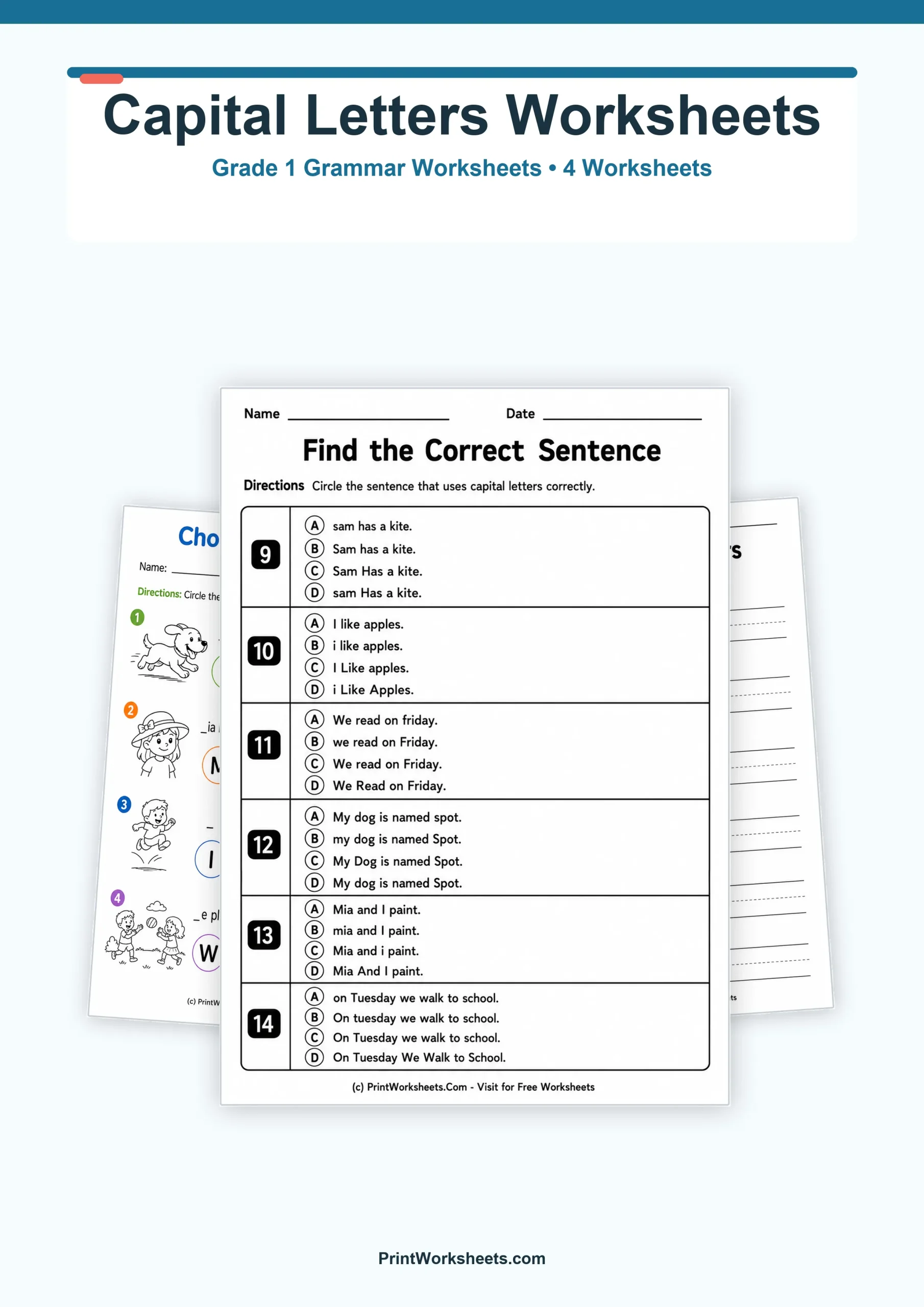
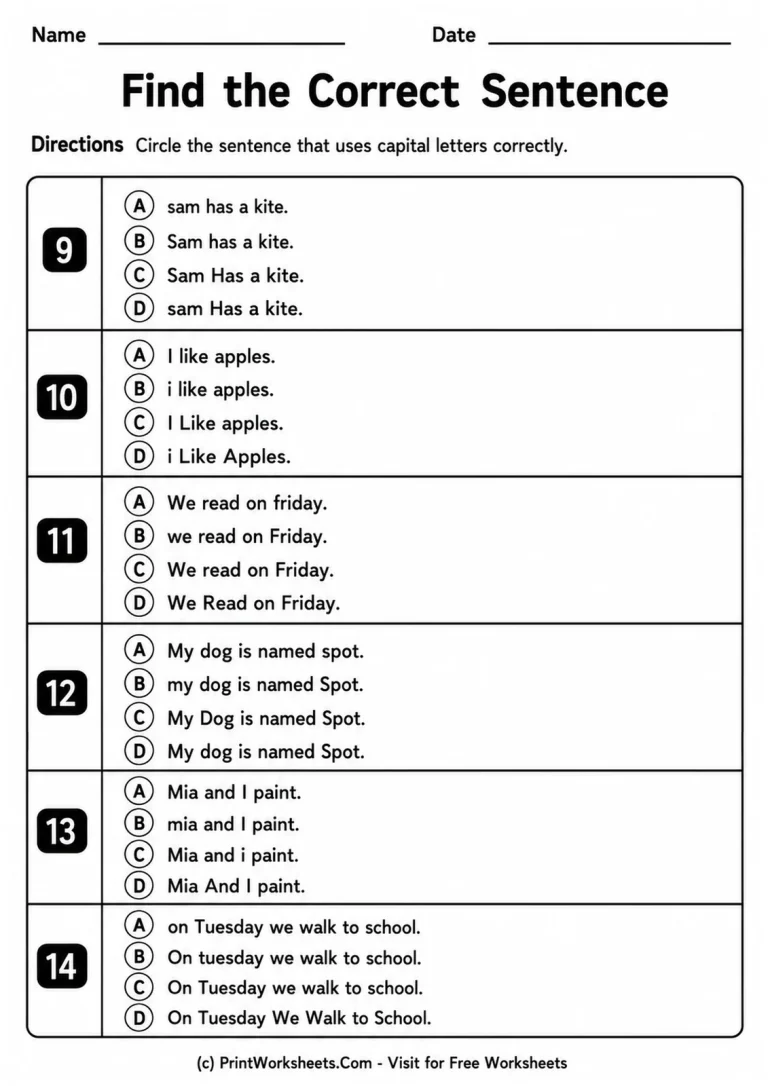
The second page raises the challenge by asking students to choose the correctly written sentence from four options. Six items numbered 9 through 14 include examples with Sam, Spot, Mia, Friday, Tuesday, and the pronoun I. These questions check whether students can recognize several capitalization rules at the same time instead of looking only at the first letter of a sentence.
For example, a sentence may begin correctly but still contain a lowercase name or day. That makes the activity helpful for teaching children to scan the whole sentence before deciding that it is correct. This kind of comparison practice can also lead to short classroom discussions about why one option works and the others do not.
Fix Capitalization Errors by Rewriting Sentences
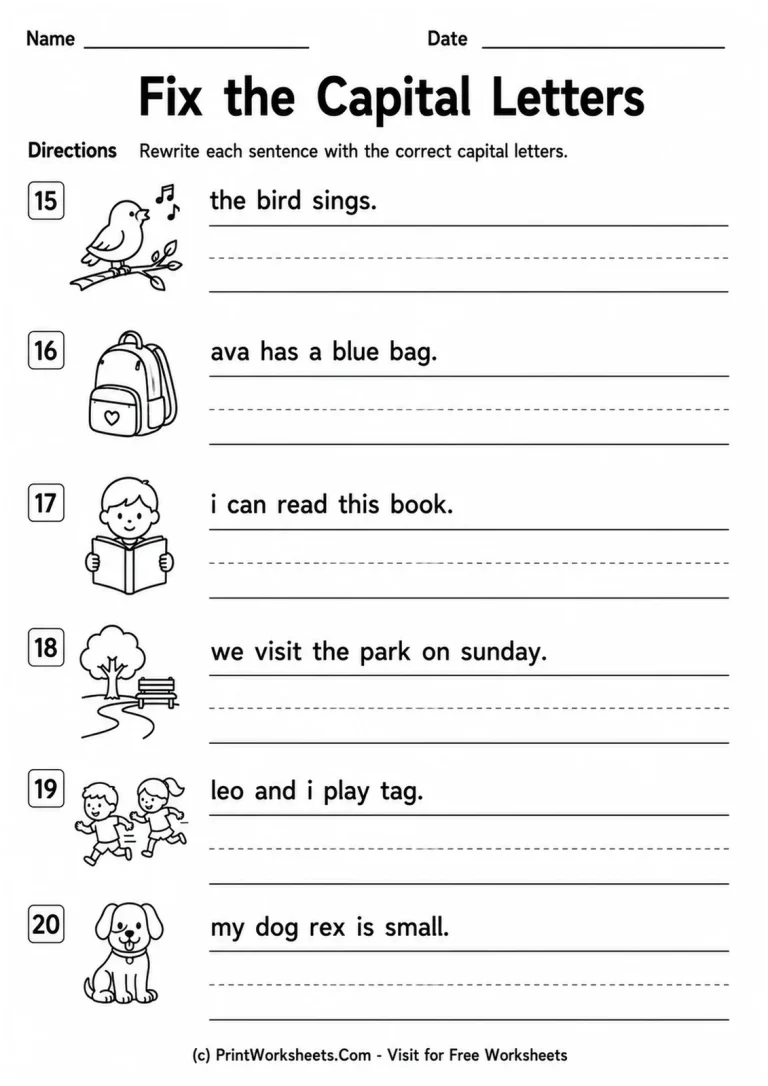
On the third worksheet, students move from recognizing correct capitalization to producing it themselves. Items 15 through 20 show sentences with lowercase-letter errors and ask children to rewrite the complete sentence correctly. Examples include names such as Ava, Leo, and Rex, the day Sunday, sentence openings, and the pronoun I.
Rewriting the entire sentence adds an important writing step. Students must find the capitalization problem, remember the correct form, and then copy the sentence with the change in place. This makes the page useful after direct instruction, during independent practice, or as a quick review of whether students can apply the rule without multiple-choice support.
Use Capital Letters in Everyday Writing
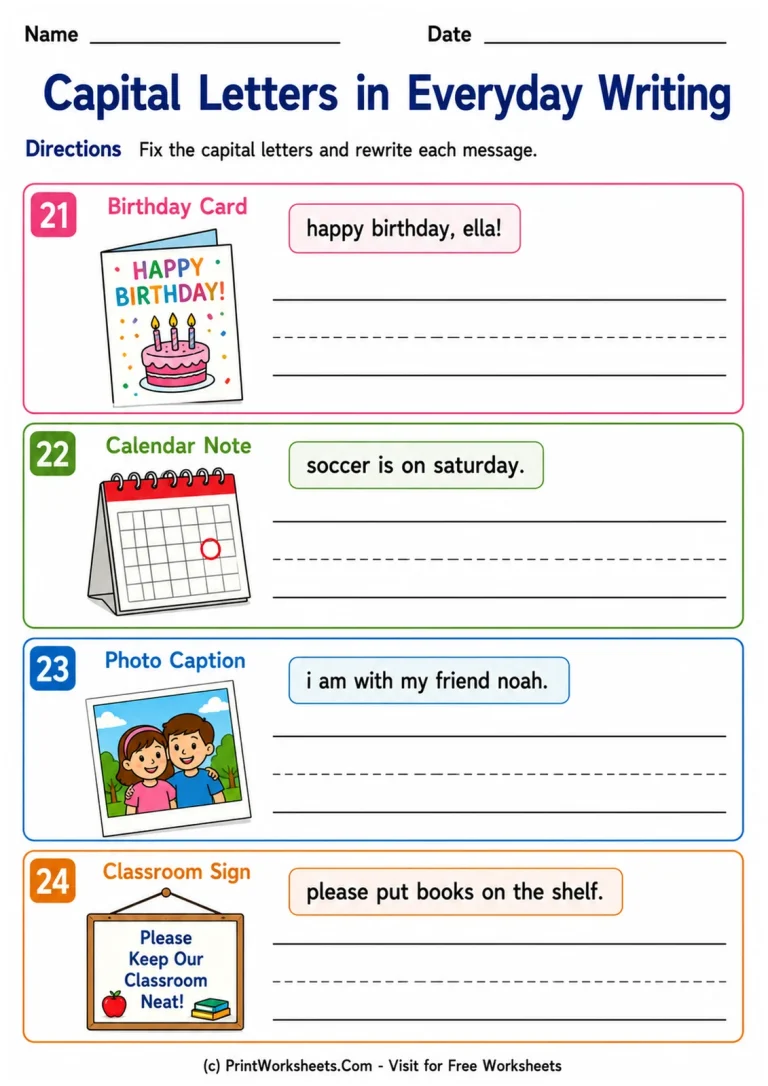
The fourth page brings capitalization into familiar real-world situations. Four activities ask students to correct and rewrite short pieces of everyday writing, including a birthday card, a calendar note, a photo caption, and a classroom sign. Names such as Ella and Noah and the day Saturday appear alongside sentence beginnings, giving children several reasons to use capital letters within meaningful text.
This final step helps students see that capitalization is not only a worksheet rule. The same skills are needed when writing a note, labeling a picture, adding something to a calendar, or making a sign. That connection can make the practice especially useful before students begin their own short messages or classroom writing projects.
Skills Covered in This Printable Set
Together, the four pages provide practice with starting sentences with capital letters, capitalizing names of people and pets, writing days of the week correctly, using a capital I, identifying correctly capitalized sentences, and rewriting sentences that contain errors. The progression from choosing a letter to correcting complete messages gives teachers and parents several ways to support the same grammar skill at different levels of independence.
These Grade 1 worksheets can be used for whole-class grammar lessons, literacy centers, small-group reinforcement, homework, or extra practice. Teachers may use the pages in sequence for a short capitalization unit or select individual activities based on what students need most. The set is especially useful when children are ready to move beyond simply naming uppercase letters and begin applying capitalization rules in complete sentences and practical writing.