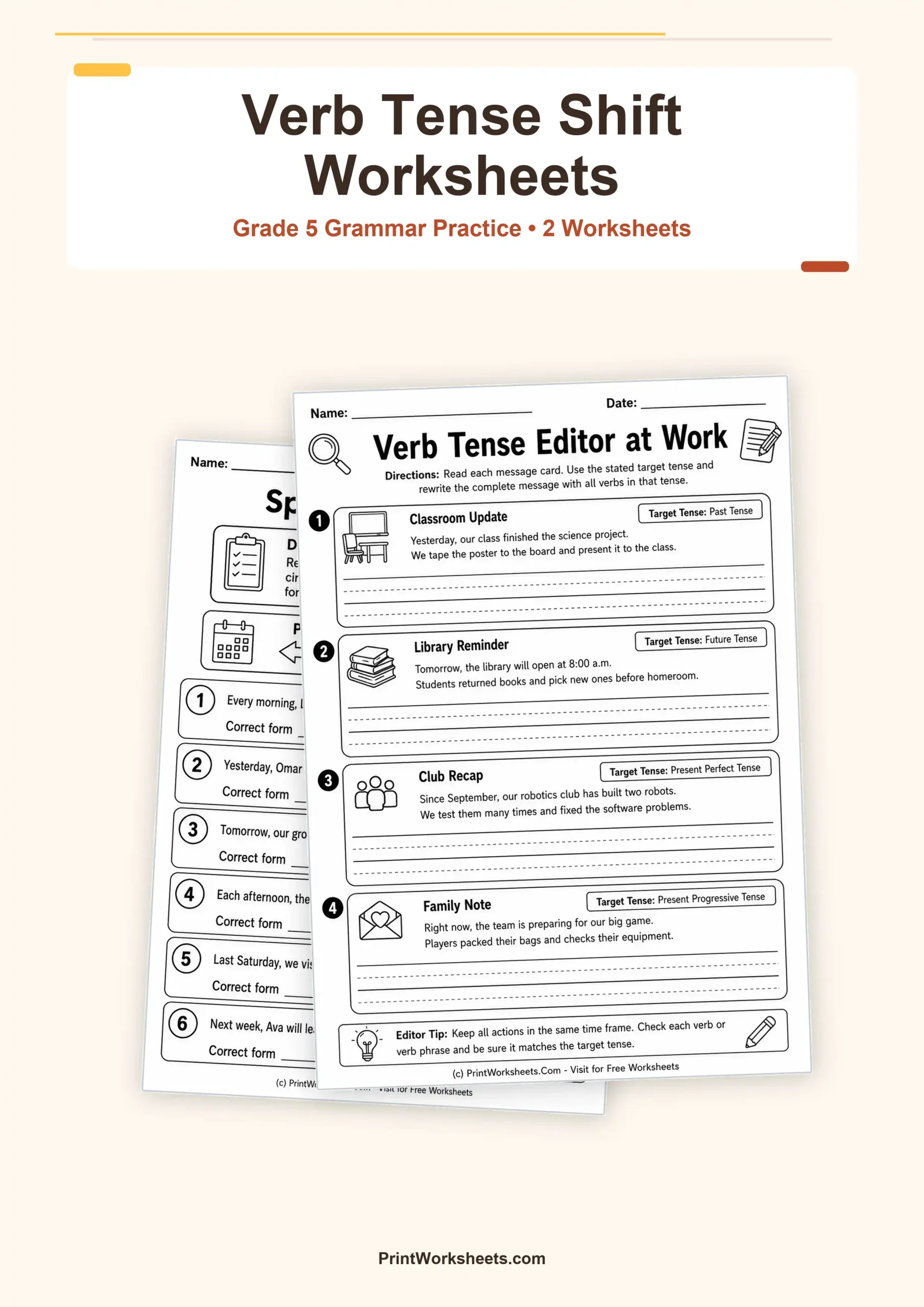
These verb tense shift worksheets give fifth-grade students two different ways to practice keeping verb tense consistent. Students begin with short sentences that contain clear time clues and one verb that does not match the intended time frame. They then move to a more demanding editing task in which an entire short message must be rewritten so every action follows a stated target tense. The progression makes the set useful for students who can recognize common verb forms but still need practice noticing when a sentence or short passage changes tense without a clear reason.
Practice with Verb Tense Shift Worksheets for Grade 5
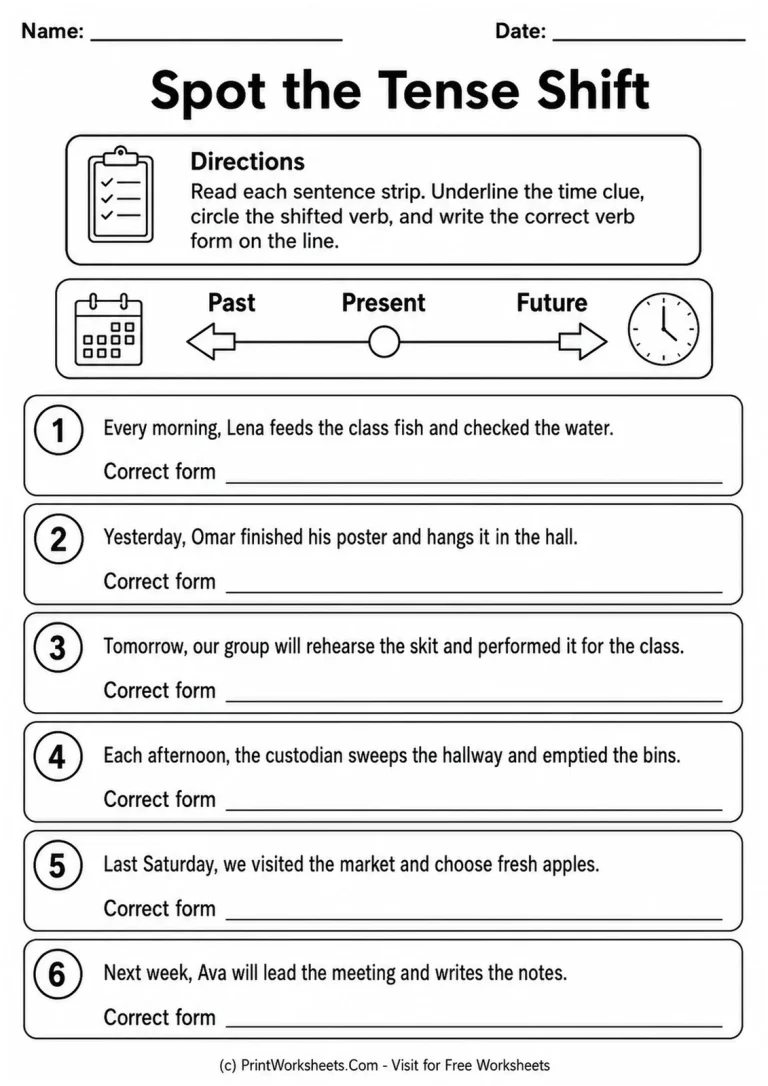
The first worksheet, Spot the Tense Shift, uses six short school and everyday-life sentences. Each item includes an explicit clue such as Every morning, Yesterday, Tomorrow, Each afternoon, Last Saturday, or Next week. Those clues help students connect the meaning of the sentence with the verb form that should be used.
For every sentence, students complete three separate editing actions. They underline the time clue, circle the verb that shifts tense, and write the corrected verb form. This structure encourages students to explain the grammar through evidence in the sentence rather than simply guessing which verb sounds better. The activity includes habitual present, simple past, and future contexts, giving students repeated practice moving between common time frames.
Because the time markers are visible and specific, the worksheet can also help teachers see where a student is having difficulty. A learner may understand the time clue but choose the wrong verb form, or may correct the verb without first identifying the clue that controls the tense. Those differences can guide follow-up instruction.
Move from Single Sentences to Tense Consistency
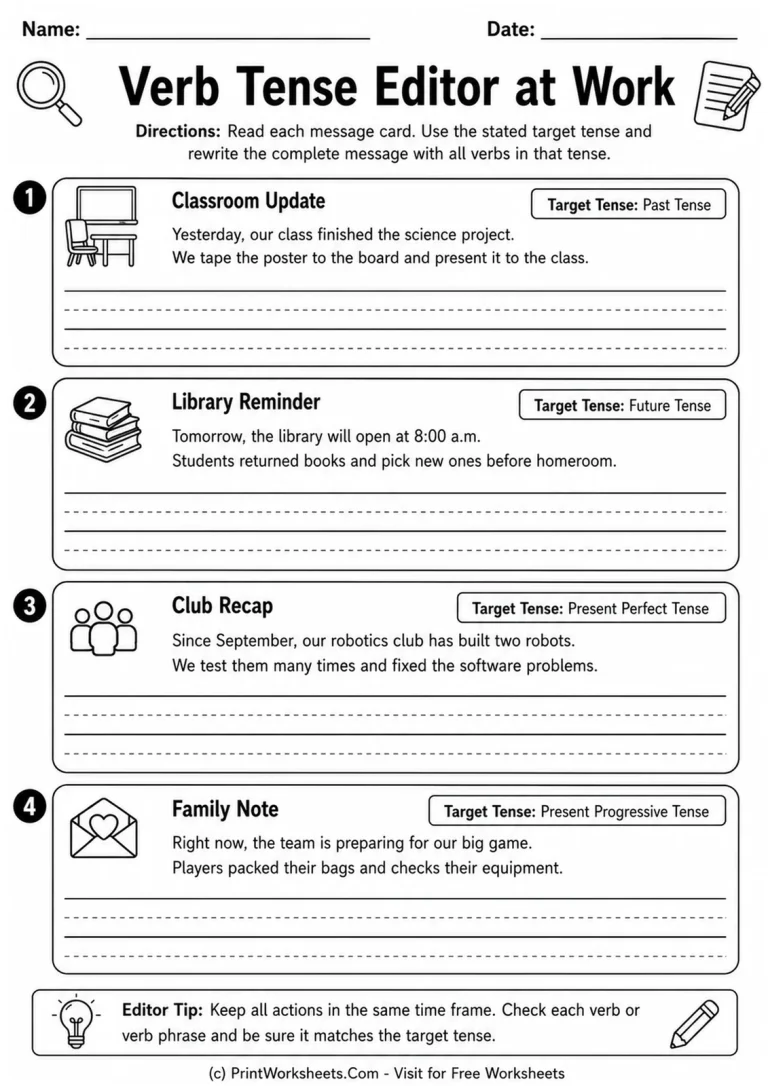
The second approved worksheet, Verb Tense Editor at Work, expands the same skill into short-message editing. Instead of correcting one verb at a time, students rewrite four complete message cards so that all verbs remain consistent with a clearly labeled target tense.
The messages use realistic contexts: Classroom Update, Library Reminder, Club Recap, and Family Note. Each card names the tense students should use before they begin rewriting. The four targets are past tense, future tense, present perfect tense, and present progressive tense. This format requires students to pay attention to the relationship among several verbs instead of treating each verb as an isolated question.
Why Whole-Message Rewriting Matters
Verb tense consistency becomes more challenging when students write more than one sentence. A student may begin a message in past tense and then unintentionally move into present tense, or may use a future form in one sentence but switch back to a present form in the next. Rewriting a complete message gives students practice checking the time frame across a connected piece of writing.
The activity also provides a useful bridge between grammar exercises and real editing. Students are not only selecting a verb from a list. They must read the meaning of the message, identify the required time frame, and adjust the verbs so the whole passage works together. This makes the task suitable for grammar lessons, editing practice, independent work, literacy centers, or targeted review before longer writing assignments.
Ways Teachers and Parents Can Use These Worksheets
The two pages can be used together or separately. The shorter sentence-level activity works well as an introduction, warm-up, independent practice page, or quick check after a lesson on consistent verb tense. The message-rewriting activity can follow when students are ready to apply the same concept across several connected sentences.
For additional support, an adult can ask the student to say the time clue aloud before changing the verb. For example, words such as Yesterday or Last Saturday signal that the sentence should stay in a past time frame, while Tomorrow or Next week point toward future meaning. This simple routine helps students connect grammar choices with context.
Students who are ready for a challenge can explain why each original verb creates a tense shift or compare how the meaning changes when a message is rewritten in a different target tense. These extensions keep the focus on grammatical reasoning rather than memorization.
Build Stronger Editing Habits
Consistent verb tense is an important part of clear fifth-grade writing. These printable activities help students slow down, look for time evidence, check verb forms, and revise sentences or short passages when the tense changes unnecessarily. By progressing from clearly marked sentence clues to full-message rewriting, the worksheets provide focused practice that can support both grammar instruction and everyday editing skills.