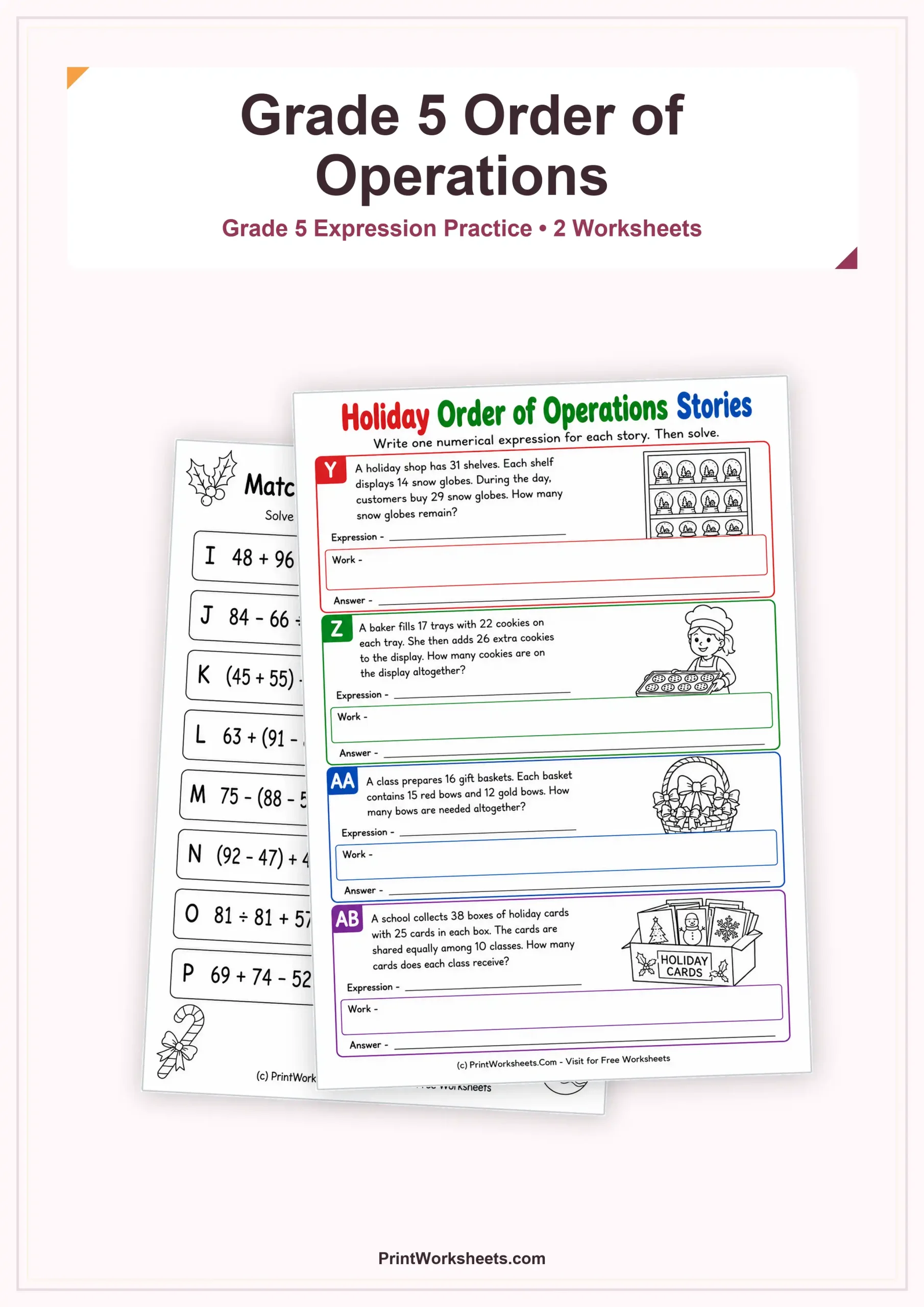
These order of operations worksheets give fifth-grade students focused practice with multi-step expressions that use parentheses, multiplication, division, addition, and subtraction without introducing exponents. The set moves from evaluating ready-made numerical expressions to building expressions from real-life situations, so students practice both following the correct operation sequence and deciding how a situation should be represented mathematically. This makes the worksheets useful for independent practice, small-group instruction, homework, or a short skills review before more advanced numerical-expression work.
Grade 5 Order of Operations Worksheets Without Exponents
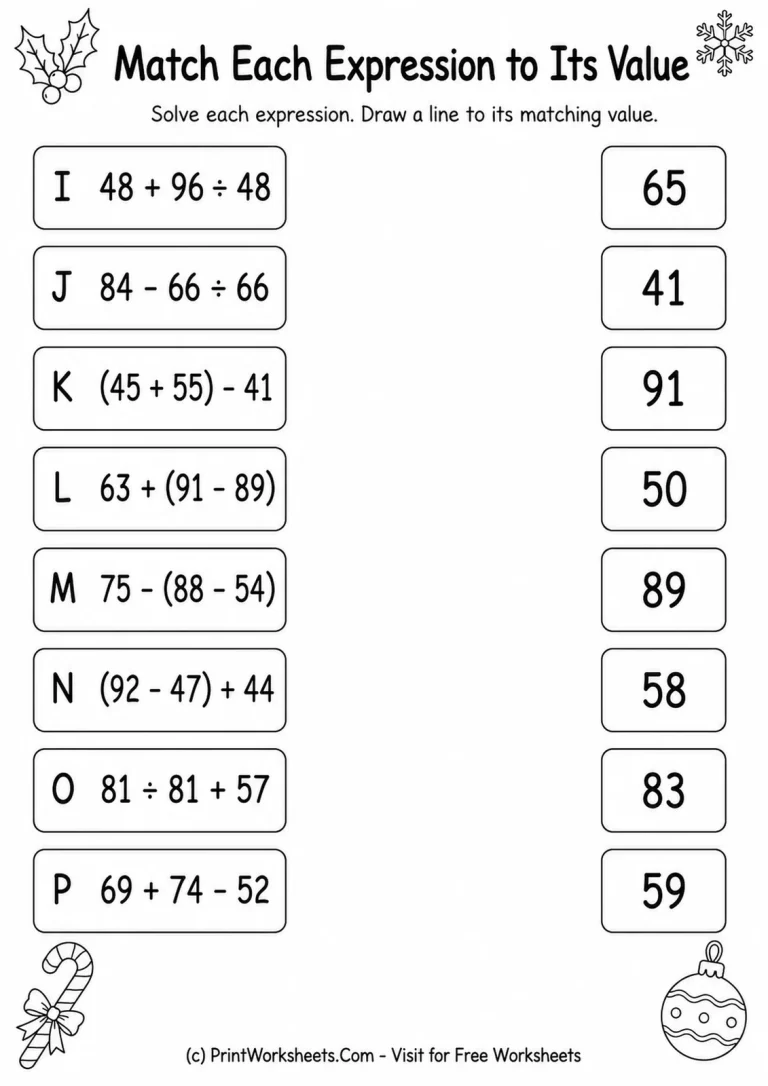
The first worksheet, Match Each Expression to Its Value, asks students to solve eight numerical expressions labeled I through P and connect each one to its correct value. The answer choices include 65, 41, 91, 50, 89, 58, 83, and 59, with one unique match for every expression. Because students cannot rely on repeated answers, they need to evaluate each expression carefully and check that the result fits only one choice.
The problems mix several forms of operation-order reasoning. Expressions such as 48 + 96 ÷ 48 and 84 − 66 ÷ 66 require students to perform division before addition or subtraction. Others, including (45 + 55) − 41 and 63 + (91 − 89), place parentheses at the center of the calculation. Together, these examples reinforce that students should not simply work from left to right. They must identify the operation that has priority, complete it accurately, and then continue with the remaining operations.
Move From Solving Expressions to Writing Them
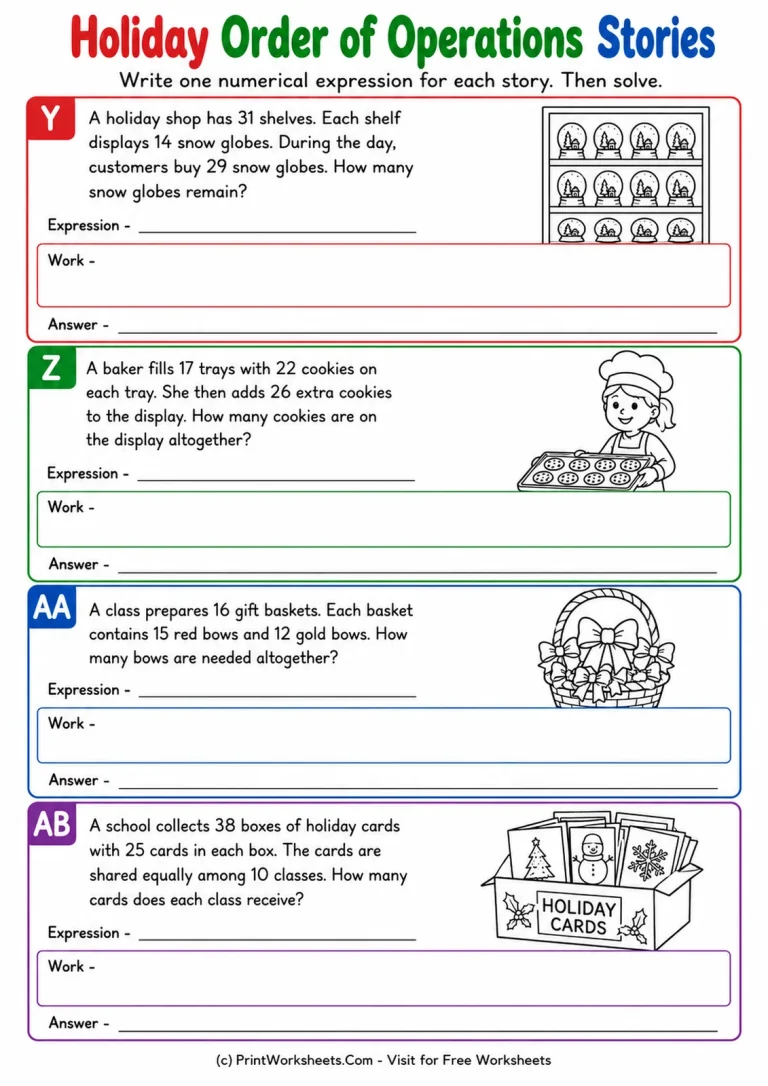
The second worksheet, Holiday Order of Operations Stories, raises the level of thinking by asking students to create a numerical expression before solving. Instead of being handed the operations in symbolic form, students read four short situations, decide which quantities belong together, write one expression that represents the story, show their work, and find the final answer.
The contexts give students concrete reasons to use multiple operations. One problem describes 31 shelves with 14 snow globes on each shelf and then removes 29 sold snow globes. A student can represent the situation with multiplication followed by subtraction, recognizing that the total number stocked must be found before the sold items are removed. Another problem uses 17 trays of 22 cookies with 26 additional cookies, requiring students to combine multiplication and addition in a single expression. Other stories involve bows on gift baskets and cards divided among classrooms, expanding practice across different operation combinations.
Build Stronger Numerical Expression Reasoning
This progression is especially useful in Grade 5 because it connects procedural accuracy with mathematical interpretation. On the matching page, students concentrate on evaluating expressions correctly. On the story page, they must first determine what the operations mean in context. A student who can calculate accurately but chooses the wrong structure for a word problem will see that writing the expression is an important part of the solution, not just an extra step.
The worksheets also provide natural opportunities for mathematical discussion. Teachers can ask students to explain which operation they completed first and why, compare two different-looking expressions, or describe how parentheses change the calculation. During the word problems, students can explain what each number represents and why a particular operation belongs before another. These conversations help reveal whether students truly understand order of operations or are only following a memorized routine.
Ideas for Classroom and Home Practice
For a quick lesson, use the matching activity after reviewing parentheses and the rule that multiplication and division are completed before addition and subtraction. Students can solve each expression independently and then use the value list as a built-in reasonableness check. The page also works well in pairs: one student can calculate while the other explains the operation order, then they can switch roles.
The story worksheet works well after students are comfortable evaluating expressions. Encourage them to underline important quantities, decide what should happen first in the situation, and write the complete expression before calculating. Parents and teachers can ask students to read the expression aloud in words to confirm that it matches the original story. This slows down guessing and strengthens the connection between language and mathematical structure.
Focused Practice Before More Advanced Expressions
Because the problems intentionally avoid exponents, students can concentrate on the core Grade 5 skills of grouping symbols and the four basic operations. The two approved activities provide a compact progression from evaluating numerical expressions to constructing and solving multi-step expressions from word problems. They are well suited for targeted review, extra practice, math centers, or preparation for later work with more complex numerical expressions.