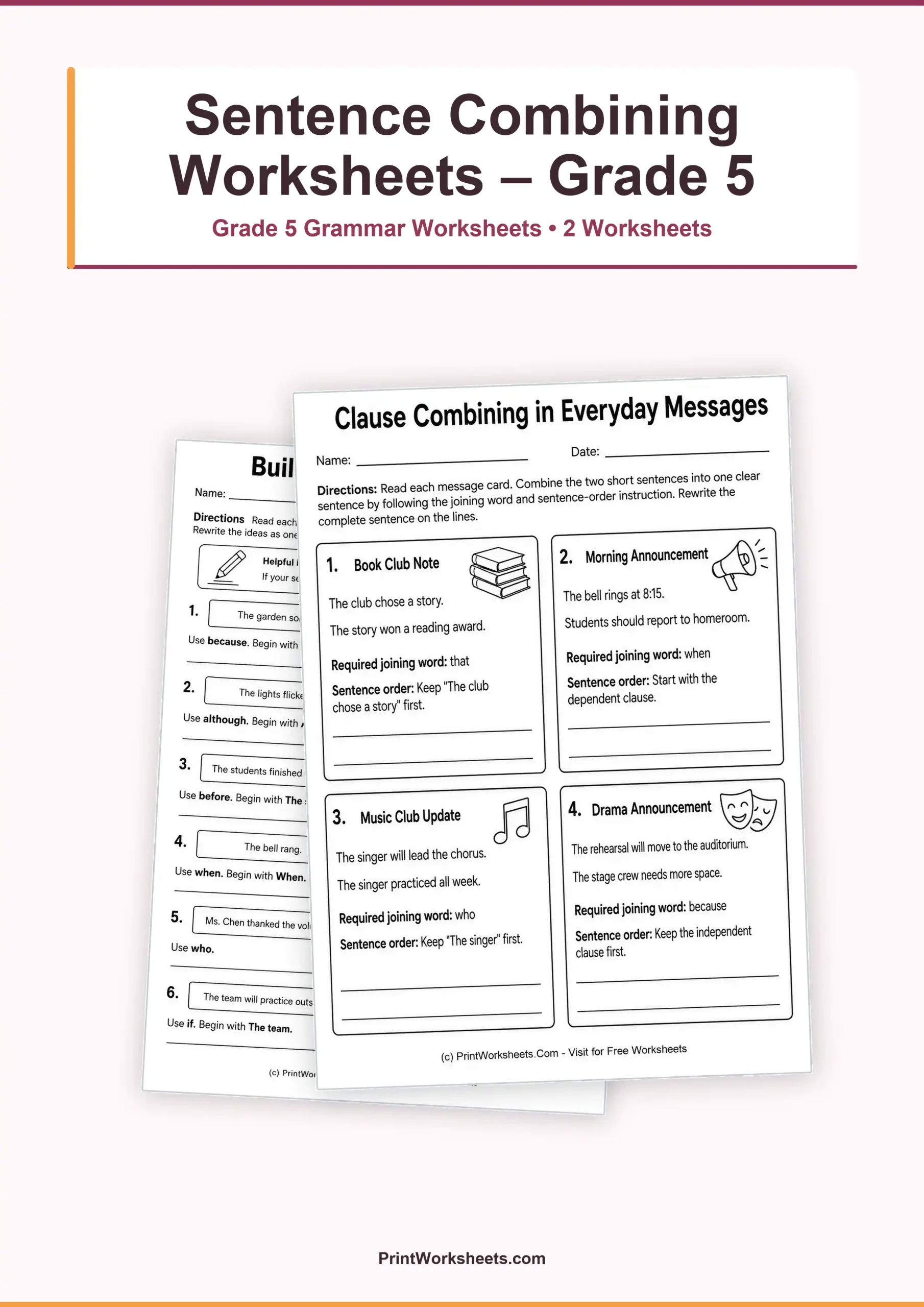
Strong sentences do more than place two ideas side by side. They show how those ideas are connected. These Grade 5 sentence combining worksheets give students focused practice turning short statements into smoother, more complete sentences by choosing and using clause-joining words correctly. The activities move from structured combinations with clear prompts to open-response school messages, helping students notice how meaning changes when clauses are reordered or connected with different words.
Sentence Combining Worksheets for Clause Connections
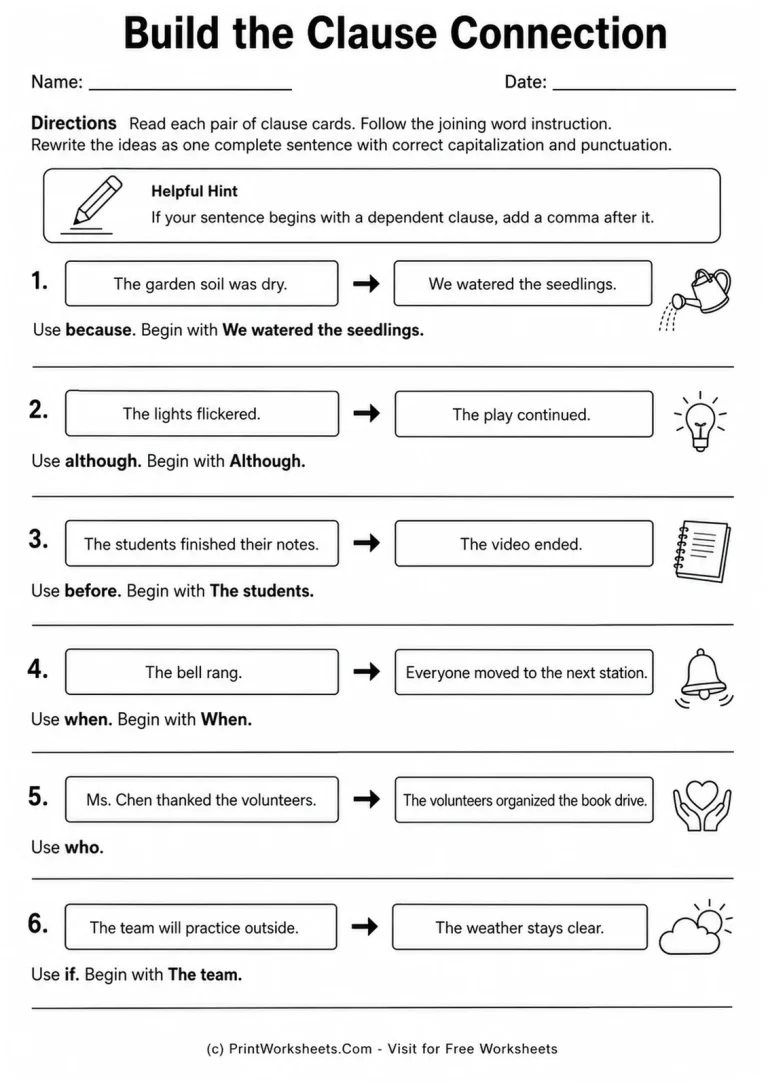
The first worksheet, Build the Clause Connection, presents six pairs of ideas that students combine into one complete sentence. Each item supplies a specific joining word such as because, although, before, when, who, or if. This keeps the task focused on sentence construction rather than making students guess which connector to use.
Some prompts also require a particular sentence beginning. A student may need to start with Although, When, or The students, for example. That extra condition encourages careful attention to clause order. Students cannot simply copy both statements and insert a word between them; they need to reshape the ideas so the finished sentence is grammatical and logical.
The worksheet also includes an important punctuation reminder: when a dependent clause comes first, a comma is used after that introductory clause. This gives fifth graders a practical reason to connect grammar and punctuation rather than treating them as unrelated skills.
Practice with Subordinating Conjunctions and Relative Clauses
The guided page introduces several useful sentence relationships. Because can show a reason, although can signal contrast, before and when can establish time, and if can introduce a condition. Students also work with who as they connect information about a person to another clause. These varied prompts help students see that sentence combining is not one fixed formula.
Working with these joining words also supports students as they begin writing longer explanations, responses, and narratives. Instead of producing a series of short sentences, they can learn to connect related information in ways that make relationships between ideas clearer.
Apply Clause Combining in Everyday School Messages
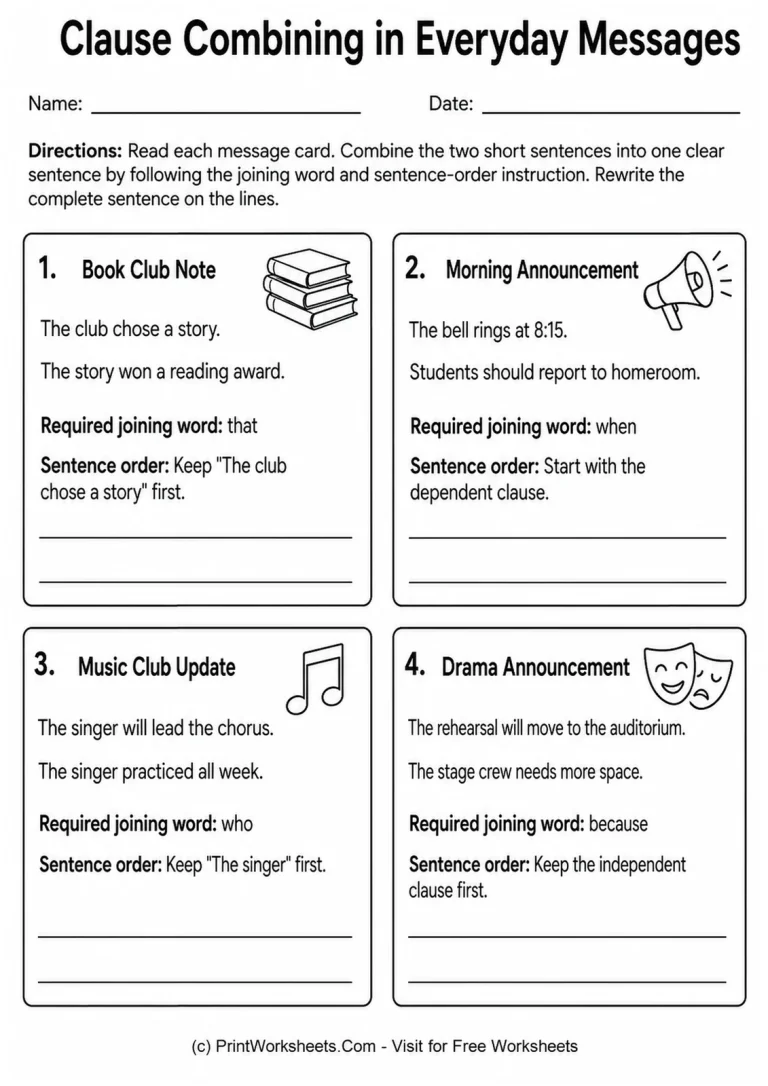
The second approved worksheet, Clause Combining in Everyday Messages, shifts from guided clause cards to four contextual writing tasks. Students work with a Book Club Note, Morning Announcement, Music Club Update, and Drama Announcement. Each card provides two short sentences that must be rewritten as one sentence.
The joining word is still required, but students have more responsibility for constructing the final sentence. The prompts use that, when, who, and because, and each activity also includes a sentence-order rule. Students therefore need to read both the meaning and the structural requirement before writing their response.
This format makes the grammar practice feel closer to authentic school writing. A morning announcement or club update needs information to be concise and easy to follow, so combining related statements into one well-formed sentence has a clear purpose. The open-response lines also give students space to write the full revised sentence rather than selecting an answer from a list.
Skills Students Practice
Across the two worksheets, fifth graders practice combining dependent and independent clauses, using subordinating conjunctions, building relative clauses with who and that, following required clause order, and adding a comma after an introductory dependent clause when needed. Because the activities require complete written responses, teachers can also observe capitalization, end punctuation, and sentence fluency as students work.
The progression works well for a short grammar lesson, independent practice, literacy centers, homework, or review. Teachers can begin with the highly scaffolded clause-card activity, model one or two examples aloud, and then move students to the school-message page for more independent application. Parents can use the same sequence for extra practice at home by asking students to explain why a joining word makes sense and how changing the clause order affects punctuation.
Build More Flexible Grade 5 Sentences
Sentence combining gives students a practical bridge between grammar knowledge and real writing. These worksheets ask students to do more than identify a conjunction or label a clause. They must use the grammar to produce a complete sentence that preserves the original ideas and follows a specific structural rule. Beginning with guided combinations and ending with contextual rewriting gives students a manageable path from supported practice to independent sentence construction.