These Grade 5 claims and evidence passages give students repeated practice with one of the most important habits in close reading: deciding which details actually support an author’s point. Instead of stopping at simple comprehension, the worksheets ask students to compare evidence, judge its strength, and explain the connection between a claim and the facts that make it convincing. The set uses practical topics such as school schedules, bike safety, food waste, wildlife crossings, reusable supplies, historic preservation, and community cooling centers, so students can focus on reasoning while reading about familiar real-world issues.
Claims and Evidence Practice That Builds Stronger Reasoning
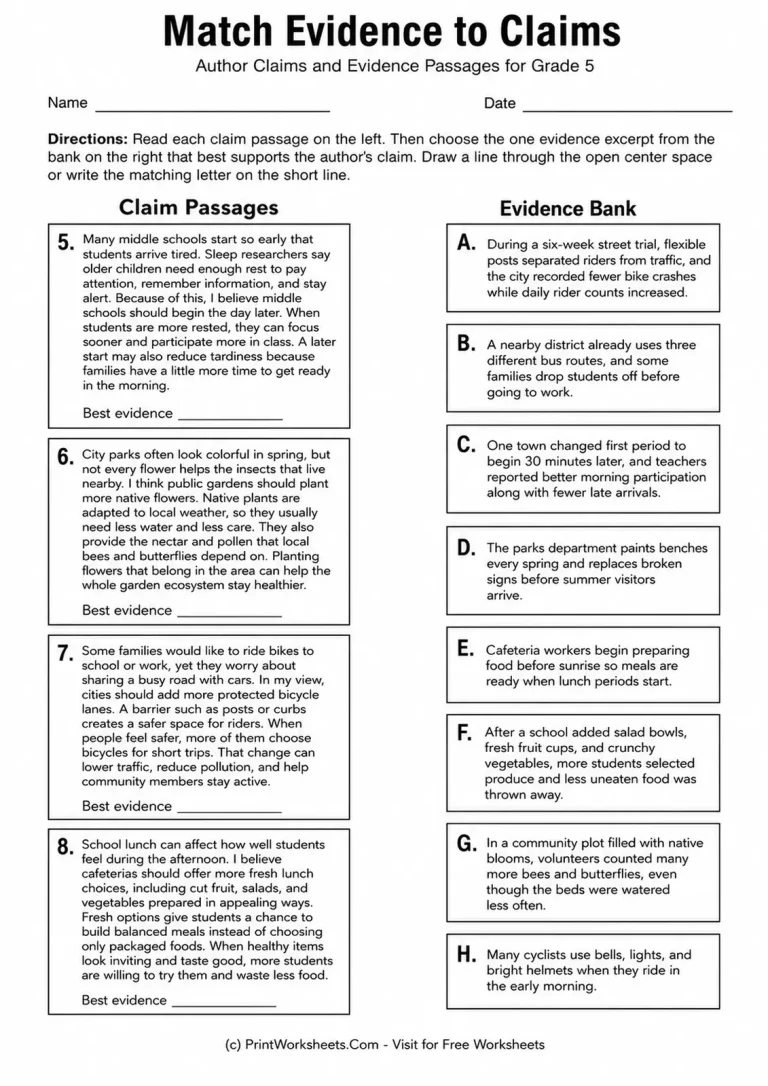
The first worksheet uses a matching format. Students read four claim passages and choose the best supporting excerpt from an evidence bank. The claims cover starting middle school later, planting native flowers, adding protected bicycle lanes, and offering fresher cafeteria choices. Each evidence bank includes both useful and distracting details, requiring students to look for a direct relationship rather than simply matching repeated words.
For example, the later-school-start claim is best supported by evidence from a town where first period began 30 minutes later and teachers reported better morning participation along with fewer late arrivals. The bicycle-lane claim is supported by a street trial in which flexible posts separated riders from traffic and fewer bicycle crashes were recorded while rider counts increased. These details make the activity especially useful for teaching students that strong evidence should directly address the author’s central point.
Moving From Relevant Evidence to the Strongest Evidence
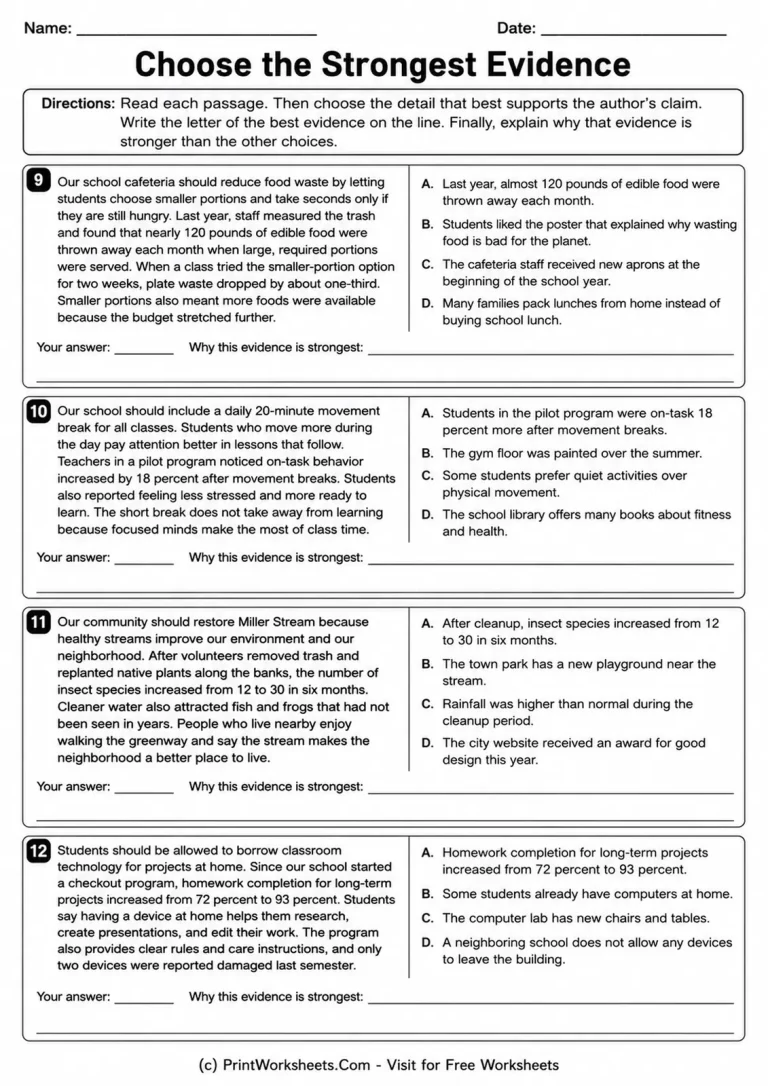
The next page raises the level of thinking. Students read four longer passages, select the strongest evidence from four choices, and then explain why their selection is better than the alternatives. One passage argues for smaller cafeteria portions and includes a measurement of nearly 120 pounds of edible food discarded each month. Another supports daily movement breaks with pilot-program data showing an 18 percent increase in on-task behavior.
Additional passages use measurable results from environmental restoration and classroom technology. After cleanup and native planting at Miller Stream, insect species increased from 12 to 30 in six months. In a technology checkout program, completion of long-term projects increased from 72 percent to 93 percent. Because the answer choices also contain unrelated or weaker details, students must distinguish evidence that is merely connected to the topic from evidence that clearly proves the claim.
Explaining How Evidence Supports an Author’s Claim
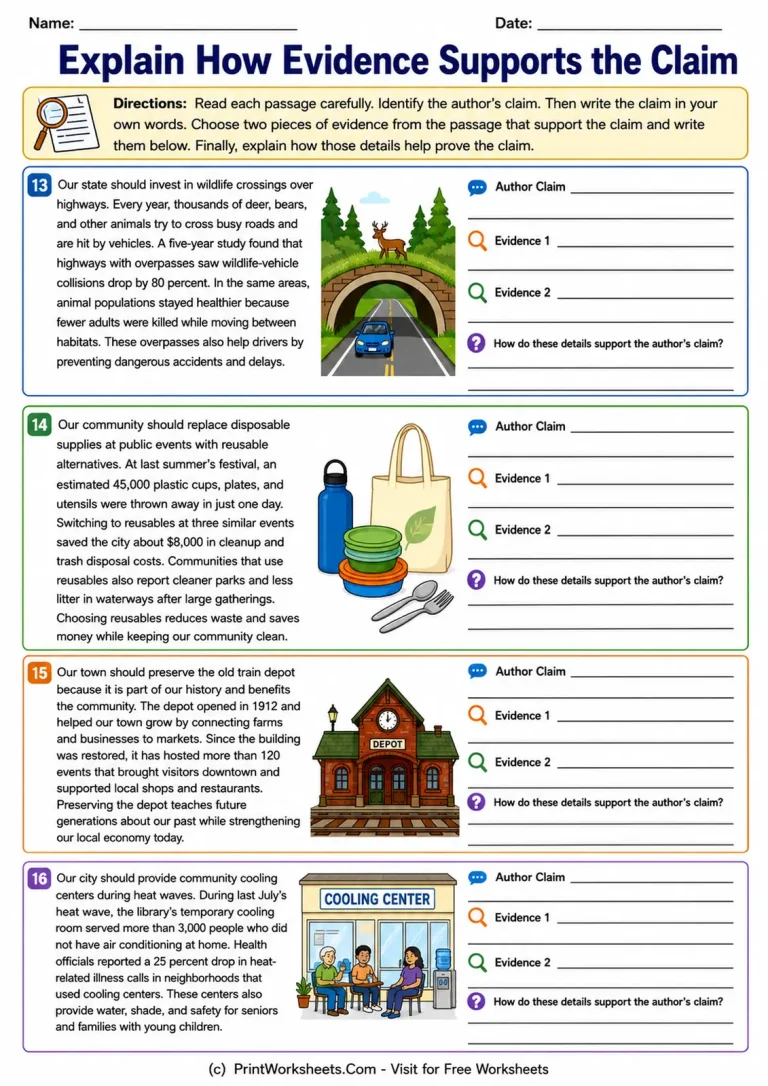
The final worksheet moves into open-response reading. Students identify the author’s claim in their own words, record two supporting pieces of evidence, and explain how those details help prove the claim. This format encourages students to combine comprehension with written reasoning rather than relying on multiple-choice recognition.
The passages offer several strong opportunities for evidence-based discussion. A wildlife-crossing passage reports that highways with overpasses saw wildlife-vehicle collisions drop by 80 percent in a five-year study. A passage about reusable supplies describes an estimated 45,000 plastic cups, plates, and utensils discarded during one festival and reports about $8,000 in cleanup and disposal savings at similar events that switched to reusable items. Other passages describe a restored train depot that has hosted more than 120 events and a temporary cooling center that served more than 3,000 people during a heat wave, alongside a 25 percent drop in heat-related illness calls in nearby areas using cooling centers.
Ways to Use These Grade 5 Reading Passages
Teachers can use the matching page as guided practice, asking students to underline the exact words in each evidence choice that connect to the claim. The strongest-evidence page works well for partner discussion because students can compare why one option is more convincing than another. The open-response page is a natural independent follow-up or short assessment because students must select evidence and explain their reasoning in complete sentences.
For students who need support, have them first label each passage’s claim and then sort details into strong, weak, or unrelated evidence. More advanced readers can be asked to rank all available evidence from strongest to weakest and defend their ranking. Across the set, students practice reading closely, using quantitative details, separating relevant information from distractions, and writing clear explanations about how evidence supports an author’s claim.