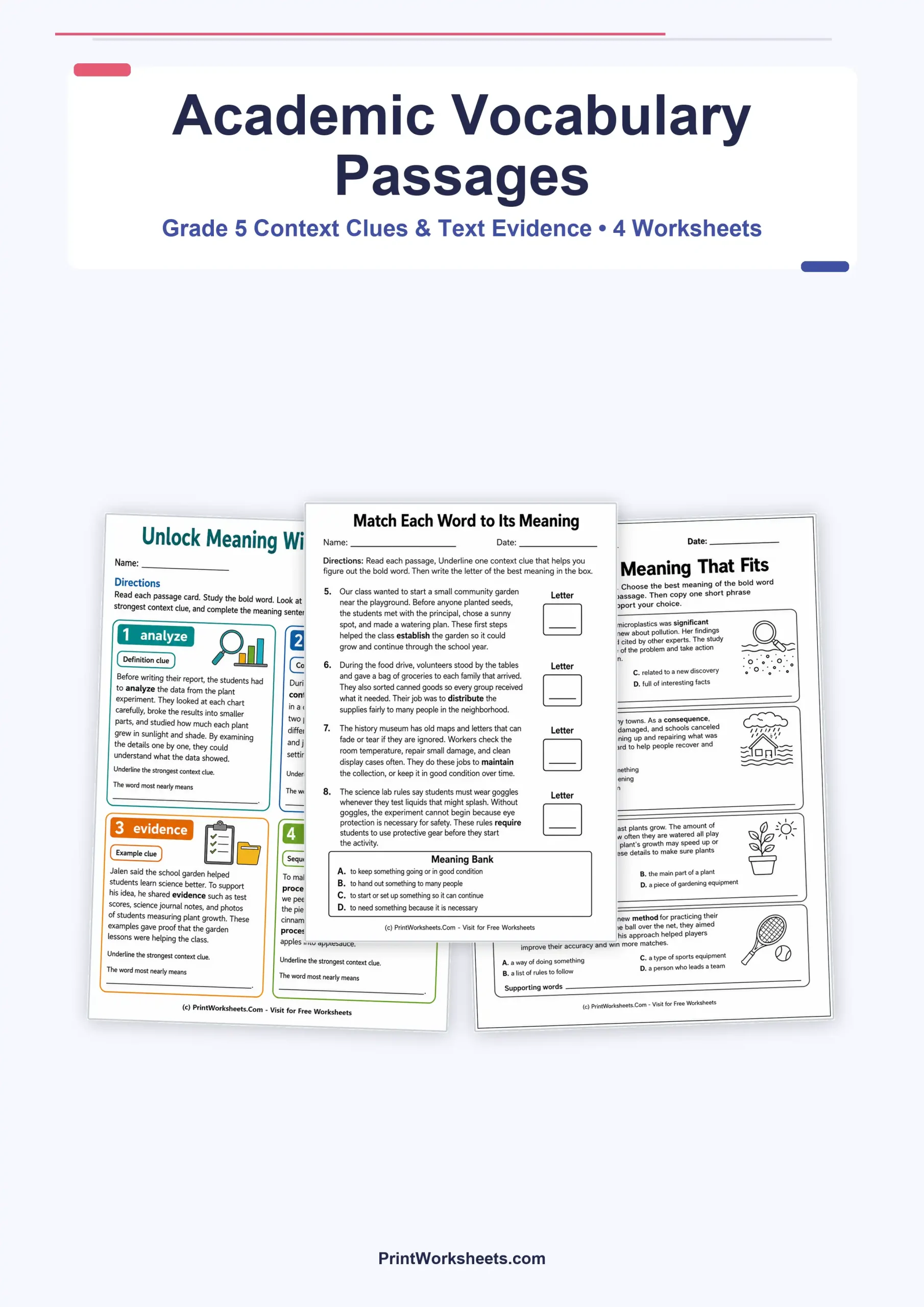
Academic vocabulary passages give fifth graders a practical way to work out unfamiliar words while they are actually reading. This four-page printable set moves students through 16 useful academic words, including analyze, contrast, evidence, process, establish, distribute, maintain, require, significant, consequence, factors, method, interpret, indicate, responded, and occur. Instead of asking students to memorize isolated definitions, each activity places the target word inside a short passage and asks readers to use nearby details as evidence for meaning.
Academic Vocabulary Passages Built Around Context Clues
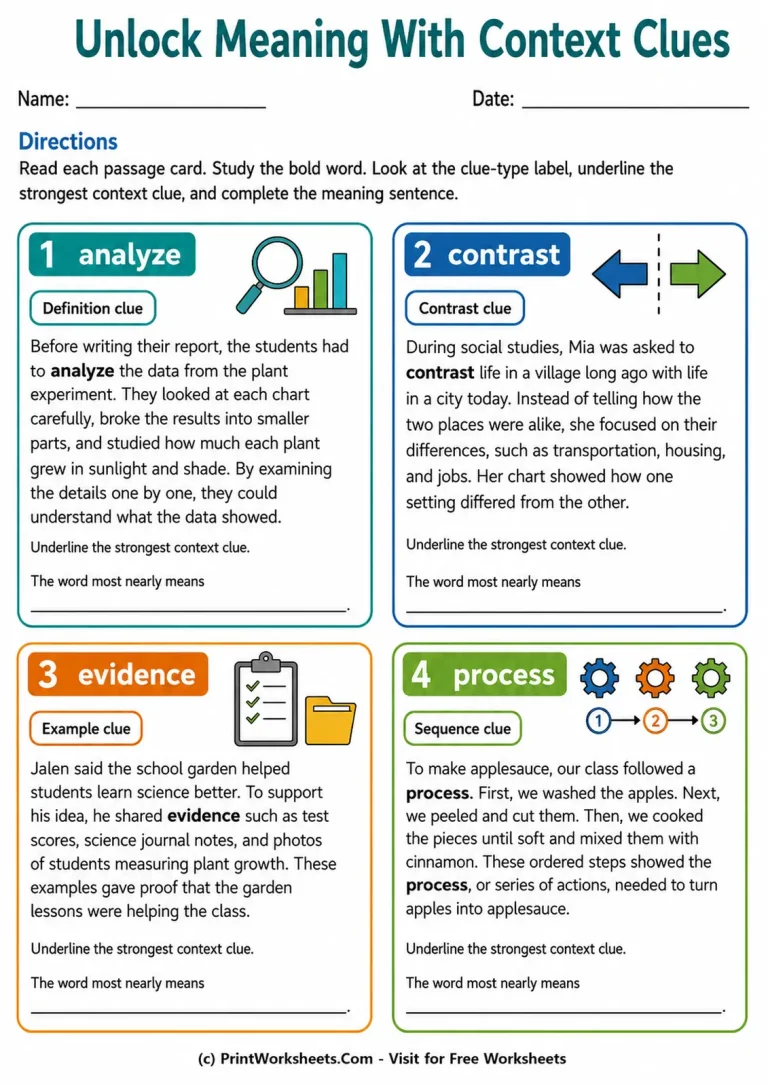
The first worksheet makes the thinking process visible by labeling four different clue types. Students work with analyze through a definition clue, contrast through a contrast clue, evidence through an example clue, and process through a sequence clue. After reading each card, they underline the strongest clue and complete a sentence explaining what the bold word most nearly means. Because the clue type is named on the page, this activity works especially well as an introduction or guided lesson before students are expected to identify clue patterns independently.
How the Four Worksheets Increase the Challenge
From labeled clues to meaning-bank matching
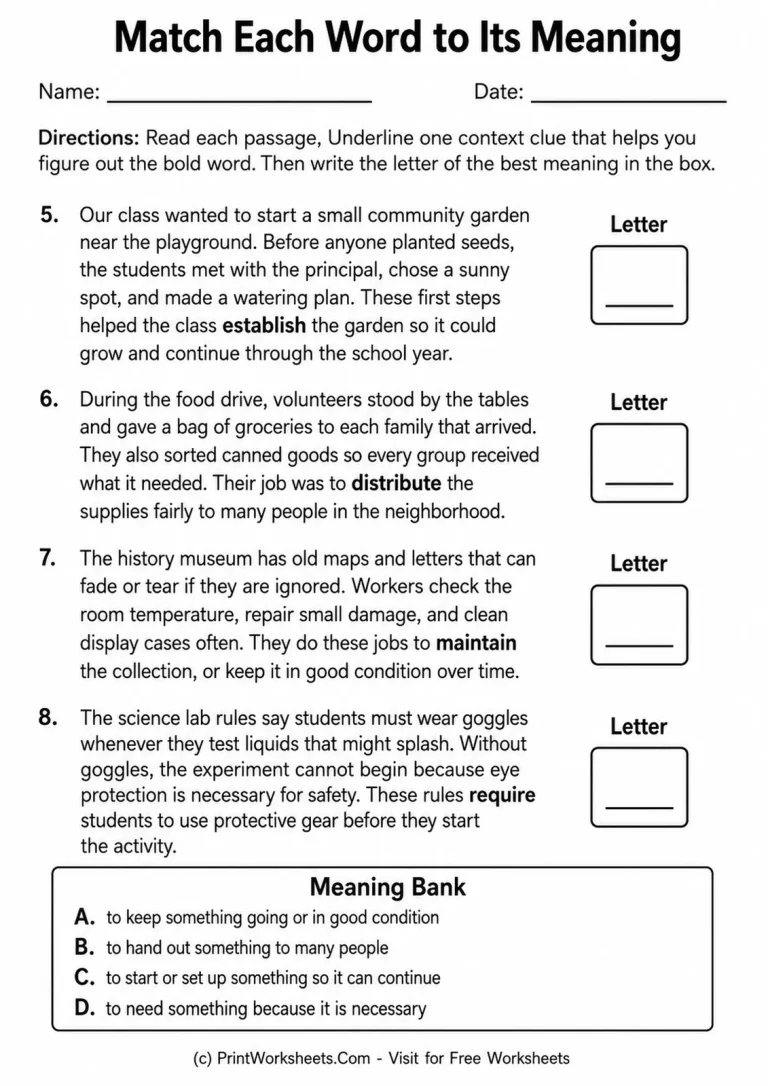
The second page removes the clue-type labels and asks students to make their own connections. Short passages feature establish, distribute, maintain, and require. Students underline one context clue and then match each target word to a definition in the Meaning Bank. The passages provide concrete support: establishing a garden is connected with the first steps needed to set it up, distributing supplies is shown through handing groceries to families, maintaining a museum collection is explained through keeping it in good condition, and requiring goggles is tied directly to something necessary for safety.
Choosing a meaning and proving it with text
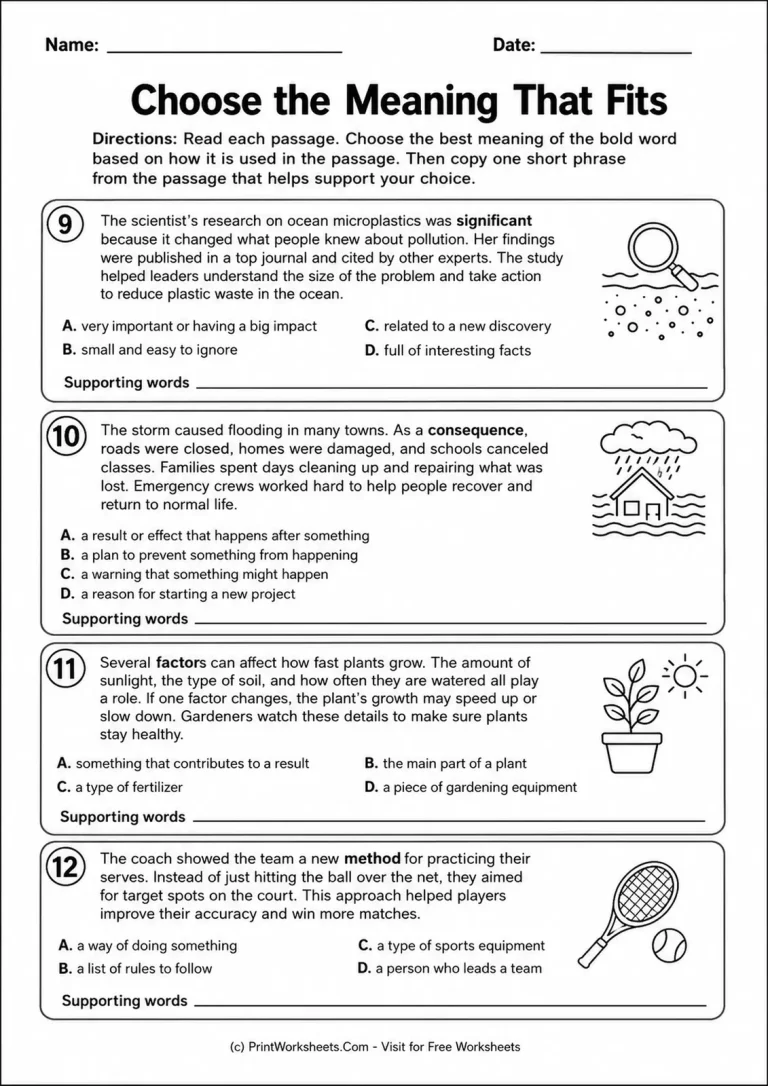
The third worksheet adds another layer of evidence. Students read passages about ocean microplastics, storm flooding, plant growth, and tennis practice while determining the meanings of significant, consequence, factors, and method. Each question includes four answer choices, but the task does not stop with selecting a letter. Students must also copy a short phrase from the passage that supports the choice. That combination encourages them to connect vocabulary decisions to specific language rather than relying only on a guess or a familiar-sounding definition.
Explaining meanings in the student’s own words
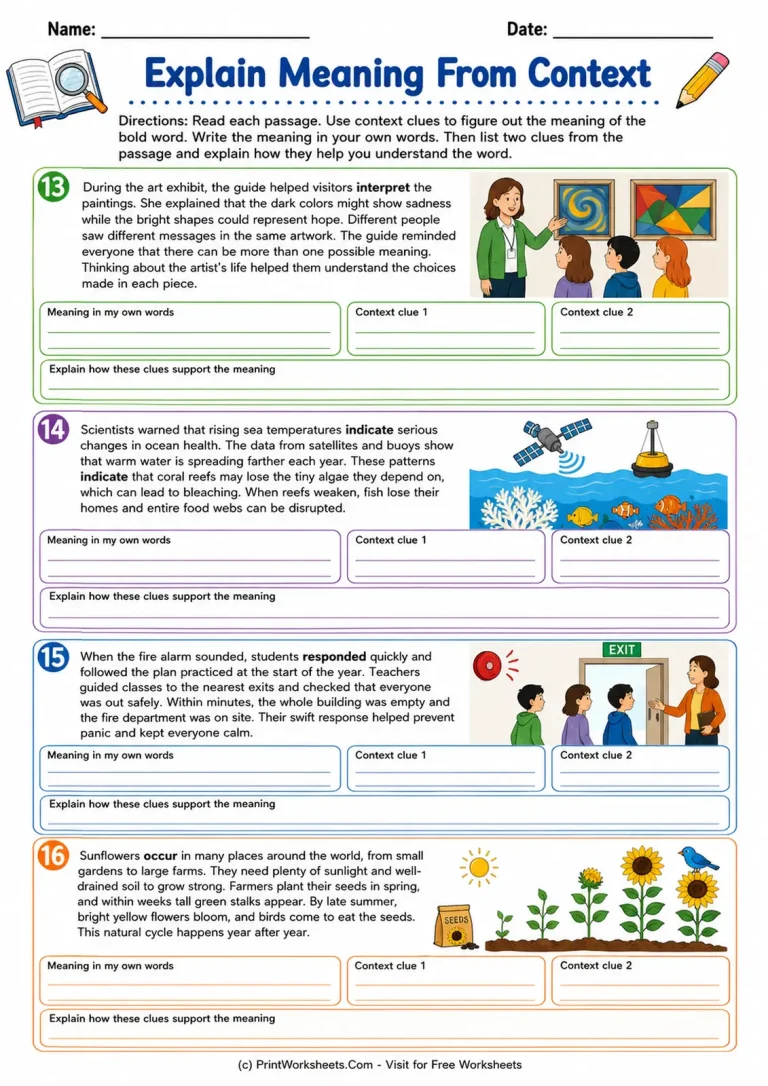
The final page shifts to open response. Students infer the meanings of interpret, indicate, responded, and occur in passages about an art exhibit, changing ocean conditions, a school fire alarm, and sunflower growth. For every passage, they write the meaning in their own words, record two context clues, and explain how those clues support the meaning. This format asks for more than recognition: students must show the reasoning that connects the passage details to the vocabulary word.
Why This Set Supports Grade 5 Reading Comprehension
Fifth-grade readers encounter academic vocabulary across science, social studies, literature, classroom directions, and informational texts. The passages in this set reflect that range. Students move from a plant experiment and a community garden to museum preservation, laboratory safety, ocean research, weather consequences, art interpretation, and natural growth cycles. That variety helps reinforce the idea that context-clue strategies are transferable across subjects rather than limited to a single reading unit.
The task sequence also separates several related reading behaviors. Students identify a clue, connect it to a probable meaning, distinguish the best definition from distractors, select supporting language, and eventually explain the relationship between evidence and meaning. Teachers can therefore see whether a learner is struggling with vocabulary itself, with locating relevant clues, or with explaining reasoning in writing.
Classroom and Home Use Ideas
Use the first page for teacher modeling or partner practice, especially when introducing definition, contrast, example, and sequence clues. The matching page can serve as independent practice after a mini-lesson. The multiple-choice page works well for a quick comprehension check because students must provide supporting words in addition to an answer choice. The open-response page is a useful follow-up when students are ready to explain their thinking more fully.
For extra support, have students highlight the bold word first and then mark only the sentence or phrase that gives the strongest clue. More confident readers can cover the answer choices on the multiple-choice page, predict a meaning before looking at the options, and then compare their wording with the choices. On the final page, students can discuss two possible clues with a partner before writing the explanation independently.
A Printable Sequence for Moving Beyond Guessing
Across the four worksheets, students repeatedly practice a simple but important habit: read around the unfamiliar word, notice what the passage reveals, and support the inferred meaning with evidence. By moving from labeled clue types to independent written explanations, the set gives Grade 5 readers several ways to practice academic vocabulary in context while strengthening close reading and evidence-based reasoning at the same time.