These Grade 5 function tables worksheets help students move from straightforward input-output rules to missing-value problems and multi-step algebraic thinking. The set begins with familiar operations such as adding, subtracting, multiplying, and dividing, then develops into rules written with variables and more demanding questions that require students to work backward. A final application page places function rules inside short real-world situations, giving learners practice deciding how a rule connects an input to an output.
Practice Function Tables from Basic Rules to Algebraic Thinking
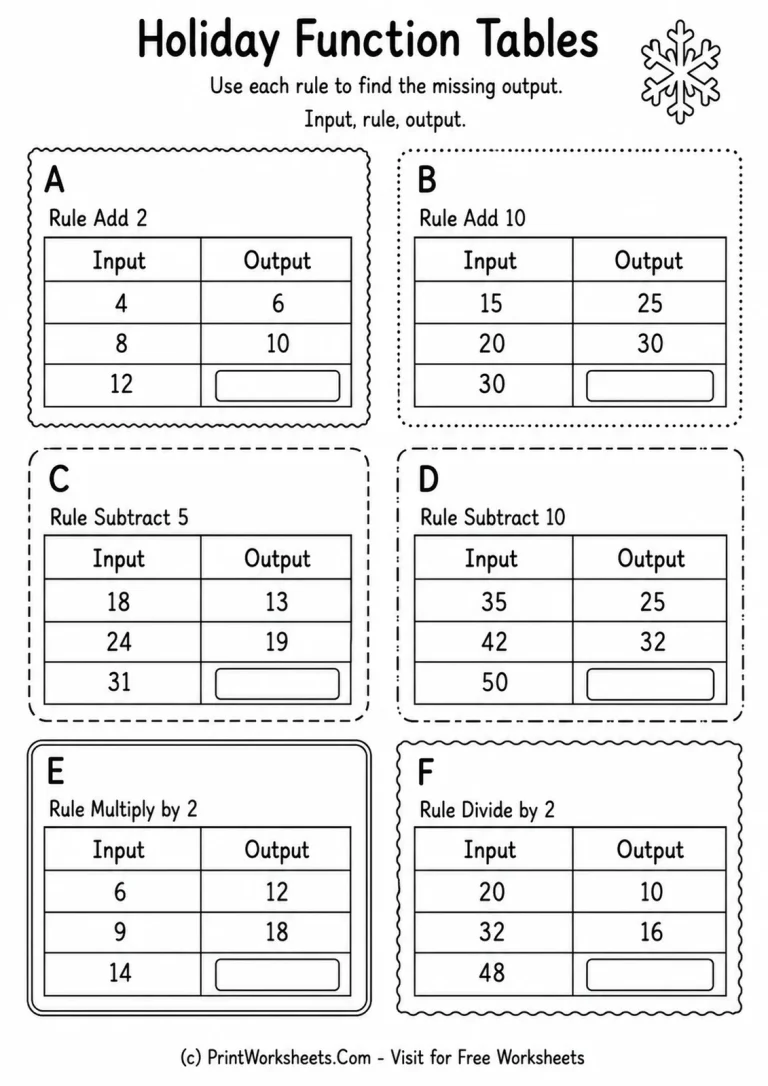
The first worksheet provides an accessible starting point for students who already understand the idea that a rule changes one number into another. Learners complete holiday-themed tables by applying rules such as Add 2, Add 10, Subtract 5, Subtract 10, Multiply by 2, and Divide by 2. Each table includes example input-output pairs before asking students to calculate a missing output. This structure makes the page useful as a warm-up, independent review, or quick check of whether students can follow a consistent numerical rule.
Because several operations appear on the same page, students must pay attention to the rule attached to each table rather than repeating one procedure automatically. That makes the activity useful for reinforcing operation sense while introducing the more general idea of a function: one defined rule connects every input to its corresponding output.
Find Missing Inputs and Outputs with Function Rules
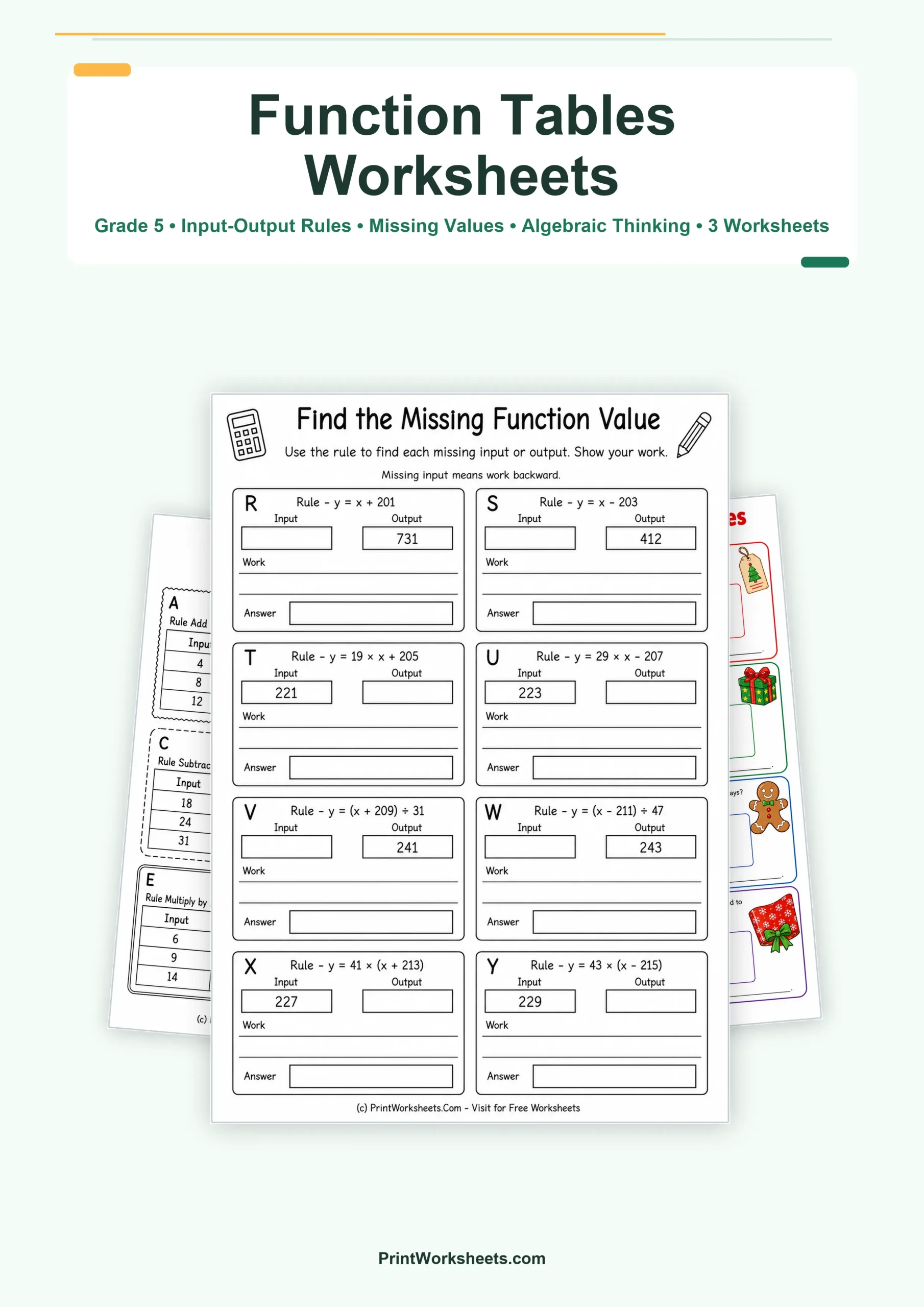
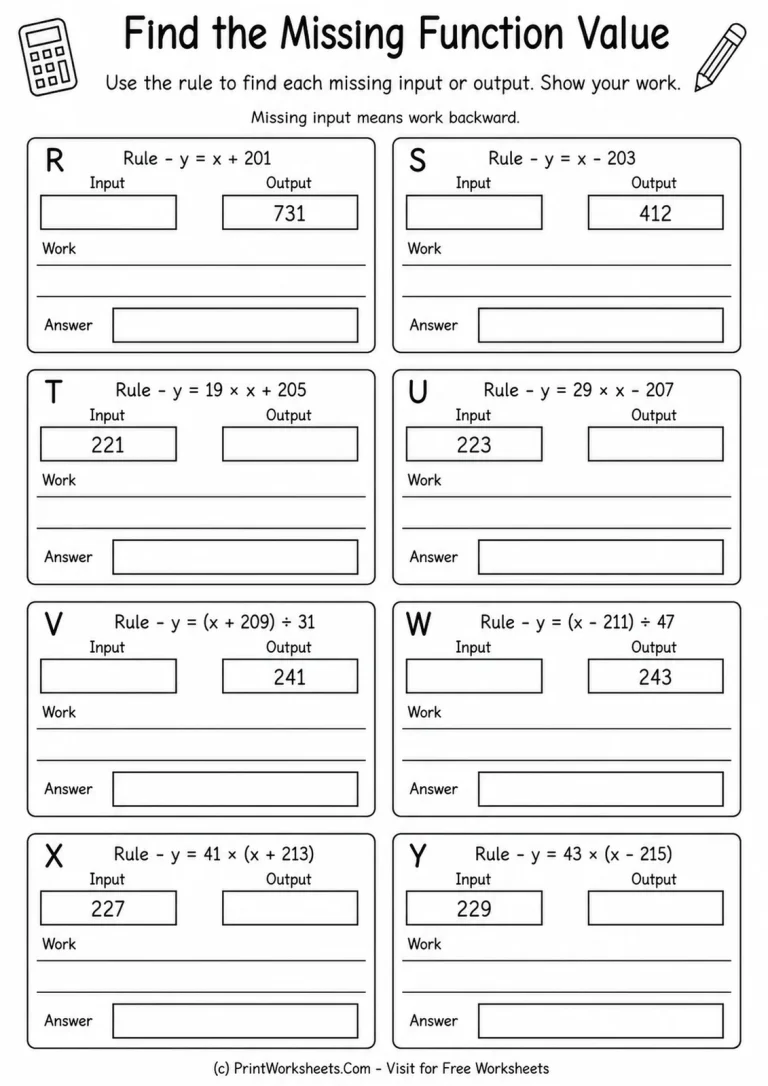
The next worksheet raises the level of challenge by presenting rules in algebraic form. Students work with functions including y = x + 201 and y = x – 203, along with more complex relationships that involve multiplication, subtraction, and grouped expressions. Some problems provide the input and ask for the output, while others provide the output and require students to determine the missing input.
Those missing-input questions are especially valuable for Grade 5 algebraic thinking because they require students to reverse the operation sequence. Instead of simply substituting a number and calculating forward, learners must identify which operations were performed and undo them in the correct order. Problems involving rules such as y = 19 × x + 205 and y = 29 × x – 207 encourage careful multi-step reasoning, while expressions built around structures such as 41 × (x + 213) and 43 × (x – 215) provide additional practice interpreting grouped operations.
Use Inverse Operations to Reason Backward
Working backward through a function strengthens the connection between arithmetic and early algebra. When students are given an output, they must ask what happened to the input and which inverse operation will undo each step. This supports later equation-solving skills without requiring formal symbolic equation procedures beyond the level of the worksheet. Teachers can also ask students to explain the reverse steps orally or in writing to check whether they understand why their missing input is correct.
Apply Function Rules in Word Problems
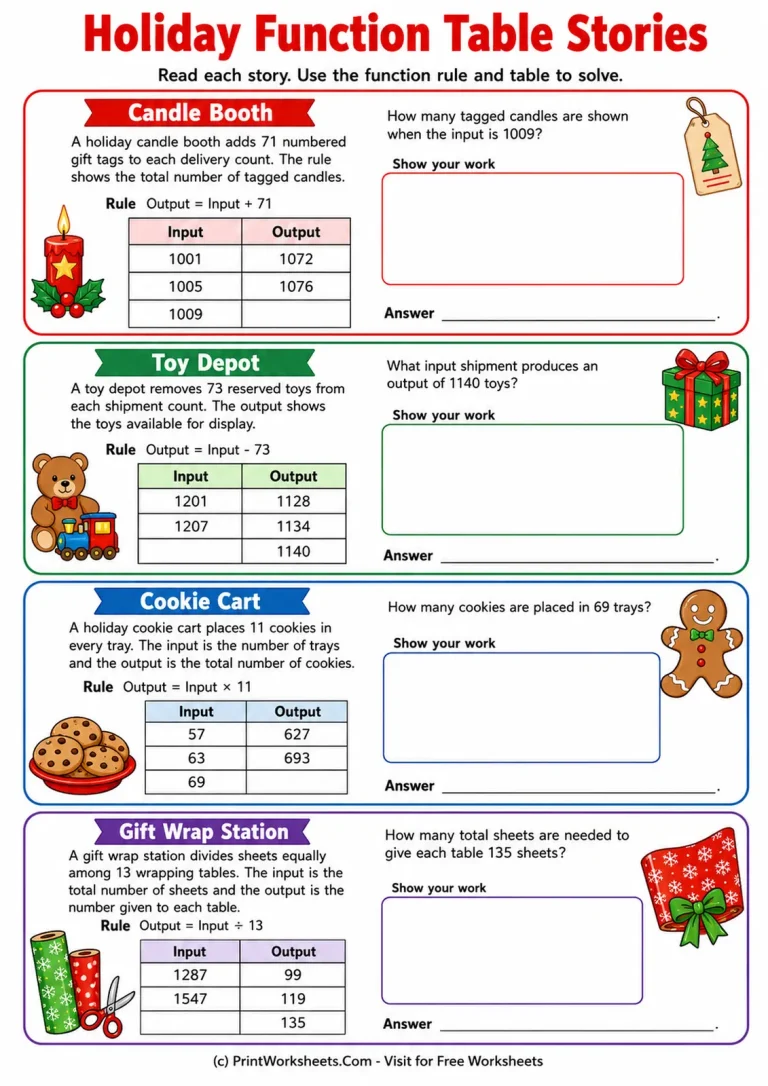
The final worksheet places function-table thinking inside four short story contexts: Candle Booth, Toy Depot, Cookie Cart, and Gift Wrap Station. Each situation gives students a numerical relationship and asks them to find a missing input or output. The contexts use addition, subtraction, multiplication, and division, so students must first understand the rule and then apply it to the information in the story.
This page is useful for showing that function tables are not isolated number puzzles. A function can represent a relationship between quantities in a practical situation, and the same forward or backward reasoning used in a table can be applied to a word problem. Requiring students to show their work also gives teachers and parents a clearer view of whether an incorrect answer came from misunderstanding the rule, choosing the wrong operation, or making a calculation error.
Ways to Use These Grade 5 Function Table Worksheets
The three worksheets work well as a short progression rather than three interchangeable practice pages. Start with the basic operation tables to review how input-output rules work. Continue with the algebraic missing-value page when students are ready to substitute values, follow multi-step rules, and use inverse operations. Finish with the story problems to check whether students can transfer the same ideas to contextual situations.
They can be used for classroom practice, math centers, homework, intervention, or additional work for students who need more experience with algebraic relationships. For stronger learners, ask for a written explanation of how a missing input was found or invite students to create a new input-output pair that follows one of the given rules. By progressing from simple tables to algebraic and contextual reasoning, this printable set gives Grade 5 students varied practice with an important foundation for later work with equations, variables, and functions.