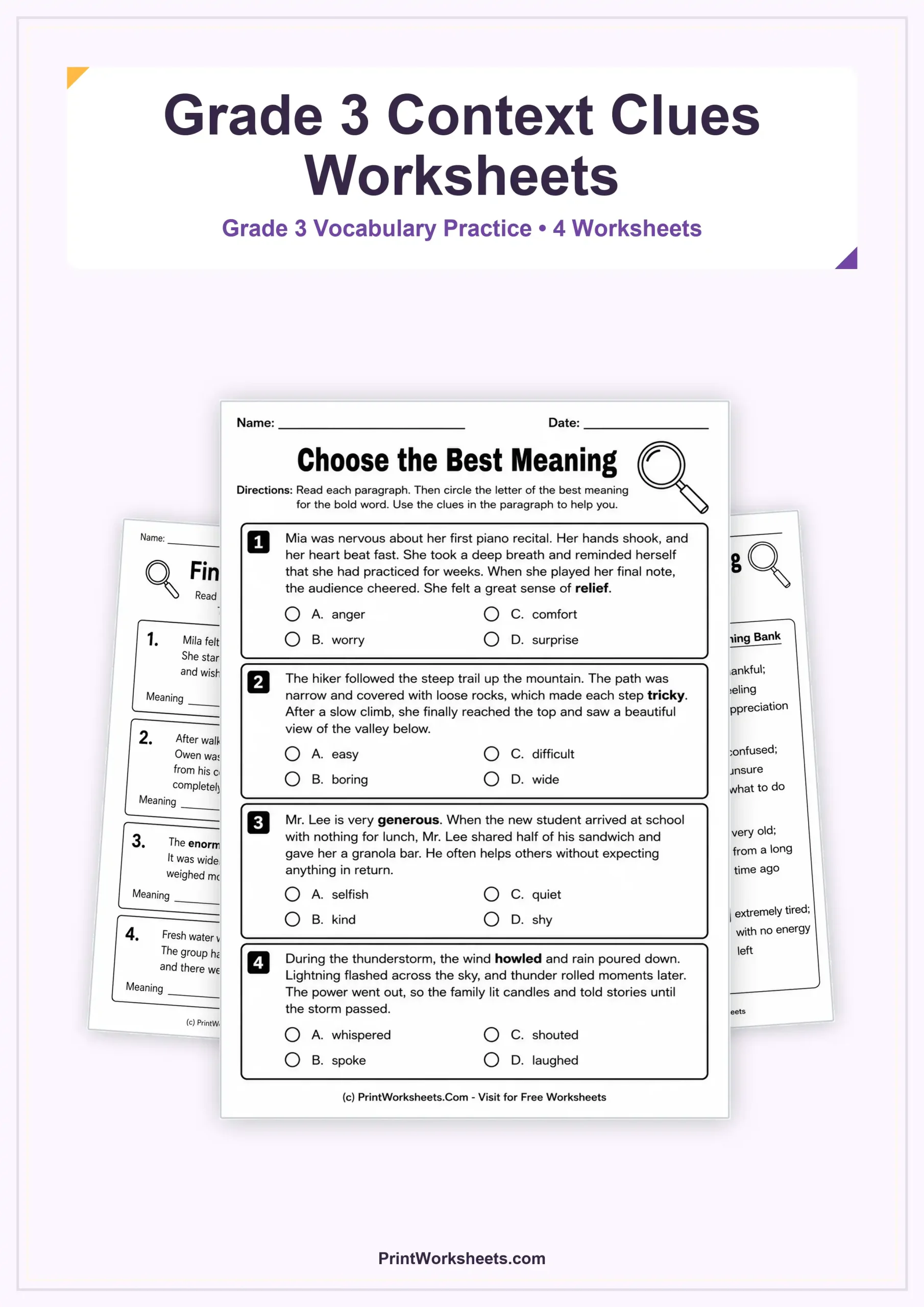
These grade 3 context clues worksheets give students repeated practice using information inside short paragraphs to determine the meaning of unfamiliar words. Rather than treating vocabulary as an isolated word-list task, each page asks readers to notice what is happening around a bold word and use those details to make a reasonable meaning choice. Across four printable activities, students move from locating helpful clues to explaining how specific evidence supports an inferred meaning.
Grade 3 Context Clues Worksheets with a Clear Skill Progression
The four worksheets vary the response format while keeping the same core reading skill in focus. This makes the set useful for introducing context clues, providing independent practice, or checking whether students can apply the strategy without heavy prompting. The sequence also increases the amount of thinking students must show as they work through the pages.
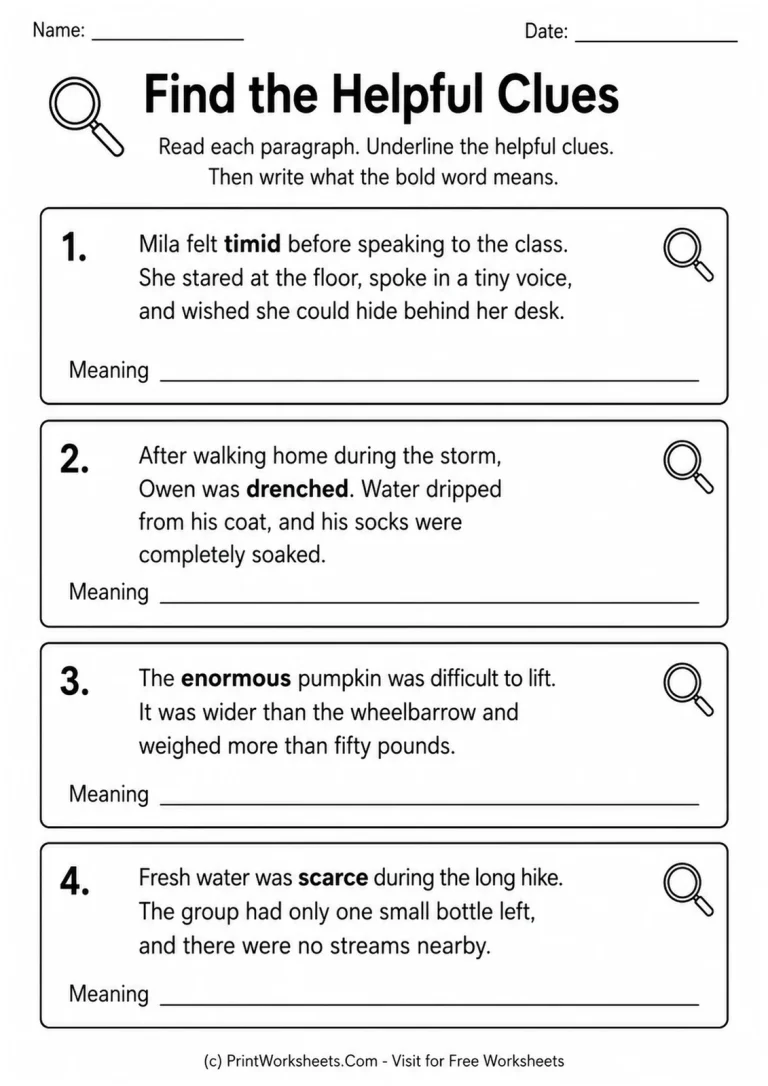
Find the Helpful Clues
The first worksheet asks students to read four short paragraphs, underline the words or phrases that provide useful context, and then write the meaning of each bold word. The target vocabulary includes timid, drenched, enormous, and scarce. Because students must mark the supporting clues before defining the word, the activity makes the reasoning process visible. Teachers can quickly see whether a student is using information from the paragraph or simply guessing from prior knowledge.
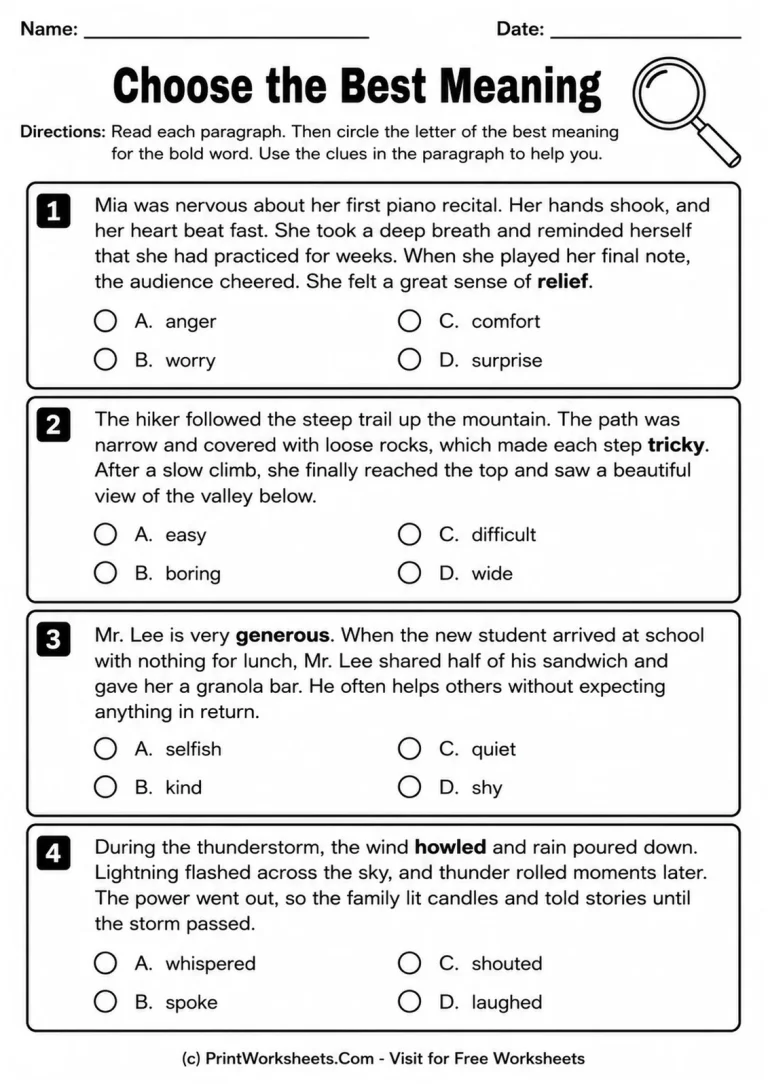
Choose the Best Meaning
The second page shifts to four paragraph-based multiple-choice questions. Students circle the best meaning for each bold word by comparing the answer choices with the surrounding details. Words include relief, tricky, generous, and howled. The short scenarios provide concrete reading situations, including feeling relief after a piano recital and describing a steep, rocky trail as tricky. This format is helpful for teaching students to reject choices that may sound possible in isolation but do not fit the paragraph.
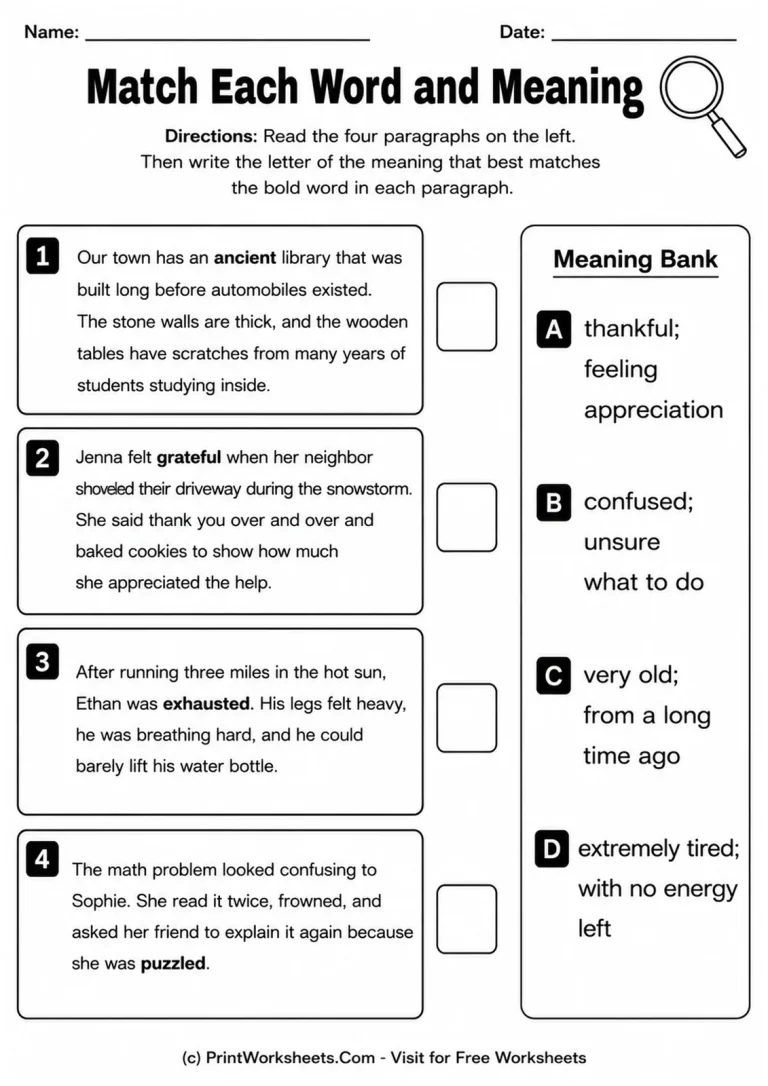
Match Words to a Meaning Bank
On the third worksheet, students read four paragraphs and match each bold word to one definition in an A-D meaning bank. The vocabulary words are ancient, grateful, exhausted, and puzzled. Matching gives students some support while still requiring careful reading. They must connect the context in each paragraph with the most accurate definition and keep track of several possible meanings at once.
Explain the Clue Evidence
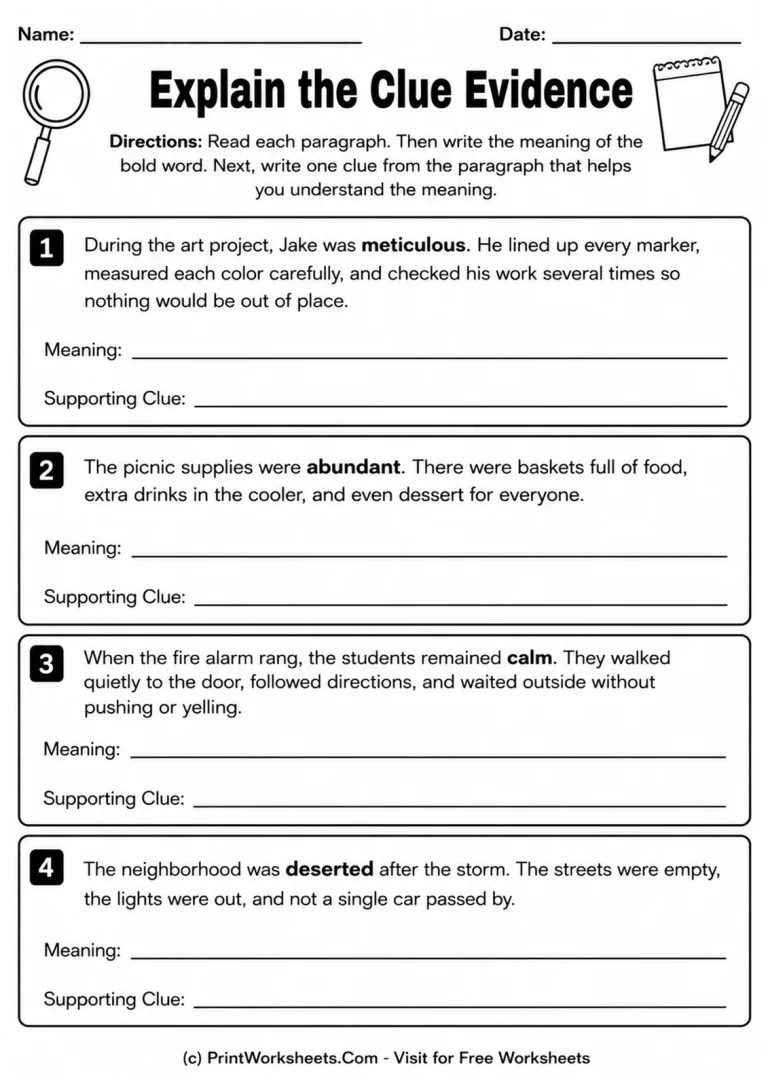
The final worksheet asks for a more independent constructed response. Students determine the meaning of each bold word and then write one clue from the paragraph that supports their thinking. The words meticulous, abundant, calm, and deserted encourage students to move beyond identifying an answer and explain why that answer makes sense. This page is especially useful as a brief assessment because it checks both vocabulary inference and the ability to cite relevant textual evidence.
Teaching Context Clues Through Short Paragraphs
Before students begin, model a simple routine: read the entire paragraph, identify details connected to the unfamiliar word, think of a meaning that fits those details, and reread the sentence with the inferred meaning in place. Encourage students to ask whether the replacement meaning keeps the paragraph logical. This prevents them from choosing a definition based only on one nearby word.
For guided practice, complete one paragraph together and have students explain which phrase helped most. During independent work, require students to underline or point to the clue before recording an answer. When reviewing responses, focus discussion on the evidence used rather than only whether the final definition is correct.
Differentiation, Review, and Extension Ideas
Students who need extra support can complete the multiple-choice or meaning-bank activities first, then return to the open-response pages. Read a paragraph aloud and pause after each sentence so students can identify details that build the meaning. More confident readers can cover the answer choices or meaning bank and propose a definition before checking the provided options.
For an extension, ask students to write a new sentence or short paragraph using one target word with enough clues for a classmate to infer its meaning. Another option is to have students compare two clues from the same paragraph and decide which one provides stronger evidence.
Quick Exit Ticket
Finish the lesson with a two-part exit ticket: give students one unfamiliar word in a short paragraph and ask them to write both a likely meaning and the exact clue that helped them decide. This mirrors the strongest skill in the worksheet set and gives teachers a quick view of who can independently connect vocabulary meaning to textual evidence.
Used as a short sequence, these worksheets help third graders practice a flexible strategy they can carry into stories, informational passages, science reading, and other vocabulary-rich texts. The changing activity formats keep the practice varied while consistently reinforcing the same goal: use the paragraph itself as evidence for word meaning.