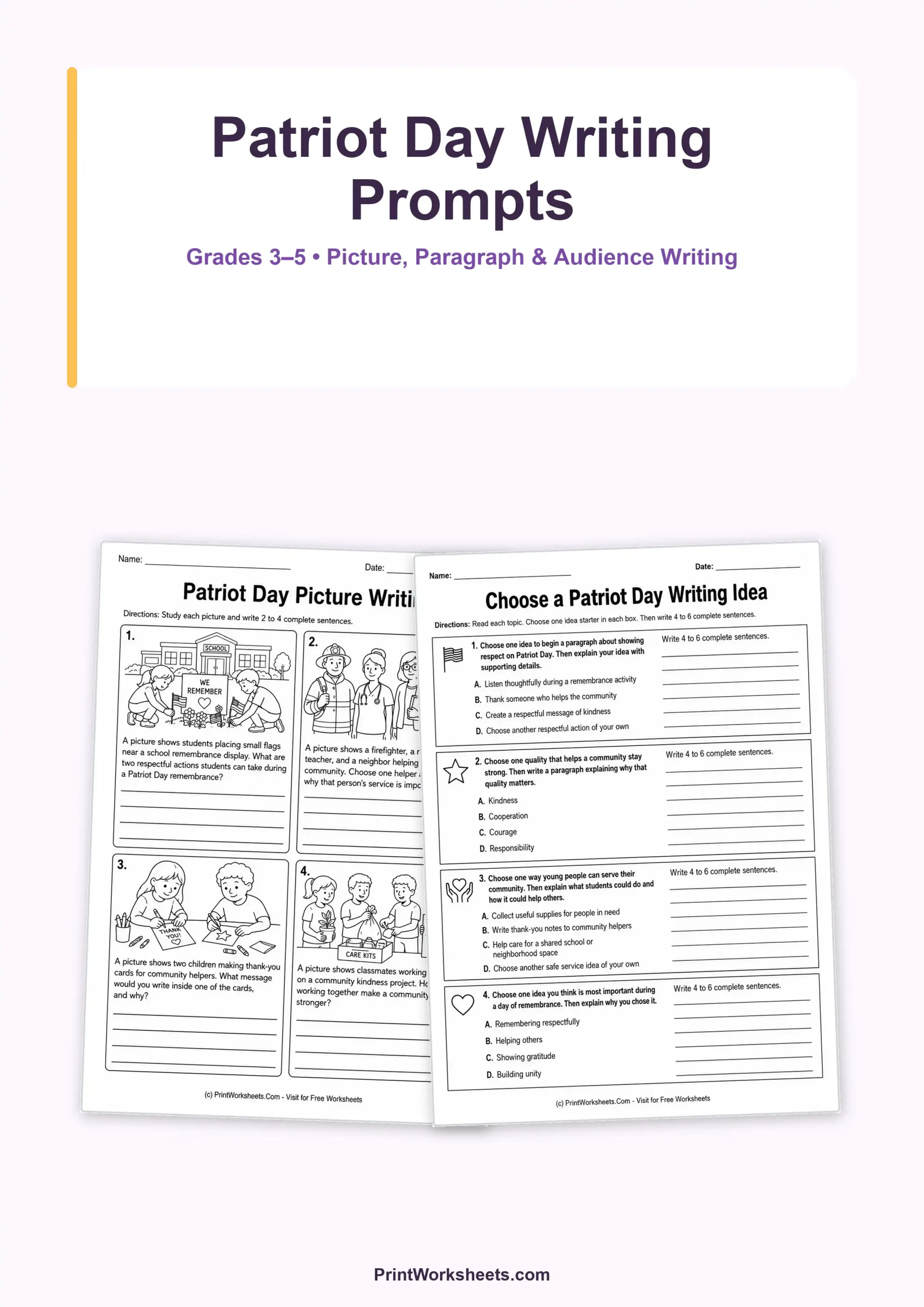
These Patriot Day writing prompts give students in Grades 3–5 three different reasons to put their own ideas into words. Instead of repeating one generic journal question, the printable worksheets move from picture-supported responses to structured paragraph choices and then to writing for a specific audience. Students write about respectful remembrance, community helpers, gratitude, kindness, service, cooperation, and unity while practicing complete sentences, supporting details, and purposeful communication.
Patriot Day writing prompts begin with visual ideas
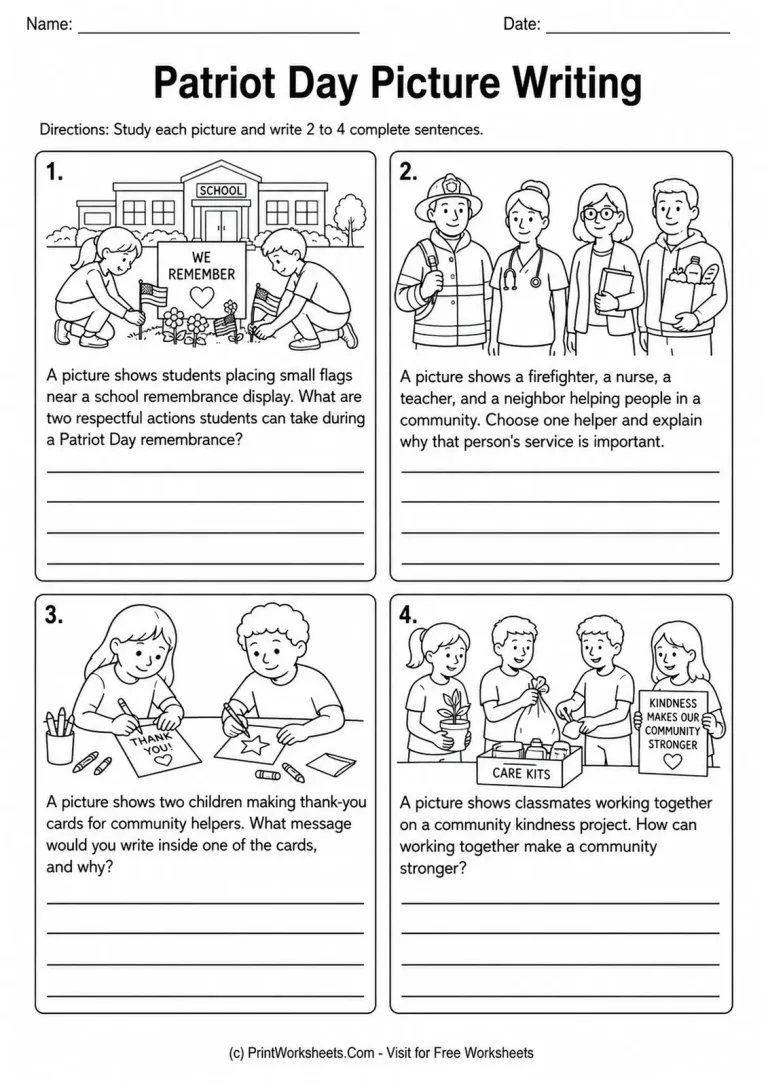
Patriot Day Picture Writing contains four illustrated situations, each followed by space for two to four complete sentences. In the first scene, children place small flags near a school remembrance display, and students describe two respectful actions people could take during a Patriot Day remembrance. Another scene shows a firefighter, nurse, teacher, and neighbor. Writers choose one helper and explain why that person’s service is important.
The other two picture prompts shift toward gratitude and cooperation. Students decide what message they would place inside a thank-you card for a community helper and explain why they chose it. They also look at classmates working together on a kindness project and explain how cooperation can make a community stronger. The pictures provide enough concrete context to start writing while leaving the actual message, examples, and reasoning to the student.
Choosing an idea and developing it with details
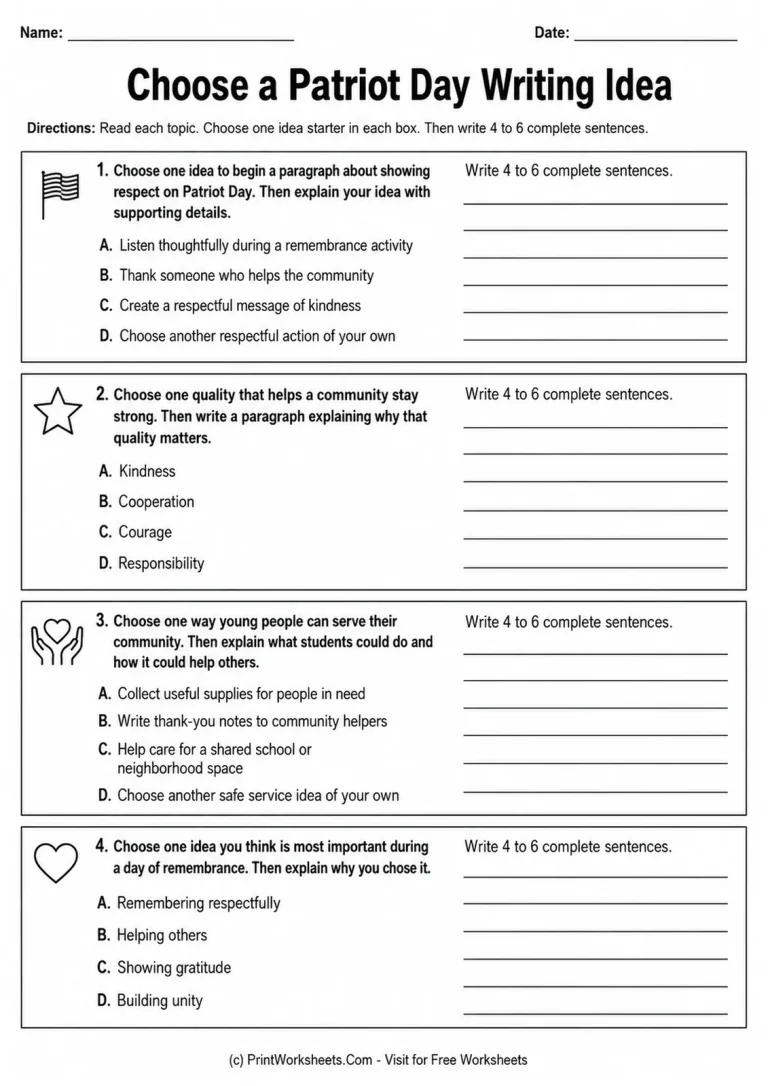
Choose a Patriot Day Writing Idea increases the writing load to four to six complete sentences. Each of its four sections gives students a focused topic plus several possible starting ideas. For a paragraph about respect, students might write about listening thoughtfully during a remembrance activity, thanking a community helper, creating a respectful message, or choosing another appropriate action of their own.
A second prompt asks students to select kindness, cooperation, courage, or responsibility and explain why that quality helps a community stay strong. The service section offers concrete possibilities such as collecting useful supplies for people in need, writing thank-you notes, or caring for a shared school or neighborhood space. The final topic asks writers to choose which idea matters most during a day of remembrance: remembering respectfully, helping others, showing gratitude, or building unity. These choices reduce the difficulty of getting started without turning the task into fill-in-the-blank writing.
Writing for a real audience changes the message
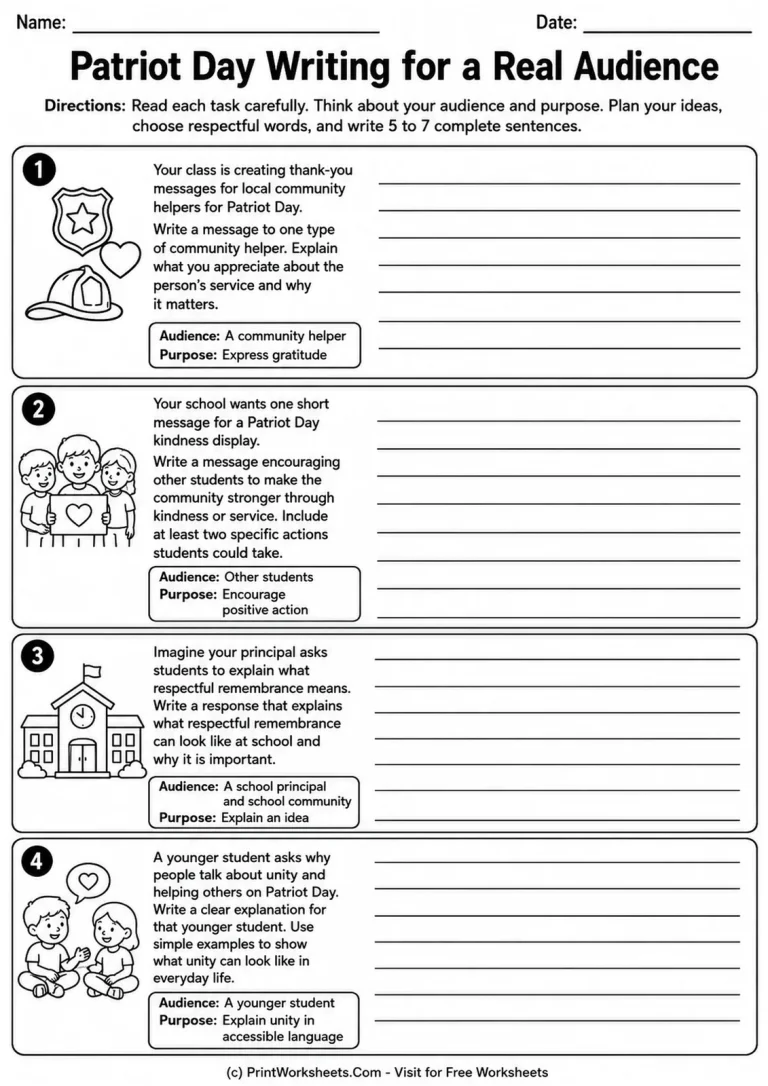
The most advanced worksheet, Patriot Day Writing for a Real Audience, asks students to write five to seven complete sentences and makes both audience and purpose explicit. One task asks for a thank-you message to a community helper, with the purpose of expressing gratitude and explaining why that person’s service matters. Another asks students to address their classmates and encourage at least two specific acts of kindness or service.
The audience changes again in the third prompt. Students imagine that their principal wants an explanation of what respectful remembrance can look like at school and why it is important. The final task is written for a younger student who wants to understand why people talk about unity and helping others on Patriot Day. Writers are told to use simple examples and accessible language. These shifts encourage students to think about tone, vocabulary, examples, and the amount of explanation a particular reader needs.
A writing progression built around purpose
The three approved worksheets form a useful progression without forcing every student into the same kind of response. Picture prompts make the first step concrete. Choice-based topics then require students to select a position or idea and support it across a short paragraph. Authentic-audience prompts add another layer by asking writers to adapt their message for community helpers, classmates, school leaders, and younger children.
The set is designed for original responses, so there is no single-answer teacher key. Teachers can instead look for complete thoughts, relevant supporting details, respectful language, and evidence that the student considered the stated purpose. For a companion activity that shifts from generating original writing to reading and responding to text, the Patriot Day reading comprehension passages provide a distinct literacy option for the same grade range.