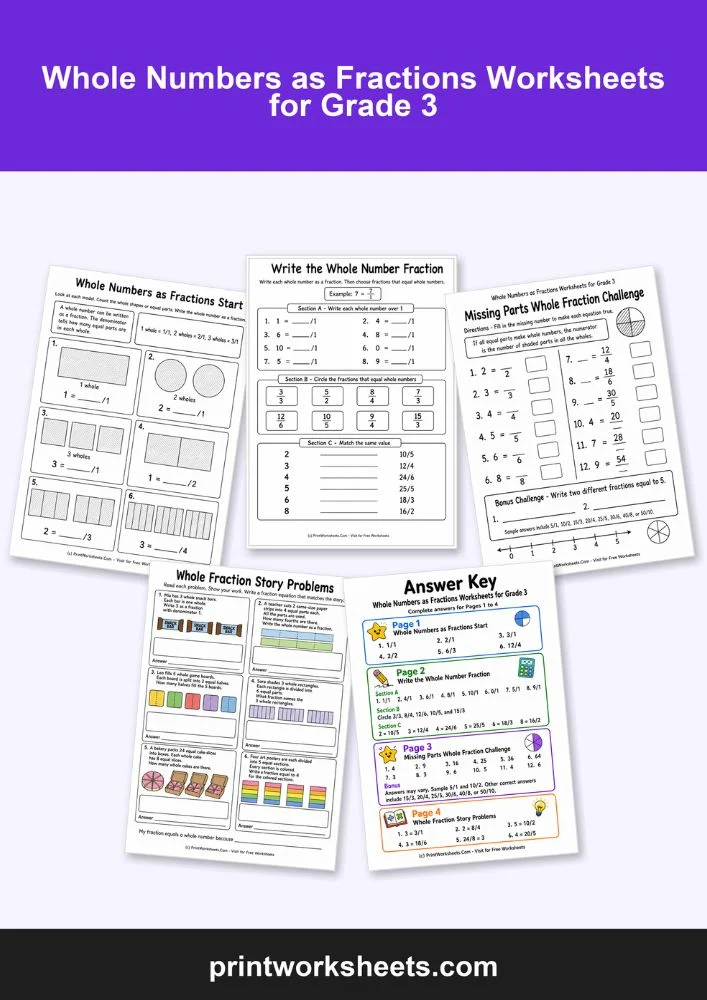
These whole numbers as fractions worksheets for grade 3 include two student pages with 28 tasks. The first page, Whole Numbers as Fractions Start, contains six shaded visual models. The second page, Write the Whole Number Fraction, contains 22 writing, selection, and matching tasks. Students count complete wholes, write numbers such as 1, 2, and 3 as fractions, circle fractions that equal whole numbers, and connect values such as 4 with 24/6.
The worksheets begin with the basic rule that a whole number can be written as a fraction with denominator 1. They then extend that idea by showing that a complete whole divided into equal parts can also be represented by fractions such as 2/2, 6/3, and 12/4.
Whole Numbers as Fractions Worksheets for Grade 3
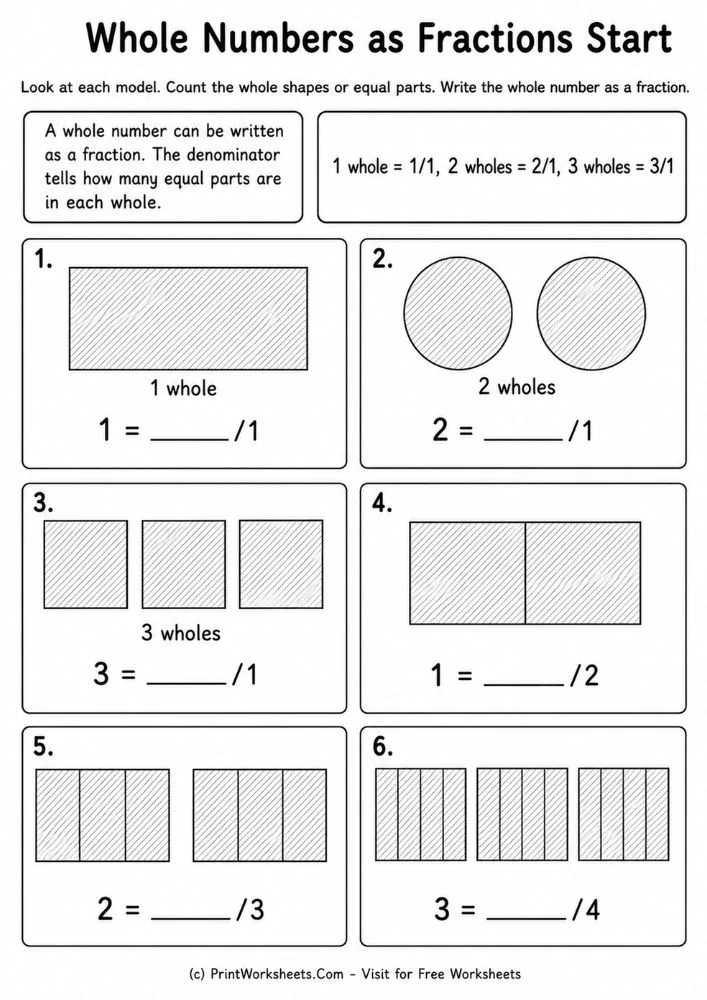
The visual starting page contains six large model cards. The first three cards show one shaded rectangle, two shaded circles, and three shaded squares. Students complete equations that represent these models as 1/1, 2/1, and 3/1.
The next three cards keep the same whole-number values but change the denominator. One complete rectangle is divided into two equal parts, two rectangles are divided into thirds, and three rectangles are divided into fourths. Students count every shaded equal part and complete equations including 1 = 2/2, 2 = 6/3, and 3 = 12/4.
This progression helps students see that the numerator counts all included equal parts, while the denominator shows the number of equal parts in each whole. The fraction bar does not automatically mean that the value is less than one.
Related fraction review: Use the unit fractions on number lines worksheets for grade 3 to review how denominators describe equal parts before representing complete wholes.
Write Each Whole Number with a Denominator of One
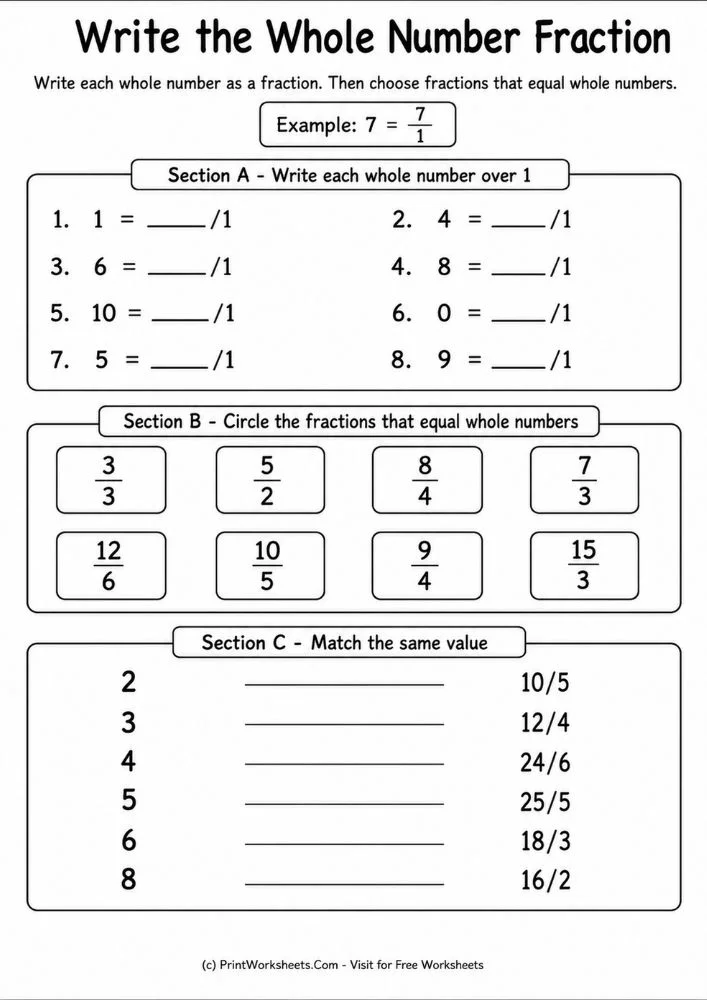
The second worksheet begins with eight direct equations. Students rewrite the whole numbers 1, 4, 6, 8, 10, 0, 5, and 9 as fractions with denominator 1. A printed example shows 7 = 7/1, giving students a clear response format before they begin.
Including zero allows students to apply the same fraction structure to 0/1. The activity remains focused on writing the numerator that preserves the value of the printed whole number.
Identify Fractions That Equal Complete Whole Numbers
Section B presents eight fraction cards. Students circle the fractions that have whole-number values. The choices include 3/3, 5/2, 8/4, 7/3, 12/6, 10/5, 9/4, and 15/3. Students must evaluate each fraction rather than selecting cards only because the numerator and denominator match.
The correct choices represent several different whole-number values. For example, 3/3 equals 1, 8/4 equals 2, and 15/3 equals 5. The nonexamples provide a contrast with fractions that do not divide evenly.
Match Whole Numbers with Equivalent Fractions
The final section lists the whole numbers 2, 3, 4, 5, 6, and 8 beside six shuffled fractions. Students draw matching lines between pairs such as 2 and 10/5, 3 and 12/4, 5 and 25/5, and 8 and 16/2.
This matching format asks students to use division and fraction equivalence instead of copying a numerator over 1. It also demonstrates that the same whole number can be represented with many numerator-and-denominator combinations.
Continue practicing: The equivalent fractions with area models worksheets for grade 3 help students compare different fraction models that represent the same value.
A Two-Page Teaching Sequence
- Begin with the shaded models: Ask students to count the wholes and then count all shaded equal parts.
- Move to denominator 1: Use the direct equations to establish the whole-number-over-one pattern.
- Check whole-number values: Have students divide the numerator by the denominator before circling each choice.
- Finish with matching: Students connect six whole numbers with equivalent fractions written using different denominators.
The two pages can be used together for a focused lesson or separately for visual introduction and independent fraction practice.