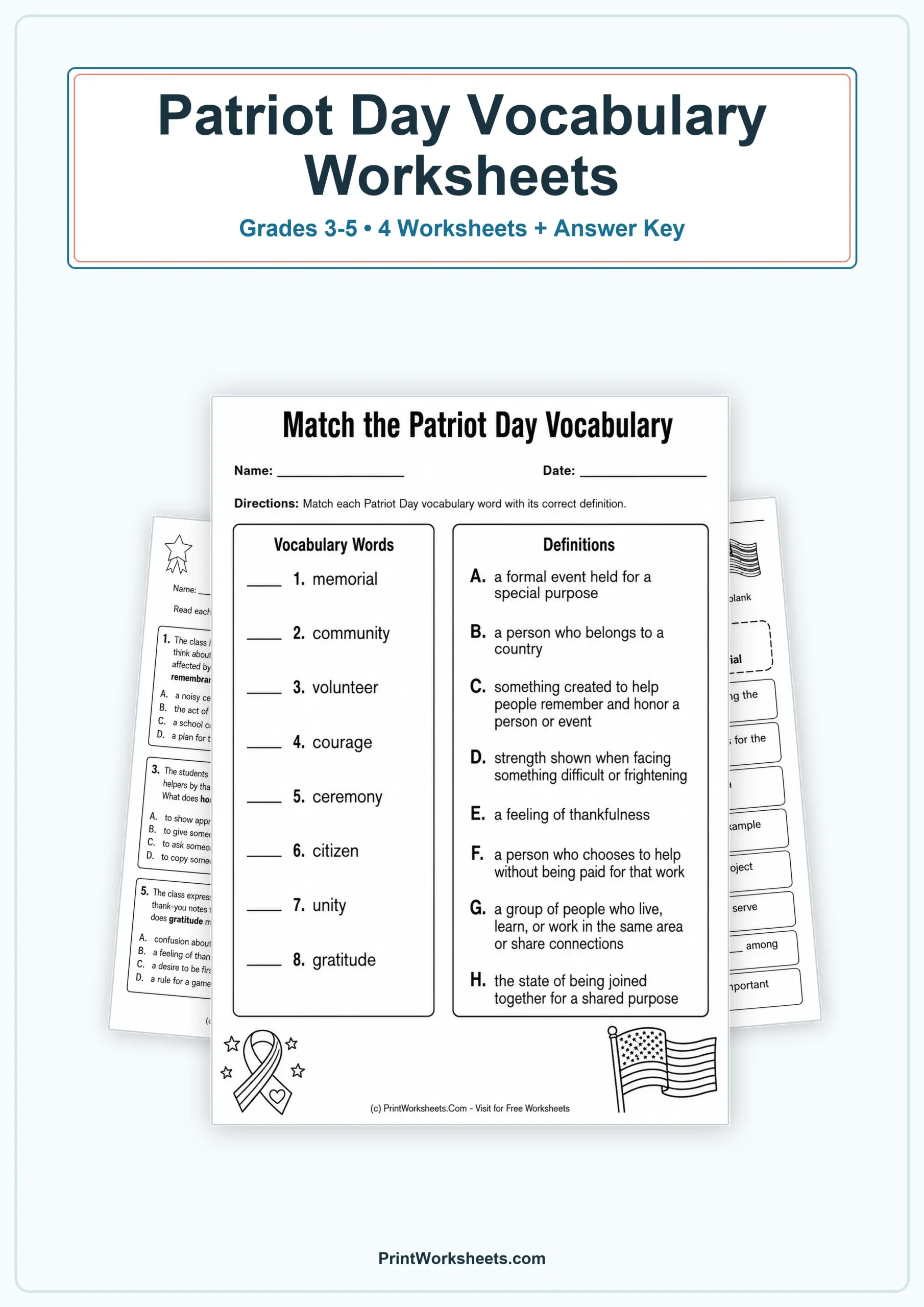
These Patriot Day vocabulary worksheets give students in Grades 3-5 repeated, purposeful practice with words connected to remembrance, community, service, and civic responsibility. Rather than presenting a list for simple memorization, the four student pages move important terms through context clues, definition matching, sentence completion, and a short reading passage. Students encounter words such as remembrance, respect, honor, service, gratitude, unity, memorial, volunteer, ceremony, courage, community, and citizen in several different language situations, helping them connect definitions with actual usage.
Four Different Patriot Day Vocabulary Tasks
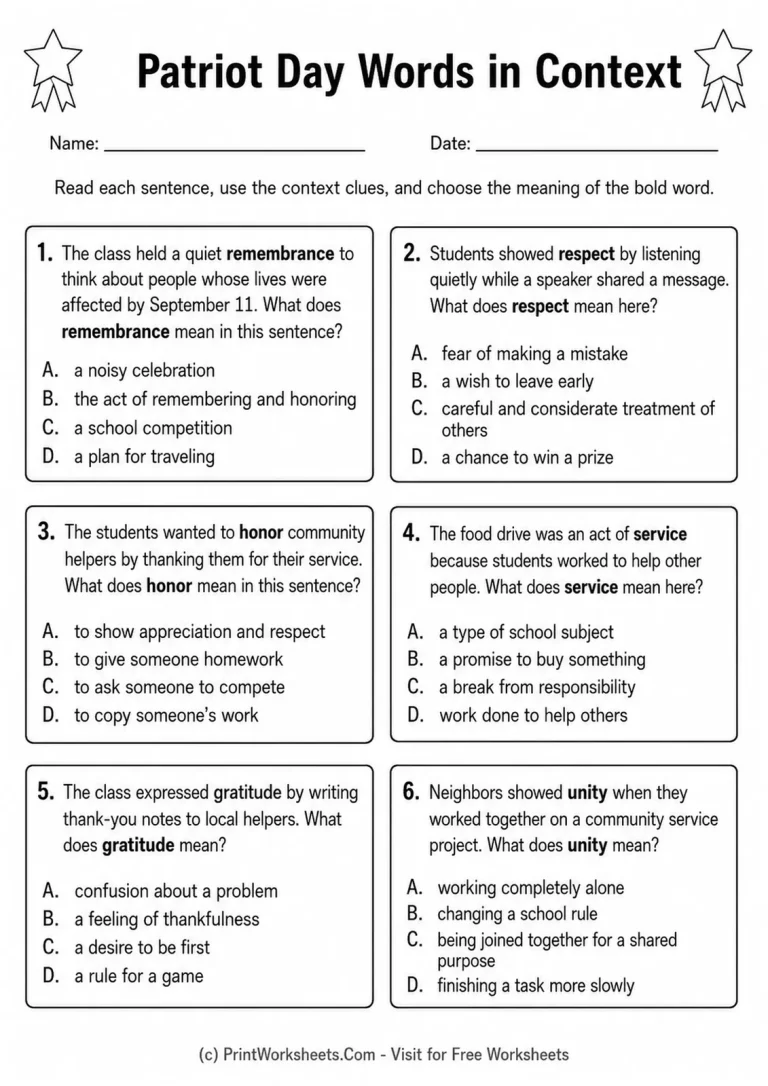
The first worksheet begins with six multiple-choice context-clue questions. Students read short situations about a quiet remembrance, respectful listening, honoring community helpers, a food drive, thank-you notes, and neighbors working together. Each question asks for the meaning of a bold word. This format requires students to use the surrounding sentence instead of relying only on memorized definitions, making it a useful introduction or quick assessment of vocabulary understanding.
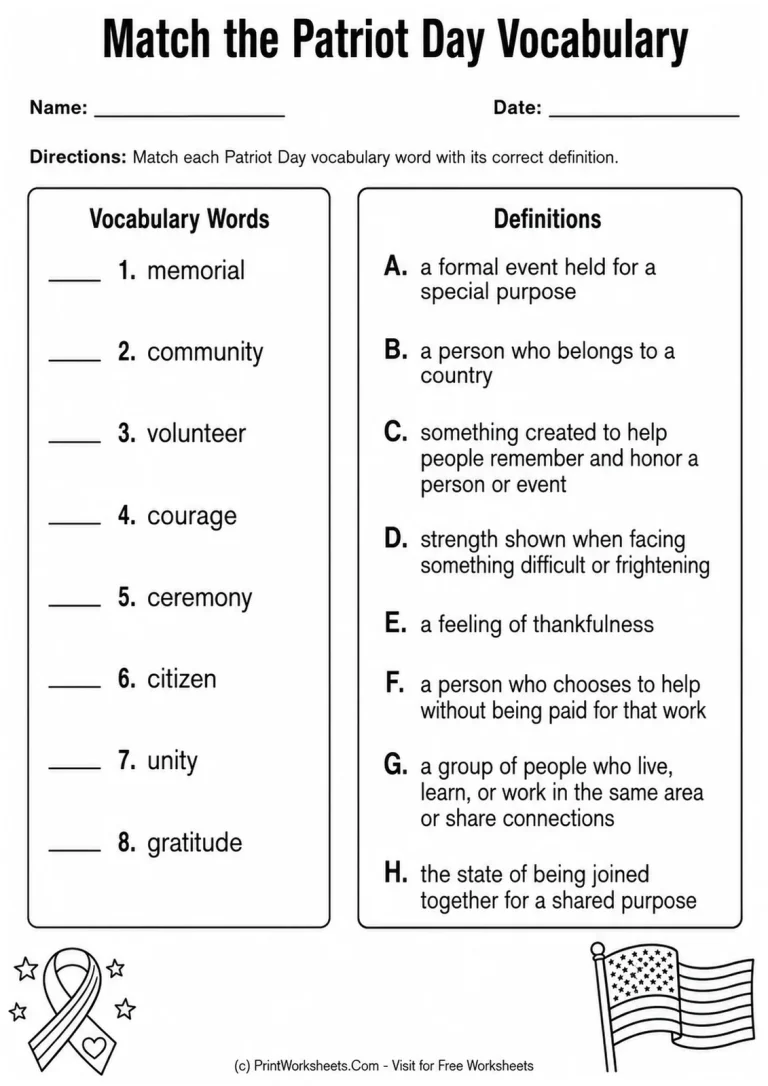
The second worksheet changes the task completely. Students match eight words with definitions labeled A through H. The set includes memorial, community, volunteer, courage, ceremony, citizen, unity, and gratitude. Definitions are written in student-friendly language, such as a person who chooses to help without being paid, strength shown when facing something difficult or frightening, and something created to help people remember and honor a person or event. The matching format gives learners a direct way to confirm precise meanings before moving into sentence-level application.
Patriot Day vocabulary worksheets move from recognition to use
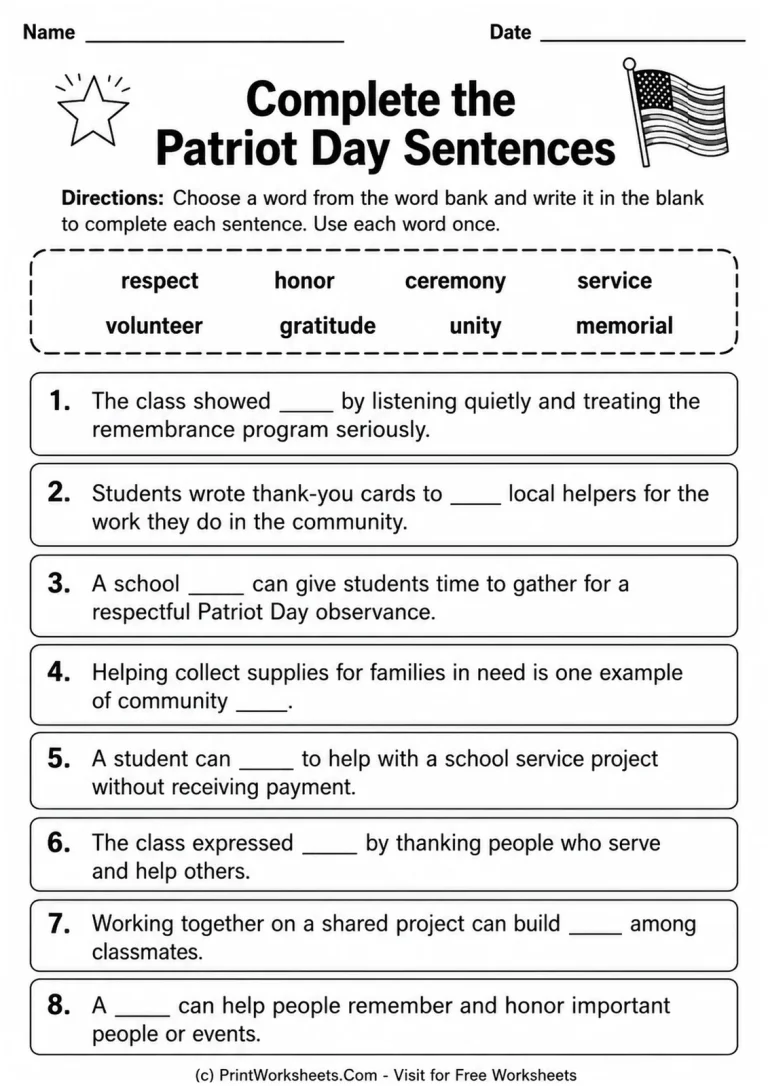
On the third worksheet, students choose from a word bank to complete eight sentences and use each word once. That change raises the level of thinking because students must consider both meaning and grammar. They decide which term correctly completes sentences about showing respect during a remembrance program, honoring local helpers, attending a school ceremony, doing community service, volunteering without payment, expressing gratitude, building unity, and understanding the purpose of a memorial. The word bank provides support while still requiring careful discrimination among related concepts.
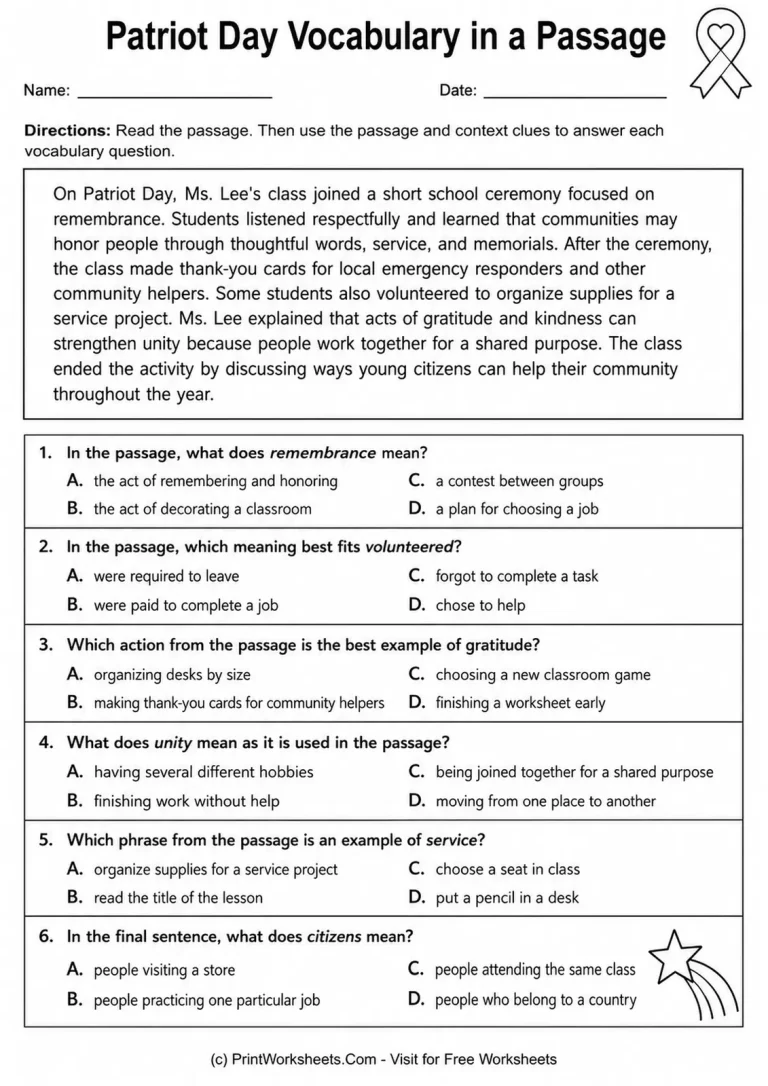
The fourth student page brings several terms together inside a connected passage about Ms. Lee’s class. Students read about a short school ceremony focused on remembrance, thoughtful words, service and memorials, thank-you cards for emergency responders, volunteers organizing supplies, gratitude, unity, and young citizens helping their community. Six multiple-choice questions then ask students to interpret vocabulary meanings and identify examples from the passage. This makes the final page especially useful for checking whether students can transfer word knowledge from isolated activities into authentic reading.
Repeated Words Appear in New Contexts
The packet gains value from purposeful repetition rather than duplicate exercises. Gratitude and unity are encountered through definitions, sentence examples, and passage questions. Volunteer first appears as a noun in the matching activity, then as a verb in a sentence, and finally as volunteered in the reading passage. Students therefore see that knowing a vocabulary word means more than recalling one definition; they also need to recognize how the word functions and what it means within different sentences.
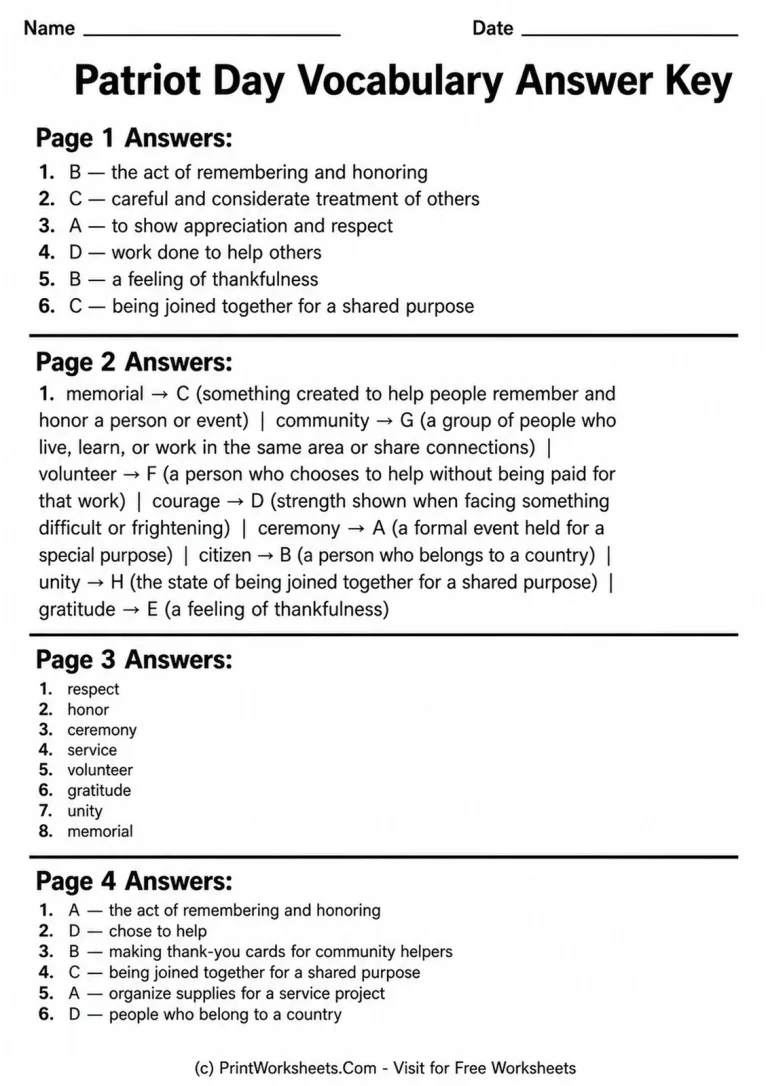
This sequence can fit into an upper-elementary literacy lesson, social studies block, independent practice period, vocabulary center, or short Patriot Day unit. Teachers can assign the pages in order or choose the activity type that best matches current instruction. The included answer key covers all four student worksheets and makes review straightforward.
Extend the Vocabulary Work into Reading and Writing
Students ready for longer texts can continue with the Patriot Day reading comprehension passages, where remembrance, service, respect, and community ideas are developed through broader comprehension tasks. Older students can connect vocabulary with chronology through the Patriot Day facts and timeline worksheets. For student-generated language practice, the Patriot Day writing prompts provide a separate opportunity to apply respectful topic language in original responses.
Across the four student pages, learners progress from identifying meanings to selecting precise words and interpreting them in connected text. That structure gives the set a clear instructional purpose while keeping each worksheet different enough to provide meaningful additional practice.