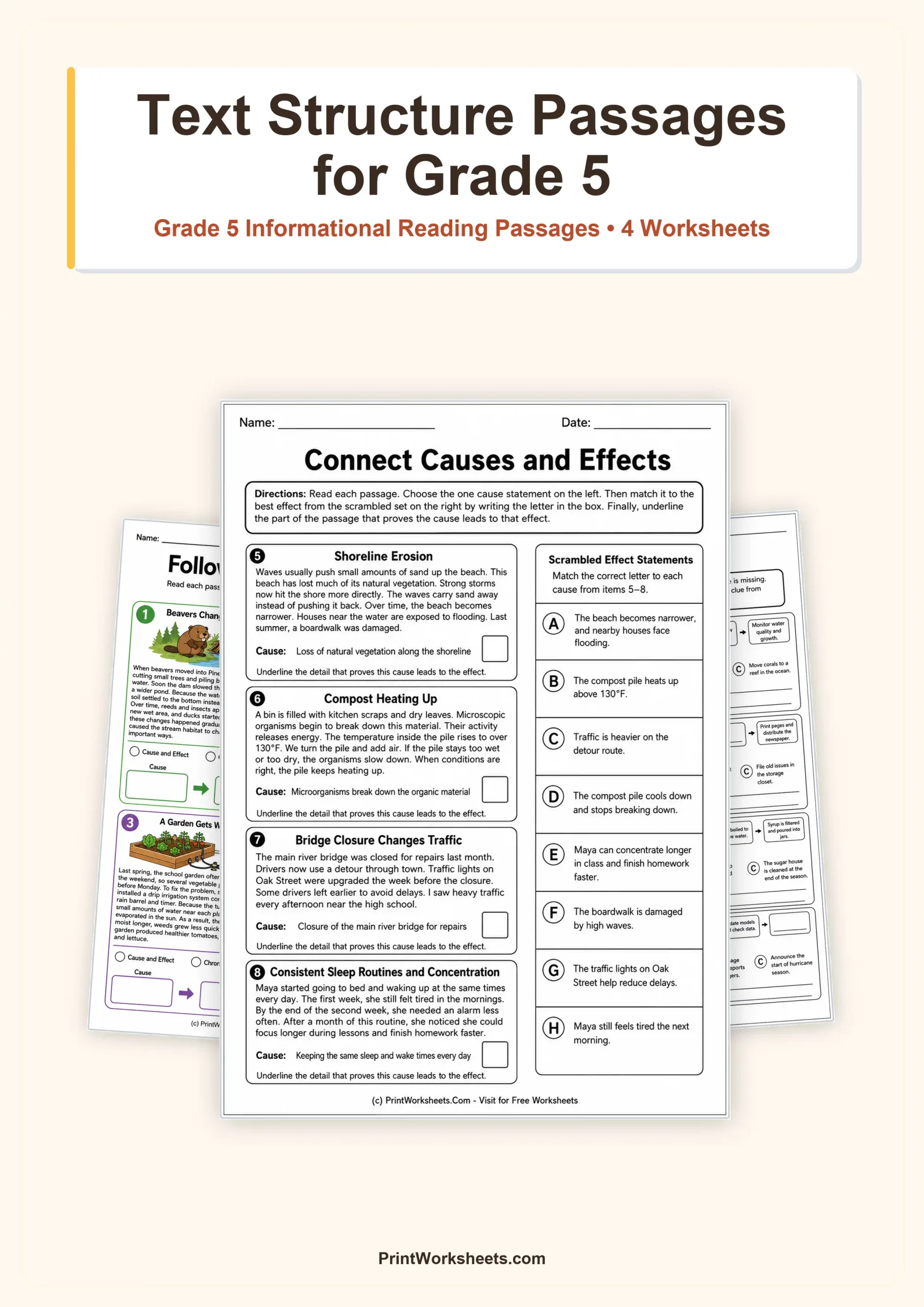
These text structure passages give fifth-grade readers repeated practice deciding how informational ideas are organized. Across four printable worksheets, students compare cause and effect with chronological order, match causes to supported outcomes, rebuild event sequences, and explain how a text structure helps readers understand a topic. The passages use science, environment, community, and everyday-life topics, so students must focus on relationships between ideas rather than rely on one familiar subject.
Grade 5 Text Structure Passages for Cause, Effect, and Chronology
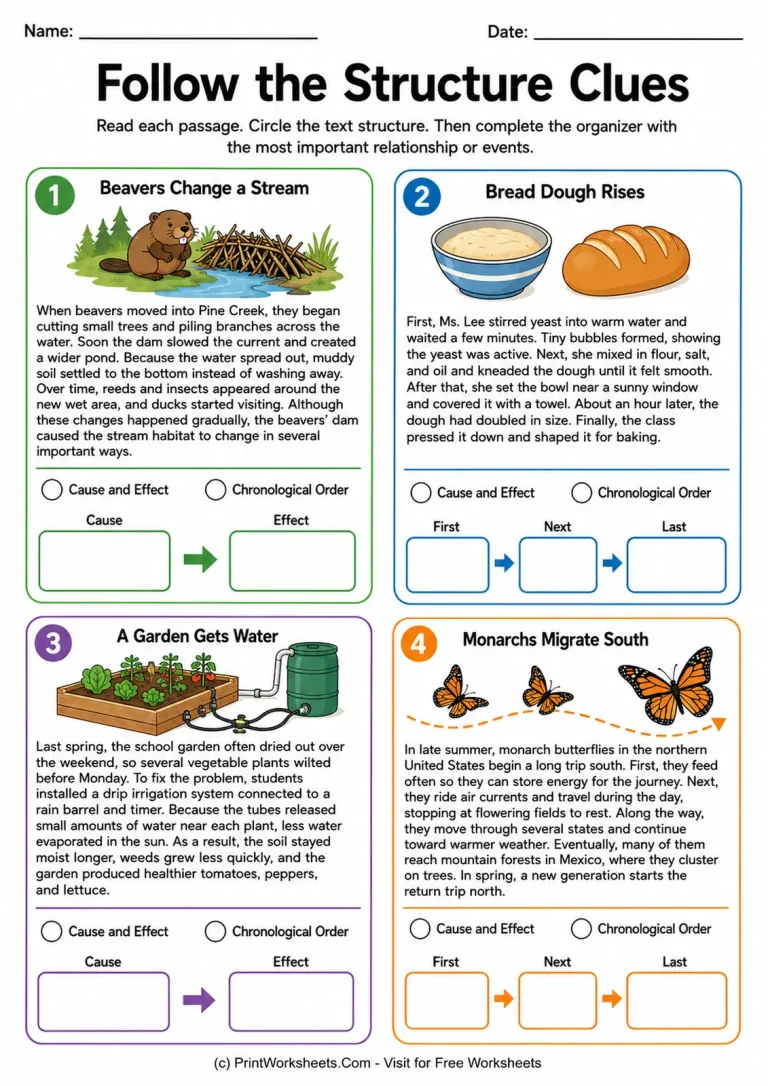
The first worksheet introduces both target structures side by side. Students read about beavers changing a stream, bread dough rising, a garden irrigation system, and monarch butterflies migrating south. Each passage asks readers to decide whether the organization is mainly cause and effect or chronological order. They then complete the matching organizer: a cause-and-effect relationship for passages built around consequences, or a First-Next-Last sequence for passages organized by time.
This contrast is useful because signal words alone are not enough. For example, the beaver passage explains how a dam slows water, changes soil conditions, and affects plants and animals, while the bread passage moves through a series of steps from activating yeast to shaping dough. Students have to notice the relationship among details, not simply circle the first transition word they see.
Move From Identifying Structure to Proving It
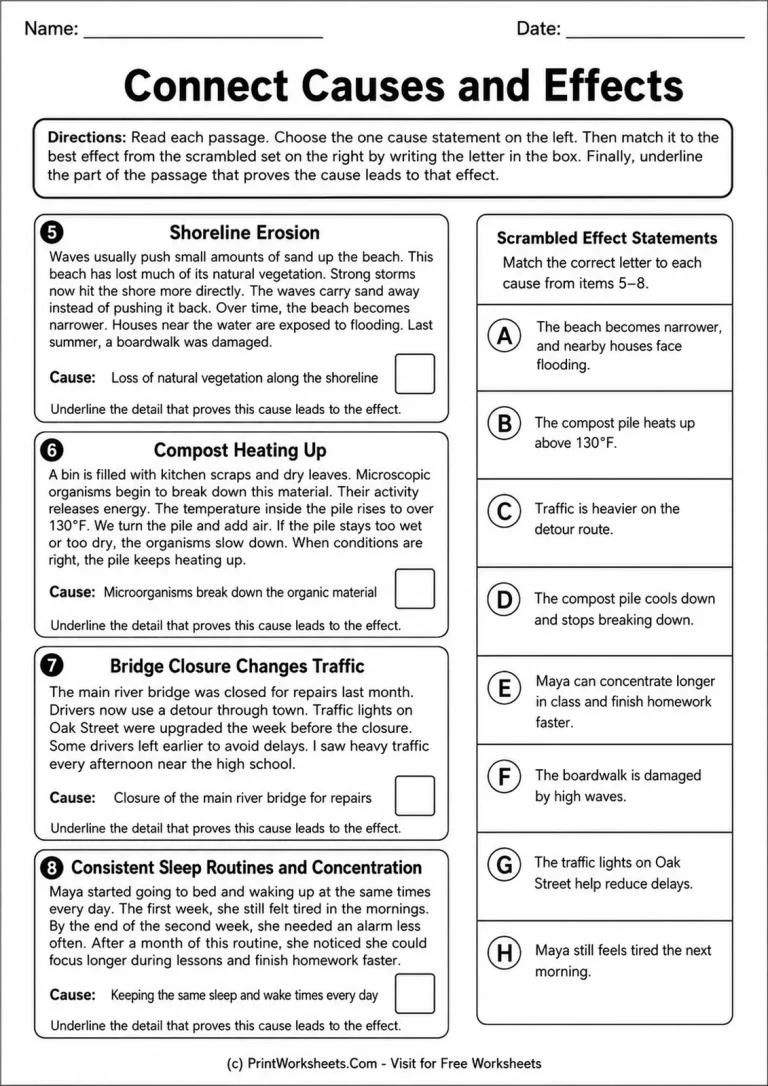
The second worksheet narrows the focus to cause-and-effect reasoning. Four short passages cover shoreline erosion, compost heating, a bridge closure, and a consistent sleep routine. A cause is supplied for each passage, and students match it to the best effect from a scrambled set. They also underline the sentence or detail that proves the relationship.
That evidence requirement makes the activity more demanding than a simple matching exercise. Students must distinguish the central effect from distracting details that may appear in the passage but do not best answer the stated cause. Teachers who want additional practice with this relationship can also use the site’s cause and effect worksheets as a companion skill resource.
Rebuild Events in Chronological Order
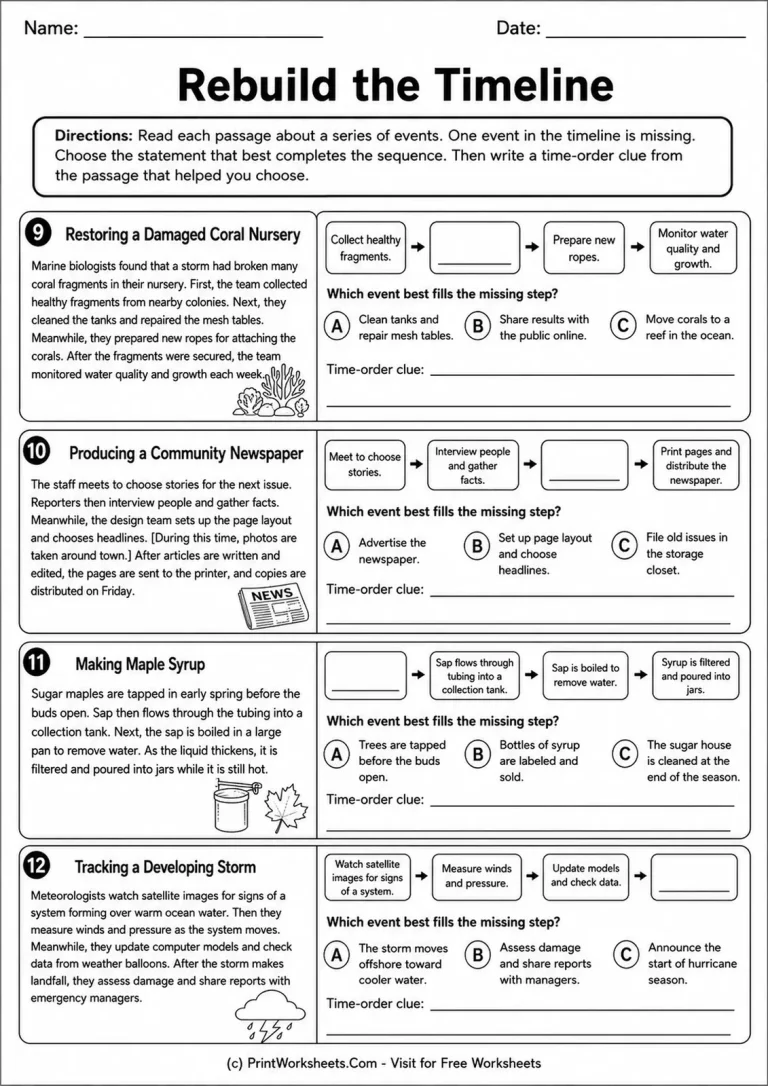
The third worksheet shifts to sequencing. Students read four process-based passages and fill a missing step in each timeline. Topics include restoring a damaged coral nursery, producing a community newspaper, making maple syrup, and tracking a developing storm. After choosing the missing event, students record a time-order clue from the passage that helped them decide.
This page strengthens the connection between sequence words and actual event order. Readers encounter clues such as first, next, meanwhile, after, and finally, but they still need to place each action in context. For example, cleaning tanks follows collecting healthy coral fragments, while assessing storm damage occurs after landfall rather than during earlier monitoring.
Explain How Organization Supports Meaning
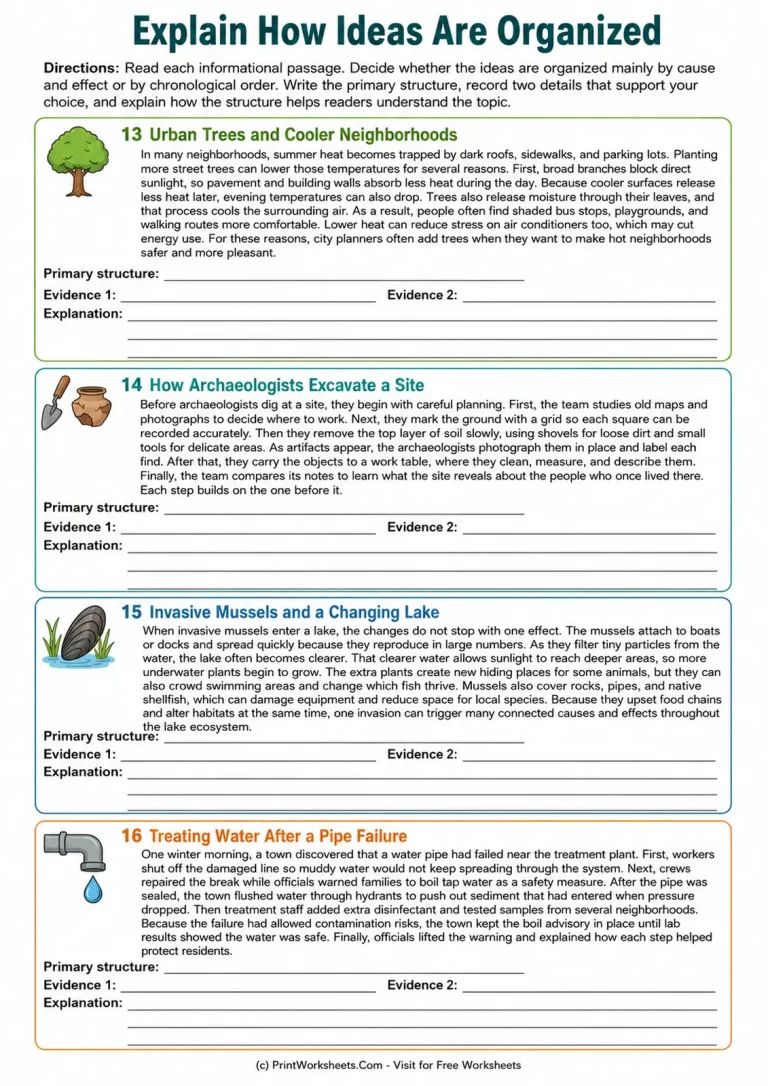
The final worksheet asks for a fuller written response. Students analyze passages about urban trees cooling neighborhoods, archaeologists excavating a site, invasive mussels changing a lake, and treating water after a pipe failure. For each passage, they name the primary structure, record two supporting details, and explain how that structure helps readers understand the topic.
The content makes the distinction between the two structures especially clear. The urban-tree and invasive-mussel passages trace connected effects, including cooler surfaces, reduced energy use, clearer water, changing plant growth, and habitat disruption. The archaeology and water-treatment passages are organized as ordered processes, with each step building on the one before it.
Ways to Use the Four Worksheets
The sequence works well as a short text-structure mini-unit. A teacher can model the first passage aloud, asking students what relationship connects the details and which organizer fits best. The matching page can then be used for partner work because students can discuss why one effect is better supported than another. The timeline page is suitable for independent practice or a quick check of sequencing skills, while the final written-response page can serve as a deeper comprehension task.
For students who need support, allow them to highlight time-order words in one color and cause/effect language in another before answering. More advanced readers can be asked to explain why an alternate structure would be less effective for one of the passages. Because the worksheets progress from recognition to evidence and explanation, they can also help teachers see whether a student can merely name a text structure or can actually justify the choice from the text.
Build Flexible Informational Reading Skills
By working with both cause-and-effect relationships and chronological sequences in the same set, students practice switching between two common nonfiction structures. The final goal is not memorizing labels. It is recognizing how authors connect events and ideas, locating details that support that organization, and using the structure to make sense of increasingly complex informational text.