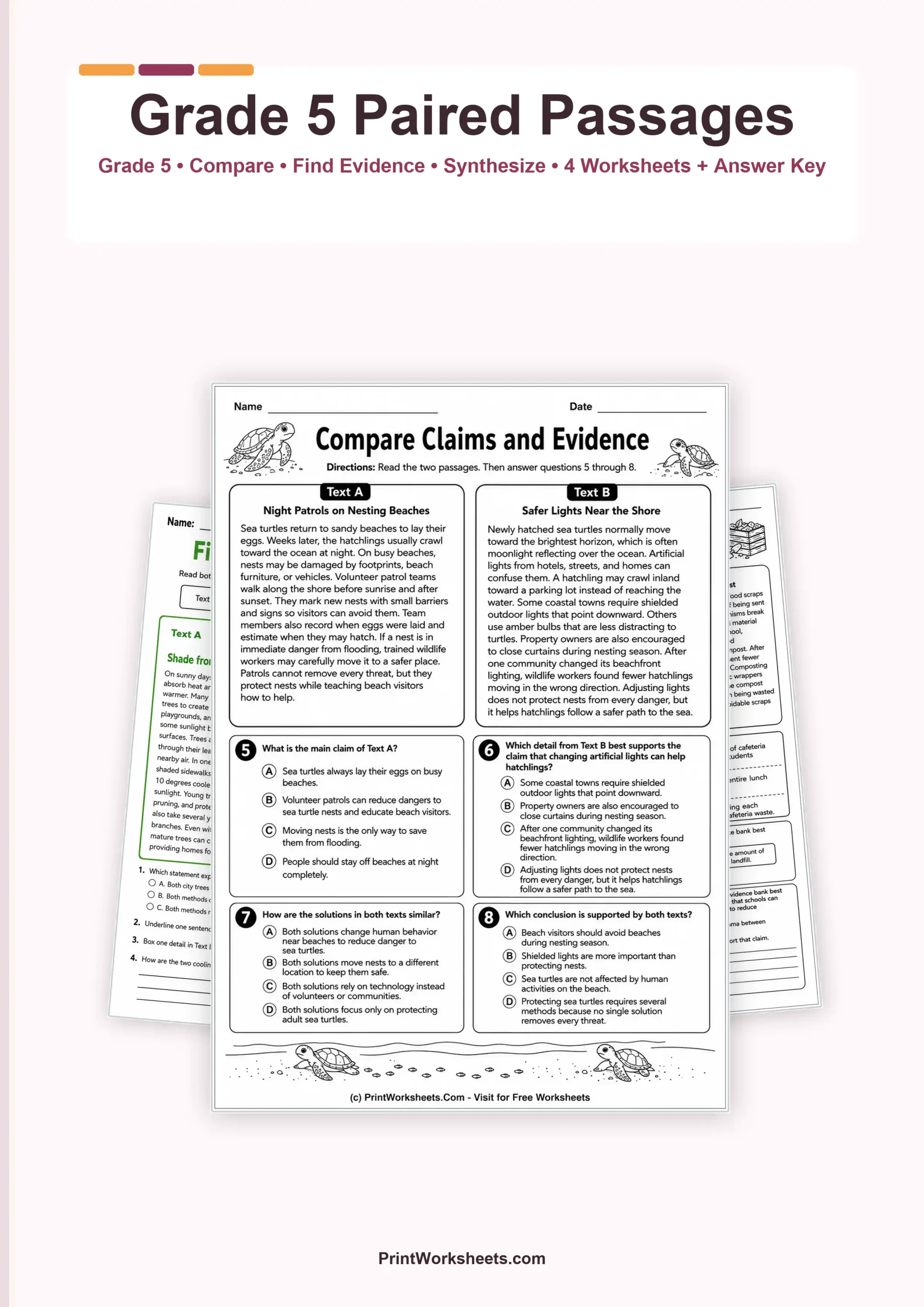
These paired nonfiction passages give fifth graders repeated practice in using evidence across two sources instead of treating each passage in isolation. The four student pages move through different real-world topics—urban heat, sea turtle protection, cafeteria waste, and stormwater management—while keeping the core reading work consistent: identify claims and shared ideas, locate supporting details, compare solutions, and explain conclusions with text evidence. Because the topics change while the reasoning routine stays recognizable, students can focus on transferring the same evidence skills from one context to another.
Paired Nonfiction Passages That Build Evidence Skills Step by Step
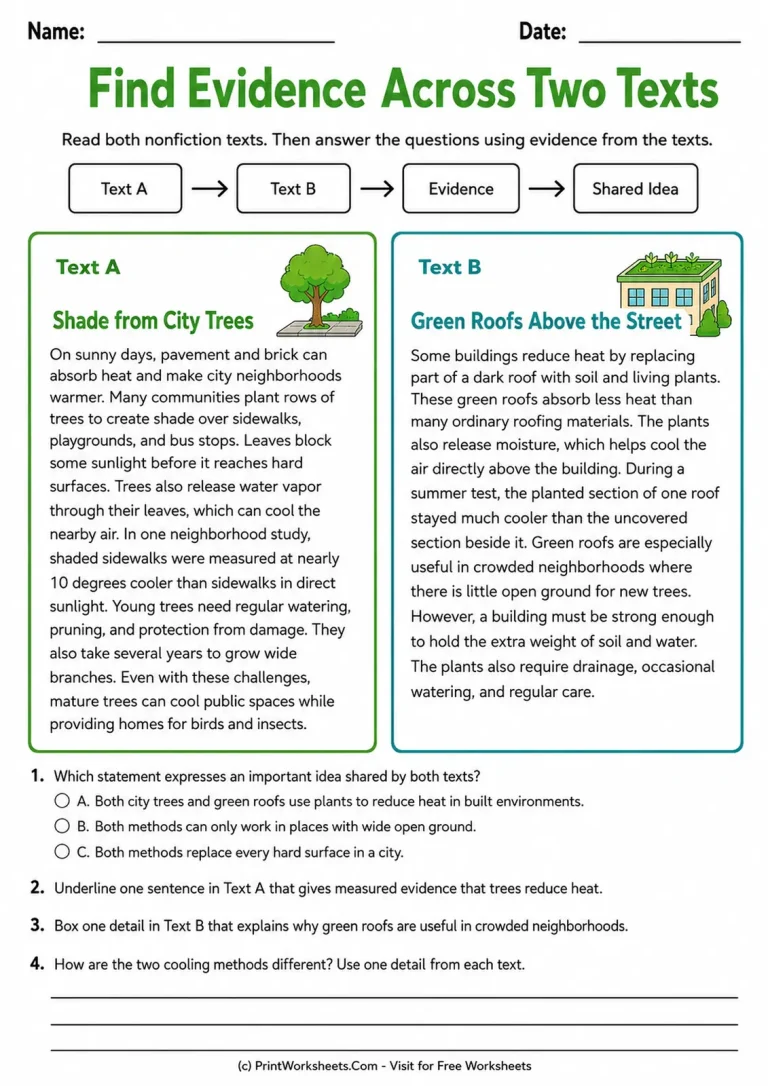
The set opens with a side-by-side comparison of “Shade from City Trees” and “Green Roofs Above the Street.” Students first identify the important idea shared by both texts, then underline measured evidence showing that trees reduce heat, box a detail explaining why green roofs are useful in crowded neighborhoods, and write a comparison using one detail from each passage. The measured evidence about shaded sidewalks being nearly 10 degrees cooler than sidewalks in direct sunlight gives students a concrete example of what strong textual evidence looks like. The final comparison also pushes them beyond simple recall by asking them to distinguish where and how each cooling method works.
Compare Claims and Supporting Evidence
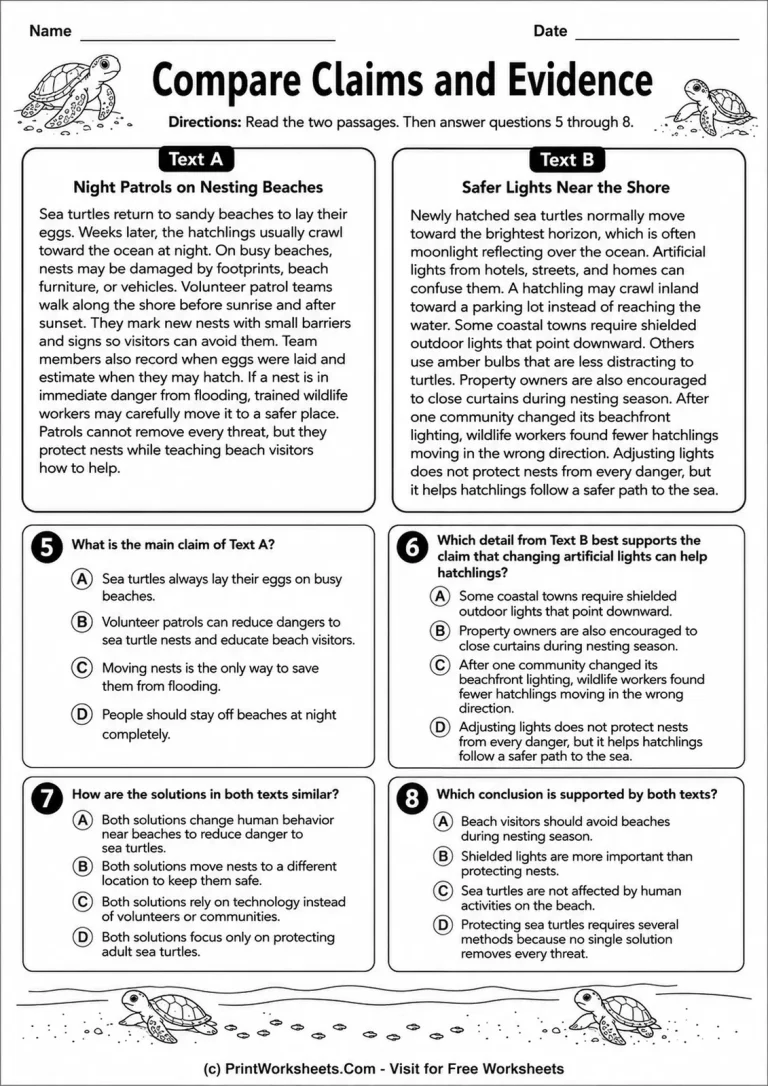
The second worksheet shifts to sea turtle conservation. “Night Patrols on Nesting Beaches” and “Safer Lights Near the Shore” ask students to work with claims, supporting evidence, similarities, and conclusions. The multiple-choice format helps students practice choosing the strongest answer from plausible alternatives. One question asks for the main claim of the patrol passage, while another asks which detail best supports the idea that changing artificial lights can help hatchlings. Students also compare the two solutions and determine the broader conclusion supported by both texts: protecting sea turtles requires more than one method because no single solution removes every threat.
Match Evidence to Claims Across Two Texts
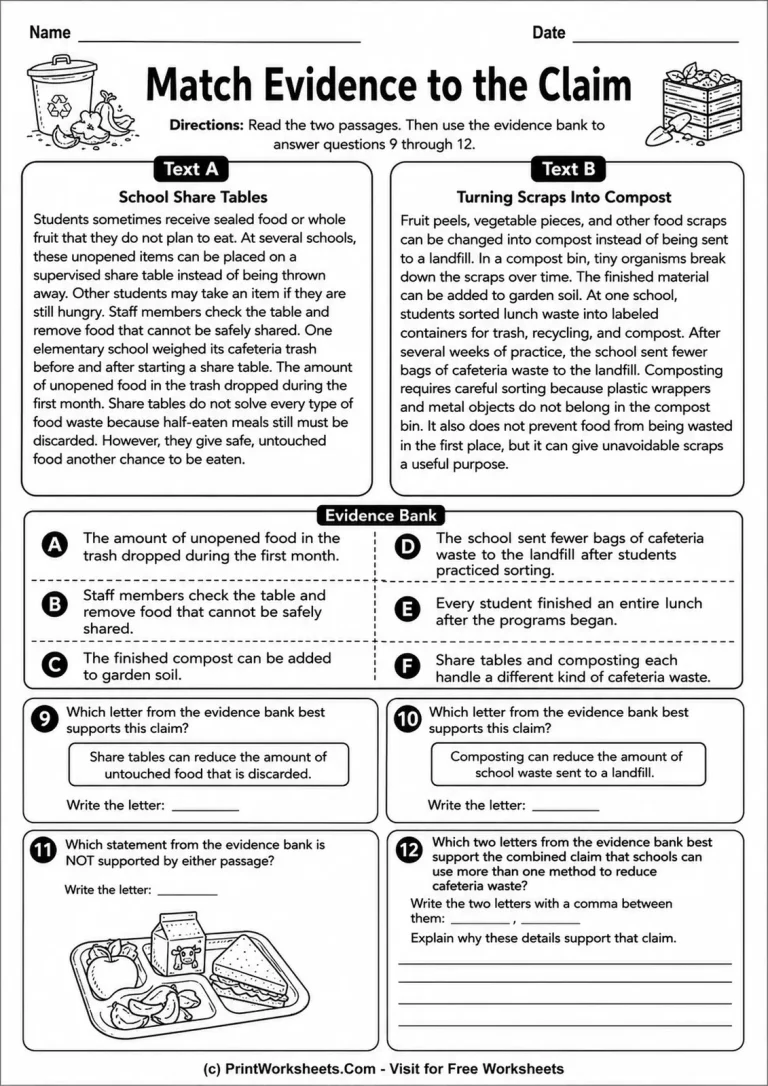
The third page introduces an evidence bank, giving students a different way to connect claims with proof. One passage explains school share tables for unopened food, and the other describes turning cafeteria scraps into compost. Students match evidence letters to claims about reducing untouched food waste and reducing landfill waste. They also identify a statement that is not supported by either passage and then combine one detail from each text to support the claim that schools can use more than one method to reduce cafeteria waste. This format is useful for teaching students to distinguish relevant evidence from details that sound reasonable but are not actually supported by the reading.
Move From Evidence Selection to Two-Source Synthesis
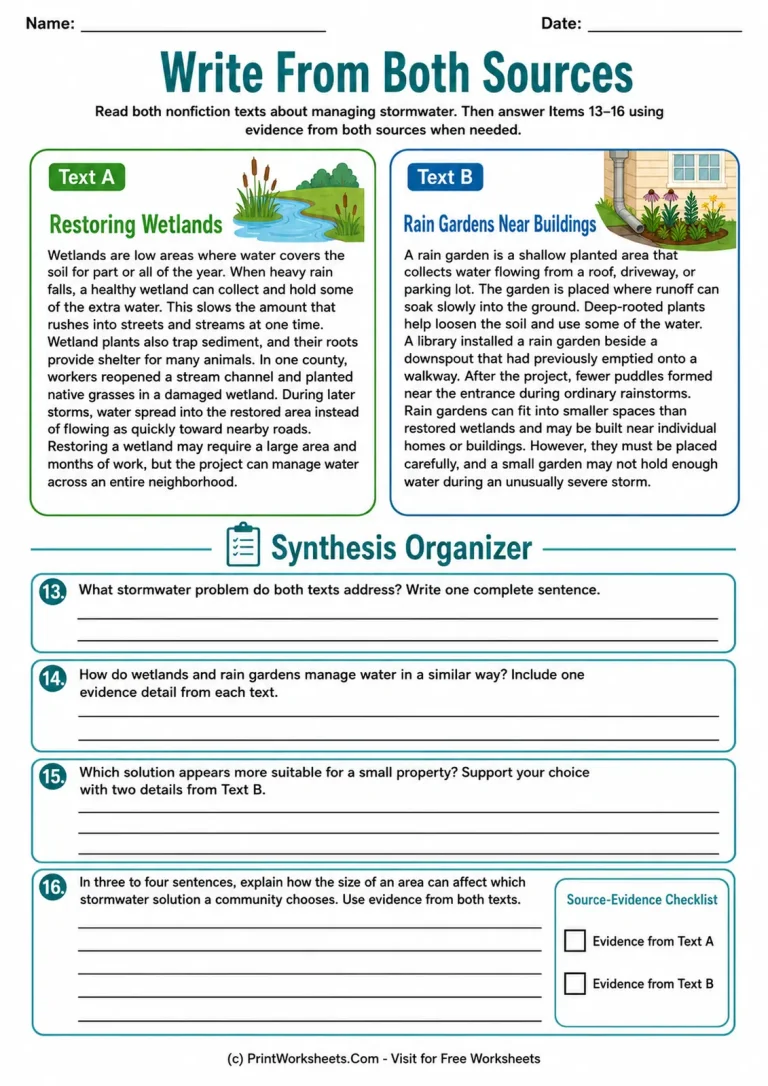
The final student page moves from selected evidence to written synthesis. “Restoring Wetlands” and “Rain Gardens Near Buildings” both address stormwater, but at different scales. Students identify the shared problem, explain how the two solutions manage water in similar ways, decide which solution is more suitable for a small property using two details from Text B, and finish with a three-to-four-sentence response using evidence from both sources. The source-evidence checklist reinforces the expectation that both texts must be represented in the final answer.
Ways to Use the Worksheets in Grade 5
These worksheets work well for whole-group modeling, partner discussion, independent practice, or small-group intervention. A teacher can model the first paired set by thinking aloud about how a shared idea differs from a supporting detail, then release students to complete later pages with less support. The sea turtle page is especially useful for practicing claim-and-evidence language in a multiple-choice setting, while the cafeteria page is a strong bridge to evidence sorting and justification. The stormwater page can serve as a short constructed-response assessment because it requires students to synthesize information across both passages rather than copy a single sentence.
For differentiation, students who need support can highlight one color for each source before answering cross-text questions, or complete a simple two-column note chart labeled Text A and Text B. More advanced readers can be asked to explain why one distractor is weaker than the correct answer or to revise a short response so that it names evidence from both passages more precisely. Teachers can also assign the pages separately by skill: comparison and shared ideas, claims and evidence, evidence matching, or multi-source writing.
Answer Key and Flexible Checking
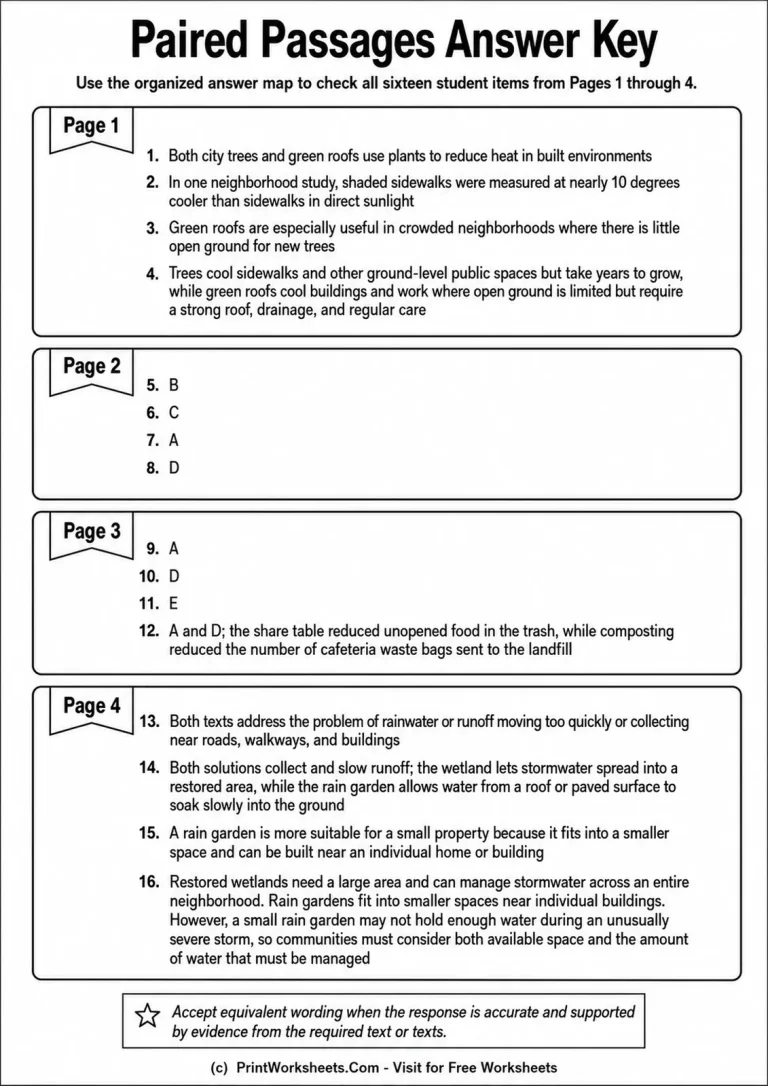
A separate answer key covers all sixteen student items, including objective answers and model responses for open-ended questions. Equivalent wording can be accepted when it is accurate and supported by the required text or texts. That makes the set practical for quick checking while still allowing students to express evidence-based ideas in their own words.
Overall, these paired nonfiction passages are most useful when students are ready to move from finding evidence in one passage to coordinating evidence across two. The varied topics keep the reading fresh, while the progression from identifying details to writing a short synthesis gives teachers a clear path for building stronger Grade 5 reading comprehension and source-based response skills.