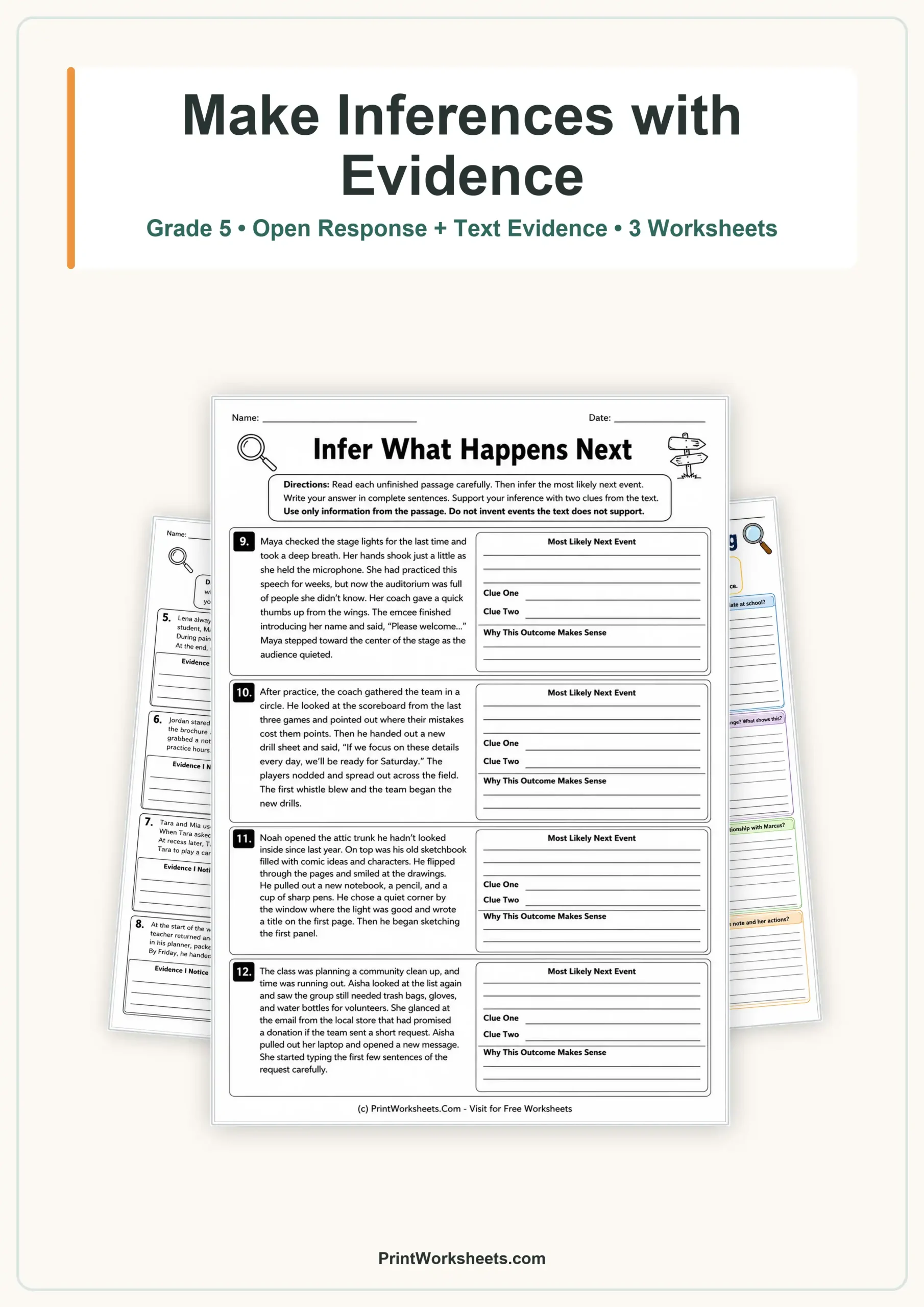
These Grade 5 inference passages move students beyond choosing an answer and into explaining how they know. Across the three printable worksheets, readers collect clues, connect those clues to what they already know, predict likely outcomes, and explain ideas that the author leaves unstated. Each task requires written thinking, making the set useful for close reading, constructed response practice, and evidence-based comprehension work.
Inference Passages That Require Students to Show Their Thinking
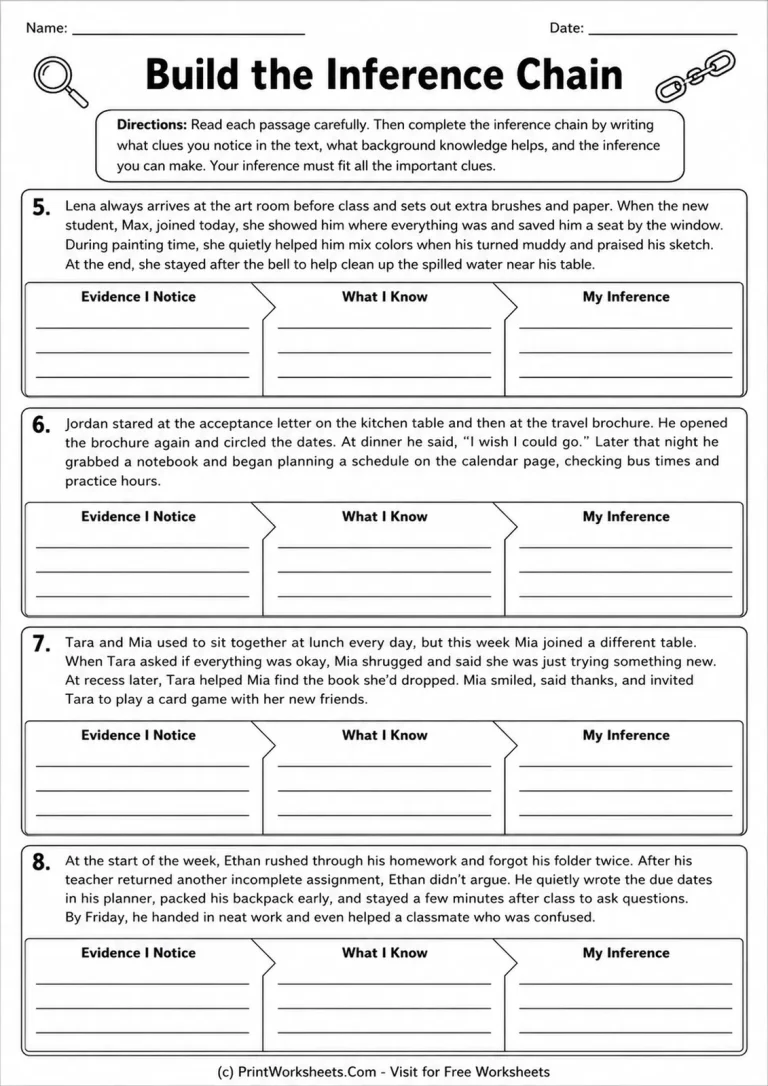
The first worksheet uses a clear three-part chain: Evidence I Notice, What I Know, and My Inference. This structure helps students separate what the passage actually says from the background knowledge they bring to the text. One passage describes Lena arriving early to the art room, helping a new student find supplies, assisting him with paint, praising his sketch, and staying to help clean up. Students can use those actions to infer that Lena is thoughtful, welcoming, and willing to help others.
Other passages on the page ask students to interpret Jordan’s planning after receiving an acceptance letter, Tara and Mia’s changing lunch routine, and Ethan’s improved school habits. These situations are especially useful because the answer is not stated directly. Students have to combine several details before reaching a conclusion that fits the whole passage.
Predicting What Happens Next with Two Text Clues
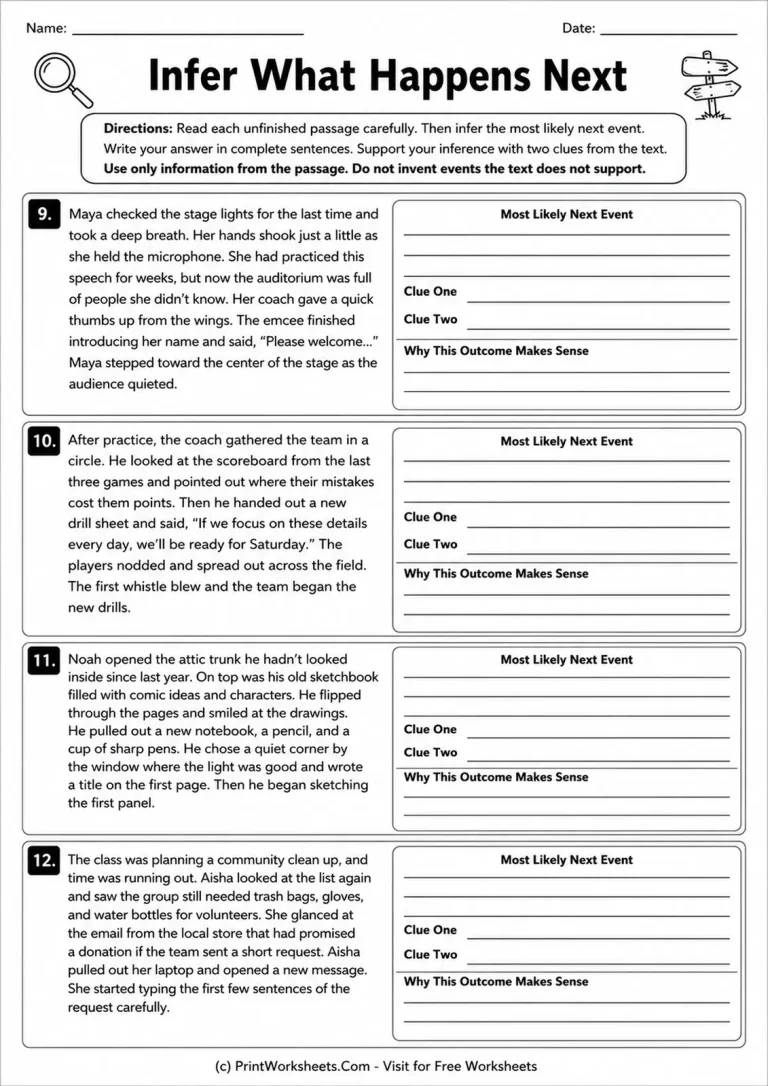
The second worksheet shifts from character and situation inference to prediction. Students read an unfinished passage and write the most likely next event. They must then provide Clue One, Clue Two, and explain why the outcome makes sense. The directions also remind students to use only information from the passage, which helps prevent unsupported storytelling.
For example, Maya has practiced a speech for weeks, stands with a microphone as the emcee introduces her, and steps toward the center of the stage while the audience becomes quiet. The strongest prediction is that she will begin giving her speech. Another passage shows a coach reviewing recent mistakes, handing out a new drill sheet, and starting practice, so students can reasonably infer that the team will continue working on the new drills to prepare for Saturday.
The remaining passages provide similarly concrete evidence. Noah opens an old sketchbook, gathers a new notebook and drawing tools, writes a title, and begins the first panel of a comic. Aisha opens a new email after reviewing supplies still needed for a community clean-up and a store’s promise to consider a donation request. In each case, students must choose a continuation supported by the sequence already on the page.
Explaining Hidden Meaning in Grade 5 Reading
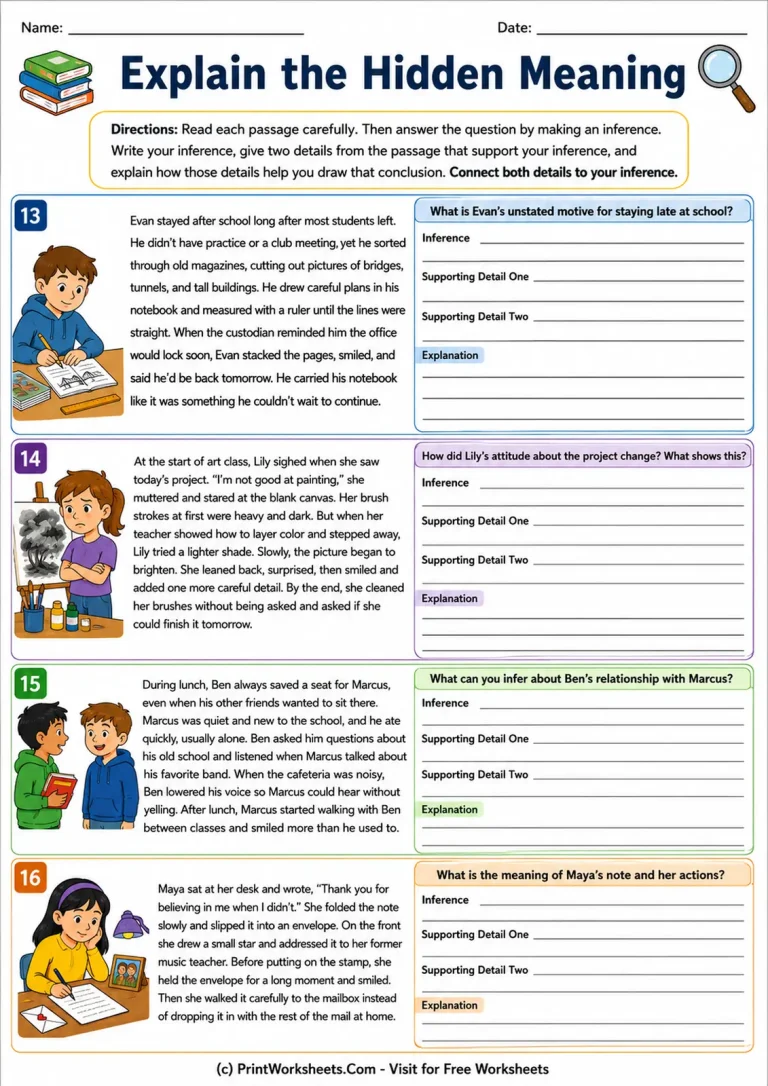
The third worksheet raises the level of interpretation by asking about unstated motives, attitude changes, relationships, and the meaning behind actions. Students write an inference, select two supporting details, and explain how both details connect to their conclusion.
From Details to Motive, Attitude, and Relationships
Evan stays late at school cutting out pictures of bridges, tunnels, and tall buildings, drawing careful plans, measuring lines, and saying he will return the next day. Those details support an inference that he is highly interested in design or construction and wants to continue the project. Lily begins an art assignment discouraged and doubtful, but after learning a technique she leans back, smiles, adds another detail, cleans her brushes without being asked, and asks to continue the next day. Students can trace that sequence to explain how her attitude changes from reluctance to growing confidence and interest.
Another passage focuses on Ben and Marcus. Ben saves Marcus a seat, asks about his old school, listens to him, lowers his voice so Marcus can hear, and helps him become more comfortable. Rather than simply labeling the relationship as friendship, students have enough evidence to explain that Ben is making a deliberate effort to support and include a new student. The final passage asks readers to interpret Maya’s thank-you note to a former music teacher and the care she takes in preparing and mailing it, supporting an inference of sincere gratitude and appreciation.
Ways to Use These Open-Response Worksheets
These pages work well for independent reading practice, small-group discussion, intervention, homework, or assessment. Teachers can first model one response aloud by naming the exact clue, stating the relevant background knowledge, and then forming an inference that fits all of the evidence. After students understand that process, they can complete the remaining passages independently.
For students who need support, ask them to underline two details before writing anything in the response box. More advanced readers can be challenged to explain why an alternative inference is weaker. Because the set progresses from an inference chain to prediction and then to hidden meaning, it can also be used across several lessons as a short Grade 5 inference unit focused on evidence, explanation, and precise written reasoning.