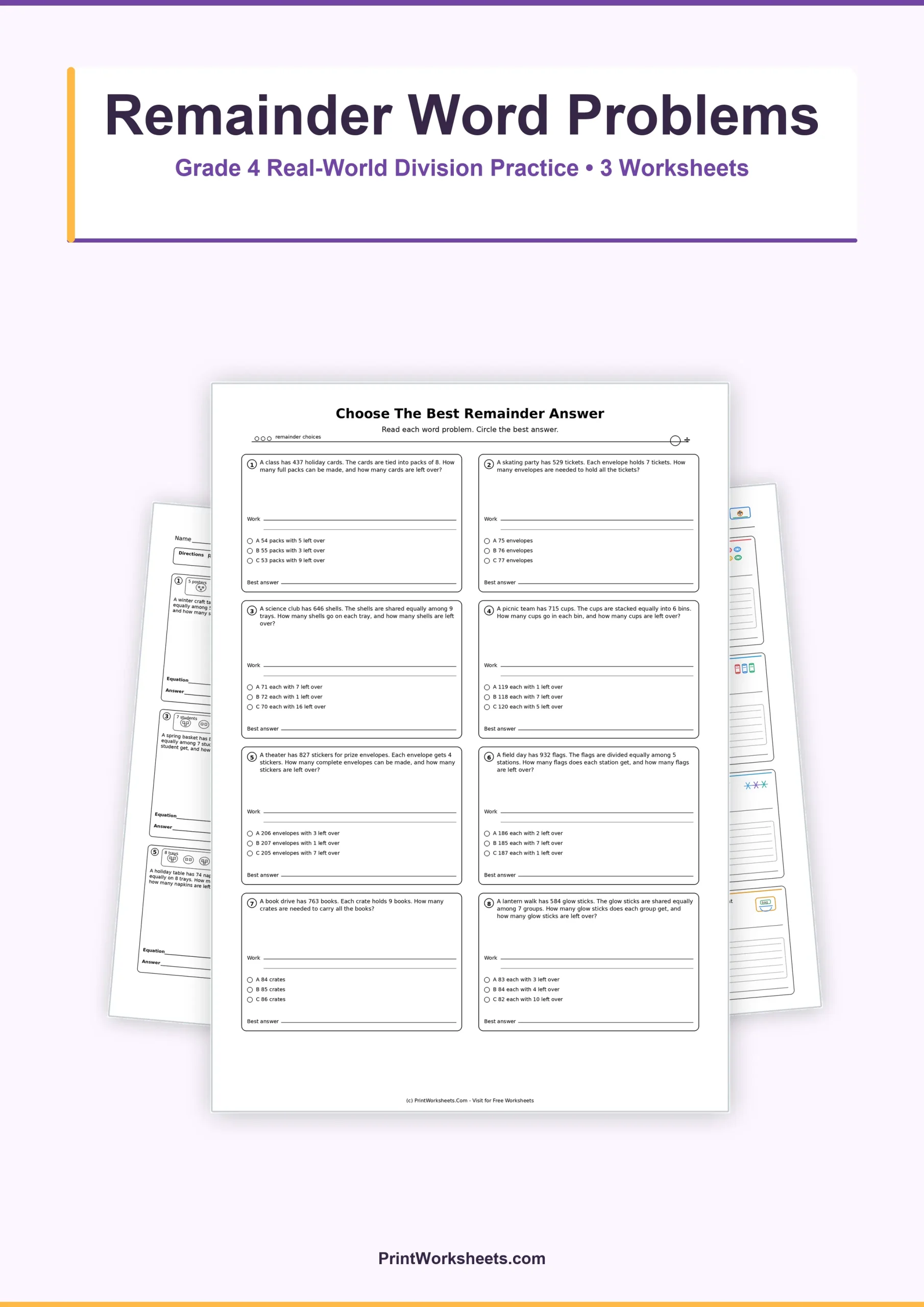
These Grade 4 remainder word problems give students a practical reason to think beyond the division algorithm. Instead of stopping after finding a quotient and remainder, learners decide what those numbers mean in situations involving groups, containers, teams, supplies, and other everyday quantities. Across three printable worksheets, the work progresses from short picture-supported stories to multiple-choice interpretation and then to open-response problems that require an equation, shown work, and a complete answer sentence.
Practice remainder word problems in meaningful contexts
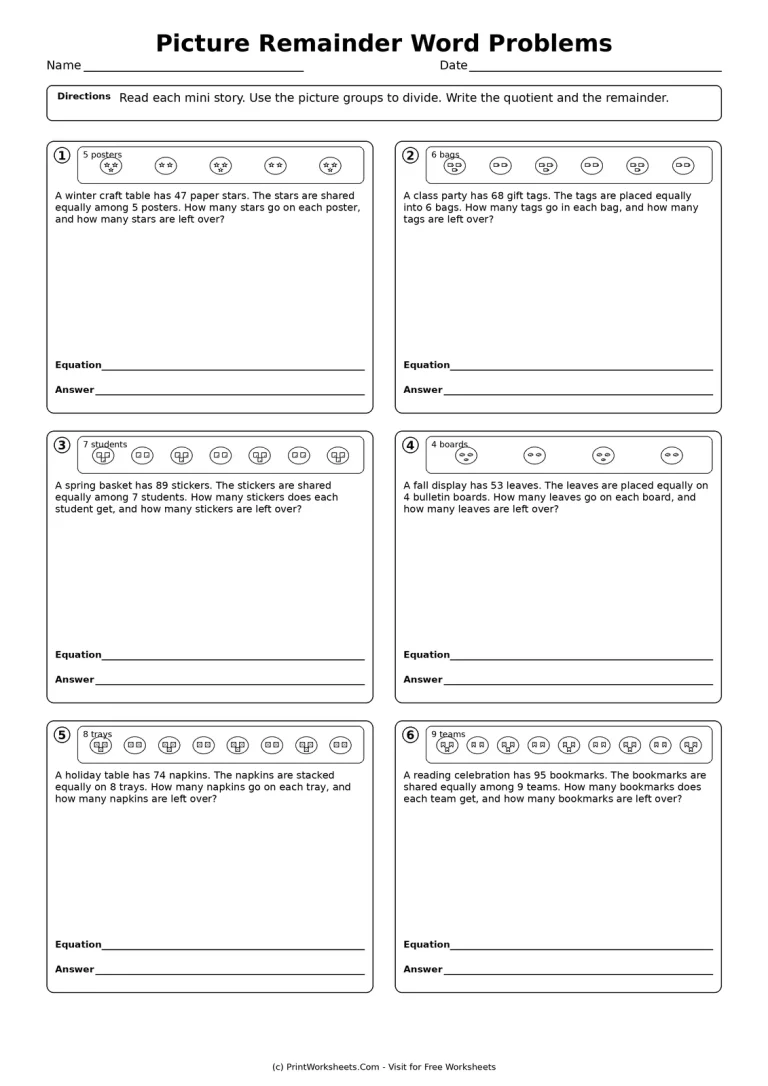
The first worksheet provides a supportive entry point with six short sharing and grouping situations. Each problem includes a visual group-count cue and asks students to determine both the quotient and the remainder. Separate spaces for an equation and a written answer encourage students to connect the numerical calculation to the wording of the story rather than writing an isolated division fact.
This format is useful for students who understand basic division but still need practice translating a situation into an equation. Teachers can ask students to identify the total amount, the group size, the number of complete groups, and what is left over before solving. That routine helps make the meaning of the remainder more concrete.
Move from calculating remainders to interpreting them
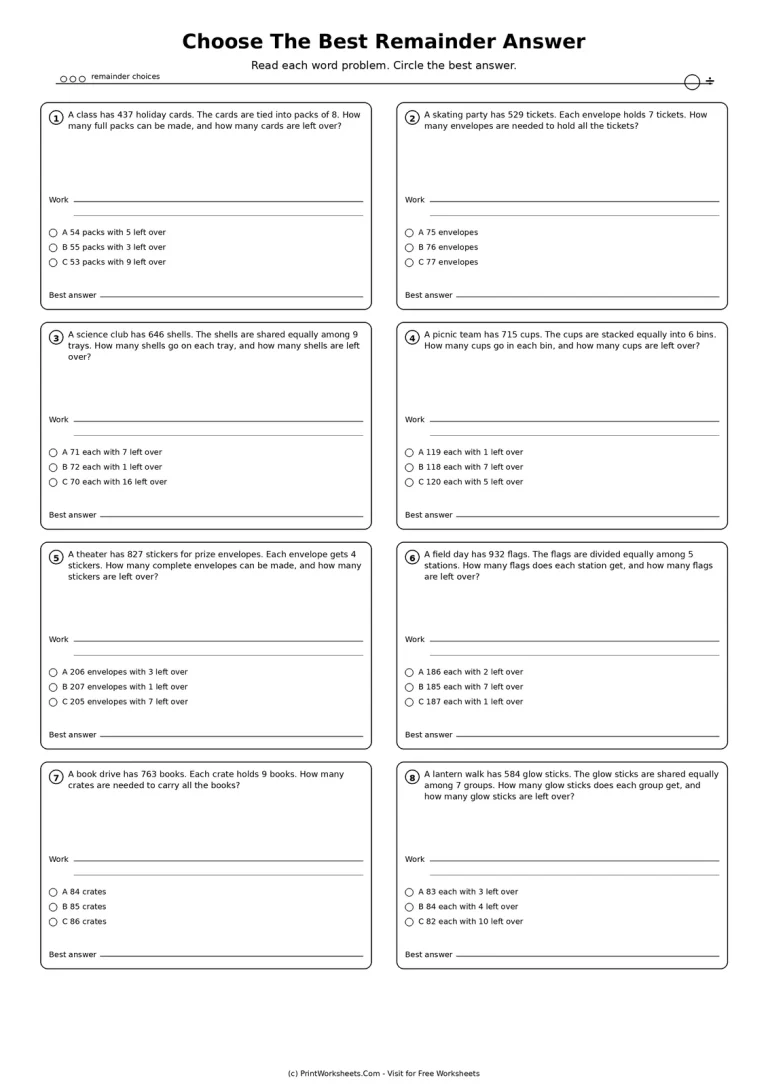
The second stage of the set uses eight multiple-choice division situations. Students show their work and then choose the answer that best fits the context. Some items can be reported naturally as a quotient with a remainder, while others require students to recognize that a leftover amount creates the need for one more container or group.
For example, one problem asks how many envelopes are needed when 529 tickets are packed 7 per envelope. The calculation leaves a remainder, but the real-world answer must include another envelope, giving a total of 76. Another asks about packing 763 books into crates that hold 9 books each; because the remaining books still need a crate, students must choose 85 crates rather than simply report the whole-number quotient. These problems make the important Grade 4 distinction between computing a remainder and deciding what to do with it.
Build on earlier sharing and grouping skills
Students who need a simpler prerequisite can review sharing and grouping division problems before working with remainders. Another useful bridge is division word problems with equal groups, which reinforces how division situations are organized before leftover amounts are introduced.
Use open-response problems for deeper reasoning
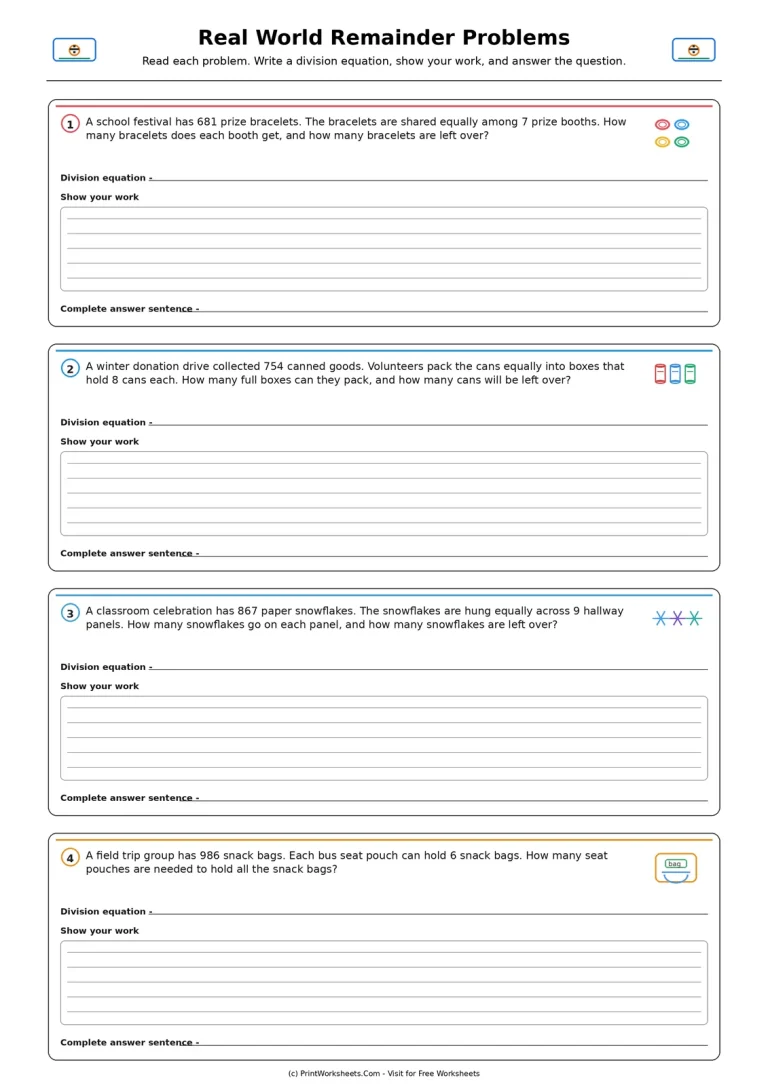
The final worksheet shifts to four larger real-world problems involving prize bracelets, canned goods, paper snowflakes, and snack bags. Students are expected to write a division equation, show their calculation, and finish with an answer sentence that matches the situation. The larger response spaces make this page especially useful when the goal is to see how a student organizes mathematical thinking rather than checking only a final choice.
One of the open-response tasks also requires students to recognize that a remainder means another container is necessary. This creates a natural opportunity for discussion: a quotient may tell how many full groups can be made, but the story determines whether the remainder should be stated, ignored, or used to increase the final count by one.
Ways to use these Grade 4 division worksheets
The three formats work well as a short instructional sequence. Begin with the picture-supported page during guided practice, use the multiple-choice page for independent checking, and save the open-response page for classwork, homework, a math center, or a small assessment. Students can also underline the question in each story and label what the remainder represents before calculating.
For additional support, let students draw quick groups or use counters before writing the equation. For students ready for a challenge, ask them to explain why two problems with similar-looking division calculations can require different kinds of final answers. That comparison focuses attention on mathematical reasoning instead of computation alone.
Help students explain what the remainder means
Successful work with remainders depends on both accurate division and careful reading. These worksheets give fourth graders repeated opportunities to connect quotients and leftover amounts to the demands of a real situation. By moving from supported stories to interpretation choices and full written responses, the set helps students practice the complete problem-solving process: represent the situation, divide, interpret the remainder, and communicate a sensible answer.