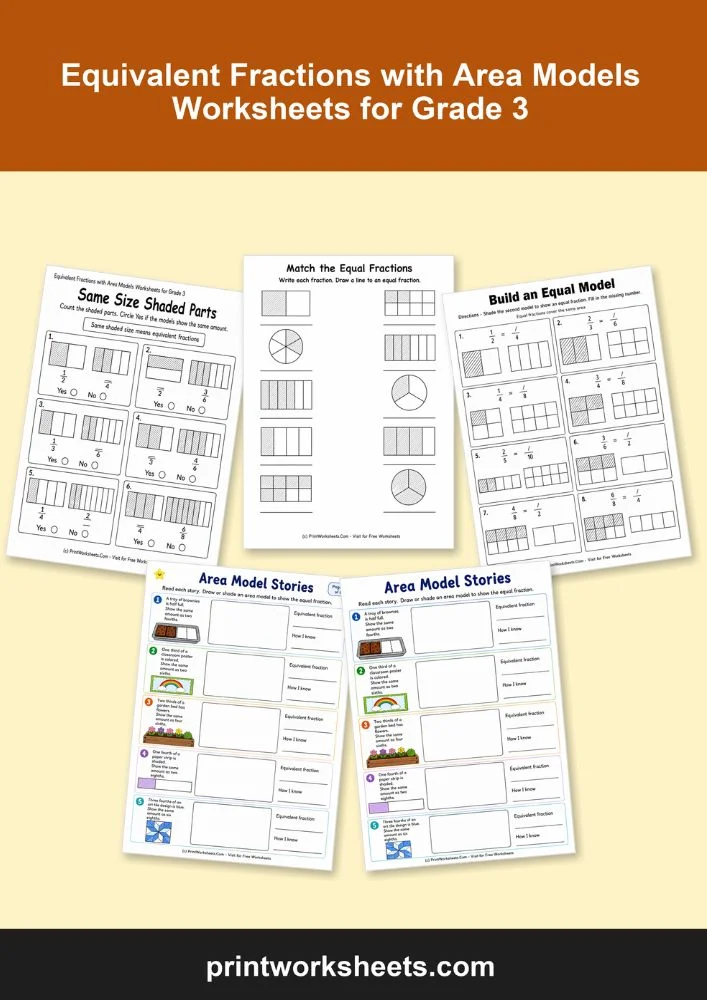
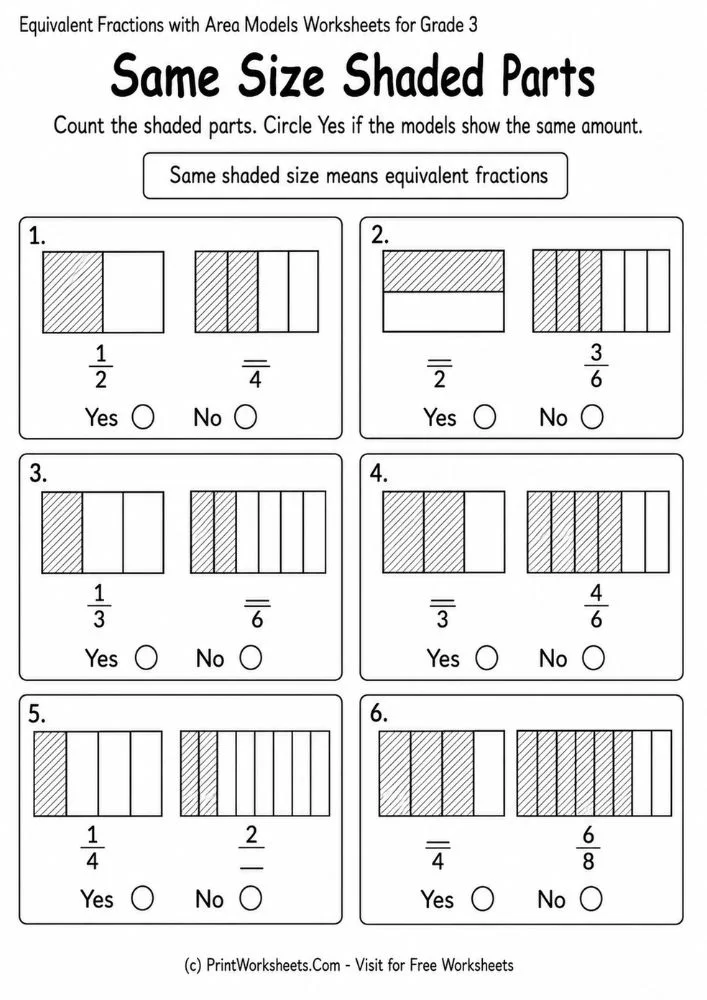
What are equivalent fractions with area models worksheets for grade 3? Equivalent fractions with area models worksheets for grade 3 are highly structured geometric printables designed to help young learners visually prove that different numerical fractions can represent the exact same physical space. Developing fractional reasoning in elementary education requires transitioning from concrete representations to abstract mathematical concepts[cite: 3]. Visual area models serve as a critical bridge in this cognitive development[cite: 3]. By systematically completing these shading and matching activities, third-grade students develop spatial reasoning skills necessary to identify equal parts of a whole[cite: 3]. Download this complete equivalent fractions with area models worksheets for grade 3 PDF directly from PrintWorksheets.Com to minimize common misconceptions associated with symbolic fraction rules in your classroom.
To build a robust mathematical foundation, educators must sequence their instruction carefully. Before introducing the complex concept of equivalent area models, students must first understand how a single fraction represents a specific continuous value. Integrating our foundational unit fractions on number lines worksheets for grade 3 ensures students grasp the base definition of a denominator before attempting to manipulate and compare different geometric shapes.
Inside the 3rd Grade Area Models PDF
This targeted geometry and fractions practice pack utilizes structured repetition to build calculation fluency alongside spatial reasoning[cite: 3]. By analyzing the provided graphic organizers, students transition from guided visual observation to independent mathematical formulation.
- Same Size Shaded Parts: This introductory verification worksheet explicitly connects spatial volume to numerical fractions. Students analyze six pairs of rectangular area models (for example, comparing a 1/2 model to a 2/4 model, or a 1/3 model to a 2/6 model). They must count the shaded segments and circle “Yes” or “No” to confirm if the models physically show the exact same amount.
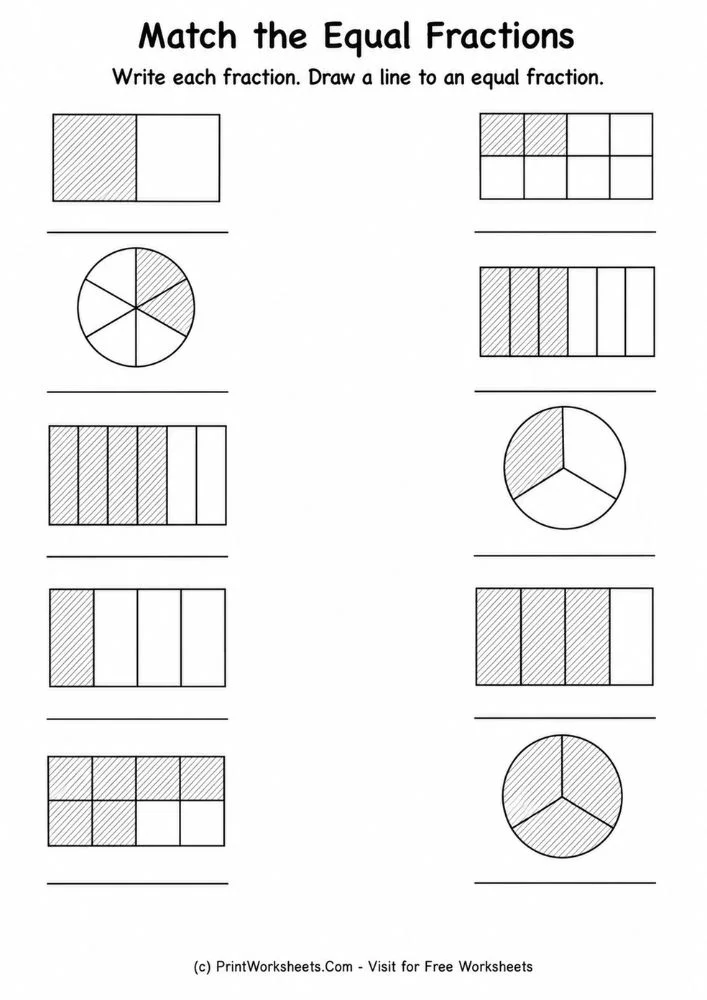
- Match the Equal Fractions: A dedicated spatial recognition page that mixes distinct geometric shapes. Students examine a left column containing shaded rectangles and sliced circles, writing the baseline fraction beneath each. They must then draw a physical line to the right column to connect the matching equivalent fraction, proving that 1/2 in a rectangle holds the same proportional value as 3/6 in a circle.
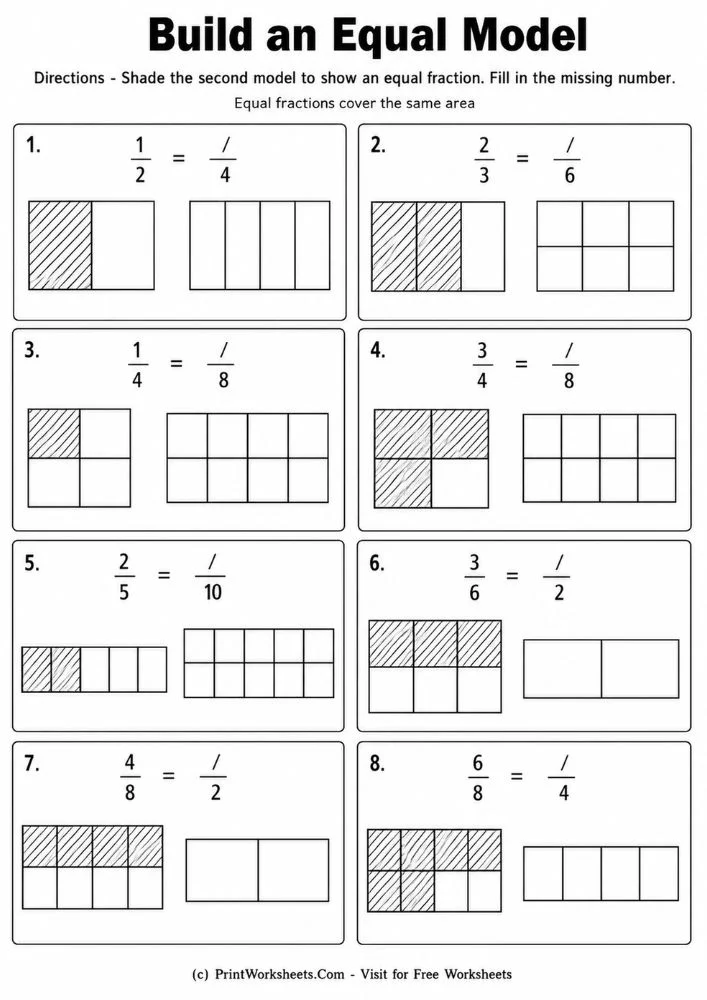
- Build an Equal Model: An interactive application worksheet where students take ownership of the geometry. The page presents an equation like 1/2 = _/4 alongside a pre-shaded model for 1/2 and a completely blank four-part model. Educators can encourage students to shade matching portions of different area models to visually confirm equivalence[cite: 3]. After physically shading the blank grids, the student writes the newly discovered numerator to complete the mathematical equation.
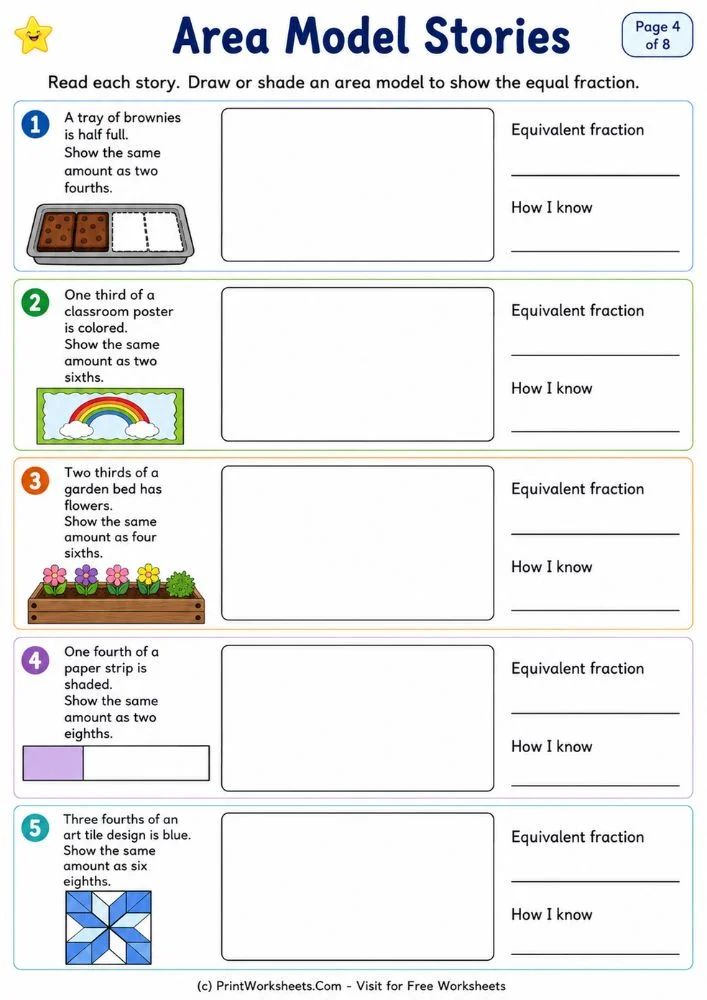
- Area Model Stories: A rigorous, high-level reading comprehension and math application page. Students read five real-world scenarios. For example, the first story states: “A tray of brownies is half full. Show the same amount as two fourths.” Students must independently draw or shade a blank box to represent the tray, write the equivalent fraction, and finally fill out a “How I know” section, requiring them to articulate their spatial reasoning using academic vocabulary. Other stories feature classroom posters (1/3 to 2/6), garden beds (2/3 to 4/6), paper strips, and art tile designs.
Differentiation Options for Teachers
To successfully integrate these visual models for students who struggle with fine motor skills or abstract geometry, provide transparent plastic fraction overlays. Allow these students to physically lay the 2/4 plastic piece directly on top of the 1/2 printable model on the paper. This immediate tactile feedback proves that the area is identical before they even pick up a pencil. For advanced or gifted learners, use the “Build an Equal Model” worksheet but intentionally white-out the provided grid lines on the second shape. Challenge them to use a ruler to partition the blank rectangle themselves before shading the equivalent amount.
Targeted Academic Skills
Deploying these structured visual organizers directly satisfies critical Common Core State Standards (CCSS) for third-grade mathematics. Specifically, these printables target CCSS.MATH.CONTENT.3.NF.A.3.B, which requires students to recognize and generate simple equivalent fractions (e.g., 1/2 = 2/4, 4/6 = 2/3) and explain why the fractions are equivalent by using a visual fraction model. Dividing a region into halves and then further partitioning it into fourths demonstrates that one-half is spatially identical to two-fourths[cite: 3]. Providing immediate feedback to correct partitioning errors before students move to symbolic notation is vital for long-term algebraic success[cite: 3].
Frequently Asked Questions
What grade levels use equivalent area models worksheets?
Equivalent area models worksheets are explicitly designed for third-grade mathematics classrooms, as this is the foundational year for rational numbers. However, they serve as crucial remediation tools for fourth and fifth graders who still incorrectly add denominators together during advanced operations.
What specific cognitive skills do these printables target?
These visual fraction printables explicitly target spatial reasoning, proportional matching, numerator calculation, geometric partitioning, and the ability to formulate written mathematical arguments based on visual evidence.
Why are area models better than just teaching the multiplication rule?
Area models are better than just teaching the multiplication rule because structured repetition reinforces the conceptual understanding that different fractions can represent the exact same portion of an area[cite: 3]. If a student only memorizes “multiply the top and bottom by two,” they have learned a trick, not actual mathematics. Area models provide the visual proof that makes the trick logical.