These fractions greater than one on number lines worksheets for grade 3 include 3 student pages with 20 total tasks. The pages are titled Number Line Fractions Above One, Plot Fractions Past One, and Fraction Line Story Problems. Students read dots already placed on number lines, plot fractions such as 3/2, 5/2, 4/3, 9/4, and 13/6, and then write matching mixed numbers in short story contexts. The set keeps the focus on counting equal intervals, moving past 1 whole, and naming the value shown on the line.
The worksheets use halves, thirds, fourths, and sixths across different number-line lengths. Students see that once they pass 1 whole, the fraction is still counted in equal jumps from 0. This helps connect improper fractions and mixed numbers in a visual way.
Fractions Greater Than One on Number Lines Worksheets for Grade 3
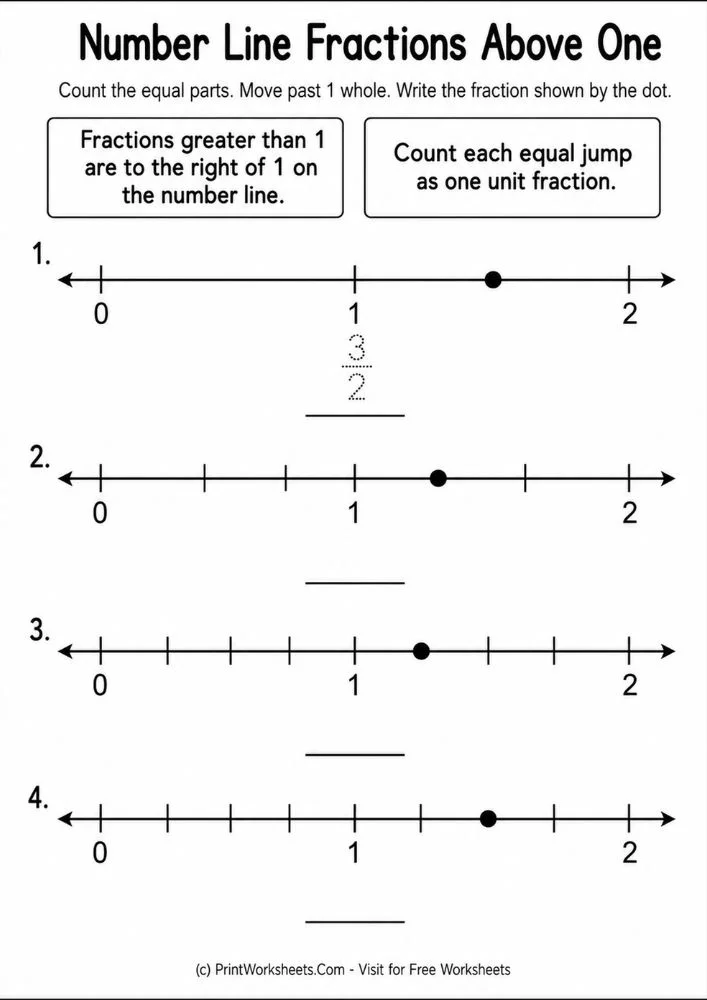
The first worksheet, Number Line Fractions Above One, asks students to study four number lines and write the fraction shown by the dot. Each line already includes the point, so students concentrate on counting the equal parts and deciding how far the dot is from zero. The page begins with halves and then moves to smaller intervals such as thirds and fourths.
This page works well as an introduction because students do not need to draw their own point. They simply count the equal jumps, notice that the dot is to the right of 1, and write the full fraction. That makes it a strong first step before independent plotting.
Related review: Start with the unit fractions on number lines worksheets for grade 3 if students need more practice counting equal intervals before moving past 1 whole.
Plot Fractions Past One with Different Denominators
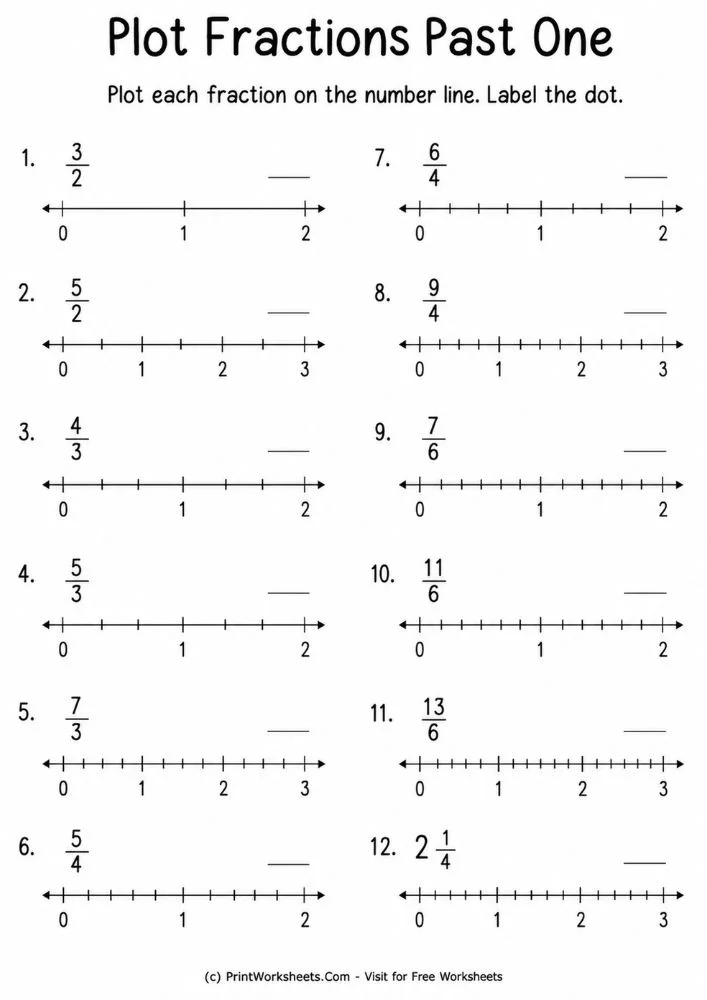
The second worksheet, Plot Fractions Past One, gives 12 number lines for direct plotting practice. Students place and label fractions including 3/2, 5/2, 4/3, 5/3, 7/3, 5/4, 6/4, 9/4, 7/6, 11/6, 13/6, and 2 1/4. The number lines extend to 2 or 3 depending on the value, so students must pay attention to both the denominator and the size of the fraction.
Because the worksheet mixes improper fractions and one mixed number, students can compare different forms while still using the same skill. They practice deciding whether the point should land just past 1, halfway to 2, or farther along the line.
Use Story Problems to Connect Improper Fractions and Mixed Numbers
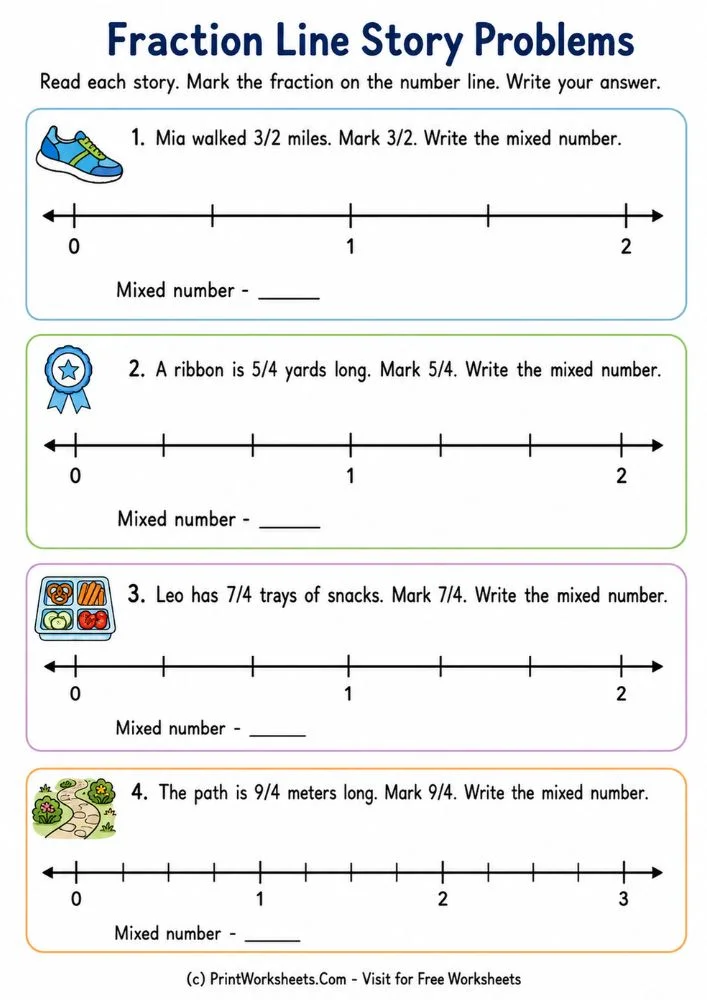
The third included page, Fraction Line Story Problems, turns number-line practice into four short word problems. Students mark 3/2 miles, 5/4 yards, 7/4 trays, and 9/4 meters on number lines and then write the mixed number. This page adds a simple context while keeping the task focused on reading and labeling positions correctly.
The mixed-number blanks make students translate between forms after plotting the point. For example, once students place 3/2, they can see it as 1 1/2. When they place 9/4, they can count two full wholes and one more fourth.
Continue practicing: The equivalent fractions with area models worksheets for grade 3 help students compare fraction values after they locate fractions greater than one on a number line.
A Clear Three-Page Sequence for Number-Line Fraction Practice
- Page 1: Read the dot and write the fraction greater than 1.
- Page 2: Plot and label fractions past 1 with several denominators.
- Page 3: Apply the same skill in short story problems and convert to mixed numbers.
This three-page set fits small-group work, independent review, or a short lesson sequence on fractions beyond one whole. The progression moves from reading a marked point to plotting independently and then explaining the value through word problems.