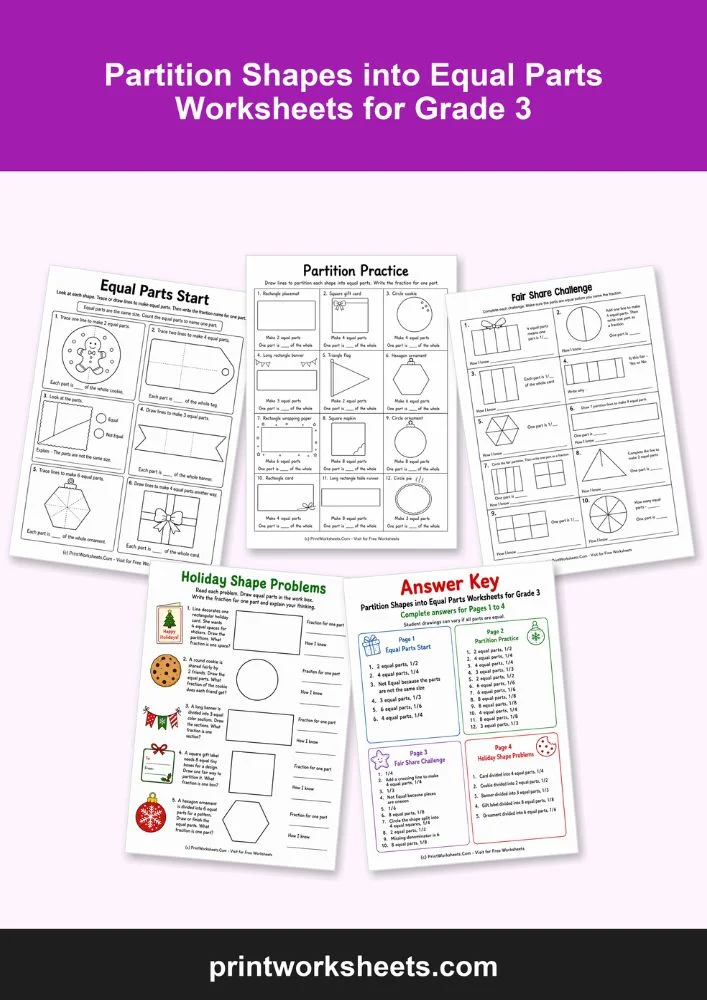
These partition shapes into equal parts worksheets for grade 3 include three student pages with 27 numbered tasks. The visible pages—Partition Practice, Fair Share Challenge, and Holiday Shape Problems—ask students to draw equal partition lines, judge whether shares are fair, and write the fraction name for one part. Responses include short fraction blanks, Yes or No decisions, circled choices, and “How I know” explanations. Printed examples range from making two equal parts in a rectangle to dividing a square into eight equal boxes and completing a triangle line to show halves.
The shapes include rectangles, squares, circles, a triangle, a regular hexagon, a banner, a gift card, an ornament, and a pie. Across the set, denominators 2, 3, 4, 6, and 8 appear in repeated visual contexts. Students must focus on equal size rather than simply counting any regions that happen to be drawn.
Partition Shapes into Equal Parts Worksheets for Grade 3
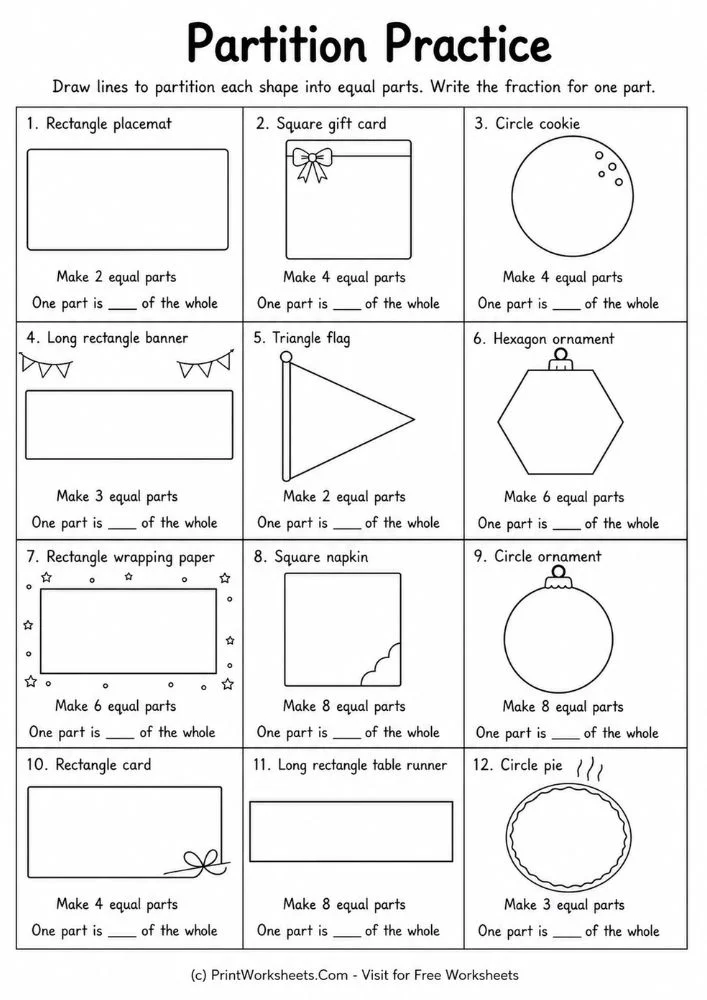
The Partition Practice page provides 12 blank shape models. Each box names the object, tells students how many equal parts to make, and finishes with “One part is ___ of the whole.” Students partition a rectangle placemat into halves, a square gift card and circle cookie into fourths, a banner into thirds, a triangle flag into halves, and a hexagon ornament into sixths. Later items ask for sixths or eighths in wrapping paper, a napkin, an ornament, a table runner, and a pie.
This page lets students compare more than one valid partitioning method. A rectangle can be divided with vertical strips, horizontal strips, or a balanced grid, provided every region has the same area. The written fraction blank connects the number of equal regions to the denominator.
Related visual review: Use the unit fractions on number lines worksheets for grade 3 to connect equal partitions in shapes with equal intervals on a number line.
Decide Whether Each Fair Share Is Truly Equal
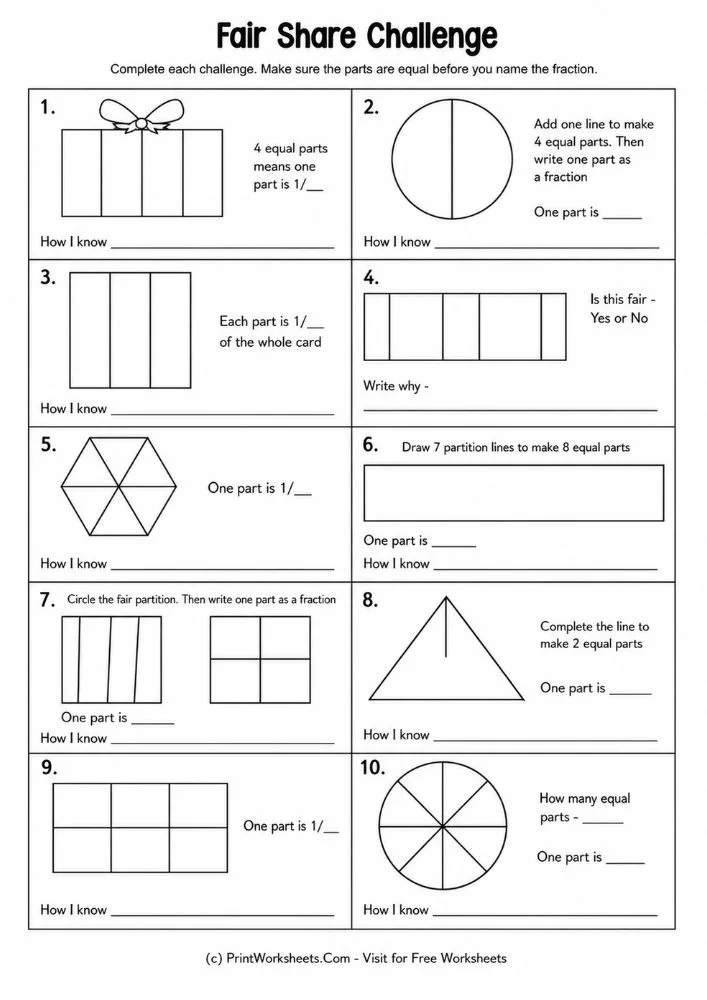
The Fair Share Challenge page moves from open drawing to checking and completing partitions. Ten challenges include a gift divided into four strips, a circle that needs one crossing line, a card divided into thirds, an uneven rectangle, a hexagon divided into six triangles, and a long rectangle that needs seven lines for eighths.
Students also circle the fair partition from two choices, complete a partial line in a triangle, count six equal regions in a rectangle, and read eight sectors in a circle. Several “How I know” lines require a brief explanation, such as noting that the regions are the same size or that an uneven partition is not fair. This keeps the visual decision tied to the meaning of equal parts.
Continue practicing: The equivalent fractions with area models worksheets for grade 3 extend this visual work by comparing different partitions that cover the same amount.
Apply Equal Partitioning to Holiday Shape Problems
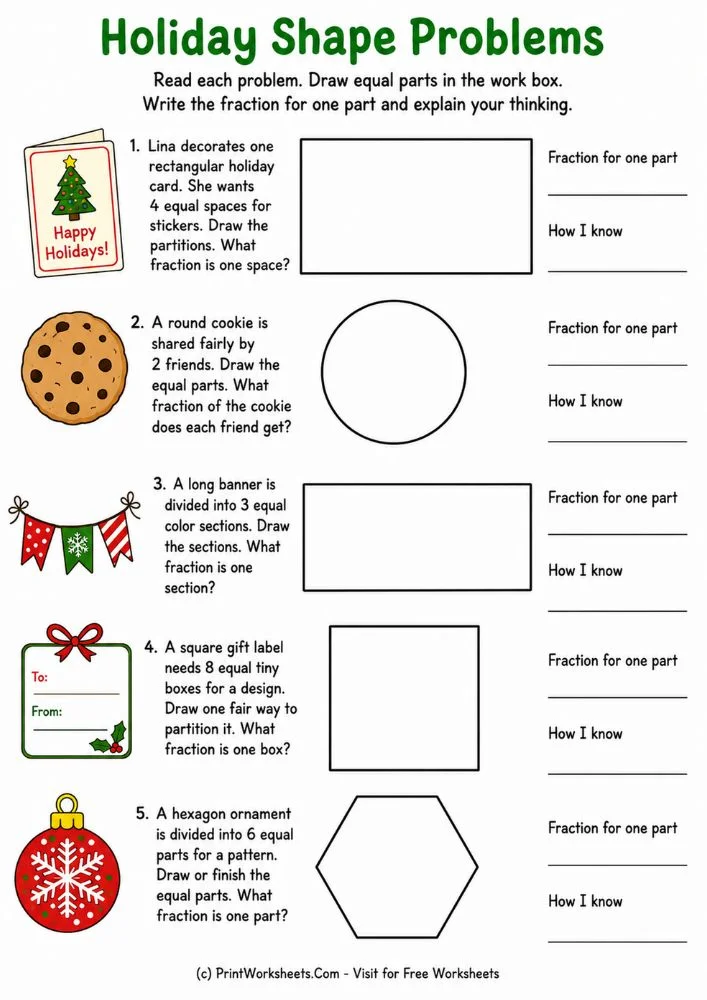
The full-color Holiday Shape Problems page places the same skill in five short situations. Students divide a rectangular card into four sticker spaces, share a round cookie between two friends, split a banner into three color sections, create eight boxes on a square gift label, and partition a hexagon ornament into six parts.
Each problem includes a large work shape, a “Fraction for one part” line, and a “How I know” line. The prompts keep the calculation simple so the main work remains visual: make equal regions, count the total regions, and name one region with a unit fraction.
Use the Three Pages as a Clear Practice Sequence
- Begin with Partition Practice: Model one example, then let students choose fair ways to divide the remaining shapes.
- Continue with Fair Share Challenge: Ask students to check existing lines before drawing or completing a partition.
- Finish with Holiday Shape Problems: Have students pair each drawing with a fraction and a short equality explanation.
The three-page sequence works for a focused fraction lesson, small-group visual practice, or independent review. Because the same denominators appear in several shapes, students can compare how halves, thirds, fourths, sixths, and eighths look in different wholes.