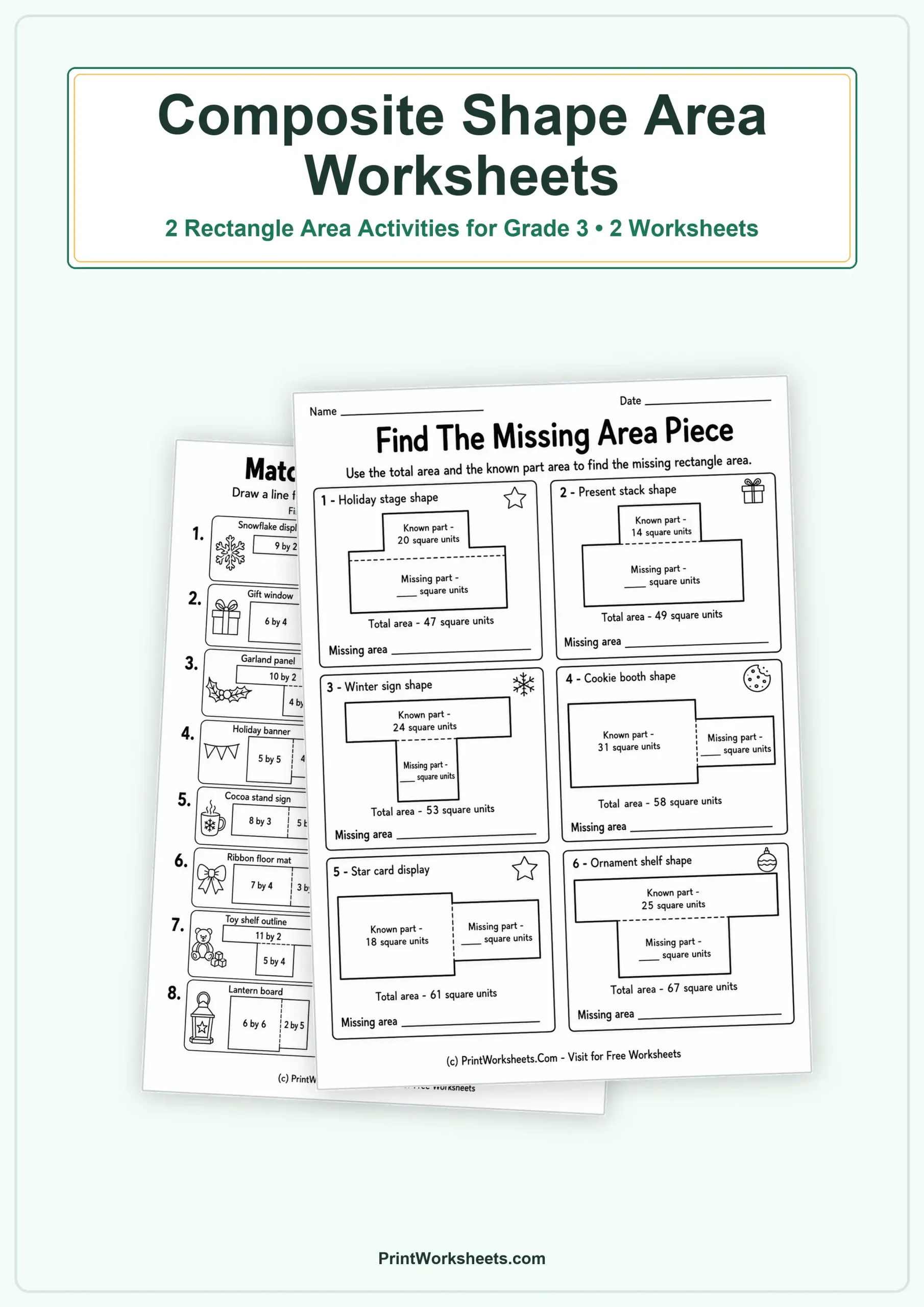
These composite shape area worksheets give third graders two different ways to work with shapes built from rectangles. Instead of stopping after finding the area of one rectangle, students connect two rectangular parts to a larger whole. One worksheet asks them to calculate and match total areas, while the other reverses the thinking by giving the total area and one known part so students can determine the missing rectangle area.
Composite Shape Area Worksheets with Two-Rectangle Models
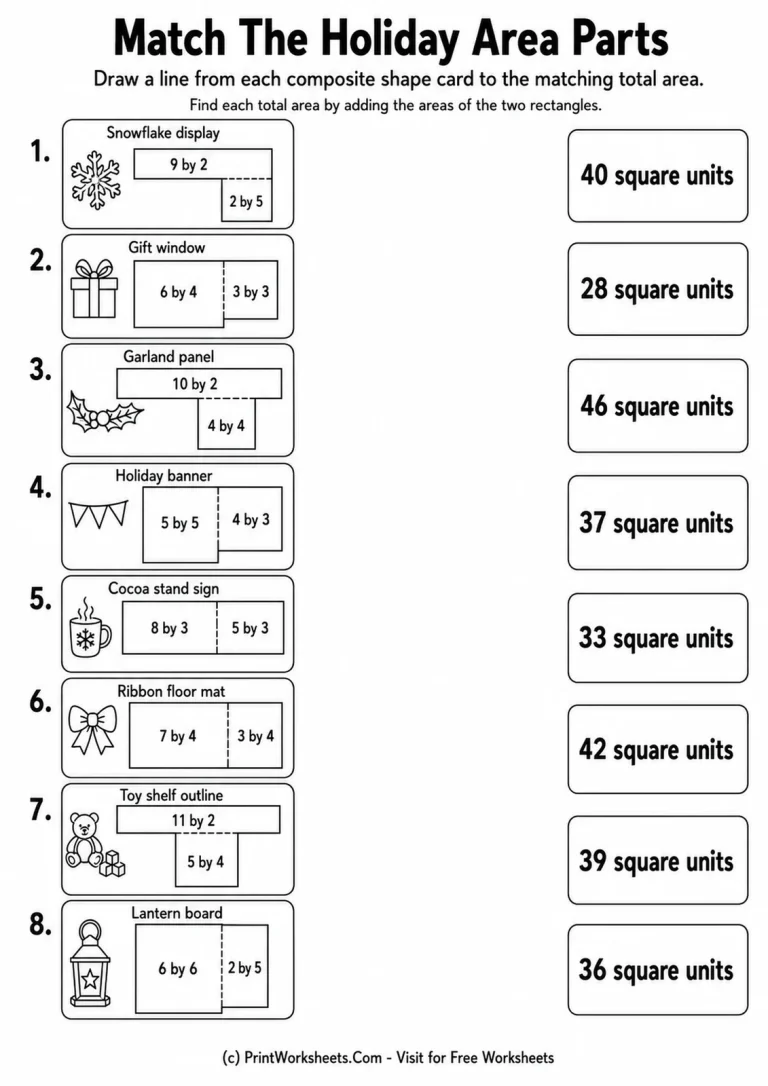
The first activity, Match The Holiday Area Parts, presents eight composite shape cards. Each card shows two rectangular sections with dimensions already labeled, such as 9 by 2 and 2 by 5, or 6 by 4 and 3 by 3. Students find the area of each rectangle, add the two results, and then draw a line to the matching total area on the opposite side of the page.
This format makes the structure of a composite area problem visible. Students are not asked to guess which measurements matter. The two rectangle dimensions are clearly provided, so the mathematical work stays focused on multiplication for rectangular area and addition for combining parts. The eight correct totals are 28, 33, 36, 37, 39, 40, 42, and 46 square units, giving students a useful range of products and sums without moving beyond manageable Grade 3 arithmetic.
The matching design also changes the response style from a standard write-the-answer worksheet. Because all eight totals appear as choices, students can use calculation, comparison, and elimination as they work. Holiday-themed labels such as Snowflake display, Gift window, Garland panel, Cocoa stand sign, Ribbon floor mat, Toy shelf outline, and Lantern board add visual variety while the task remains centered on area.
Finding a Missing Area from the Total
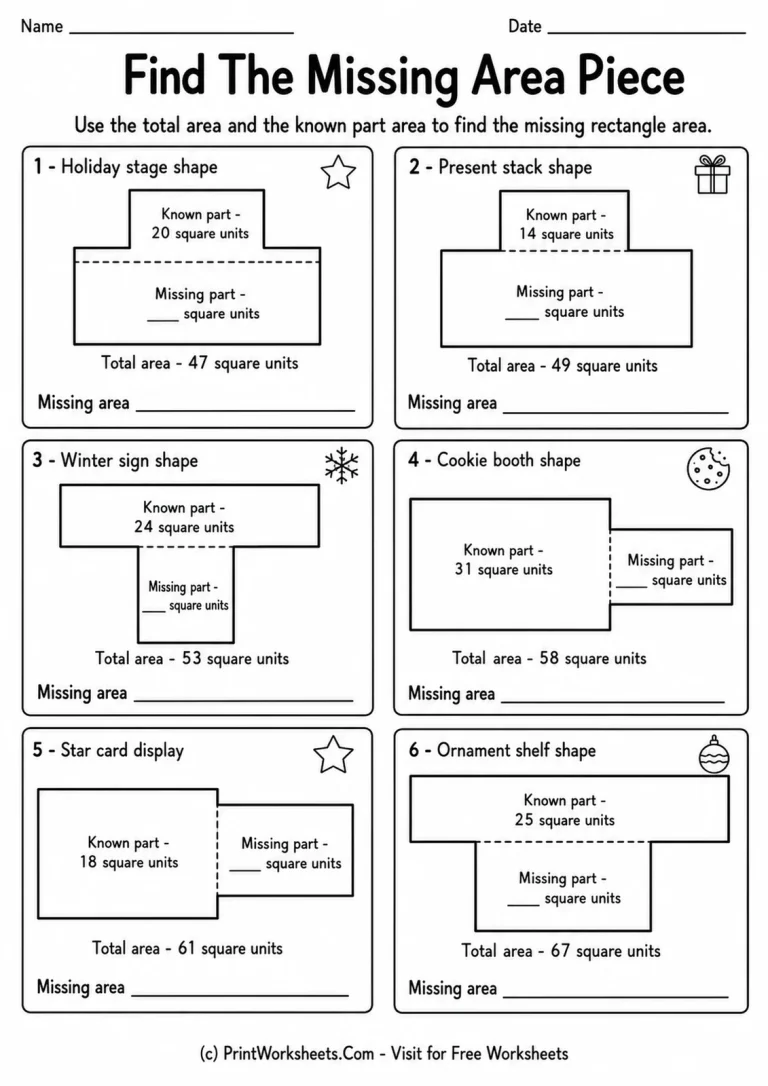
The second worksheet, Find The Missing Area Piece, shifts the reasoning. Each of six composite figures includes a total area and the area of one known rectangular part. Students must determine how much area belongs to the missing rectangle. For example, a shape with a total area of 47 square units and a known part of 20 square units requires students to calculate 47 minus 20 to find a missing area of 27 square units.
The remaining problems follow the same relationship with different values: 49 and 14, 53 and 24, 58 and 31, 61 and 18, and 67 and 25 square units. The resulting missing areas are 35, 29, 27, 43, and 42 square units. This turns composite area into a part-whole problem and gives students practice recognizing that the total area equals the sum of its rectangular parts.
That progression is useful after students have learned basic rectangle area. A child who can multiply length by width may still need practice deciding how separate areas combine. These pages make that relationship explicit in two directions: add the parts to find the whole, then subtract a known part from the whole to find what is missing.
How These Grade 3 Area Worksheets Fit into Practice
Teachers can use the matching page first as guided or independent practice because the rectangle dimensions are visible on every card. The missing-area page works well afterward as a follow-up challenge, math center task, homework page, or short assessment of part-whole understanding. Both worksheets consistently use square units, helping reinforce the correct unit language for area.
Students who need additional preparation can begin with area of rectangles with unit squares worksheets before moving to composite figures. After they are comfortable combining and separating areas, area and perimeter word problems worksheets can extend the skill into written problem-solving situations.
From Rectangle Area to Part-Whole Reasoning
These worksheets are especially useful when students are ready to see area as more than a single multiplication fact. The first page builds totals from two known rectangles; the second begins with the total and asks students to recover an unknown part. Together, they provide a compact sequence for strengthening composite shape area reasoning while keeping the calculations accessible for third-grade learners.