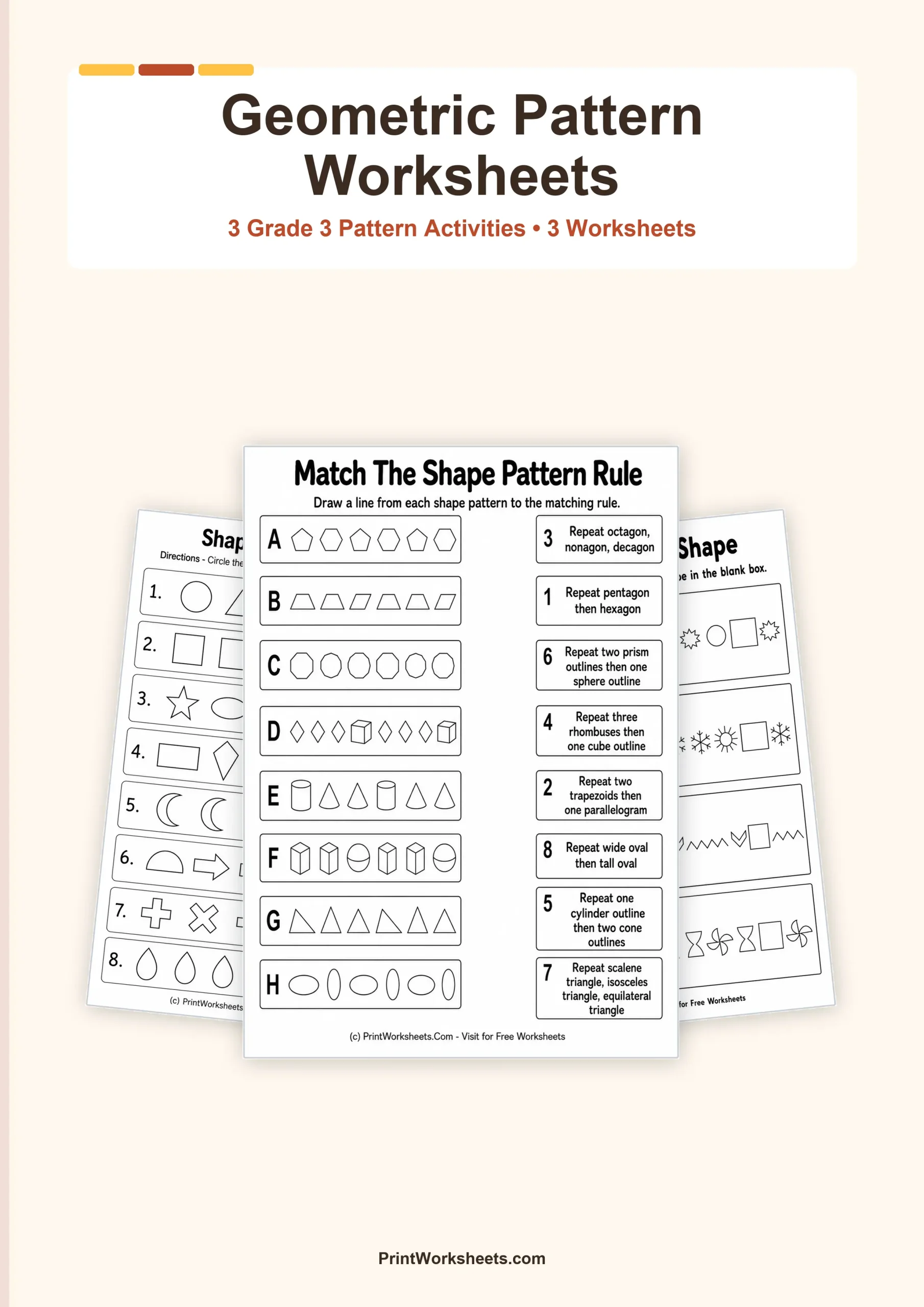
Geometric pattern worksheets give third graders a concrete way to study how shapes repeat, change position in a sequence, and follow a predictable rule. This printable set focuses on visual pattern reasoning rather than computation. Across three student pages, learners identify a repeating unit, predict the next shape, connect a visible pattern to its written rule, and determine which shape is missing from the middle of a sequence. The activities move from direct visual continuation to more explicit rule language, making the set useful for independent math practice, centers, homework, or a short geometry review.
Geometric pattern worksheets that build rule recognition
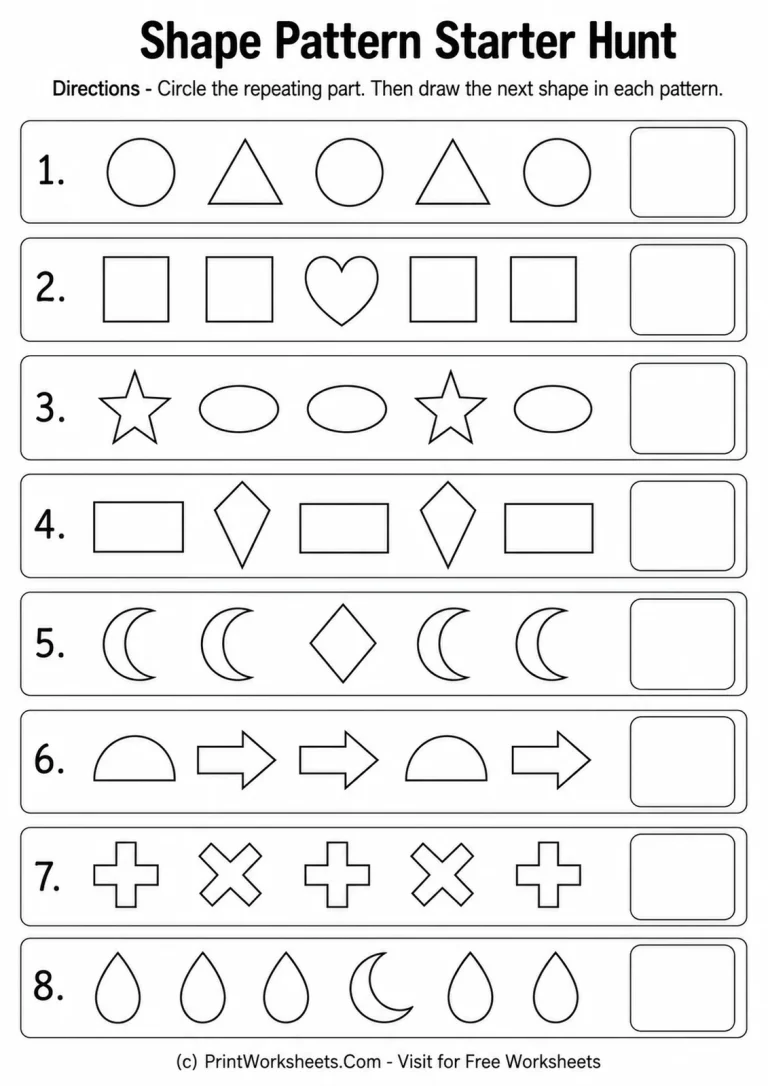
The first worksheet, Shape Pattern Starter Hunt, asks students to circle the repeating part and then draw the next shape. Eight rows use familiar outlines such as circles, triangles, squares, hearts, stars, ovals, kites, crescents, arrows, crosses, teardrops, and other simple forms. The patterns are not all built from the same structure. Students encounter alternating patterns as well as sequences with repeated pairs or longer units, so they need to notice the actual rule instead of assuming every row is an AB pattern.
This page works well as a starting activity because students can reason directly from what they see. A teacher can also ask students to describe the repeating unit aloud before they draw. That small step turns a visual task into mathematical language practice: “circle, triangle” or “square, square, heart,” for example. Students who finish quickly can extend any row by two or three more shapes.
Match shape patterns to written rules
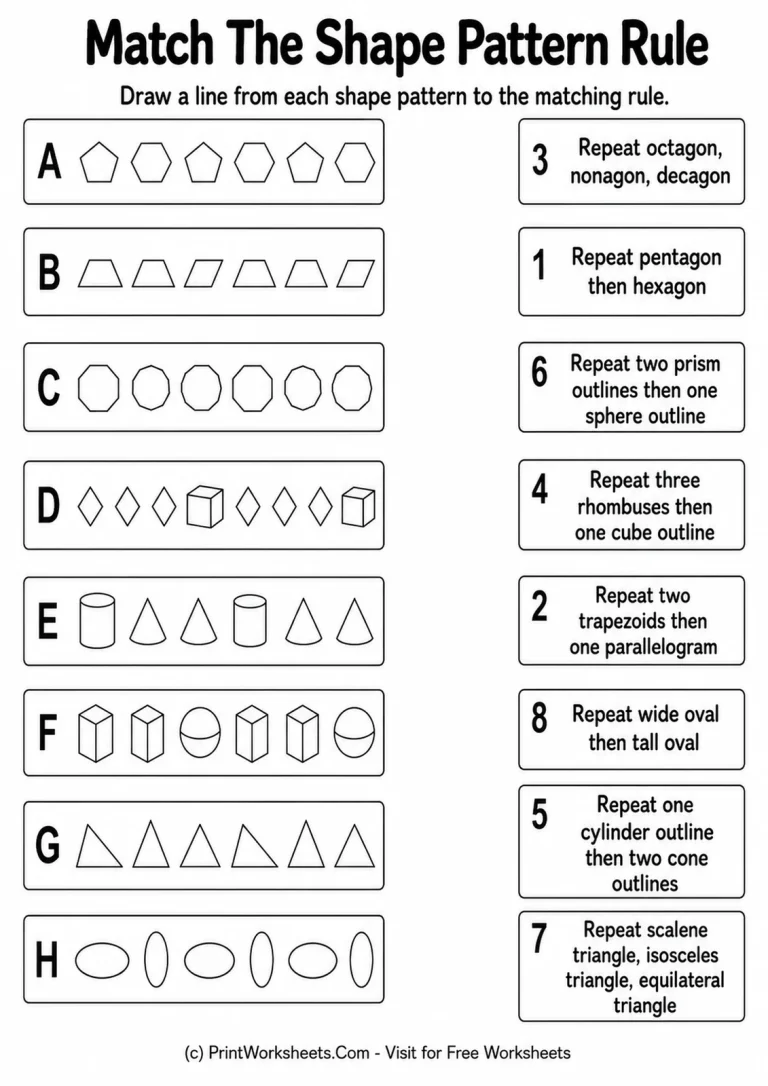
The second worksheet, Match The Shape Pattern Rule, raises the level of abstraction. Eight lettered patterns must be connected to eight numbered rule cards. Some sequences alternate pentagons and hexagons, while others repeat groups involving octagons, nonagons, decagons, trapezoids, parallelograms, rhombuses, cubes, cylinders, cones, prisms, sphere outlines, triangles, or ovals. Students therefore have to compare both the visual order and the wording of each rule.
This is especially useful for Grade 3 students who can extend a pattern visually but need more practice explaining why the pattern works. The matching format encourages them to check each sequence carefully: Which shape comes first? How many times does it repeat? Does the group contain two shapes or three? Those questions support precise pattern vocabulary and help students connect geometry names with sequence structure.
From spotting a pattern to finding a missing element
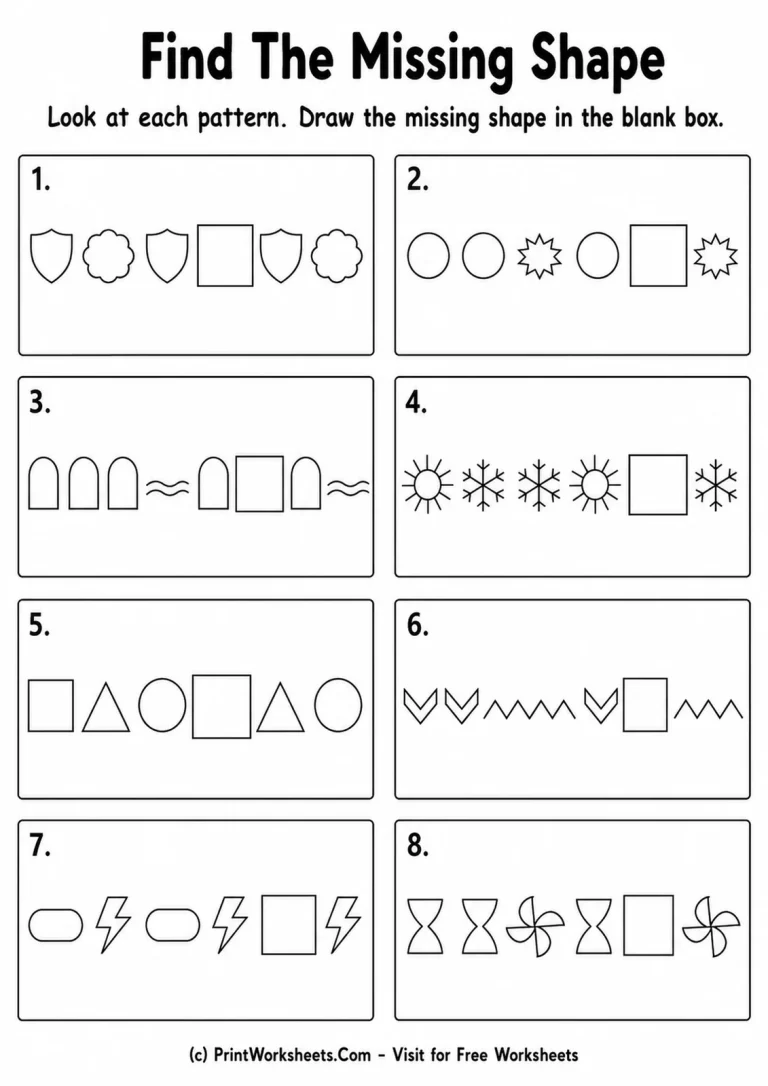
The third worksheet, Find The Missing Shape, changes the task again. Instead of placing the next object at the end, students draw a missing shape inside a blank box located within each sequence. Eight problems use distinct visual combinations, including shield-and-cloud shapes, circles with a burst shape, arches with wavy lines, suns with snowflakes, square-triangle-circle patterns, chevrons with zigzags, capsules with lightning bolts, and hourglass shapes with pinwheel-like figures.
Missing-middle problems require students to look on both sides of the blank. They cannot rely only on the first few shapes; they must infer the repeating unit and check that the shape they choose makes the entire sequence consistent. This makes the page a strong follow-up after simple “what comes next?” practice and adds useful reasoning without turning the worksheet into a reading-heavy activity.
Ways to use these Grade 3 shape pattern pages
For a short lesson, start with the first page and have students mark the repeat unit before completing each row. Use the second page on another day to emphasize mathematical language and shape names. Save the missing-shape page for independent practice, an exit ticket, or a small-group check of whether students can reconstruct a pattern when information is removed.
The set also pairs naturally with other visual math resources on the site. Students who enjoy themed geometry practice can continue with winter shapes worksheets. For a different kind of sequence practice that combines visual patterns with number thinking, see finger counting patterns worksheets. If your class is also working on picture-based operations, addition with pictures worksheets offer another visual approach.
What students practice with geometric shape patterns
These worksheets reinforce several connected Grade 3 skills: identifying a repeating unit, extending a sequence, interpreting a written pattern rule, using geometry vocabulary, and finding a missing element from surrounding evidence. Because the three pages use different response types—drawing, matching, and completing a gap—students are asked to show understanding in more than one way. Print the full set for a compact pattern mini-unit, or choose one page when you want targeted practice with a specific kind of reasoning.