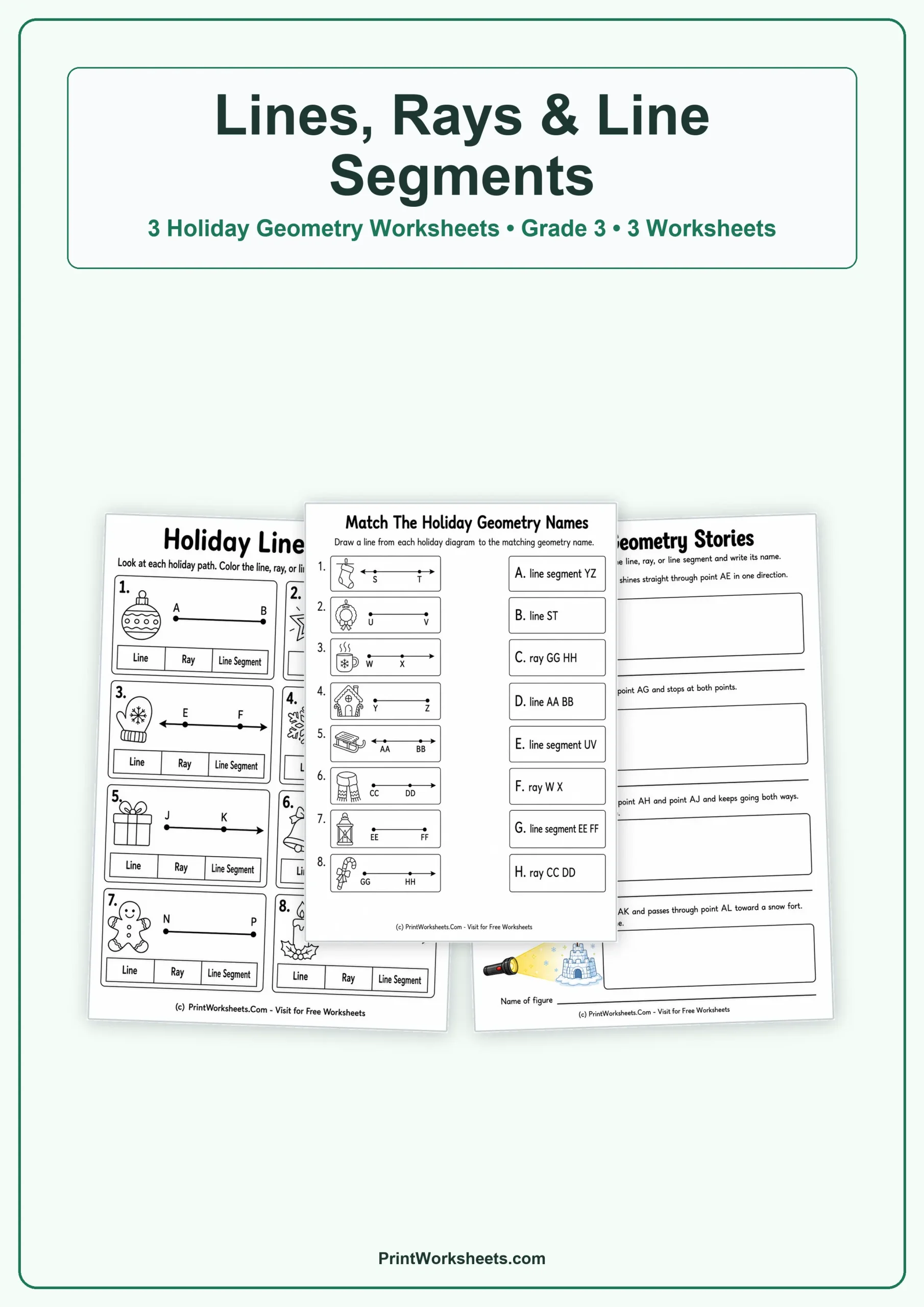
These lines rays and line segments worksheets give Grade 3 students several ways to work with one of the first important ideas in geometry. Instead of repeating the same identification exercise, the set moves from recognizing visual features to using point names and then interpreting short story situations. Holiday and winter illustrations add interest, but every approved activity keeps the mathematics focused on deciding whether a figure extends in two directions, begins at one endpoint and continues in one direction, or stops at two endpoints.
Lines, Rays and Line Segments Worksheets for Visual Classification
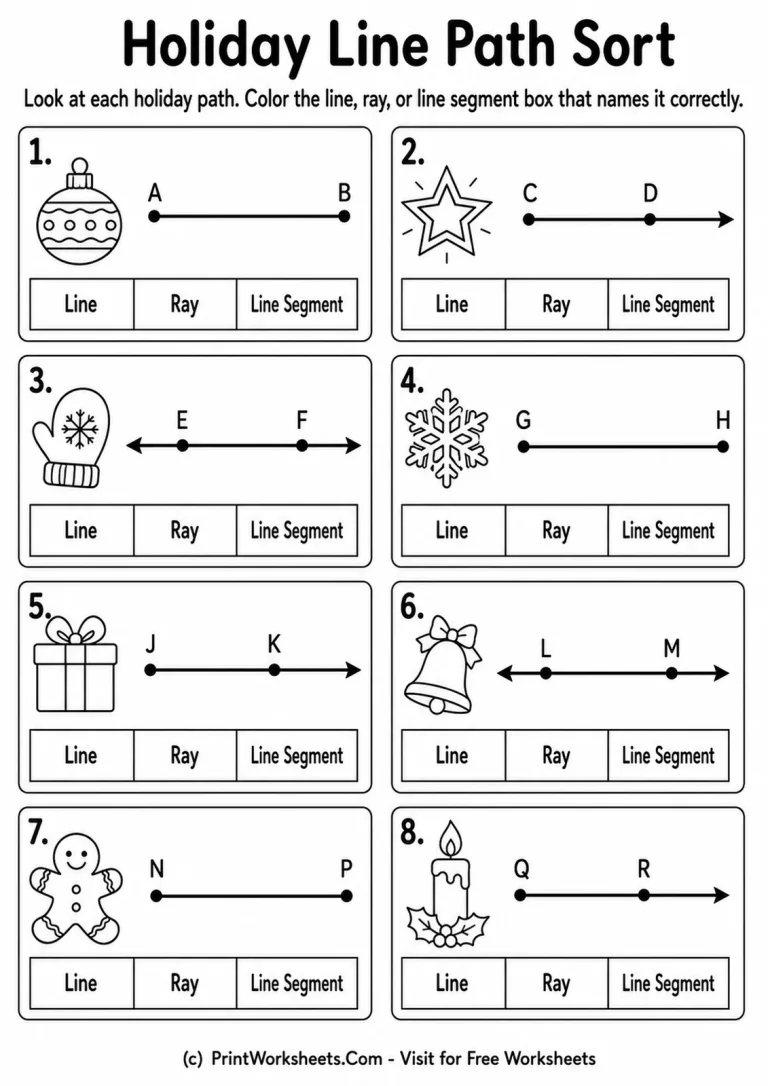
The first worksheet, Holiday Line Path Sort, presents eight clearly separated diagrams. Students inspect each figure and choose Line, Ray, or Line Segment. The diagrams include labeled points such as A and B, C and D, E and F, and other pairs, while arrows and solid endpoints provide the visual evidence needed to make each decision.
This page is useful for checking whether students understand the defining features instead of relying only on vocabulary. A line has arrows showing that it continues in both directions. A ray begins at an endpoint and continues in one direction. A line segment has two endpoints and stops at both. Because all three figure types appear multiple times, students get repeated practice comparing these characteristics within one page.
Practice Naming Geometry Figures with Points
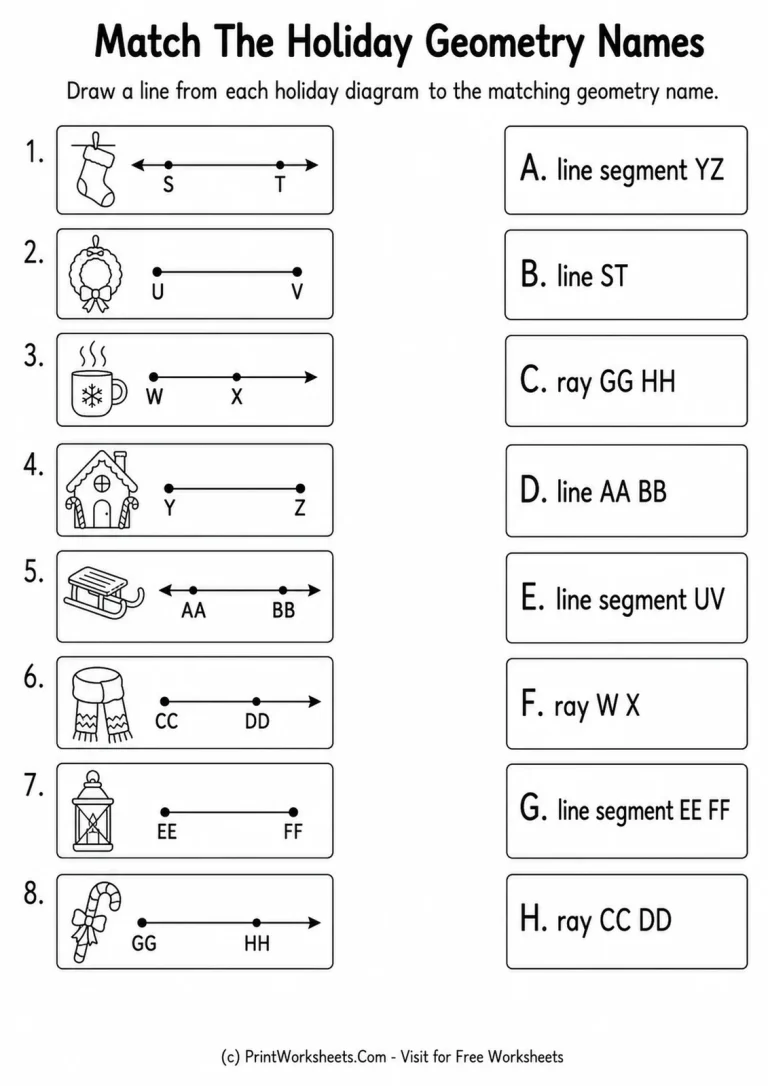
The second worksheet, Match The Holiday Geometry Names, raises the difficulty by combining the type of figure with its point labels. Eight diagrams on the left are matched to names on the right, including examples such as line ST, line segment UV, ray WX, line segment YZ, line AA BB, ray CC DD, line segment EE FF, and ray GG HH.
This matching format helps bridge the gap between seeing a figure and describing it mathematically. Students must pay attention to both the arrows or endpoints and the letters attached to the points. The use of single-letter and double-letter labels also gives learners experience reading geometry names without changing the underlying concept.
Students who need related Grade 3 geometry work can continue with perimeter of polygons worksheets for Grade 3. That resource shifts from identifying geometric figures to measuring the distance around polygons, making it a useful next topic within the same subject area.
Move from Recognition to Drawing
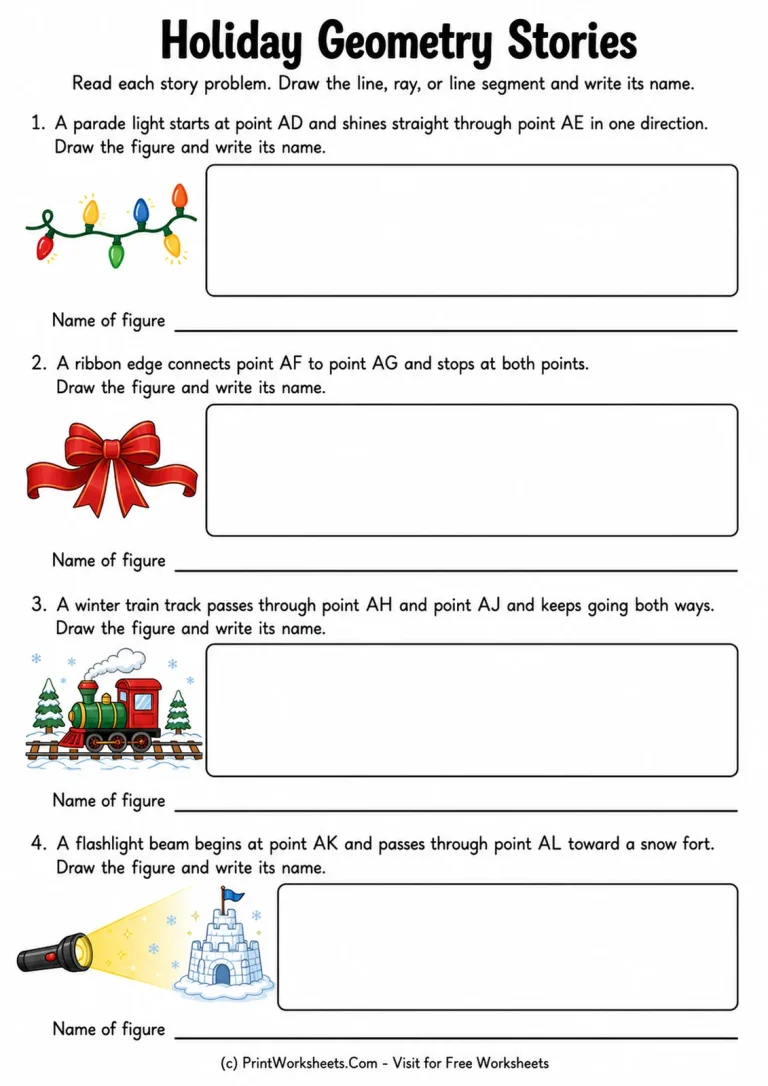
The third approved activity, Holiday Geometry Stories, changes the task completely. Students read four short situations, determine which kind of figure is being described, draw it in a large response box, and write its name. The language supplies meaningful geometric clues. One parade light starts at point AD and shines through AE in one direction, which describes a ray. A ribbon connects AF to AG and stops at both points, describing a line segment. A winter train track passes through AH and AJ and continues both ways, describing a line. A flashlight begins at AK and passes through AL toward a snow fort, giving another ray example.
This page is especially valuable because students cannot solve it by simply copying a visible model. They must translate phrases such as “stops at both points,” “keeps going both ways,” and “begins at” into the correct geometric representation. The generous drawing boxes also allow students to show endpoints, arrows, and labeled points clearly.
How to Use This Grade 3 Geometry Set
A practical sequence is to begin with the sorting worksheet, continue with the matching page, and finish with the story problems. That order moves from concrete visual recognition to formal naming and finally to independent construction. Teachers can use the pages across several lessons, while parents can choose one activity at a time for focused home practice.
For students who are also working with number-line representations, fractions on a number line worksheets for Grade 3 provide a different application of points and positions along a straight path. Another related option is division on number lines worksheets for Grade 3, which uses number lines for repeated jumps and division reasoning.
Together, these holiday-themed geometry worksheets give third graders a compact progression from identifying lines, rays, and line segments to naming them correctly and constructing them from written descriptions. They work well for classroom practice, review, independent work, or a seasonal math center when the goal is to strengthen precise geometry vocabulary and visual reasoning.