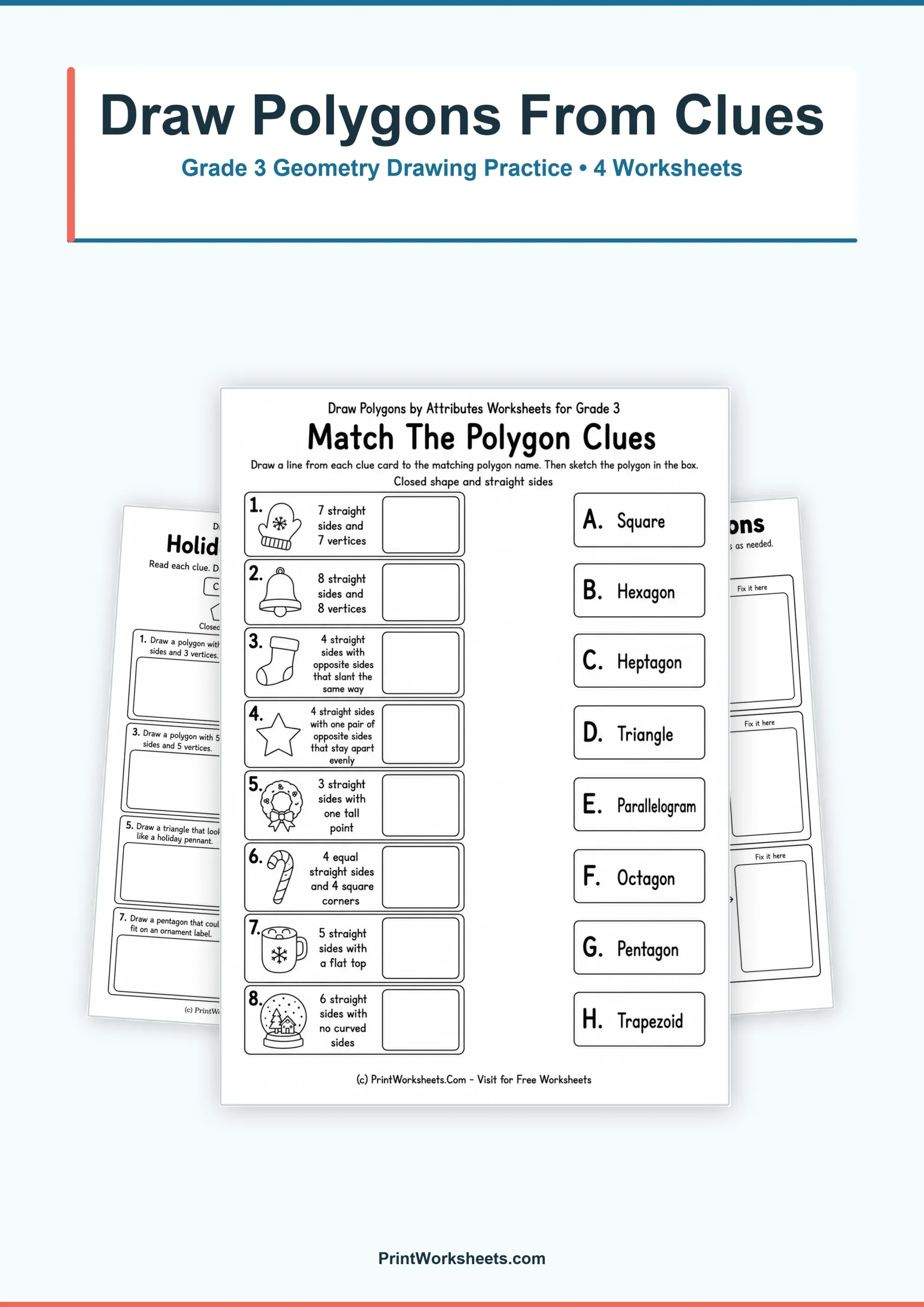
When students can name a triangle or hexagon but still struggle to create one from a description, these draw polygons by attributes worksheets provide focused practice with the language behind each shape. The four Grade 3 activities ask children to pay attention to straight sides, vertices, parallel sides, equal sides, and square corners before deciding what polygon belongs in the drawing box. Holiday-themed objects and short scenarios add context without replacing the geometry work.
Draw polygons by attributes in four different ways
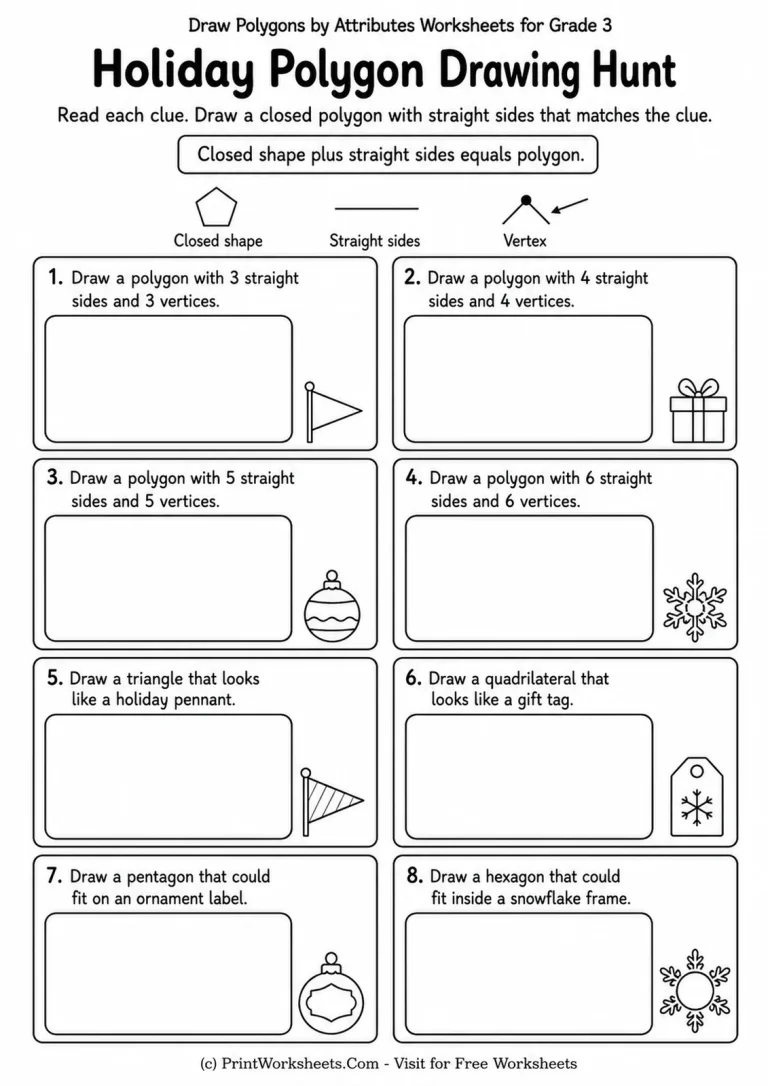
The first worksheet, Holiday Polygon Drawing Hunt, begins with direct attribute clues. Students draw closed shapes with three, four, five, or six straight sides and matching numbers of vertices. The later prompts connect those same ideas to familiar forms: a triangle that could look like a pennant, a quadrilateral that could resemble a gift tag, a pentagon for an ornament label, and a hexagon that could fit inside a snowflake frame. This gives students repeated practice translating mathematical language into a visible shape.
The page also includes a simple reminder that a polygon is a closed shape made with straight sides. Small visual examples for a closed shape, straight sides, and a vertex reinforce the vocabulary students need before they begin drawing.
Match polygon clues before sketching
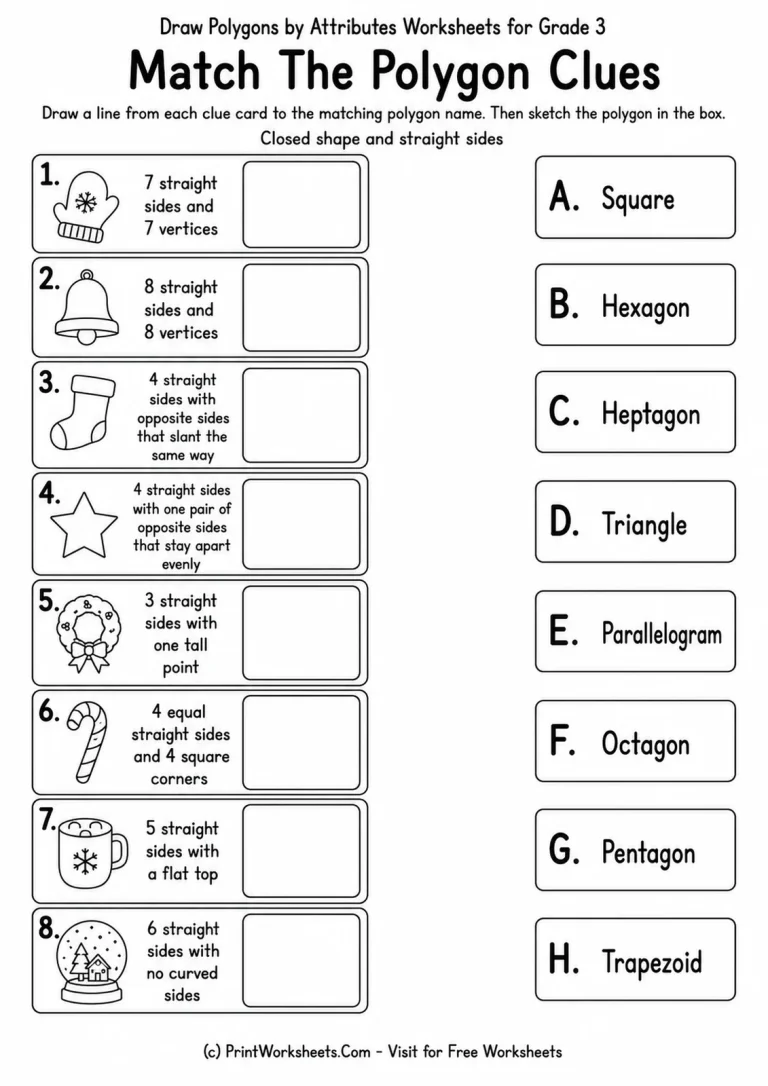
Match The Polygon Clues changes the task from direct drawing to classification. Eight clue cards describe shapes using properties such as seven or eight straight sides, one pair of opposite sides, equal sides with square corners, or opposite sides that slant the same way. Students match each clue to a polygon name and then sketch the matching shape.
The choices include square, triangle, pentagon, hexagon, heptagon, octagon, parallelogram, and trapezoid. Because students must both select a name and produce a drawing, the activity checks whether they understand the defining attribute rather than simply recognizing a memorized picture.
Correct shapes that do not meet the clue
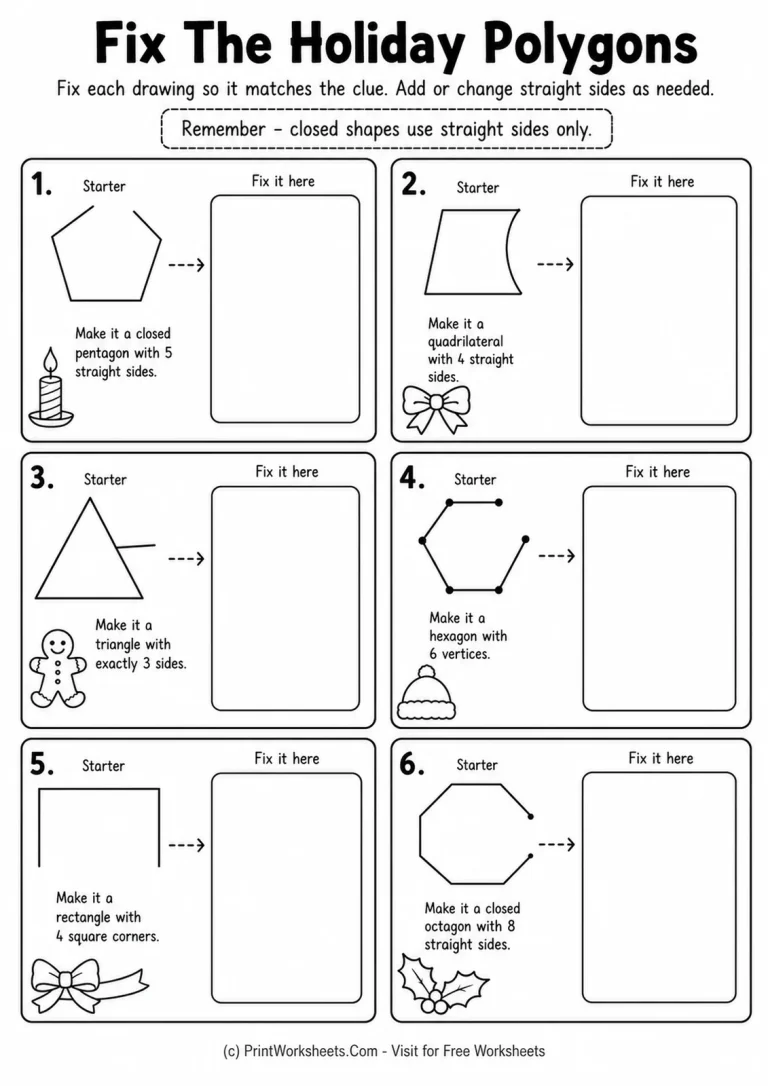
The third activity, Fix The Holiday Polygons, gives students imperfect starter drawings and asks them to repair each one. One pentagon is open, another figure contains a curved side, a triangle has an unnecessary extra segment, a hexagon is unfinished, a rectangle needs to be completed, and an octagon must be closed. Students redraw each figure in a separate box so the result matches the stated requirements.
This error-correction format is especially useful for discussing what does and does not count as a polygon. Instead of only producing correct examples, students analyze why a starter drawing fails and decide what must change. That makes the worksheet a useful bridge between basic shape identification and more careful reasoning about attributes.
Apply polygon properties in short story problems
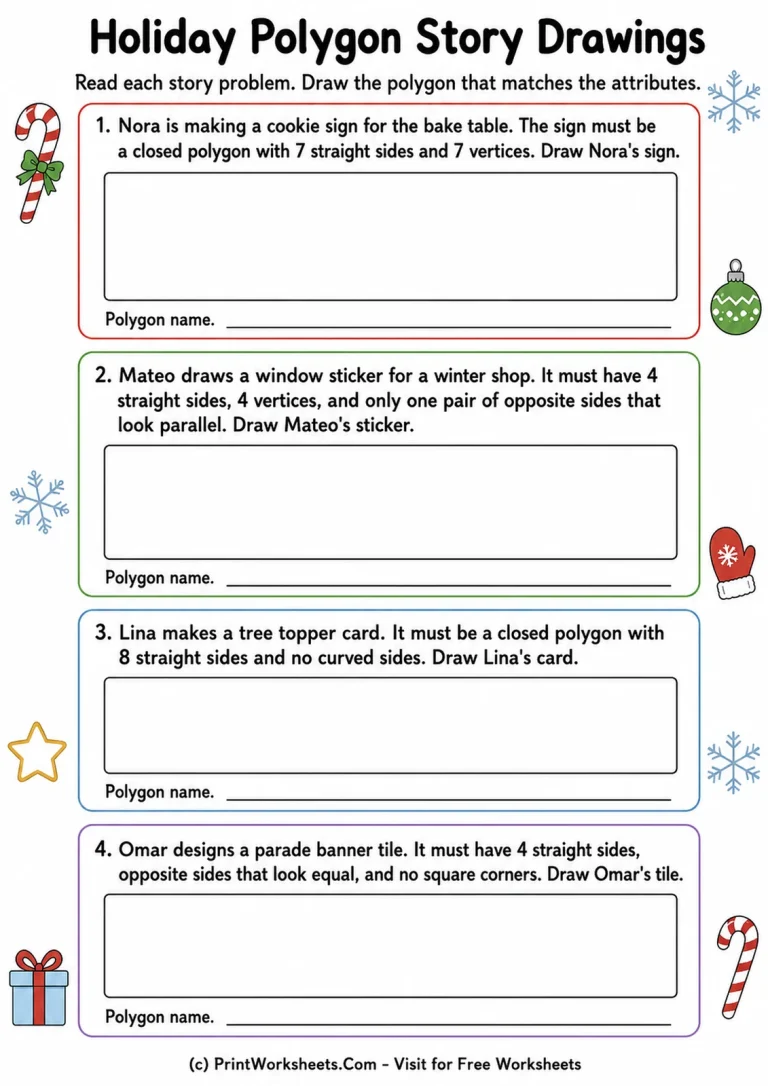
Holiday Polygon Story Drawings places the same geometry ideas inside four short scenarios. Students create a seven-sided cookie sign, a four-sided window sticker with one pair of opposite sides that appear parallel, an eight-sided tree topper card, and a four-sided parade banner tile with opposite sides that look equal and no square corners. After each drawing, students write the polygon name on a line below the work area.
These prompts naturally lead to heptagon, trapezoid, octagon, and parallelogram examples. They also encourage students to connect formal properties to practical design descriptions rather than relying only on a standard textbook diagram.
Ways to use this Grade 3 polygon set
Teachers can use the pages in sequence or select one based on the type of practice students need. Begin with the drawing hunt when students are still connecting side and vertex counts to polygon names. Move to the matching page when they are ready to distinguish more specific quadrilateral properties. Use the correction page for partner discussion or small-group instruction, asking students to explain what is wrong before they redraw each starter shape. The story page works well as independent practice because students must read, interpret, draw, and name each polygon.
For a follow-up lesson that shifts from describing shapes to measuring them, pair this set with the perimeter of polygons worksheets for Grade 3. Together, the activities can move students from identifying and constructing polygons by their attributes to working with the lengths around those shapes.
Across the set, students repeatedly use geometric vocabulary while producing their own examples. The changing task formats keep the practice purposeful: draw from a clue, match a description, repair a mistake, and apply the same attributes in a short situation. That variety makes the worksheets useful for classwork, review, math centers, or a quick check of Grade 3 polygon understanding.