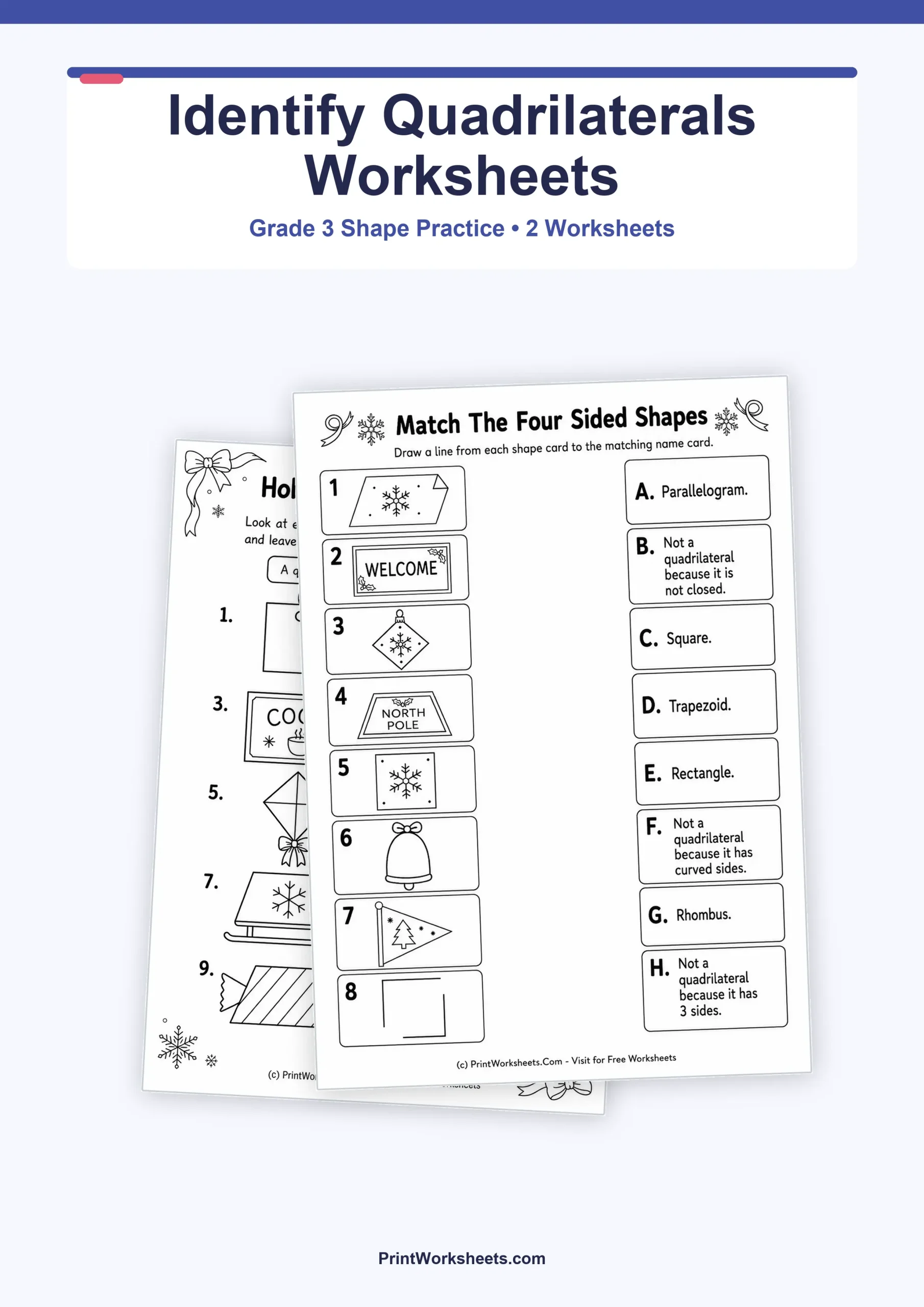
These identify quadrilaterals worksheets give Grade 3 students two different ways to practice recognizing four-sided shapes. Instead of working only with isolated textbook figures, children examine holiday-themed objects, decide which outlines meet the definition of a quadrilateral, and connect familiar shape names to visual examples. The activities focus on a simple but important rule: a quadrilateral must be closed and have four straight sides. Students then apply that rule to squares, rectangles, rhombuses, trapezoids, parallelograms, and several carefully chosen non-examples.
Identify quadrilaterals by their defining features
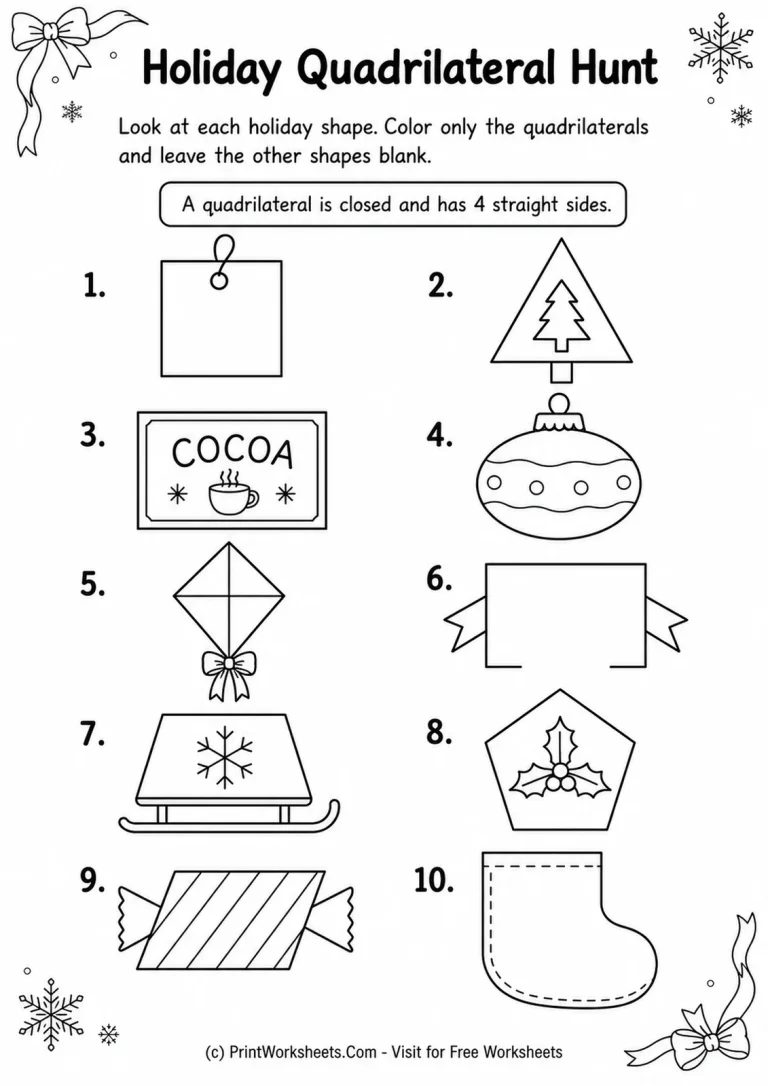
The first printable, Holiday Quadrilateral Hunt, asks students to look at ten illustrated holiday shapes and color only the quadrilaterals. A reminder box states that a quadrilateral is closed and has four straight sides, giving students a clear checklist to use while they work. The page includes several four-sided figures as well as shapes that should remain blank because they have three sides, five sides, curved edges, or an open boundary.
This type of visual sorting is useful because students cannot rely only on a shape’s orientation or a familiar classroom prototype. A diamond-shaped figure, for example, still qualifies as a quadrilateral when it has four straight connected sides. A curved ornament does not. An open figure also fails the definition even if several straight segments are visible. Looking closely at the entire outline encourages students to reason from geometric properties rather than from appearance alone.
Build quadrilateral vocabulary with matching
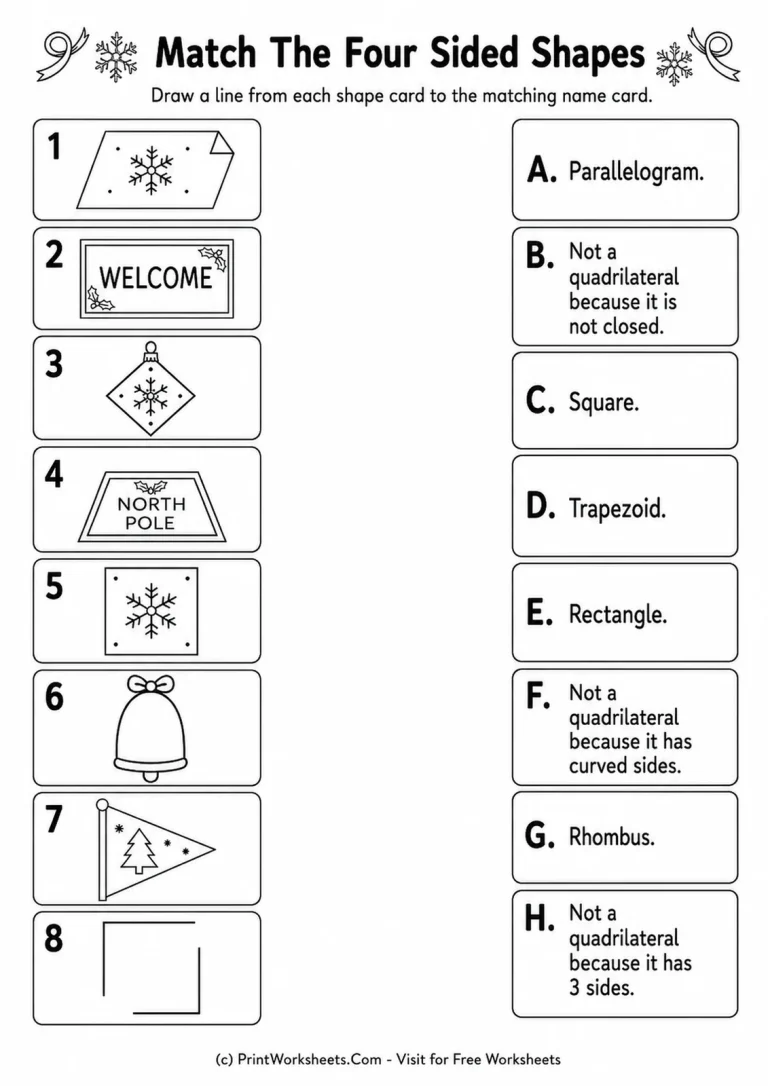
The second worksheet, Match The Four Sided Shapes, moves from general identification to more specific classification. Students draw lines from eight shape cards to matching name or description cards. The vocabulary includes parallelogram, rectangle, rhombus, trapezoid, and square. The remaining choices explain why particular examples are not quadrilaterals, including a figure with curved sides, a three-sided figure, and a shape that is not closed.
This matching format adds an important language component to geometry practice. Students are not simply deciding yes or no; they must distinguish among several quadrilateral families and connect a visual model with the correct mathematical term. At the same time, the non-example descriptions reinforce the exact properties that matter. A child who understands why an open shape is not a quadrilateral is developing stronger geometric reasoning than a child who only memorizes the names of five common figures.
What Grade 3 students practice
Across the two printable pages, students practice identifying closed figures, counting straight sides, rejecting shapes with curved boundaries, recognizing that orientation does not change a shape’s classification, and using common quadrilateral vocabulary. They also compare valid examples with non-examples, which helps make the definition of a quadrilateral more precise.
The holiday theme gives the practice a playful setting without replacing the math objective. Shape outlines appear in objects such as signs, decorations, flags, ornaments, and other seasonal designs. These varied contexts can help students notice quadrilaterals outside the usual set of plain geometric diagrams while still keeping the required features visible.
Ways to use these Grade 3 geometry worksheets
These pages can be used for independent practice after introducing quadrilaterals, as a small-group review activity, or as a quick check before moving into more detailed shape classification. The coloring page works especially well as an introductory or warm-up task because students repeatedly apply the four-straight-sides rule. The matching page is a natural follow-up because it asks students to attach more precise names and explanations to the figures they see.
Teachers can also ask students to explain one choice aloud after completing each page. Questions such as “How do you know this is a quadrilateral?” or “Why does this shape not belong?” encourage students to use terms such as closed, straight sides, curved sides, square, rectangle, and trapezoid in complete mathematical explanations. Parents using the worksheets at home can follow the same approach by asking children to point to the sides and corners before naming a shape.
Printable quadrilateral practice with clear contrasts
Together, these Grade 3 quadrilateral worksheets combine visual identification with shape-name matching, giving students repeated practice with both the definition and the vocabulary of four-sided figures. The mix of true quadrilaterals and clear non-examples makes the set useful for reinforcing what counts as a quadrilateral, what does not, and how several common quadrilateral types can look different while still sharing the same basic four-sided structure.