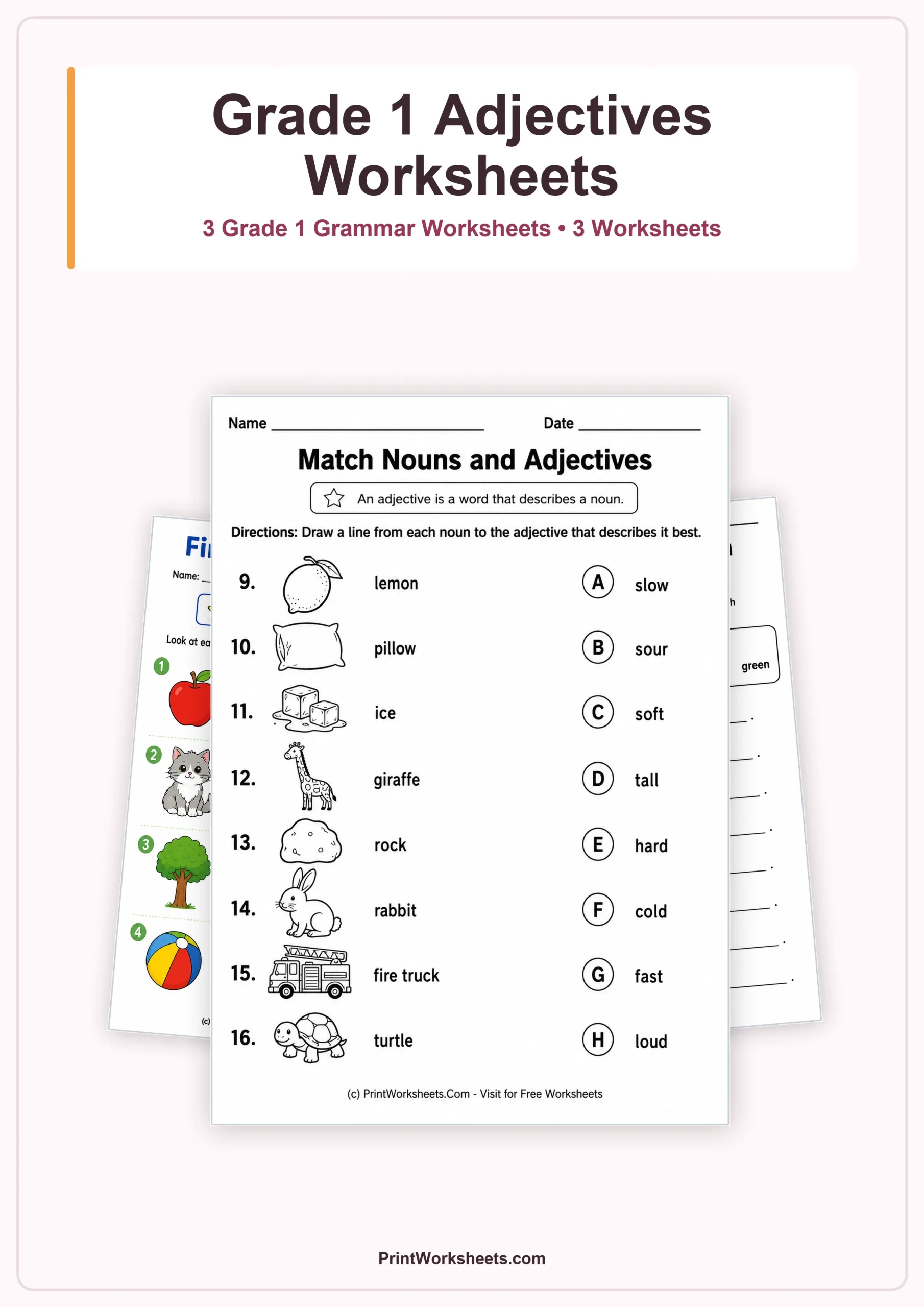
These adjectives worksheets give first graders three clear ways to practice how describing words add information about nouns. Instead of asking children to memorize a grammar rule in isolation, the set begins with familiar pictures and simple word choices, moves into matching nouns with suitable adjectives, and finishes with short sentences that require students to choose a describing word from a word bank. The progression keeps the language accessible while giving children repeated practice with the same core idea: an adjective tells more about a person, place, animal, or thing.
Adjectives Worksheets for Building Describing-Word Skills
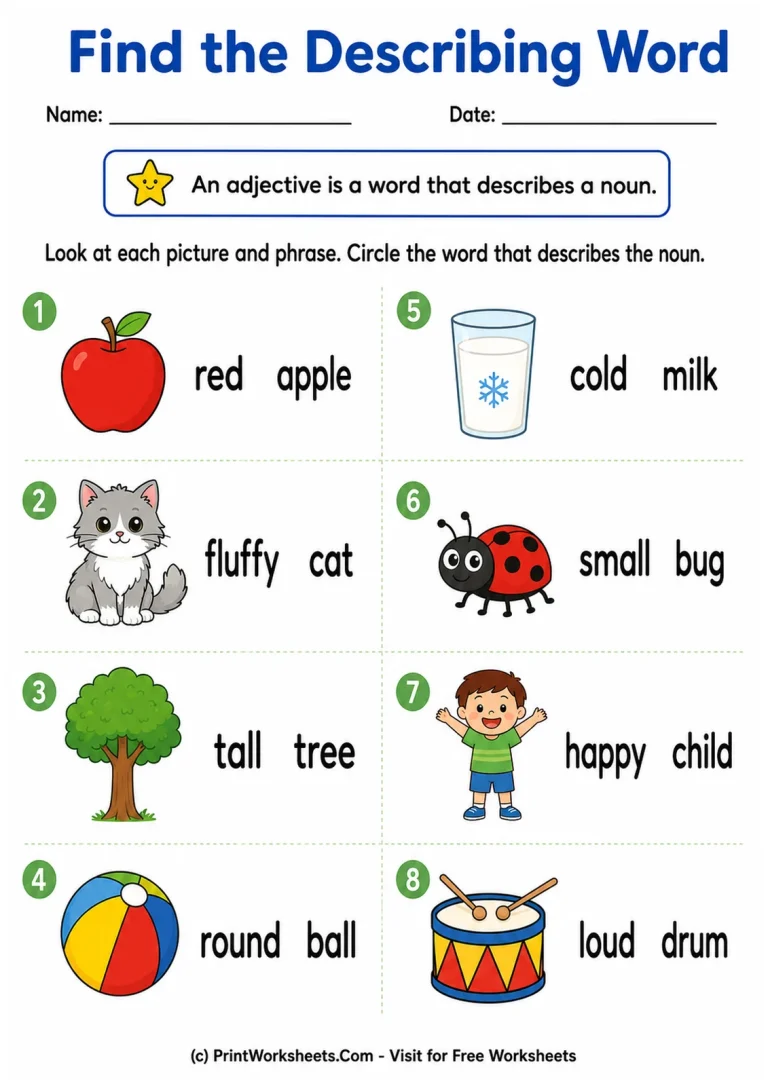
The first worksheet, Find the Describing Word, introduces adjective identification through eight picture-supported examples. Students look at a pictured noun and choose the word that best describes it. The examples use concrete combinations that are easy for young learners to understand, including a red apple, fluffy cat, tall tree, round ball, cold milk, small bug, happy child, and loud drum. A definition box reminds students that an adjective is a word that describes a noun, so children have a simple reference while they work.
This page is especially useful for students who are beginning to connect grammar vocabulary with everyday language. The pictures reduce the amount of reading required, while the two-choice format keeps attention on meaning. A child is not simply identifying a random word type; the child has to notice a visible or familiar quality and decide which word tells more about the noun.
Matching Nouns With the Best Adjectives
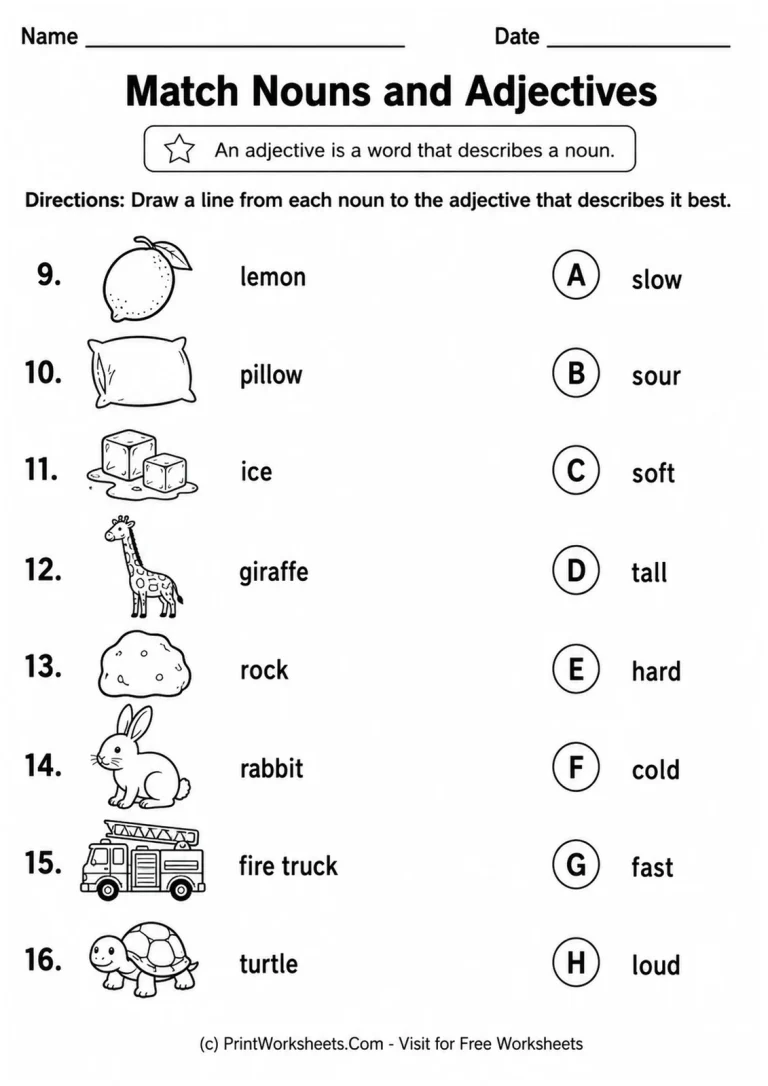
The second page, Match Nouns and Adjectives, removes the two-choice structure and asks students to connect eight nouns with eight describing words. The noun list includes lemon, pillow, ice, giraffe, rock, rabbit, fire truck, and turtle. Students match them with adjectives such as sour, soft, cold, tall, hard, fast, loud, and slow.
This activity adds a useful reasoning step because children must compare all of the available words before choosing the strongest match. For example, a lemon connects naturally with sour, a pillow with soft, and a giraffe with tall. The activity reinforces both vocabulary and grammar while showing that adjectives communicate qualities such as texture, temperature, size, speed, sound, and taste.
Using Adjectives Inside Complete Sentences
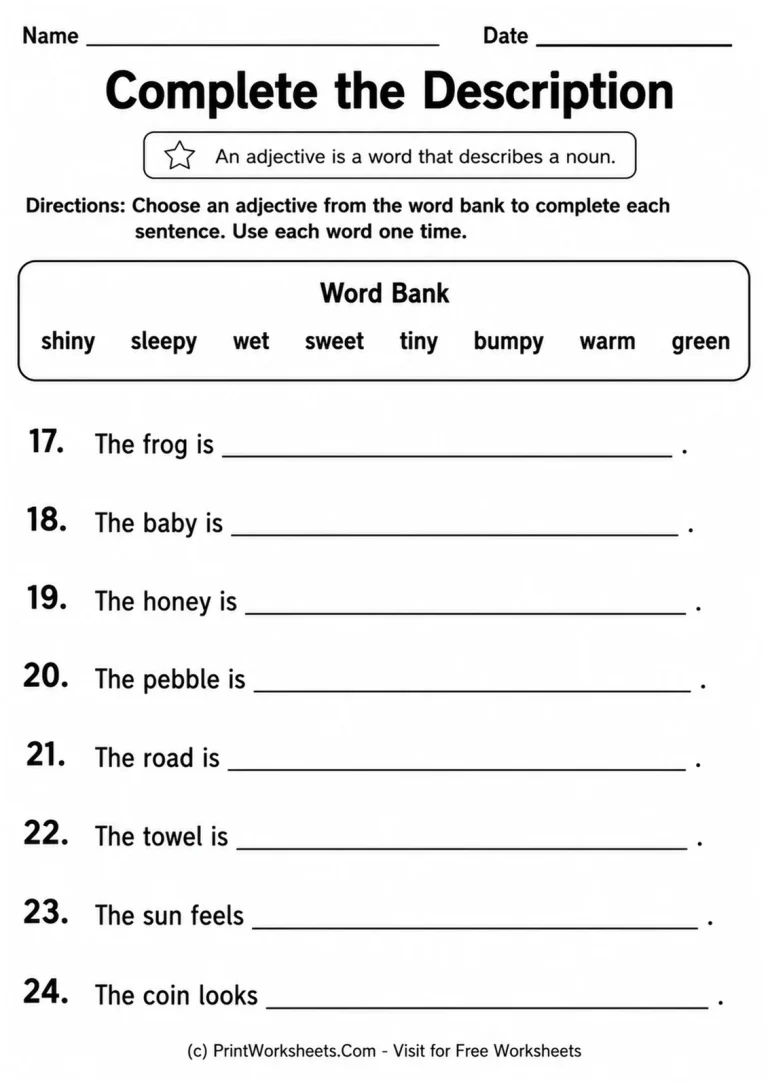
The third worksheet, Complete the Description, shifts the practice into sentence context. Students choose from the word bank adjectives shiny, sleepy, wet, sweet, tiny, bumpy, warm, and green to complete eight simple descriptions. The sentences refer to familiar subjects including a frog, baby, honey, pebble, road, towel, sun, and coin.
Because each adjective is selected in relation to a full sentence, students have to think beyond isolated noun-word pairs. They use meaning and context to decide which describing word makes the sentence sound natural. This makes the page a helpful bridge between recognizing adjectives and using them during early reading and writing tasks.
Ways to Use This Grade 1 Grammar Set
The three worksheets can be used together as a short adjective lesson sequence or separately for targeted review. Teachers may begin with the picture page during whole-group instruction, use the matching page for guided or partner practice, and assign the sentence-completion page for independent work. The set also works well in literacy centers, morning work, homework folders, intervention groups, or quick grammar review.
Parents can use the activities at home without needing lengthy directions or additional materials. The examples rely on familiar objects and simple vocabulary, which makes it easy to extend the practice through conversation. After a worksheet is complete, an adult might point to another household object and ask the child to name one or two adjectives that describe it.
From Seeing a Quality to Describing a Noun
By the end of the set, students have practiced adjectives in three connected formats rather than repeating the same exercise. They first identify a describing word with visual support, then connect nouns and adjectives by meaning, and finally select adjectives that complete sentences. This sequence gives first graders a practical foundation for recognizing how describing words make nouns more specific and sentences more informative. Print the pages for a focused Grade 1 grammar lesson, independent practice, or extra reinforcement whenever students need more experience identifying and using adjectives.