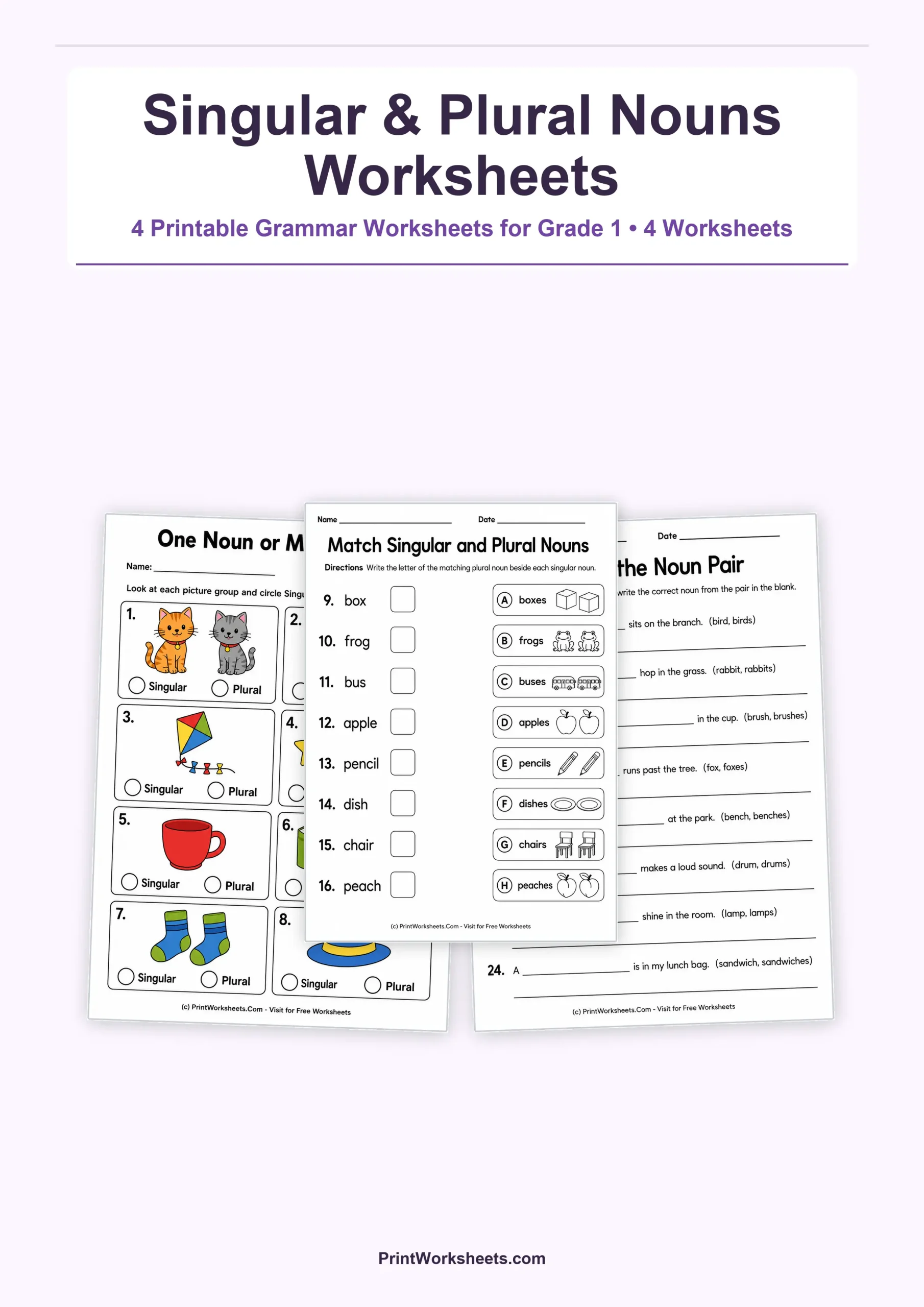
These singular and plural nouns worksheets give first grade students a clear path from recognizing one object or more than one to using the correct noun form in a sentence. Across four printable activities, children work with pictures, matching tasks, short sentence clues, and everyday noun examples. The sequence keeps the grammar skill concrete at the beginning and then gradually asks students to make more independent choices with regular plural nouns.
Practice Singular and Plural Nouns Step by Step
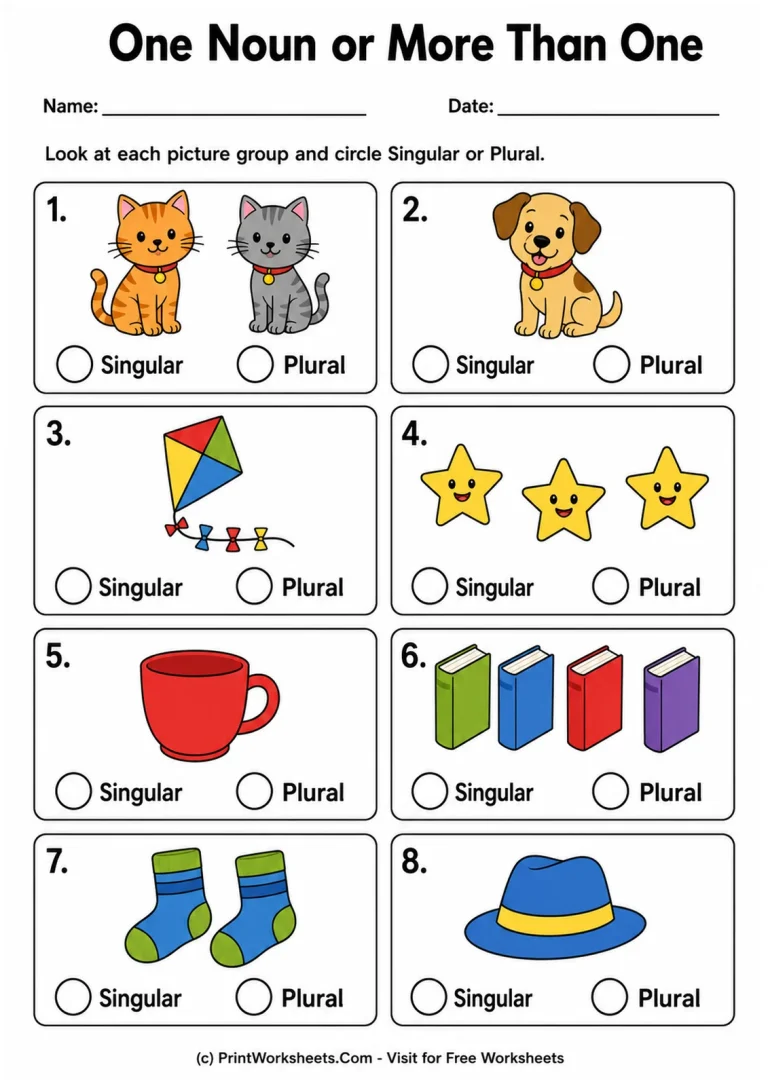
The set begins with a visual activity called One Noun or More Than One. Students study eight picture groups and decide whether each group represents a singular or plural noun. The illustrations include familiar objects and animals such as cats, a dog, a kite, stars, a cup, books, socks, and a hat. Because students can count what they see before choosing Singular or Plural, this page provides an accessible introduction to the idea that singular means one and plural means more than one.
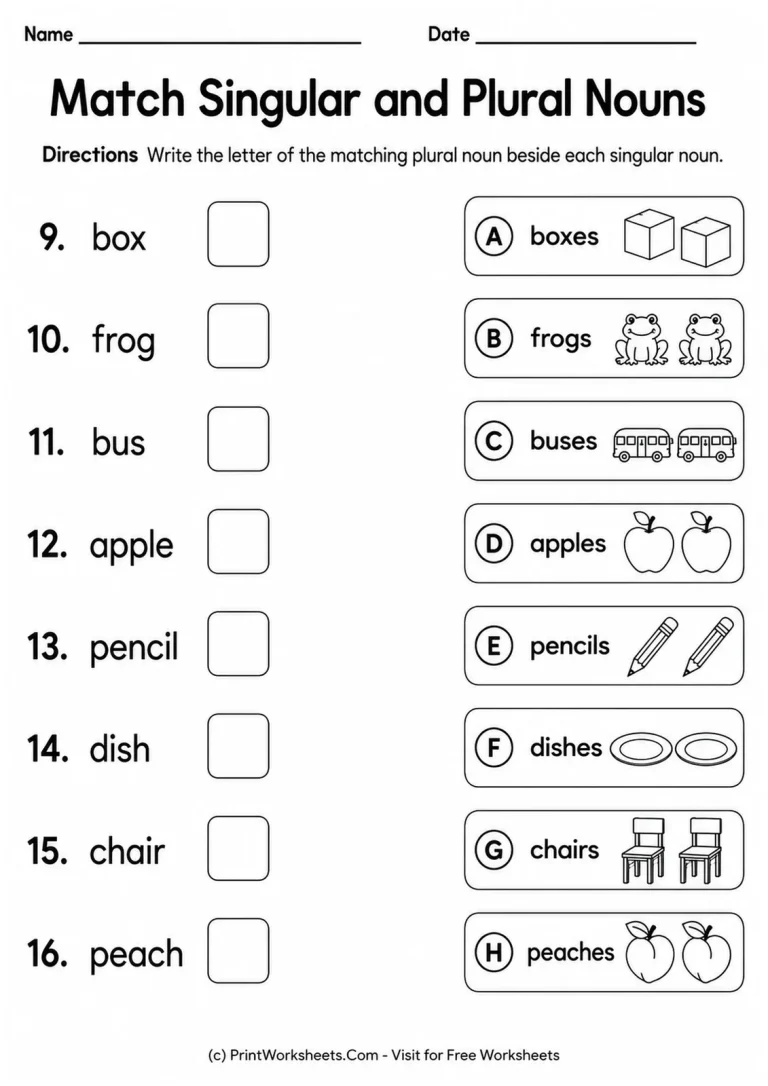
The next worksheet moves from pictures to written noun forms. In Match Singular and Plural Nouns, students connect eight singular nouns with their correct plural forms by writing the matching letter. The word pairs include box/boxes, frog/frogs, bus/buses, apple/apples, pencil/pencils, dish/dishes, chair/chairs, and peach/peaches. These examples give children practice with both common -s endings and several -es forms, helping them notice how regular plural nouns can change in different ways.
Build Confidence with Singular and Plural Noun Forms
Choose the Correct Noun in a Sentence
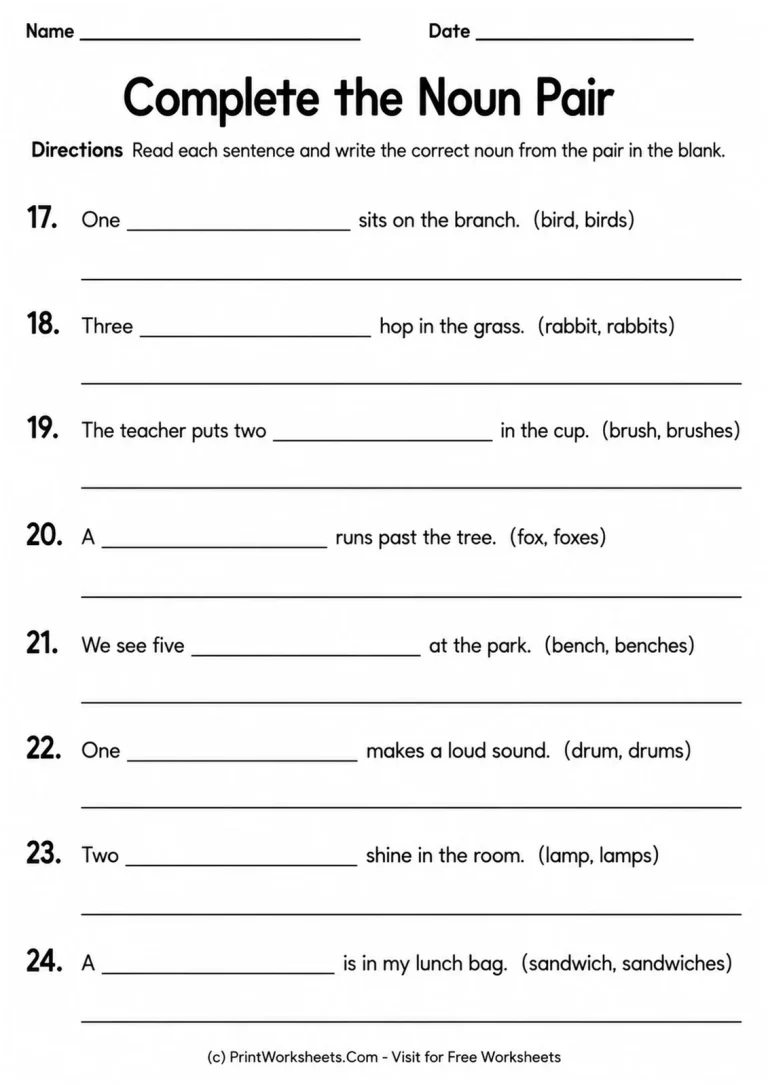
Once students have practiced identifying and matching noun forms, they apply the skill in short sentences. The Complete the Noun Pair worksheet presents eight sentence items with a singular/plural choice. Students use number words and sentence meaning to select the form that fits. Examples work with pairs such as bird/birds, rabbit/rabbits, brush/brushes, fox/foxes, bench/benches, drum/drums, lamp/lamps, and sandwich/sandwiches.
Quantity clues such as one, two, three, or five make the grammar decision meaningful rather than based only on memorizing endings. Students must connect the number in the sentence to the noun form that agrees with it. This creates useful practice for early writers who are beginning to notice that a sentence about one object needs a singular noun while a sentence about several objects usually needs a plural form.
Form the Noun and Classify It
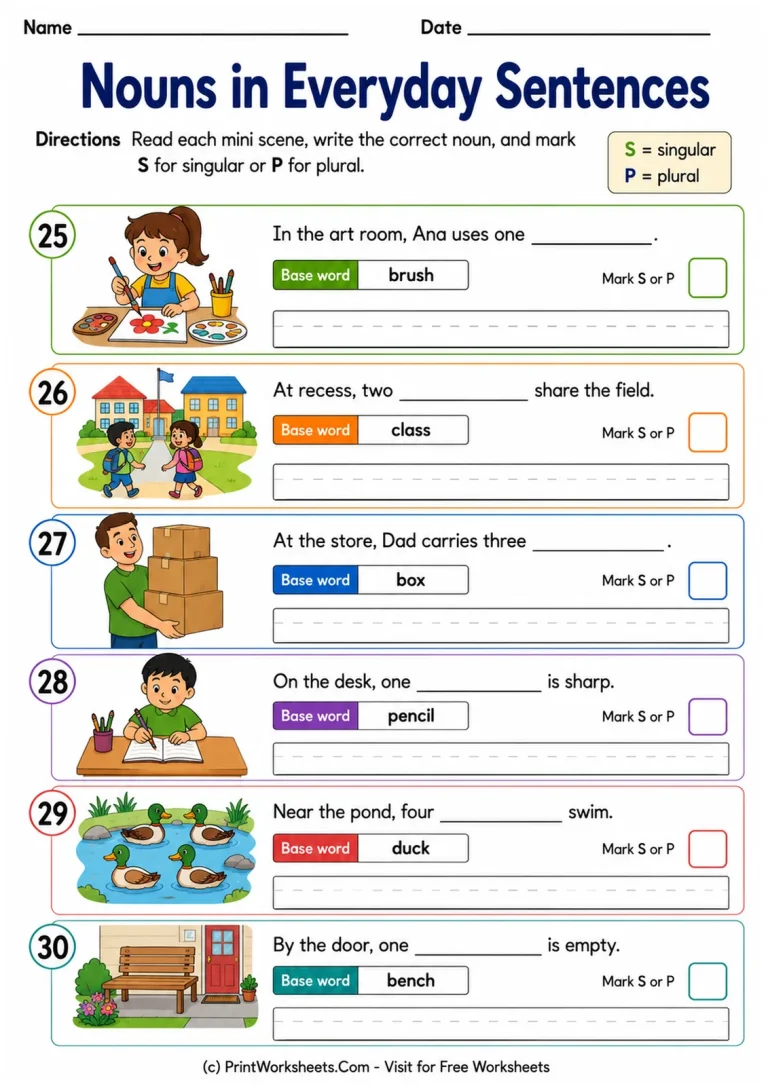
The final student page, Nouns in Everyday Sentences, combines two related skills. Students read six small contextual scenes, use a supplied base noun to write the correct form, and then mark the completed noun with S for singular or P for plural. Base words include brush, class, box, pencil, duck, and bench.
This activity asks students to do more than recognize an answer that is already printed. They must decide whether the sentence needs one or more than one, form the noun correctly, and classify their answer. Words such as brush, class, box, and bench also reinforce regular plural spelling patterns that use -es, while pencil and duck provide straightforward -s examples.
Ways to Use These Grade 1 Grammar Worksheets
The four-page progression works well for a short grammar unit because each activity adds a little more independence. Teachers can begin with the picture page during whole-group or small-group instruction, use the matching worksheet for guided practice, and move to the sentence pages when students are ready to apply the rule in context. The pages can also be used individually for morning work, literacy centers, homework, review, or a quick check of student understanding.
Parents can use the same sequence at home by asking children to explain why a noun is singular or plural before writing an answer. Simple prompts such as “How many do you see?” or “Does the sentence talk about one or more than one?” encourage students to connect the grammar rule to meaning instead of guessing from the word ending alone.
By moving from visible quantities to written noun pairs and then to sentence-level decisions, these worksheets give Grade 1 learners repeated practice with the same core concept in several formats. That variety makes the set useful for building early grammar accuracy while keeping the tasks short, concrete, and appropriate for beginning readers and writers.