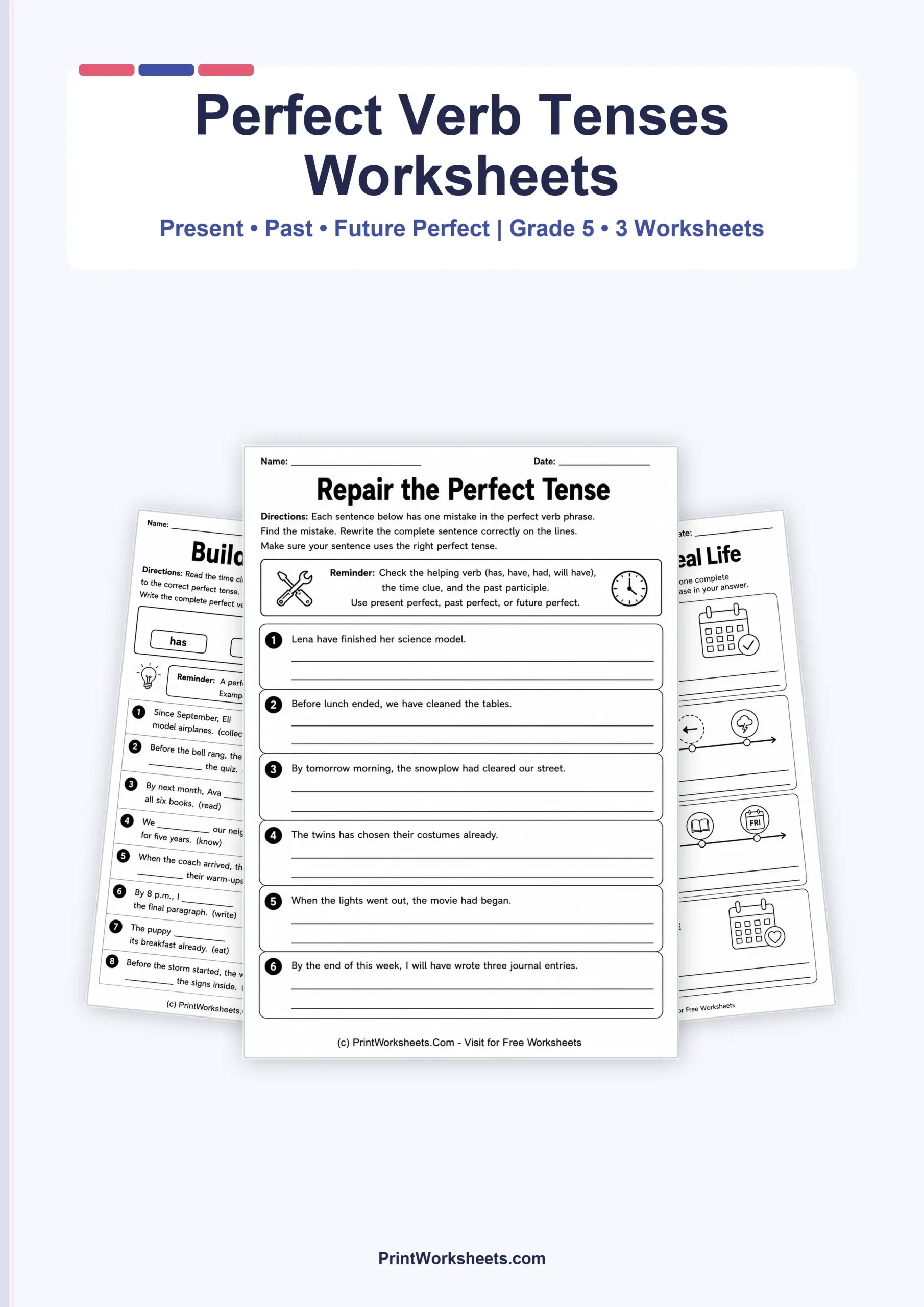
These perfect verb tenses worksheets give fifth graders focused practice with present perfect, past perfect, and future perfect forms. Instead of asking students only to identify a tense, the activities move them through three practical grammar tasks: building complete perfect verb phrases from time clues, repairing incorrect verb forms, and combining facts into sentences that use a required perfect tense. This makes the set useful for students who already recognize basic verb tenses and are ready to work more carefully with helping verbs and past participles.
Practice Perfect Verb Tenses by Building Complete Verb Phrases
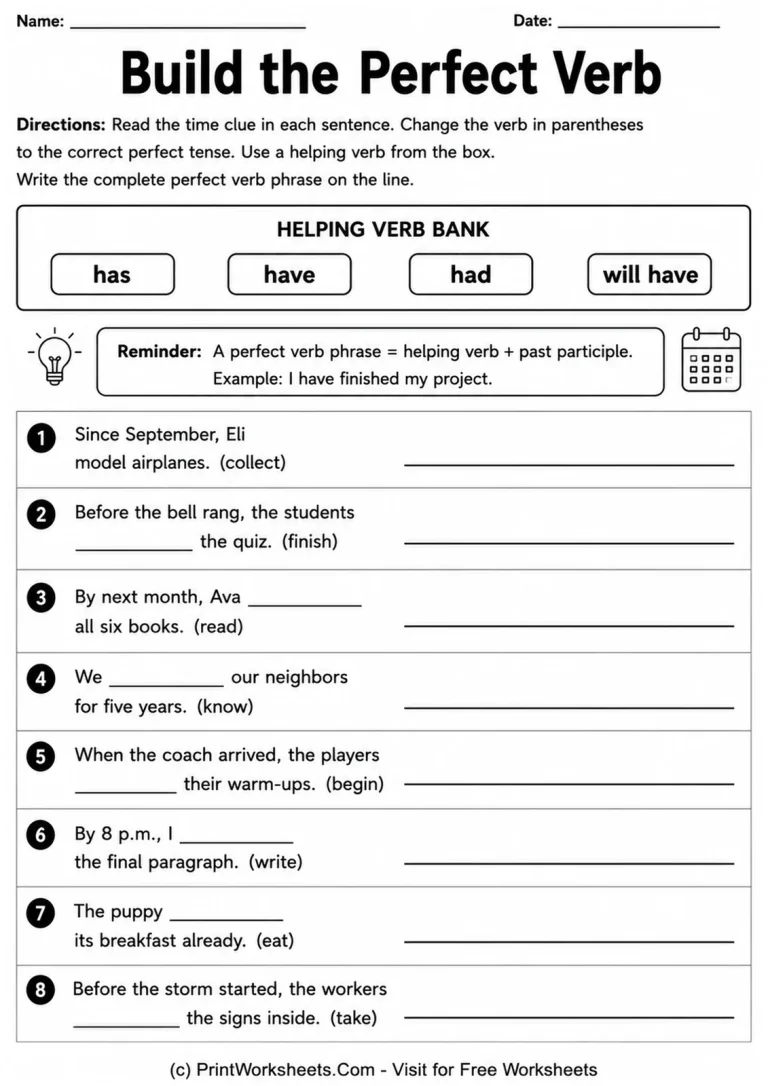
The first worksheet, Build the Perfect Verb, centers on the structure students need to control before they can use perfect tenses confidently. A helping verb bank includes has, have, had, and will have, while a reminder explains that a perfect verb phrase is formed with a helping verb plus a past participle. Students read each sentence, notice its time clue, and change the base verb in parentheses into the correct form.
The verbs include both regular and irregular examples such as collected, finished, read, known, begun, written, eaten, and taken. This variety is important because students must do more than choose the right helping verb. They also need to supply the correct past participle. Time signals such as by tomorrow morning and by the end of this week help students connect grammar form with when an action is completed.
Find and Repair Perfect Tense Errors
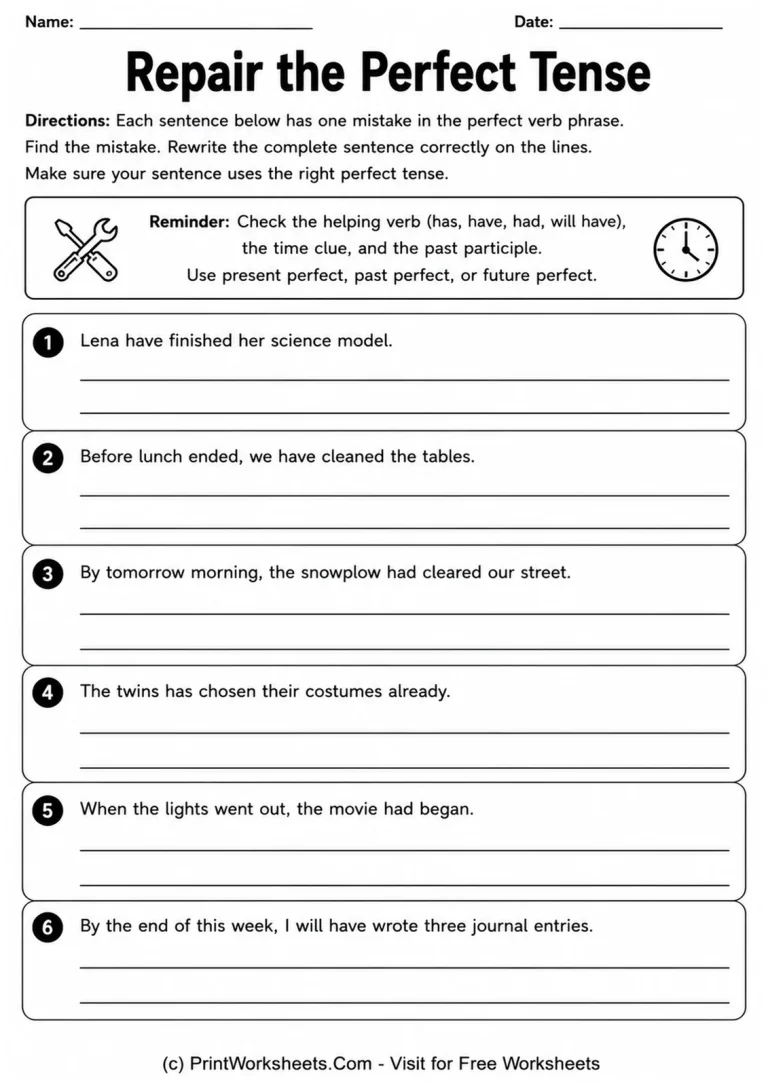
The next worksheet, Repair the Perfect Tense, changes the task from construction to editing. Each sentence contains one clear problem involving the helping verb, the tense choice, or the past participle. Students locate the mistake and rewrite the complete sentence correctly.
This activity gives students practice with details that often cause trouble in perfect-tense writing. Some items require attention to subject and helping-verb agreement, such as choosing has rather than have. Others focus on irregular participles, including corrections such as changing began to begun or wrote to written. Rewriting the whole sentence also encourages students to see the verb phrase as part of a complete thought instead of treating grammar as an isolated word-choice exercise.
Use Present, Past, and Future Perfect in Meaningful Contexts
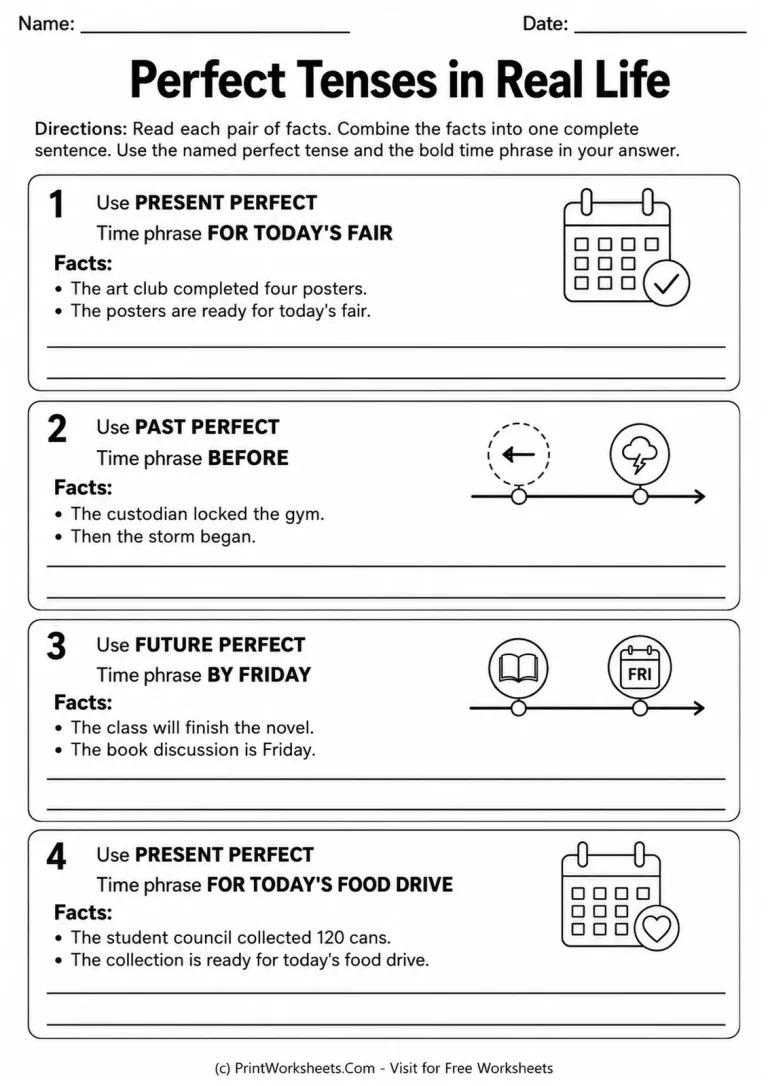
The final student page, Perfect Tenses in Real Life, asks learners to apply the grammar in complete sentences. Each activity gives two related facts and identifies the perfect tense that must be used. Students combine the information into one sentence while also including a required time expression.
The prompts use phrases such as for today’s fair, before, by Friday, and for today’s food drive. These clues make the time relationship part of the writing task. Students must decide how the event and the required tense fit together, then produce a grammatically complete sentence. This is a useful step beyond fill-in-the-blank practice because it shows whether students can actually use present perfect, past perfect, or future perfect when writing about realistic situations.
A Three-Step Grammar Sequence for Grade 5
Together, the worksheets follow a clear progression. Students begin by forming correct verb phrases, move to diagnosing and fixing errors, and finish by applying perfect tenses in sentence-combining tasks. That sequence supports both direct instruction and independent practice because each page asks students to use the same core concept in a different way.
Teachers can use the pages during a grammar lesson, as follow-up practice after introducing perfect tenses, for homework, or as a short skills check. The set also works well for review when students need extra practice distinguishing has/have + past participle, had + past participle, and will have + past participle. Parents can use the same progression for structured practice at home without needing separate activities for form, editing, and application.
What Students Practice Across the Worksheets
Across the three pages, fifth graders work with helping verbs, regular and irregular past participles, time clues, subject-helping-verb agreement, tense correction, and sentence construction. The goal is not simply to memorize the names of three perfect tenses. Students repeatedly connect the form of the verb phrase to the time relationship expressed by the sentence.
Use the worksheets in order for a gradual lesson sequence, or choose individual pages to target a specific need. The building page is especially useful when students are still learning the structure, the repair page supports editing skills, and the real-life sentence-combining page provides a stronger application task for students who are ready to write with perfect tenses more independently.