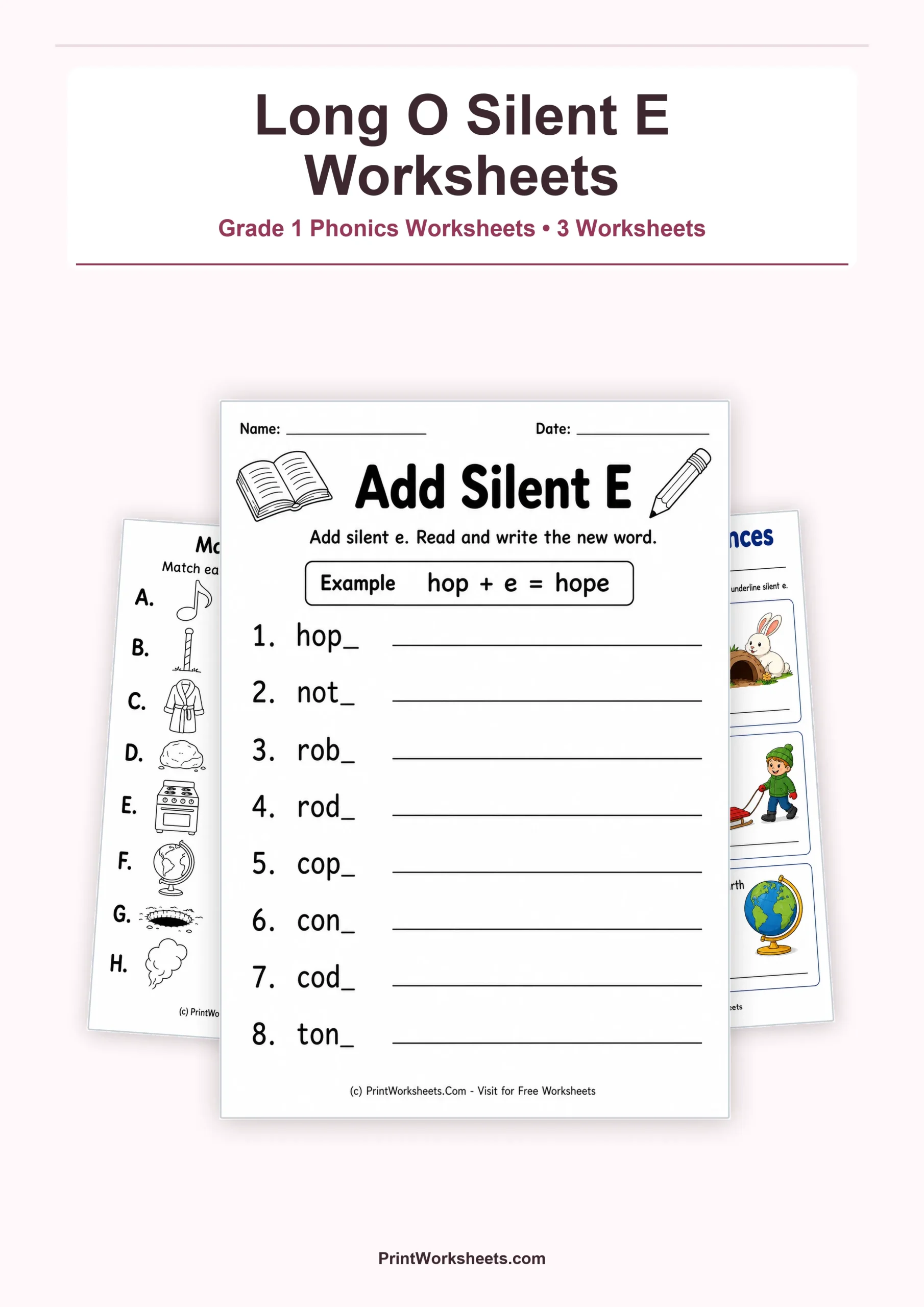
These long o silent e worksheets give first graders three different ways to work with the o_e spelling pattern. Instead of repeating the same type of exercise, the printable set moves from recognizing long O words with pictures to changing short-vowel words by adding silent e, then using long O words in simple sentence context. The activities are designed for early phonics practice with clear vocabulary, visual support, short writing tasks, and familiar CVCe word patterns.
Long O Silent E Worksheets for Grade 1
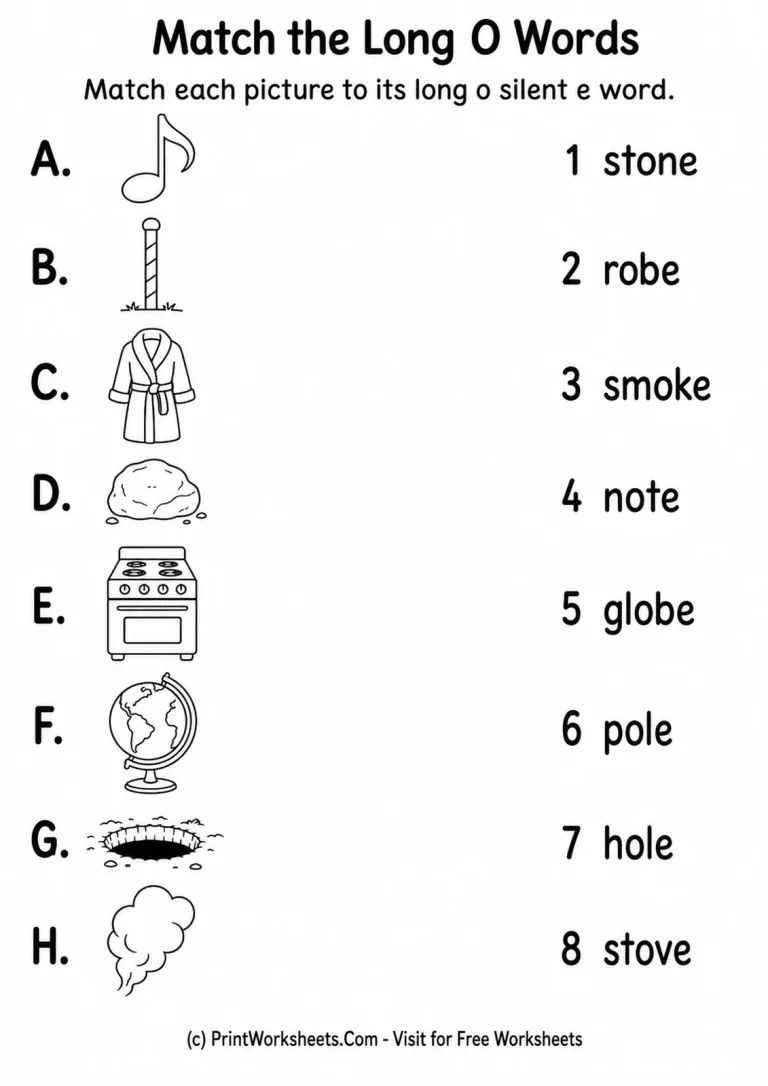
The first activity, Match the Long O Words, focuses on connecting pictures with written words. Students match eight illustrations to stone, robe, smoke, note, globe, pole, hole, and stove. Each target contains a long O sound created by the final silent-e pattern. This gives children a concrete visual clue while they look closely at the spelling of each word.
Picture-to-word matching can be especially helpful when students are still learning to recognize the o_e pattern automatically. A child can identify the picture first, locate the matching word, and then notice how the vowel and final e work together. Teachers can also use the page as a quick oral reading activity by asking students to say each matched word aloud after completing the connections.
Build Long O Words by Adding Silent E
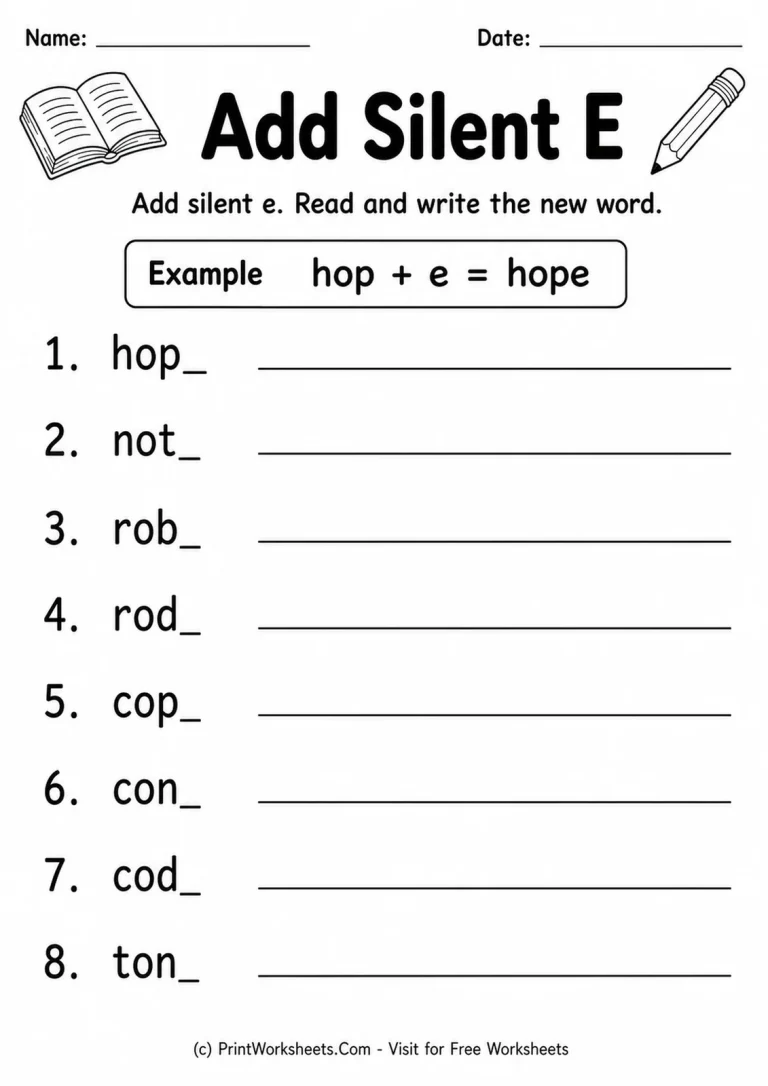
The next worksheet changes the task from recognition to word construction. It begins with the model hop + e = hope, showing students how adding a final silent e changes both the spelling and the vowel sound. Students then work with short forms such as hop, not, rob, rod, cop, con, cod, and ton and write the new words after adding e.
The resulting words include hope, note, robe, rode, cope, cone, code, and tone. This activity makes the spelling change visible instead of asking children to memorize a word list in isolation. Students can compare pairs such as hop and hope or not and note and see that a single final letter changes the vowel from short O to long O.
This page can work well after a brief phonics lesson on CVC and CVCe words. One useful teaching routine is to have students read the original short word, add the silent e, write the new word, and then read the completed long O word aloud. That sequence connects decoding, spelling, handwriting, and phonemic awareness in one compact exercise.
Use Long O Words in Sentence Context
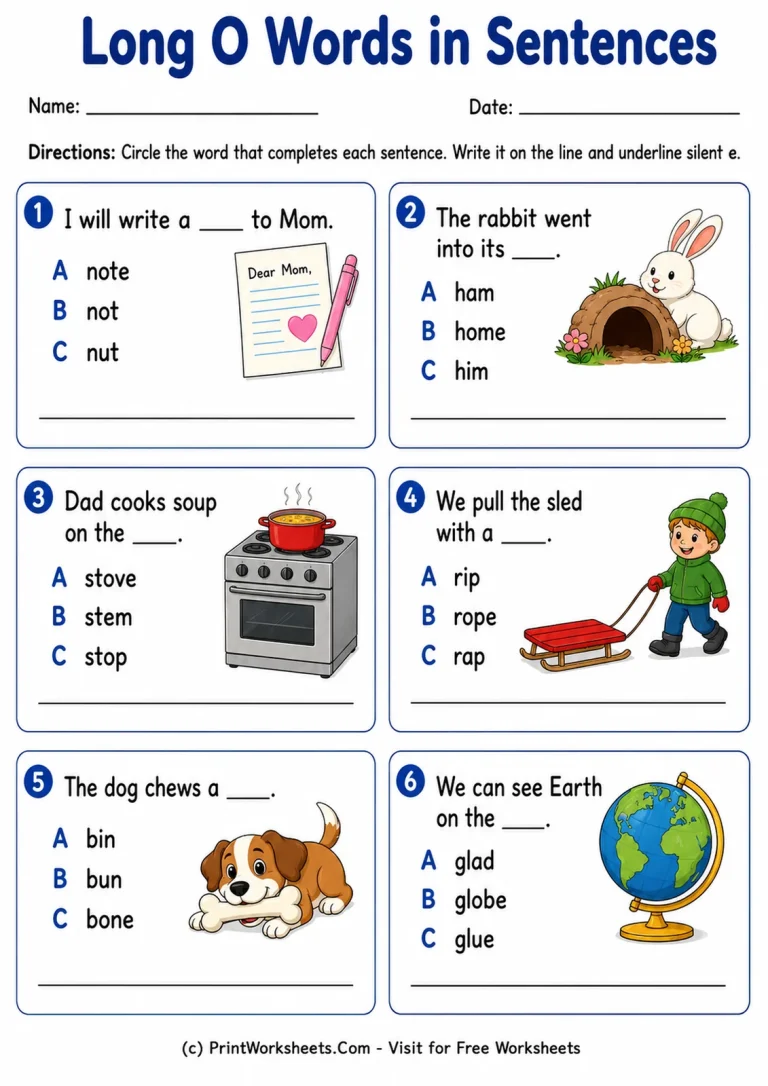
The third worksheet asks students to apply the spelling pattern inside simple sentences. Six illustrated items provide two word choices. Students select the word that makes sense, write it on the line, and underline the silent e. The target words include note, home, stove, rope, bone, and globe.
This activity adds an important layer of meaning. Students are no longer identifying a word only from its spelling pattern; they also have to use the picture and sentence to decide which option fits. Writing the chosen answer provides extra spelling practice, while underlining the silent e draws attention back to the phonics feature being studied.
Because each item combines a visual clue, a short sentence, and a focused spelling task, the page can be used for independent practice after instruction or as a teacher-guided review. It also provides a simple way to check whether students can recognize long O words beyond isolated word lists.
A Three-Step Long O Phonics Practice Sequence
Together, the three worksheets create a natural progression. Students begin by matching familiar long O words to pictures, move to creating o_e words by adding silent e, and finish by selecting and writing the correct word in context. That progression helps children encounter the same spelling concept through several kinds of thinking instead of completing several nearly identical drills.
The set is suitable for Grade 1 phonics centers, small-group lessons, independent seatwork, homework, or short review sessions. A teacher might use one sheet per day, while families can use the pages as a focused practice packet for children learning the silent-e rule. Since the activities involve reading, matching, spelling, and sentence use, they can also help reveal whether a student needs more support with decoding, recognizing the o_e pattern, or applying long O words in context.
Practice the O_E Pattern with Familiar Words
The vocabulary in this set gives students repeated exposure to recognizable long O spellings such as hope, note, robe, home, rope, bone, globe, cone, code, and stove. Repetition of the spelling feature across different activities can help children notice that the final e is silent while the earlier vowel says its long sound. The goal is not simply to complete each page, but to build a stronger connection between the printed o_e pattern, the spoken long O sound, and meaningful words students can read and write.
These printable pages offer a focused next step for first graders who already know common short O words and are ready to compare them with silent-e forms. They can be printed as a small phonics packet or used individually wherever extra long O CVCe practice is needed.