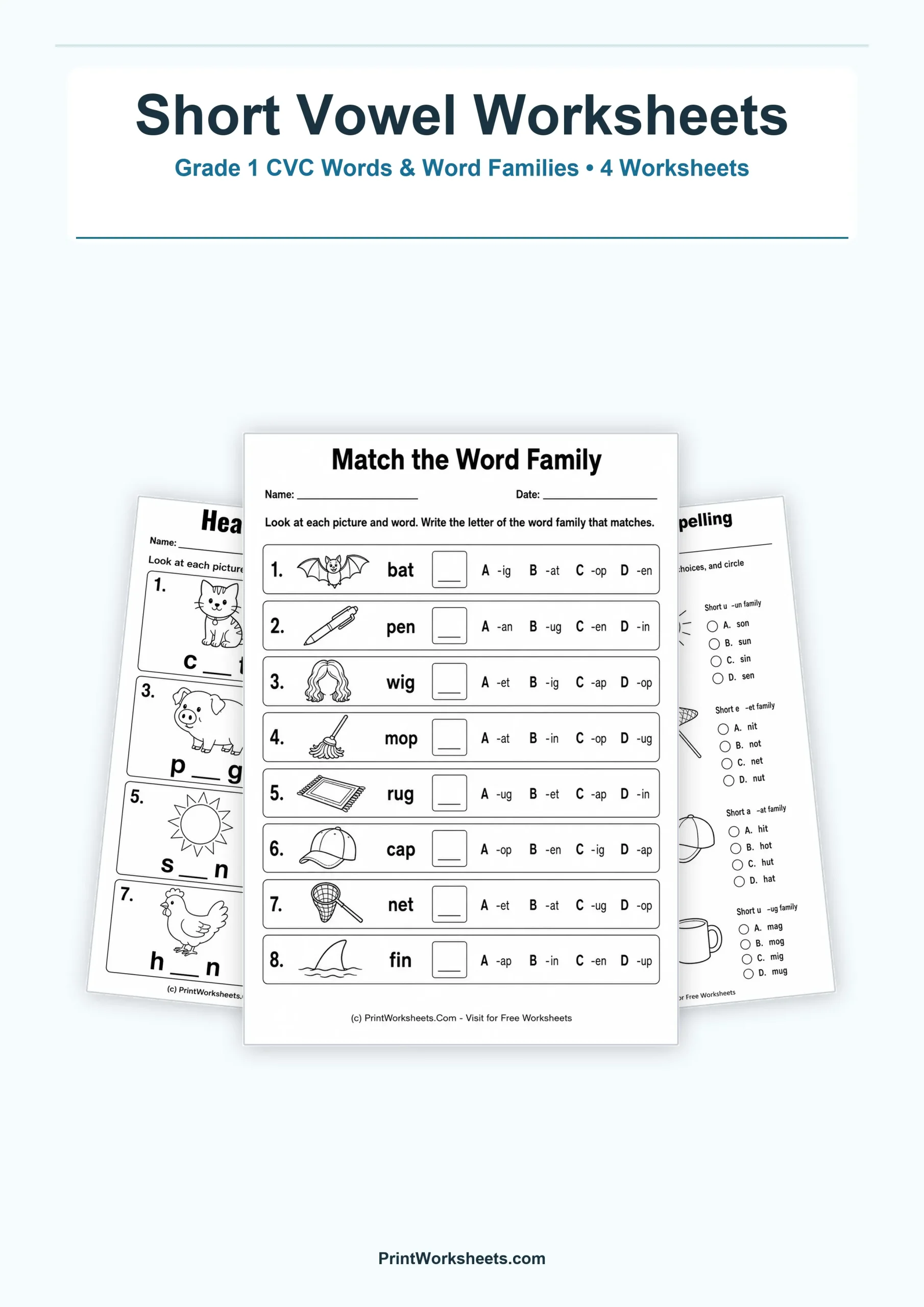
These short vowel worksheets for Grade 1 give children repeated practice with CVC spelling patterns while changing the way they respond from page to page. The set covers short a, e, i, o, and u through picture clues, word families, spelling choices, and simple sentence context. That variety makes the packet useful for students who can hear short vowels but still need practice connecting each sound to the correct letter and complete word.
From Hearing the Vowel to Using It in Context
The four student pages are arranged as a natural skill progression. Children begin with strong picture support and a missing-vowel task, move into word-family recognition, compare correct and incorrect spellings, and finish by building short-vowel words inside sentences. This sequence lets teachers revisit the same core spelling idea without repeating the same worksheet format.
Hear the Short Vowel
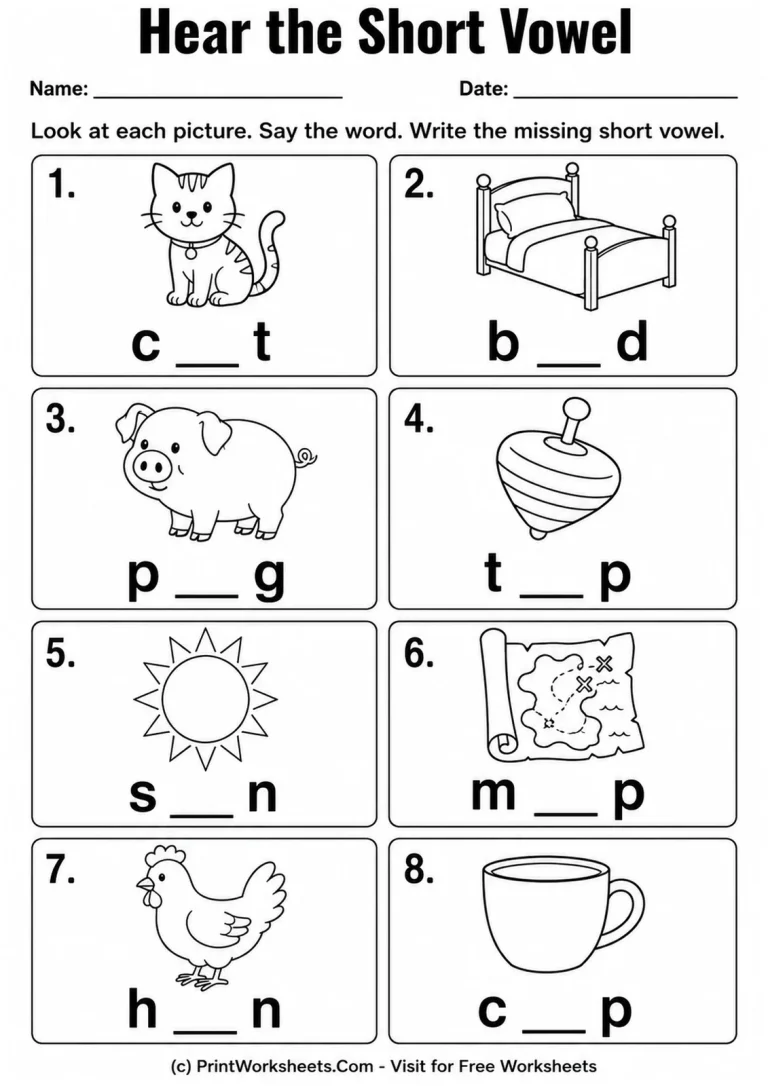
On the first page, students look at eight pictures, say each word, and supply the missing middle vowel between two printed consonants. The target words are cat, bed, pig, top, sun, map, hen, and cup. Because the beginning and ending consonants are already provided, students can focus closely on the medial vowel sound. All five short vowels appear across the activity, so the page works well as a quick review after students have learned the individual sounds.
A useful teaching routine is to have children stretch each CVC word aloud before writing. For cat, for example, students can say the three sounds slowly, identify the middle sound, and then write a. The same routine can be repeated for bed, pig, top, and sun so students connect listening, segmenting, and spelling.
Match CVC Words to Word Families
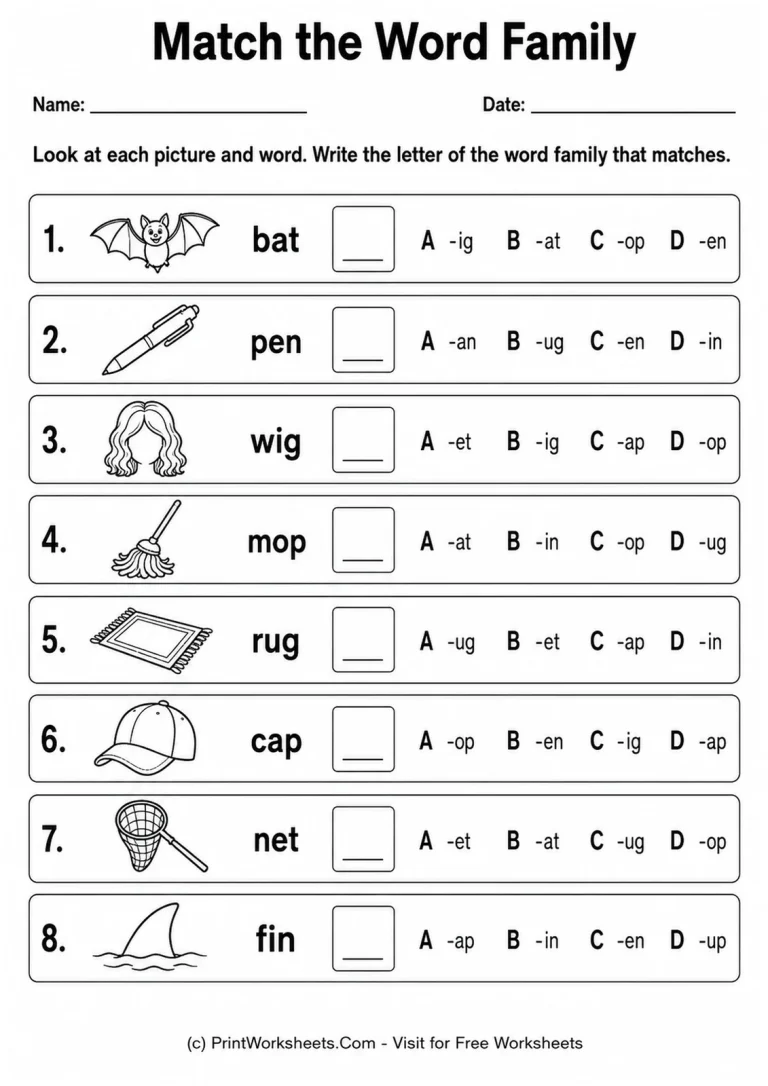
The second page shifts attention from one vowel sound to the larger spelling pattern at the end of a word. Students use pictures and printed words to match bat, pen, wig, mop, rug, cap, net, and fin to the correct word family. The families include -at, -en, -ig, -op, -ug, -ap, -et, and -in.
This task helps children notice that a short-vowel word is not only a sequence of separate sounds. It also belongs to a recurring pattern that can support faster reading and spelling. Teachers can extend the page orally by asking for one more word in a selected family, such as cat for -at or hen for -en. That turns a matching task into a brief word-building exercise without changing the worksheet itself.
Choose the Correct Spelling
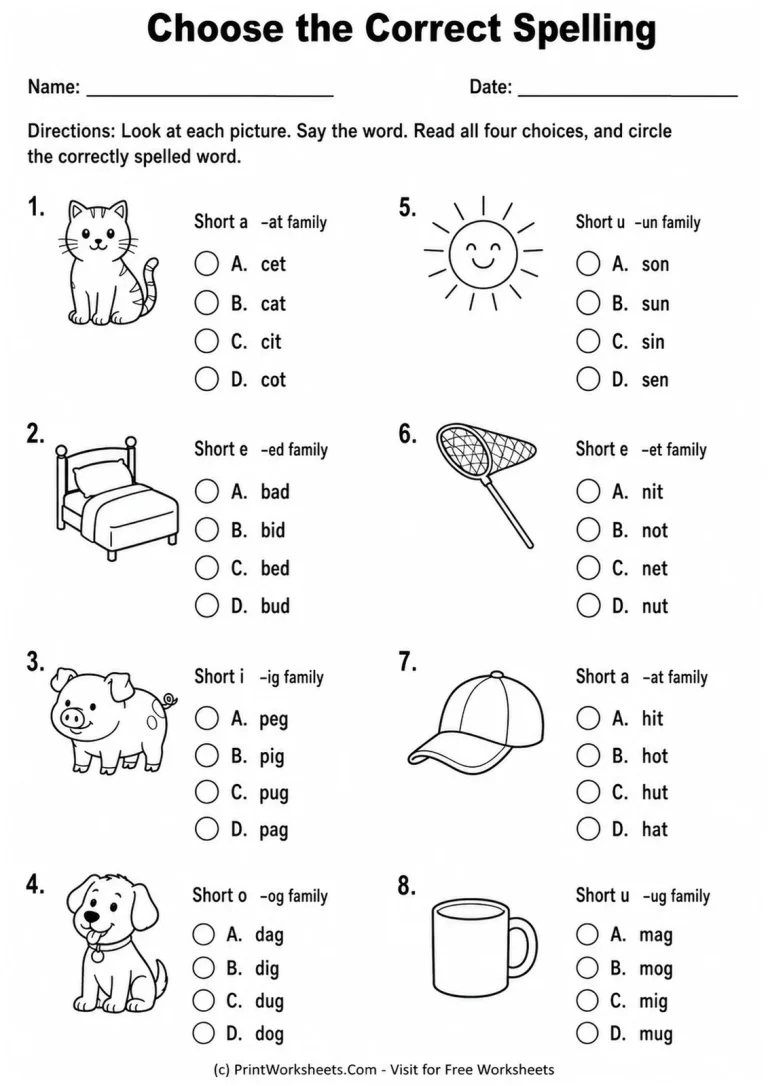
The third page asks students to circle the correctly spelled word from four options for each picture. The practice words include cat, bed, pig, dog, sun, net, hat, and mug. Instead of simply producing a missing letter, children must compare complete spellings and reject distractors.
This is a useful step because early spellers often recognize a picture and know the word orally but still confuse the written vowel. By comparing several choices, students pay attention to the full CVC pattern and the short-vowel family. The page can be used independently, in a literacy center, or in a small group where children explain why one spelling matches the picture and the others do not.
Short Vowels in Sentences
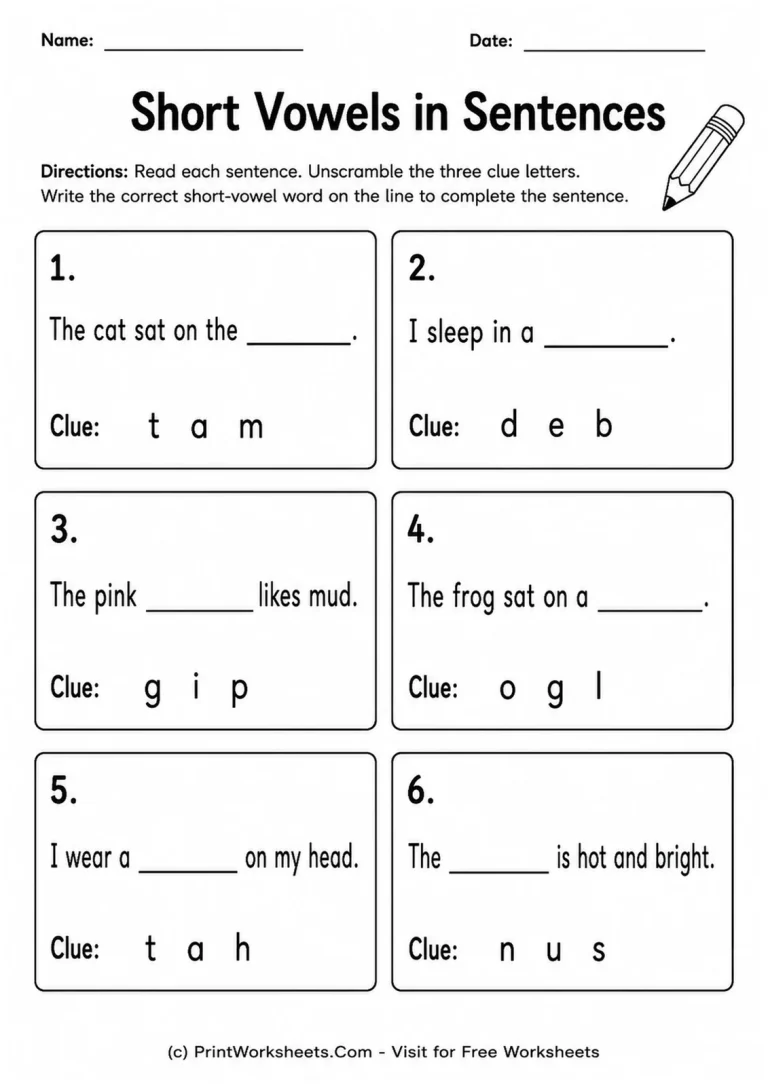
The final page adds context. Students read six simple sentences, unscramble three clue letters, and write the short-vowel word that completes each sentence. The intended words are mat, bed, pig, log, hat, and sun. This combines spelling with basic reading comprehension because the completed word must be both correctly formed and meaningful in the sentence.
For students who need support, have them unscramble the letters first and then reread the sentence with the completed word. More confident students can read the sentence before solving the letters and predict what kind of word would make sense. This page makes a strong final practice activity because students are no longer relying mainly on picture identification.
Ways to Use These Short Vowel Worksheets
The packet can fit several classroom and home routines. Use one page per day for a short spelling warm-up, place individual pages in literacy centers, assign selected activities for extra practice, or use the full sequence during a short-vowel review week. The changing task types also make it easier to observe where a child is having difficulty. A student who succeeds with pictures but struggles with sentence completion may need more practice applying CVC spelling without visual support, while a student who confuses choices on the spelling page may need extra work hearing the middle vowel.
The set is especially useful after students have been introduced to all five short vowel sounds and are ready to compare them across mixed CVC words. Because the activities move from sound identification to pattern recognition, spelling discrimination, and contextual word building, children get multiple chances to strengthen the same foundational skill in different ways.