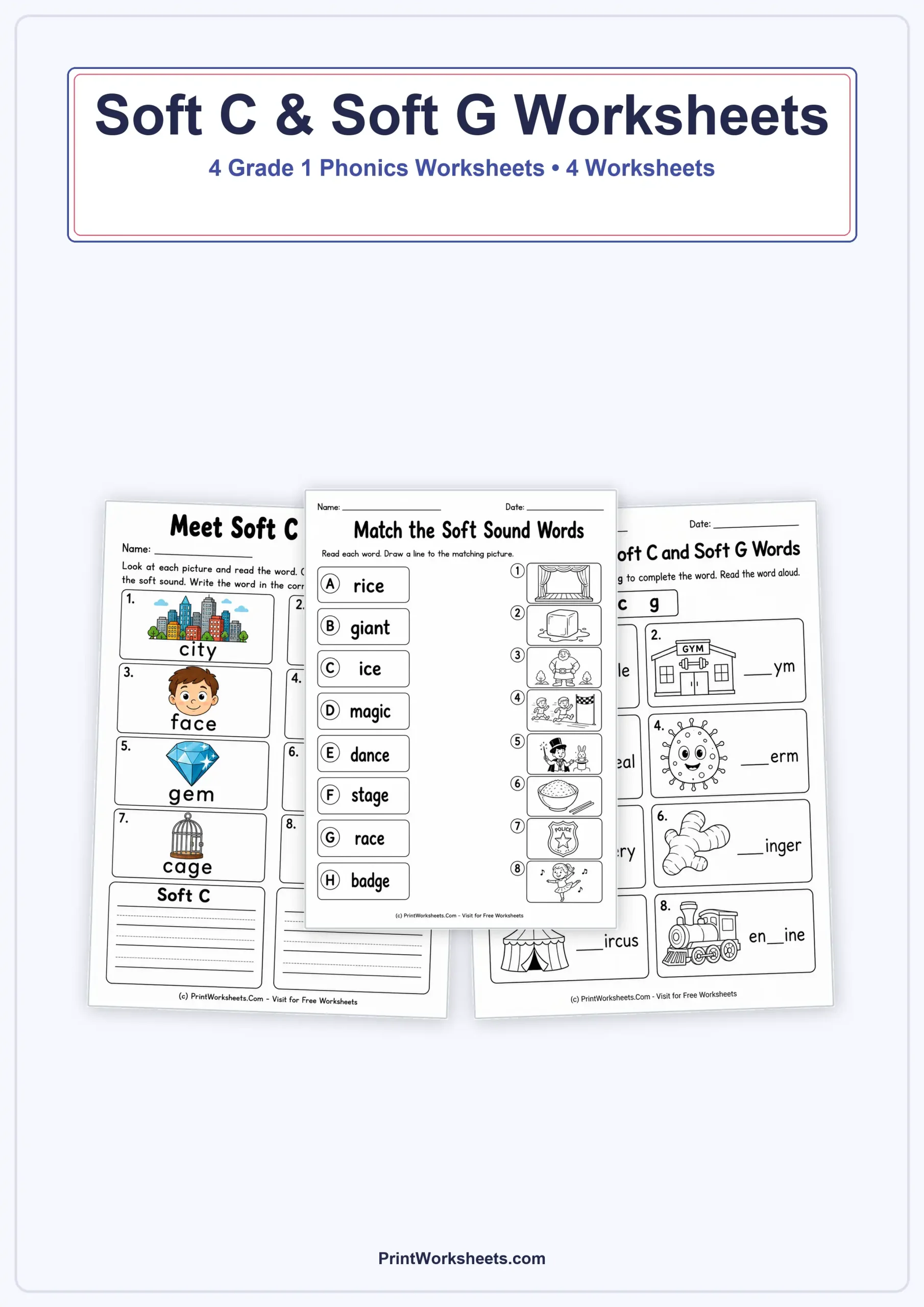
These soft c and soft g worksheets give first-grade students focused practice with two consonant sounds that can be easy to confuse during early reading. Instead of asking children to memorize a long word list, the printable set uses pictures, familiar vocabulary, letter choices, sorting, and sentence meaning to help students notice when c sounds like /s/ and when g sounds like /j/. The four student pages move through different kinds of phonics work, so learners repeatedly meet the target sounds without completing the same task over and over.
Soft C and Soft G Worksheets for Grade 1
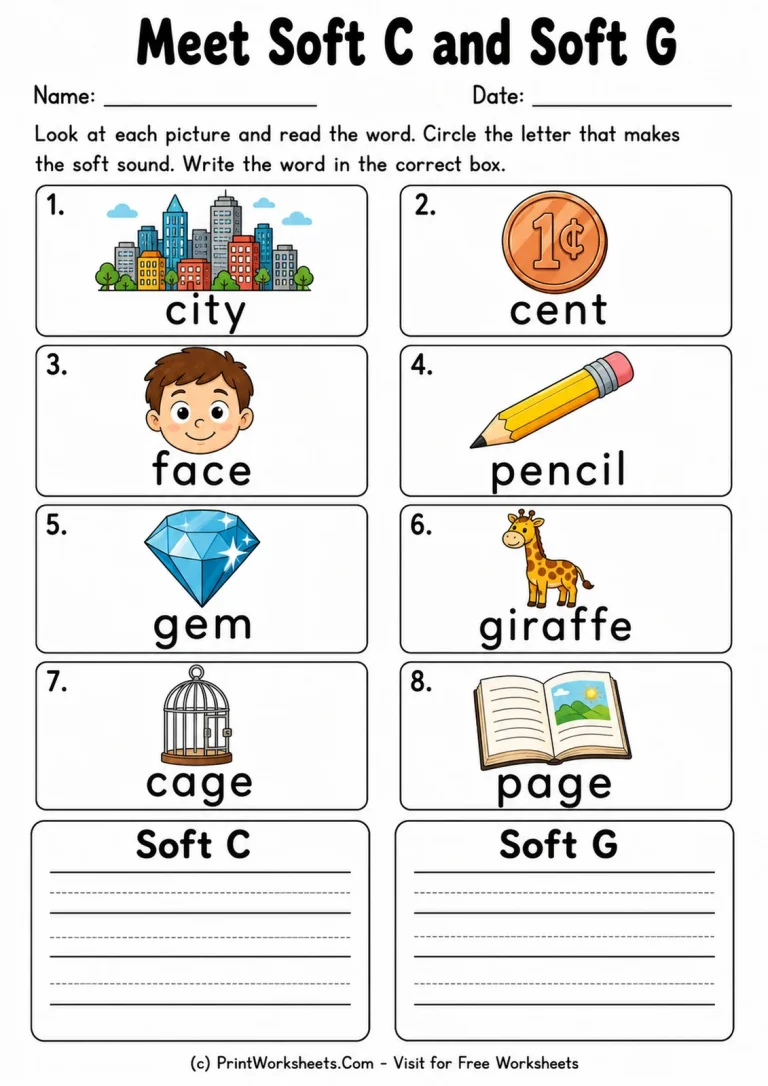
The first worksheet, Meet Soft C and Soft G, introduces the contrast directly. Students look at eight pictured words, circle the letter that produces the soft sound, and sort the words into Soft C and Soft G groups. The soft c examples include city, cent, face, and pencil, while the soft g examples include gem, giraffe, cage, and page. This activity combines visual recognition with word analysis, giving students a clear reason to look closely at the spelling inside each word.
Sorting is especially useful at the beginning of the set because students must compare examples rather than simply identify one sound in isolation. A teacher can also ask students to read each word after sorting it and listen for the target sound before checking the written letter.
Build Recognition with Pictures and Printed Words
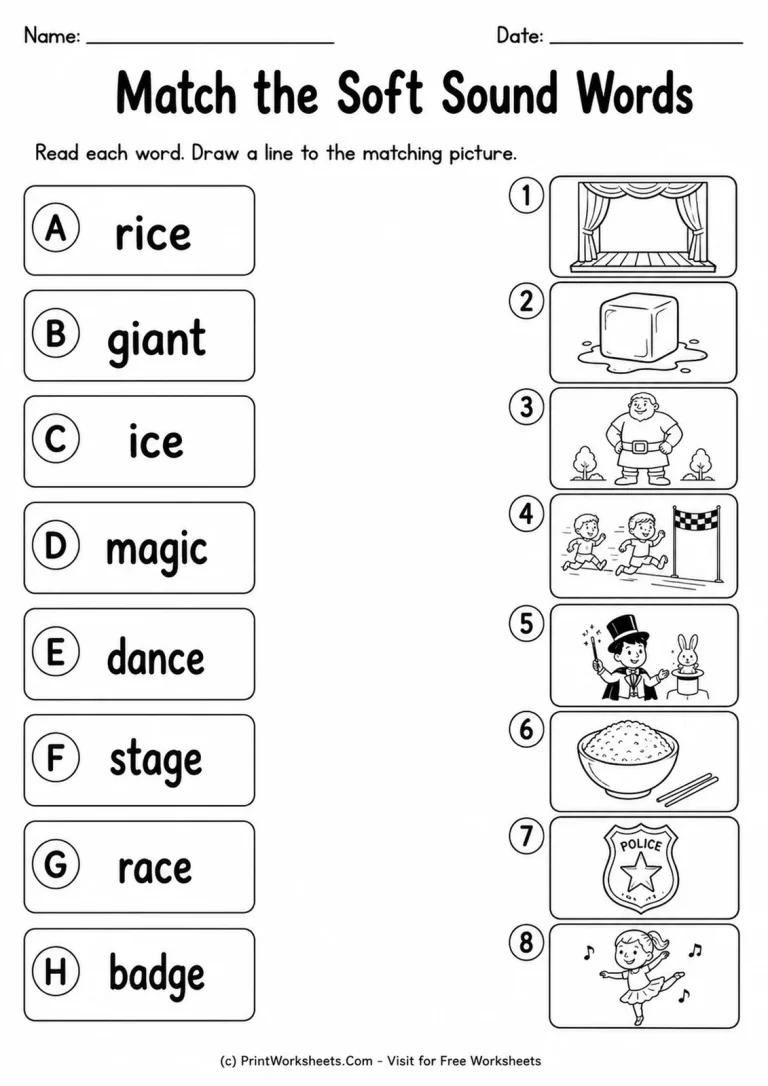
The second page, Match the Soft Sound Words, shifts attention from sorting to word recognition. Students read rice, giant, ice, magic, dance, stage, race, and badge, then draw lines to the matching numbered pictures. The images represent a stage, ice cube, giant, race, magician, rice, badge, and dancer. Because each word has a clear picture partner, students can use both decoding and meaning to confirm their choices.
This page works well after the introductory sort because the soft c and soft g examples are mixed together. Children are no longer placing every word under a labeled heading. Instead, they must read each word as a complete unit and connect it to its meaning. That makes the activity useful for independent seatwork, literacy centers, or a short follow-up lesson after direct phonics instruction.
Complete Words with C or G
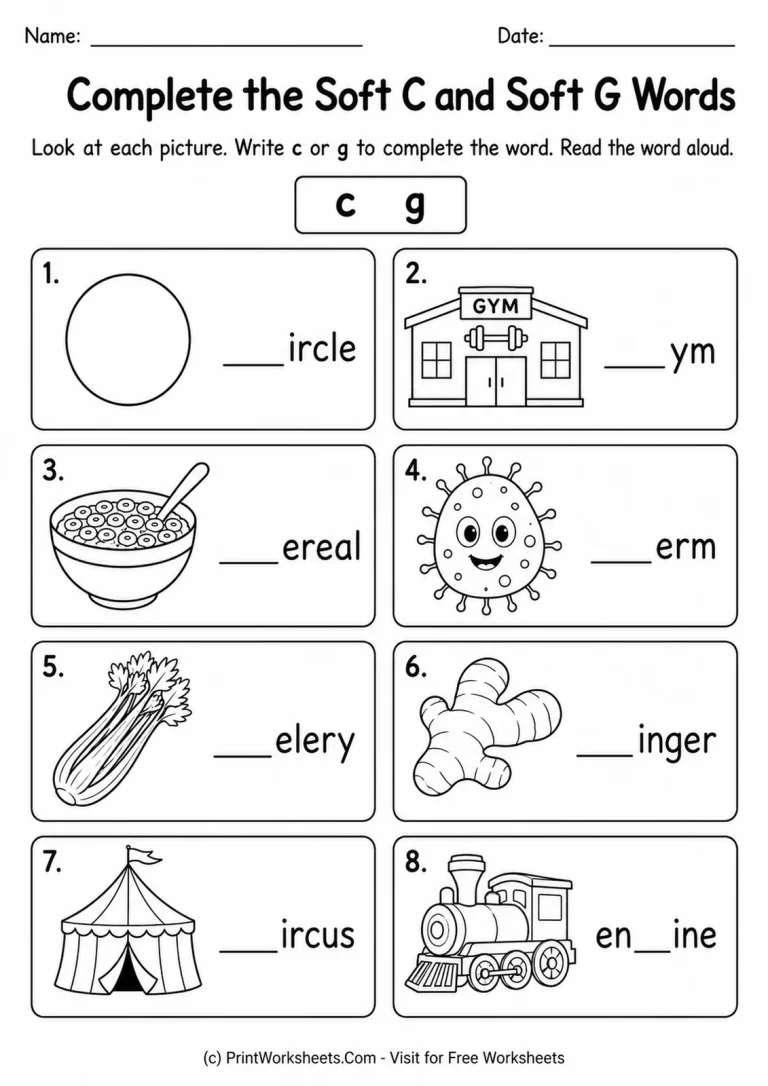
The third worksheet adds a spelling decision. Students choose either c or g to complete pictured words such as circle, gym, cereal, germ, celery, ginger, circus, and engine. After filling in the missing letter, they are asked to read each completed word aloud. This combination of spelling and oral reading helps connect the printed consonant with the sound students actually hear in the word.
The task also encourages careful attention to the entire word. Students cannot solve the item by looking at a single isolated letter; they need to recognize the picture, consider the incomplete spelling, select c or g, and then check whether the completed word sounds right. Parents can use this page for extra practice by having children point to the inserted letter before reading the whole word aloud.
Apply Soft C and Soft G in Sentence Context
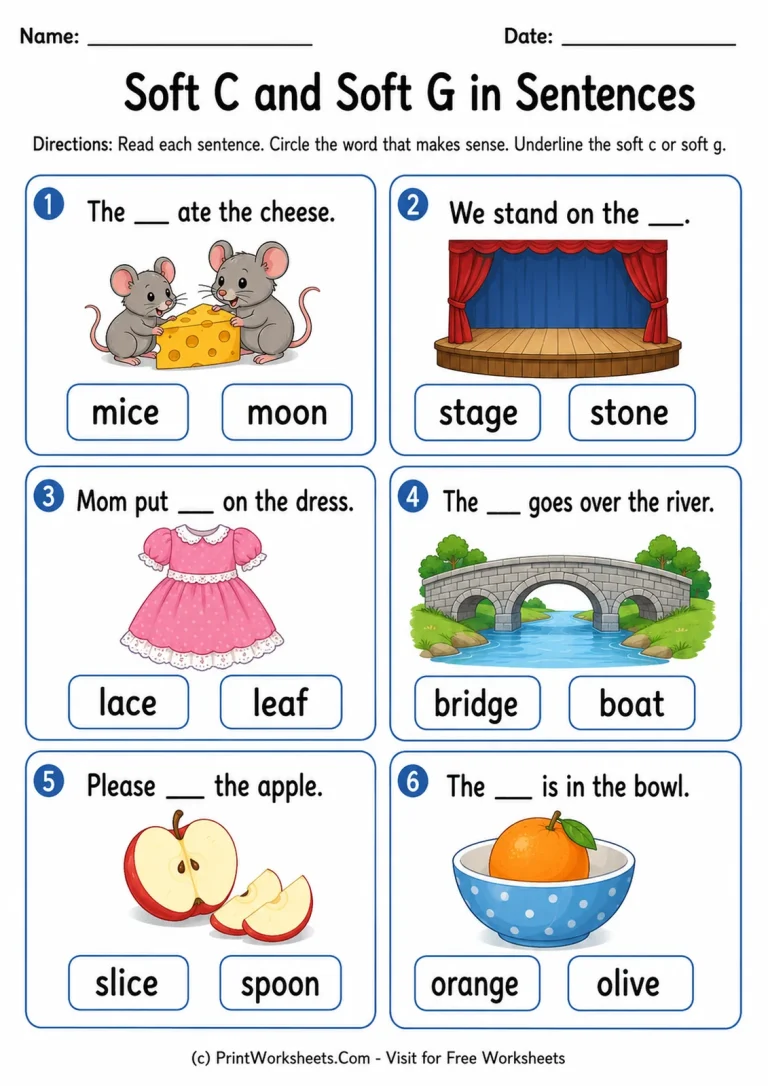
The final student page, Soft C and Soft G in Sentences, moves the skill into connected language. Students read six illustrated sentences, choose the word that makes sense, circle it, and underline the soft c or soft g in the selected answer. Choice pairs include mice or moon, stage or stone, lace or leaf, bridge or boat, slice or spoon, and orange or olive.
This sentence-level practice adds an important meaning check. A student may recognize a soft consonant pattern in an individual word, but the sentence requires the learner to decide which option fits the context as well. Underlining the target consonant keeps the phonics goal visible even while comprehension becomes part of the task.
Ways to Use the Printable Set
Teachers can use the four pages in order across several short phonics sessions: begin with identifying and sorting, continue with picture matching, move to missing-letter completion, and finish with sentence application. The pages can also be separated for literacy centers, morning work, homework, intervention practice, or review before a spelling activity. For students who need more support, an adult can read the directions aloud and model one example before independent work. For students ready for an extra challenge, ask them to say another word containing a soft c or soft g after completing each section.
Because the activities use different response types, the set gives teachers and families several ways to see whether a child understands the pattern. A learner who can sort words but struggles to complete circle or ginger may need additional spelling practice, while a learner who reads individual words accurately but misses sentence choices may benefit from more context-based reading. Used together, these printable pages provide a practical progression from noticing the soft sound to recognizing, spelling, reading, and applying soft c and soft g words in meaningful situations.