Word family spelling becomes easier for first graders when children can see how familiar beginnings and endings work together to make complete words. These Grade 1 word family spelling worksheets give students several ways to practice that idea instead of repeating the same exercise on every page. Children build short-vowel words from pictures and letter clues, match whole words to common family endings, use family words in simple sentences, and create organized spelling lists. The four activities are designed to move from supported recognition toward more independent spelling work.
Word Family Spelling Practice for Grade 1
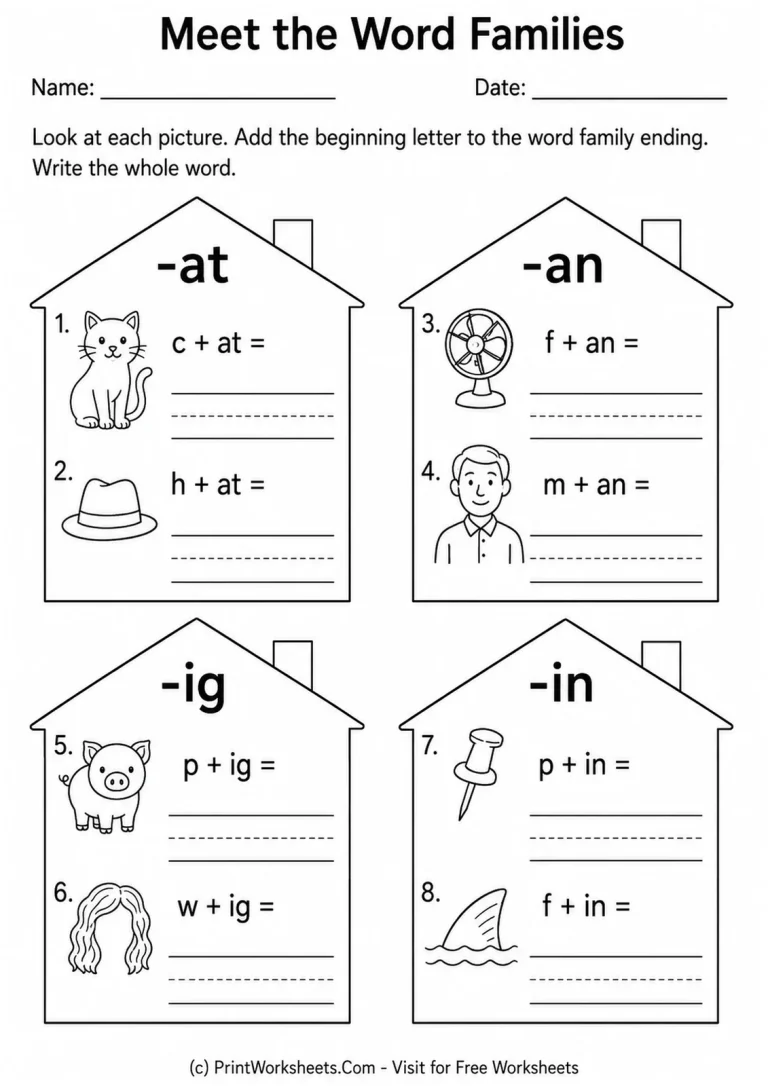
The first worksheet, Meet the Word Families, begins with picture-supported word building. Students work with the -at, -an, -ig, and -in families and combine the supplied beginning letters with each ending. The pictured targets include cat, hat, fan, man, pig, wig, pin, and fin. Because the picture and first letter are both visible, young learners can focus on hearing the short-vowel pattern, noticing the repeated ending, and writing the complete word correctly. This makes the activity especially useful when students are still developing confidence with CVC spelling.
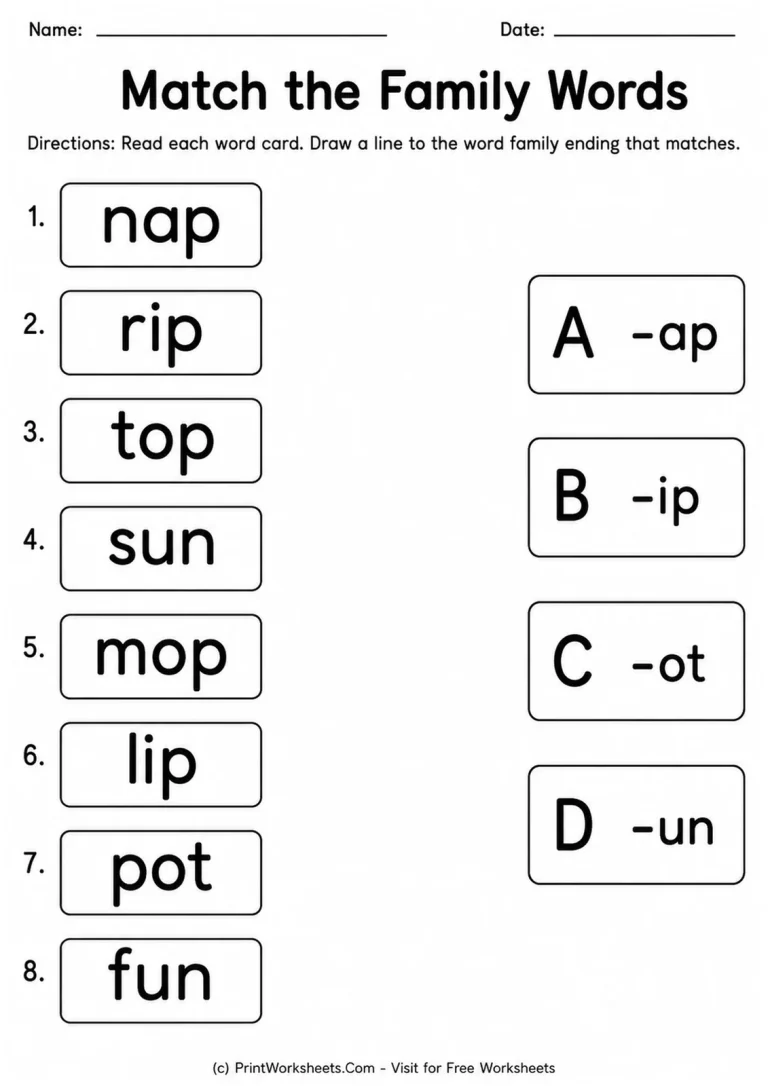
The next page changes the task from building words to classifying them. In Match the Family Words, students read nap, rip, top, sun, mop, lip, pot, and fun and connect each word to one of four endings: -ap, -ip, -ot, or -un. The activity encourages children to look beyond the first sound and pay attention to the shared spelling pattern at the end of each word. It also provides a quick way for teachers or parents to see whether a child can recognize a word family when the word is presented without picture support.
Use Short-Vowel Family Words in Context
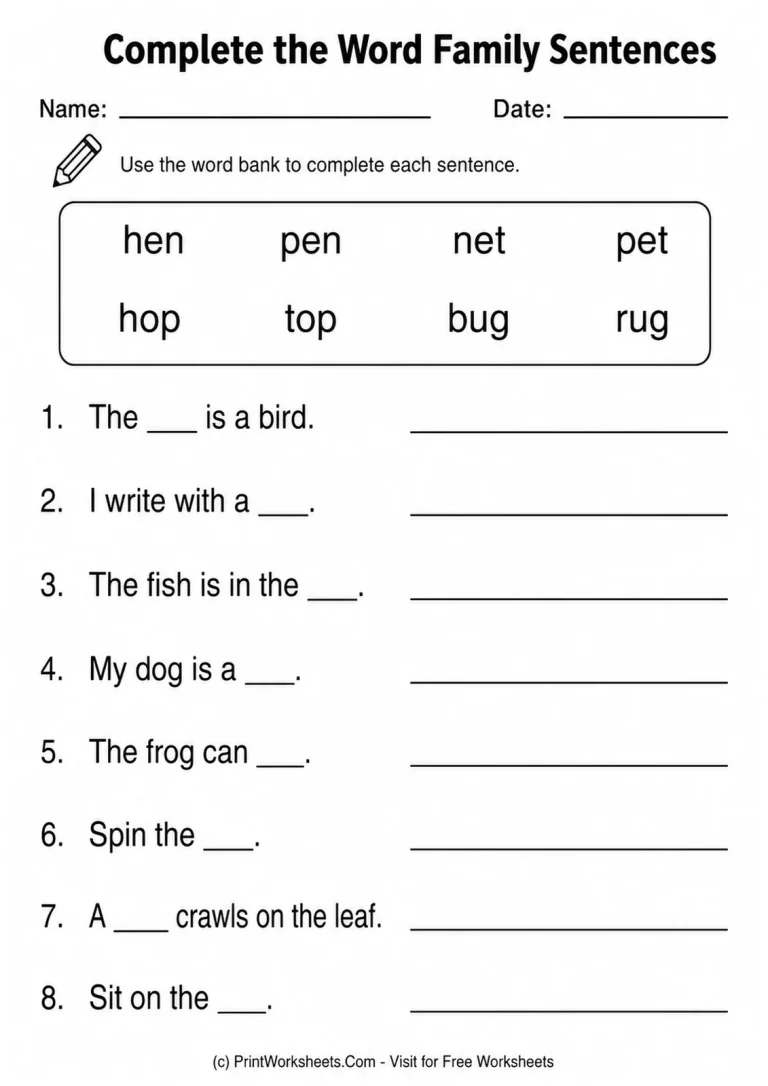
Recognizing a spelling pattern is only part of early word study. Students also need to understand the words they are reading and writing. Complete the Word Family Sentences adds that layer by asking children to choose words from a bank and place them into simple sentences. The available words are hen, pen, net, pet, hop, top, bug, and rug. Students must consider both spelling and sentence meaning, so the page connects phonics practice with basic reading comprehension.
This sentence activity can work well after a direct lesson on short-vowel families because students are no longer simply copying or matching endings. They have to decide which word makes sense in each sentence. Teachers can also use the page for literacy centers, independent practice, morning work, or a short review after students have already encountered several CVC word families.
Build and Alphabetize Spelling Lists
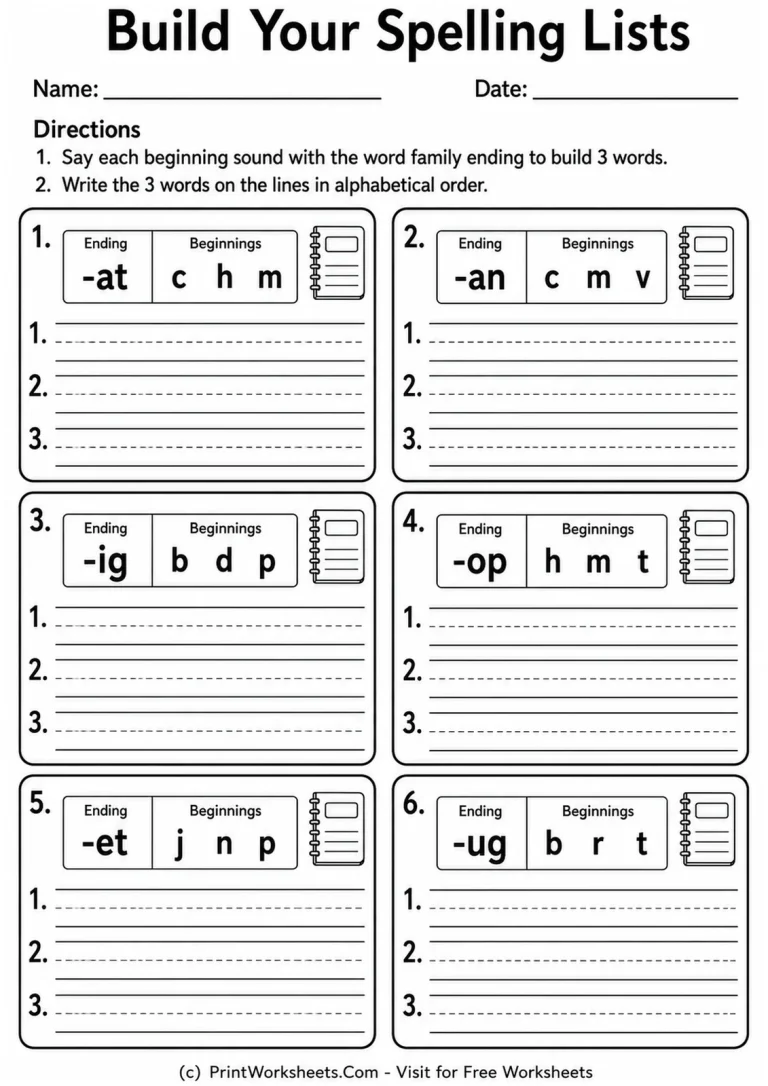
The final student page, Build Your Spelling Lists, asks children to construct words from six families: -at, -an, -ig, -op, -et, and -ug. For each family, three beginnings are supplied. Students combine those beginnings with the ending and then write the three completed words in alphabetical order. This extends the lesson beyond phonics because children practice two skills at once: accurate word construction and basic alphabetical ordering.
The alphabetical component is especially useful for Grade 1 because it gives students a practical reason to compare the first letters of words they have just built. Rather than working with an unrelated alphabetizing list, they organize words that share a spelling pattern. That keeps the phonics focus visible while introducing an early dictionary and reference skill.
Four Different Ways to Strengthen the Same Skill
Together, the worksheets create a clear progression. Students first build familiar words with picture support, then identify the correct family for whole words, apply related words inside sentences, and finally construct and organize their own short spelling lists. The variety helps children revisit short-vowel patterns without making every page feel identical.
These printable worksheets can be used as a short word-study sequence across several days or selected individually to match a student’s needs. A learner who needs extra decoding support may begin with the picture-based page, while a student ready for more independent work can move to sentence completion or spelling-list construction. The set also fits homework, intervention practice, literacy stations, small-group instruction, and additional review of common CVC patterns.
For teachers and families looking for focused Grade 1 spelling practice, this collection keeps the target narrow and useful: students repeatedly notice how beginning sounds combine with consistent word-family endings to form real words. By moving from recognition to meaning and then to organized spelling lists, the worksheets give early readers several opportunities to strengthen short-vowel spelling patterns in a practical, age-appropriate way.