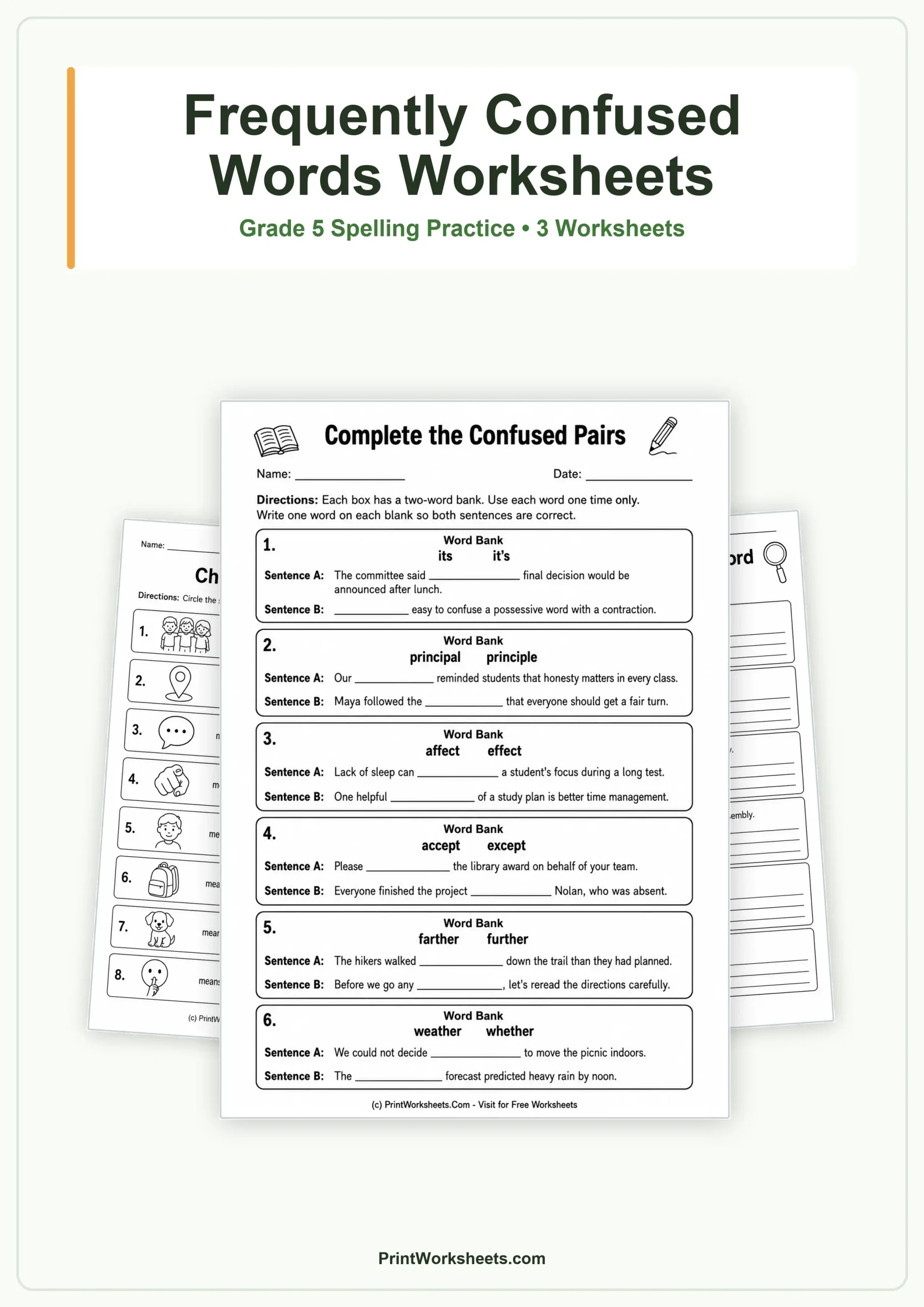
These frequently confused words worksheets give fifth-grade students focused practice with words that may sound alike, look similar, or seem interchangeable until meaning and sentence context are considered carefully. Instead of asking students to memorize isolated spellings, the activities require them to decide which word actually fits the idea being expressed. Across the set, learners work with familiar trouble spots such as their, there, they’re, your, you’re, its, it’s, quiet, and quite, then move into pairs including principal and principle, affect and effect, accept and except, farther and further, and weather and whether.
Frequently Confused Words Worksheets for Meaning and Usage
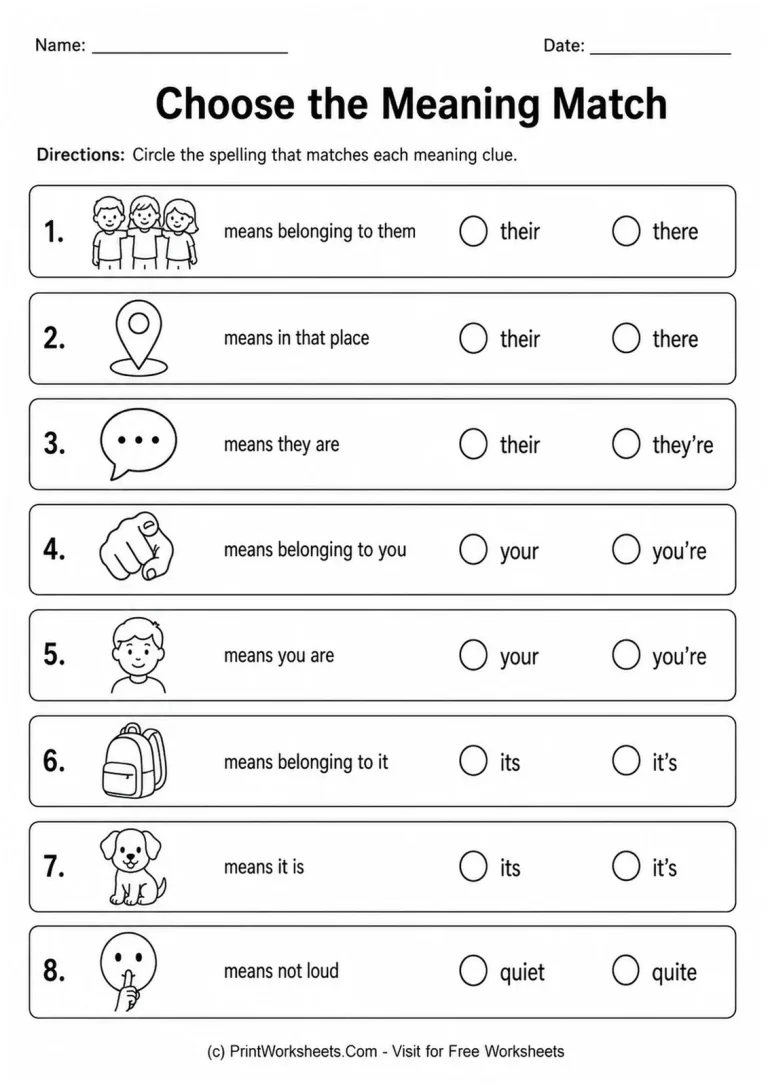
The first worksheet begins with meaning-based choices. Students read a short clue and circle the spelling that matches the intended meaning. This format makes the difference between similar-looking words concrete. For example, students must distinguish a possessive form such as their from a place word such as there, or decide whether a sentence needs your or the contraction you’re. The activity also gives practice with its and it’s and with the easily confused adjectives quiet and quite.
This type of work is useful because correct spelling is tied directly to vocabulary knowledge. A student may be able to spell two words correctly and still choose the wrong one in writing. Reading the clue first encourages learners to think about meaning before making a spelling decision, which helps build a stronger connection between word form and word function.
Practice Confused Word Pairs in Sentence Context
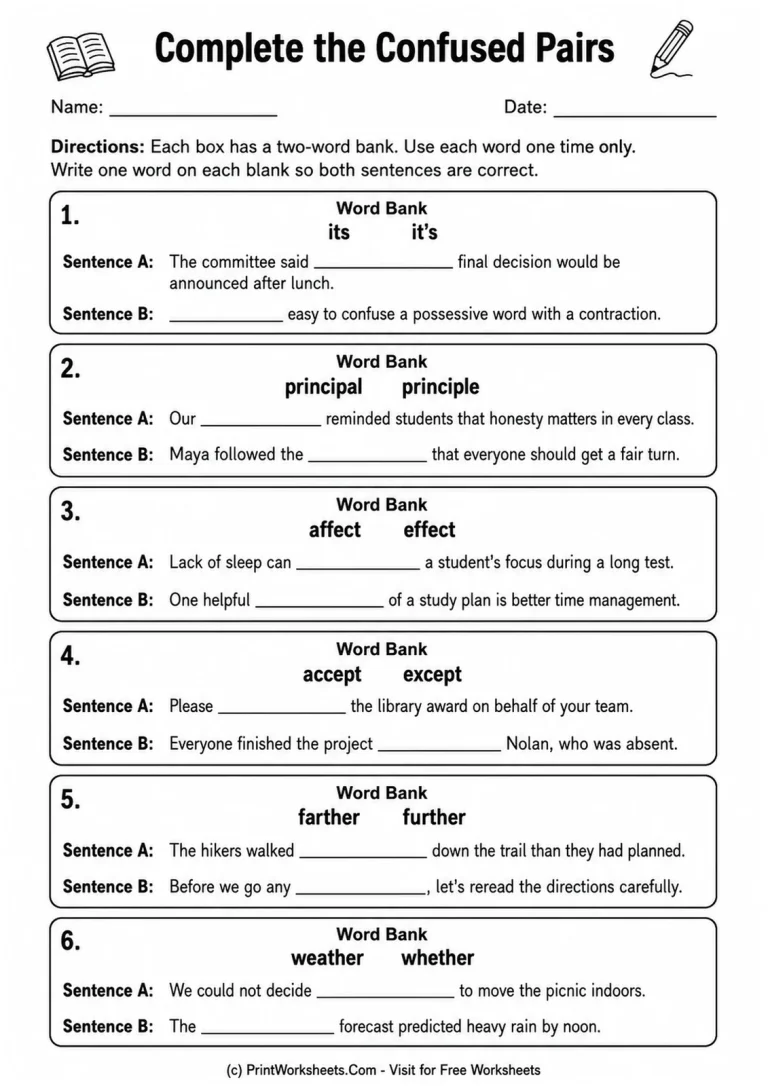
The next activity shifts from selecting an answer to completing paired sentences. Each section provides a two-word bank, and students use each word once to finish two different sentences. Because both choices are legitimate English words, students cannot rely on visual familiarity alone. They must examine how each sentence works and determine which option makes sense.
The word pairs include its/it’s, principal/principle, affect/effect, accept/except, farther/further, and weather/whether. These pairs introduce several kinds of confusion. Some involve contractions and possessives, some involve words with related pronunciations, and others depend on grammatical role or precise meaning. The affect/effect pair, for example, gives students practice noticing the difference between a verb meaning to influence and a noun referring to a result. The principal/principle pair asks them to separate a person or primary role from a rule or guiding idea.
From Choosing a Word to Proofreading a Whole Sentence
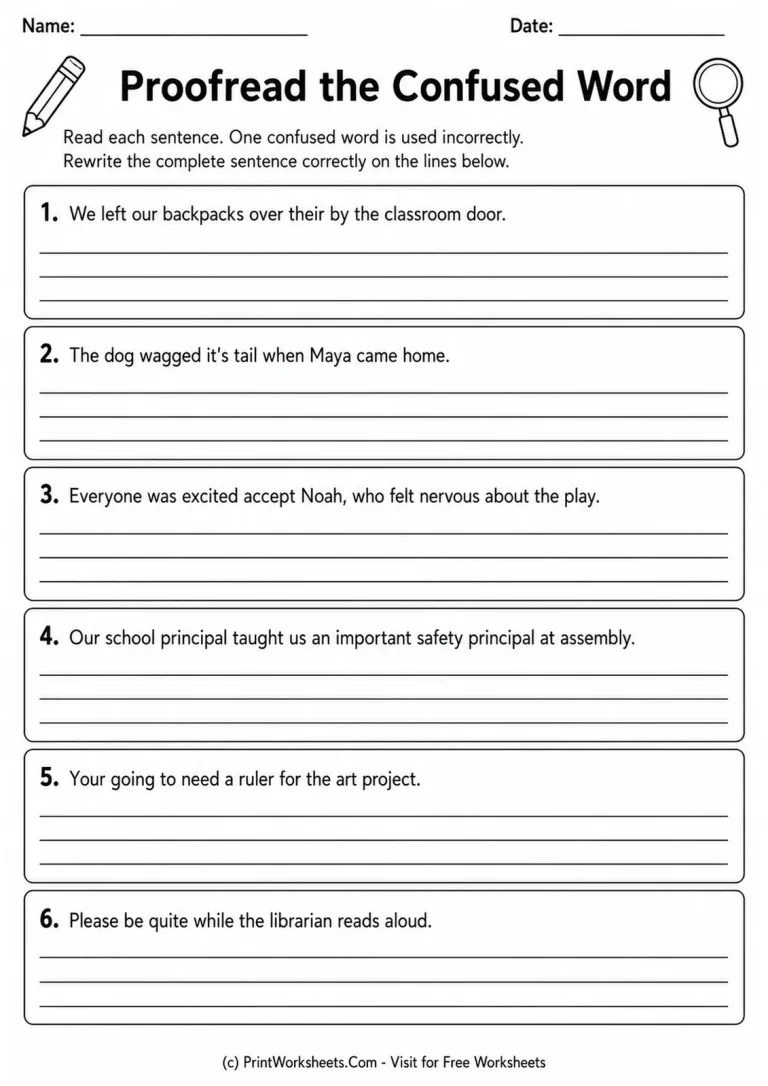
The final worksheet adds a proofreading step. Each sentence contains one incorrectly used confused word. Students identify the problem and then rewrite the complete sentence with the correct word. This makes the task more demanding than circling an option because learners must preserve the rest of the sentence while correcting the word that does not fit.
The proofreading page revisits distinctions such as there/their, its/it’s, accept/except, principal/principle, your/you’re, and quiet/quite. Rewriting the whole sentence also gives students an opportunity to check capitalization, spacing, punctuation, and overall sentence accuracy while concentrating on the target spelling choice.
How to Use These Grade 5 Spelling Worksheets
The three activities work well as a short sequence because the level of independence increases from page to page. Teachers can begin with the meaning-choice worksheet during a spelling lesson or review block, use the paired sentence activity for guided or independent practice, and finish with proofreading as an application task. The pages can also be used separately for morning work, literacy centers, homework, intervention, or a quick review before a writing assignment.
Parents can use the same progression for extra practice at home. When a student chooses the wrong word, asking them to explain the meaning of both options can be more useful than simply giving the correct answer. For pairs such as weather/whether or farther/further, creating an additional oral sentence with each word can reinforce the distinction before the student returns to written work.
Build More Accurate Spelling Through Context
Frequently confused words are challenging because many errors are not caused by an inability to spell. The student may know how to spell both choices but still need practice deciding which one belongs in a particular sentence. These Grade 5 worksheets address that problem directly by combining meaning, grammar, context, and proofreading. Students progress from recognizing the right word to applying it in sentences and finally correcting misuse in complete written statements, making the set a practical resource for spelling review and more accurate everyday writing.