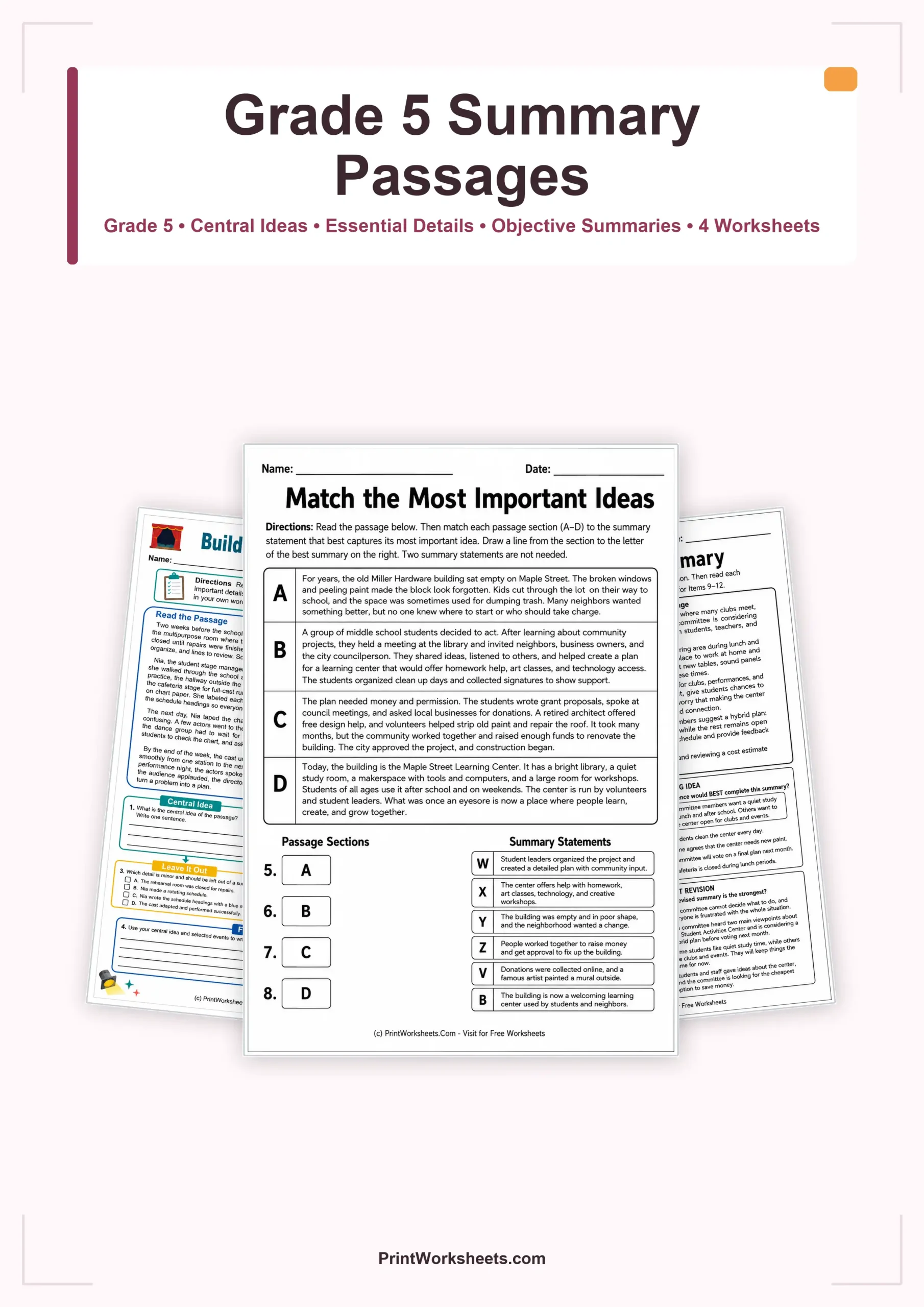
These summary passages for Grade 5 give students repeated practice with one of the hardest parts of reading comprehension: deciding what matters enough to include in a summary and what should be left out. Across four different activities, students move from identifying a central idea and choosing essential events to evaluating weak summaries and finally writing a complete objective summary of a longer text. The set is especially useful for students who can understand a passage but still need support turning that understanding into a concise written response.
Grade 5 Summary Passages That Build the Skill Step by Step
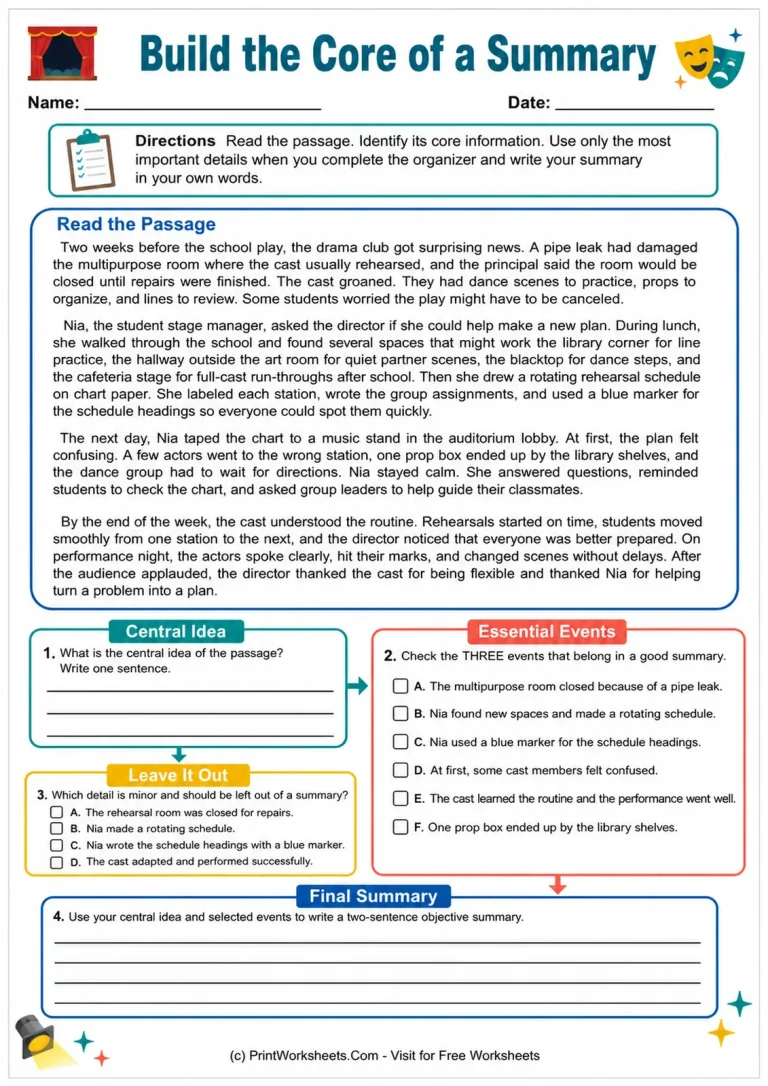
The first worksheet, Build the Core of a Summary, uses a school drama-club problem to make the summarizing process concrete. A pipe leak closes the usual rehearsal room, and Nia, the student stage manager, helps organize alternate practice spaces and a rotating schedule. Students first state the central idea, then choose the three events that belong in a good summary, identify a minor detail that should be omitted, and use those choices to write a two-sentence objective summary. This page makes the difference between an important event and an interesting but unnecessary detail visible before students have to write on their own.
From Main Ideas to Section Summaries
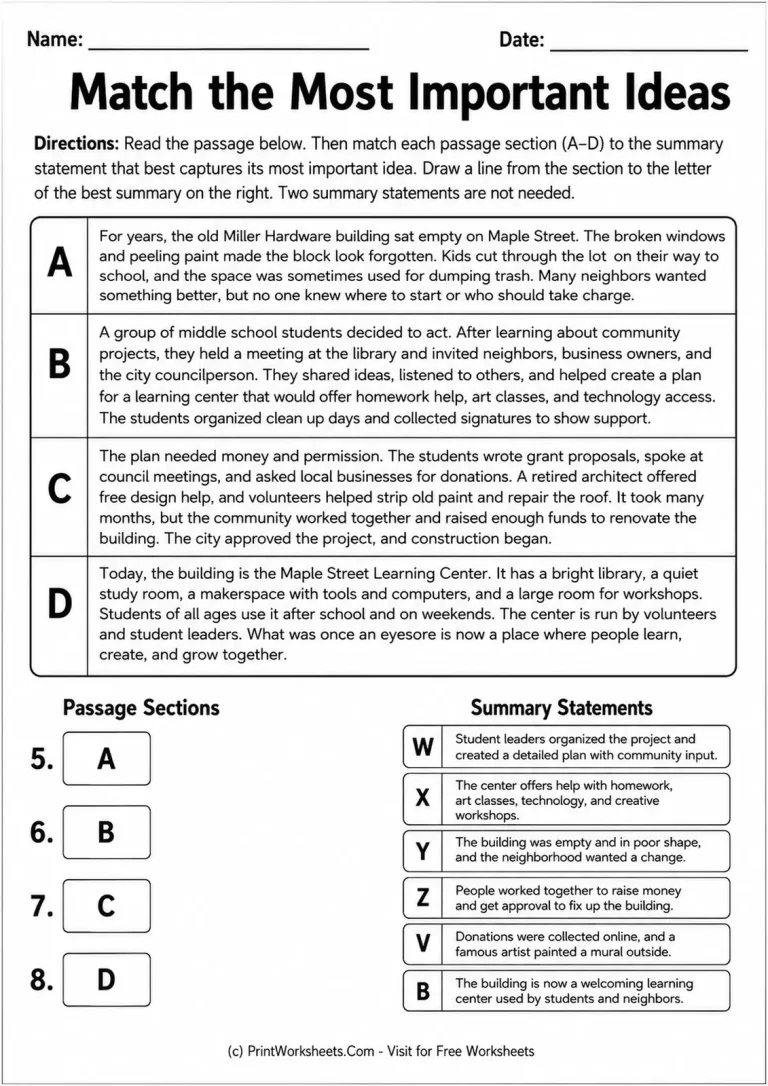
The second page asks students to match four sections of a passage with the summary statement that best captures each section’s most important idea. The text follows the transformation of an empty, run-down Maple Street hardware building into a community learning center. Students track the problem, student leadership, fundraising and approval, and the finished center. Two extra summary statements act as distractors, so students cannot simply match by shared vocabulary; they have to decide which statement represents the main point of each section.
This activity is useful for teaching students that a longer text can contain several smaller main ideas that work together. It can also prepare students for writing paragraph-by-paragraph notes before composing a whole-text summary.
Evaluate and Repair Weak Summaries
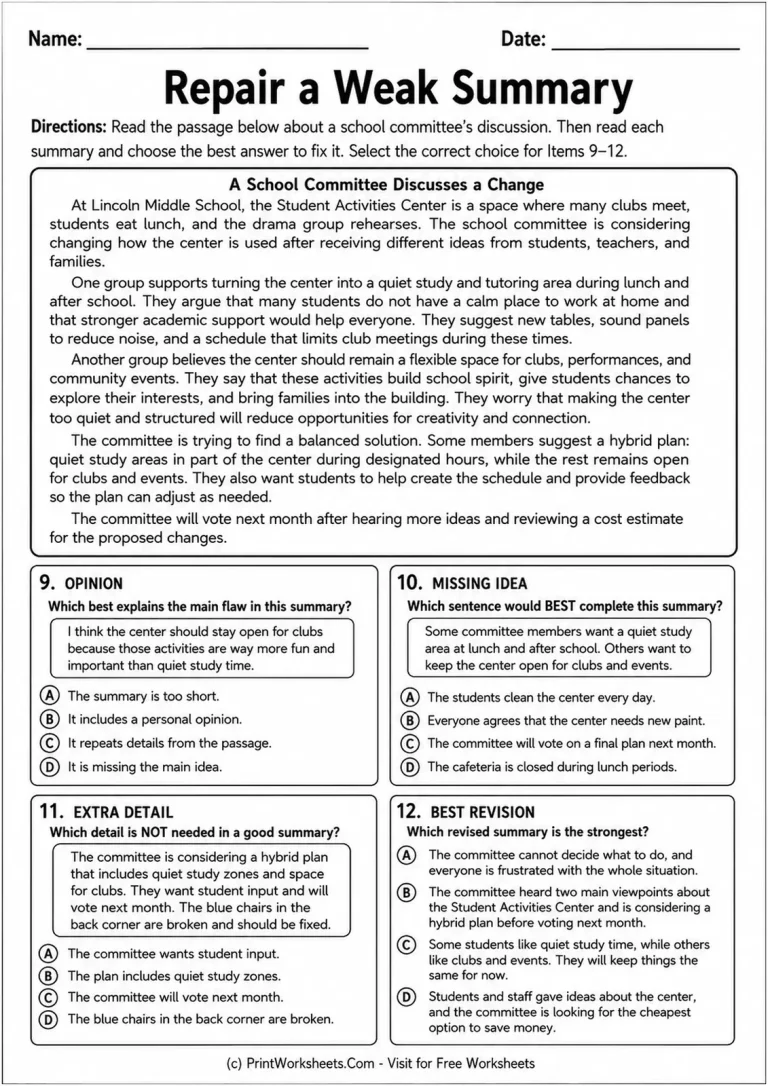
Repair a Weak Summary shifts the work from selecting information to judging the quality of a summary. The passage describes a school committee considering different uses for a Student Activities Center. One group favors quiet study and tutoring, another wants to preserve space for clubs and events, and the committee considers a hybrid plan before a future vote.
Students answer four multiple-choice questions about common summary problems. They identify a personal opinion, choose a missing important idea, spot an unnecessary detail, and select the strongest revised summary. Because the questions focus on flaws students often make in their own writing, this page works well as a bridge between reading comprehension and revision.
Plan and Write a Complete Objective Summary
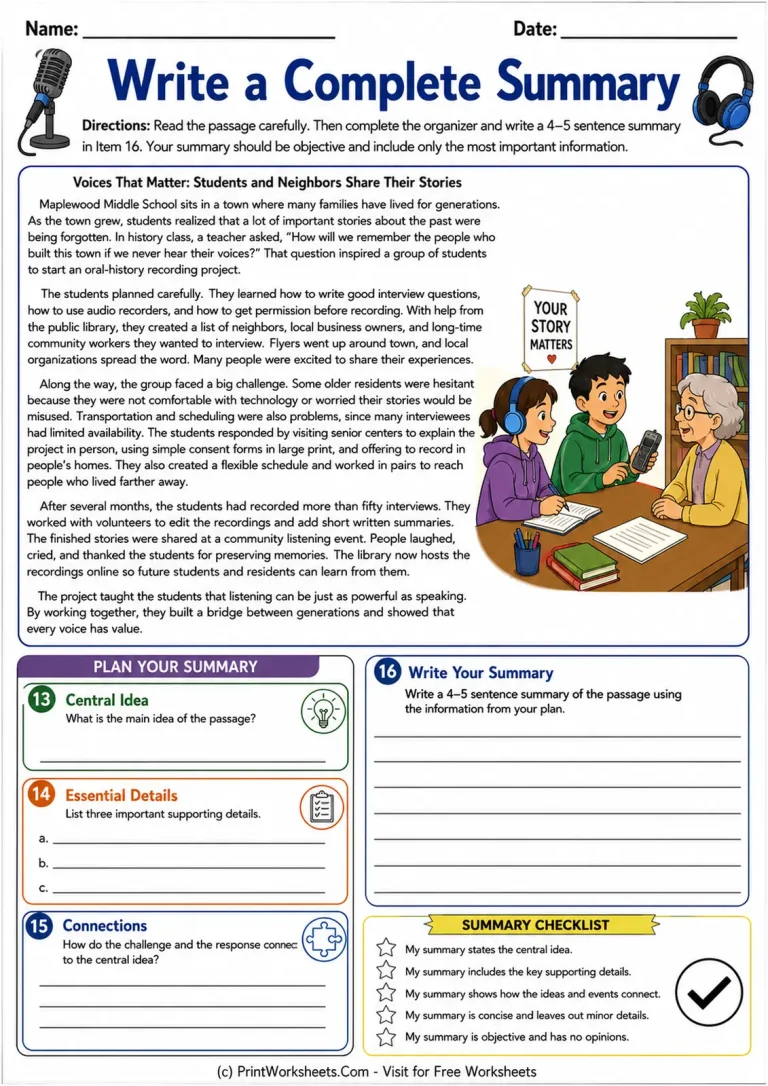
The final worksheet provides the most independent task. Students read Voices That Matter: Students and Neighbors Share Their Stories, a longer passage about Maplewood Middle School students creating an oral-history recording project. They learn interview and recording skills, recruit local residents, face technology and scheduling challenges, adapt by visiting senior centers and using flexible schedules, and eventually record more than fifty interviews that are edited and shared with the community.
Before writing, students complete a planning organizer. They state the central idea, list three essential details, and explain how the challenge and response connect to the central idea. They then write a four- to five-sentence summary and use a checklist to confirm that it includes the central idea, key details, clear connections, concise wording, and no personal opinions.
How Teachers and Parents Can Use This Set
These worksheets can be used in sequence over several lessons or selected individually for targeted practice. For whole-group instruction, model how to ask, “Would the reader still understand the passage without this detail?” before students complete the first page. In small groups, have students defend why one detail is essential while another is minor. The matching page works well for partner discussion because students can compare how they identified the main point of each section.
For students who need more support, allow them to underline the problem, response, and outcome in different parts of the passage before writing. Students ready for a challenge can rewrite a weak summary in their own words or reduce a longer response to fewer sentences without losing the central idea. The final oral-history passage is also a strong option for independent practice because its planning boxes make the thinking process visible before the student writes.
A Focused Resource for Stronger Reading Responses
This set gives fifth graders several ways to practice the same core reading skill without repeating the same task format. Students select, match, evaluate, organize, and write, all while learning that a strong summary is accurate, concise, objective, and built around the most important ideas. That progression makes the worksheets useful for reading centers, intervention, homework, test preparation, or a short summarizing unit.