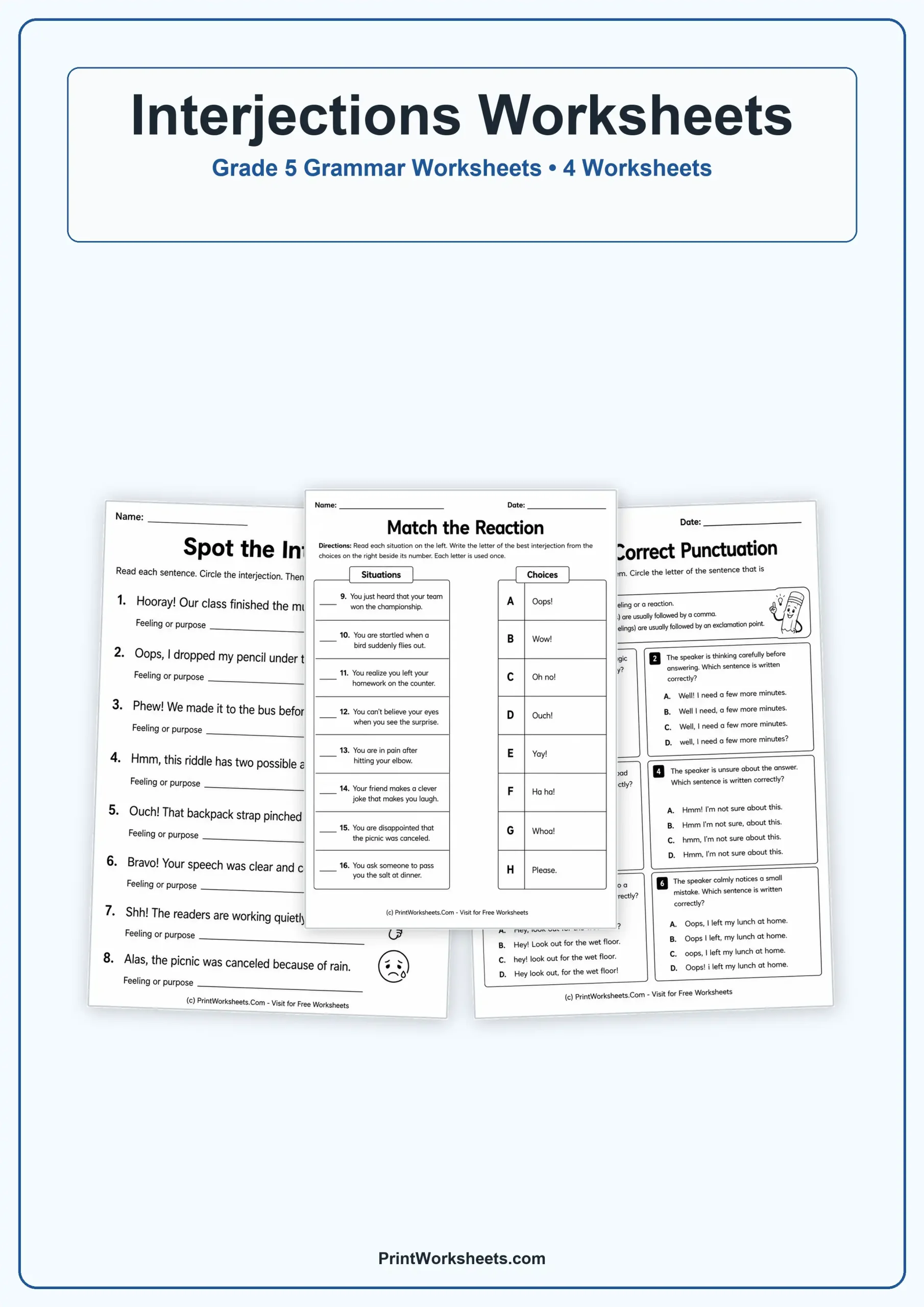
These interjections worksheets give fifth-grade students several ways to study how short reaction words work inside complete sentences. Instead of treating interjections as a list to memorize, the activities ask learners to notice what each expression communicates, connect reactions with everyday situations, decide how strongly a speaker is reacting, and choose punctuation that fits the meaning. Across four printable pages, students work with expressions such as Hooray, Oops, Phew, Hmm, Ouch, Bravo, Shh, Alas, Wow, Oh no, Yay, Whoa, Hey, and Yikes.
Interjections Worksheets for Meaning and Context
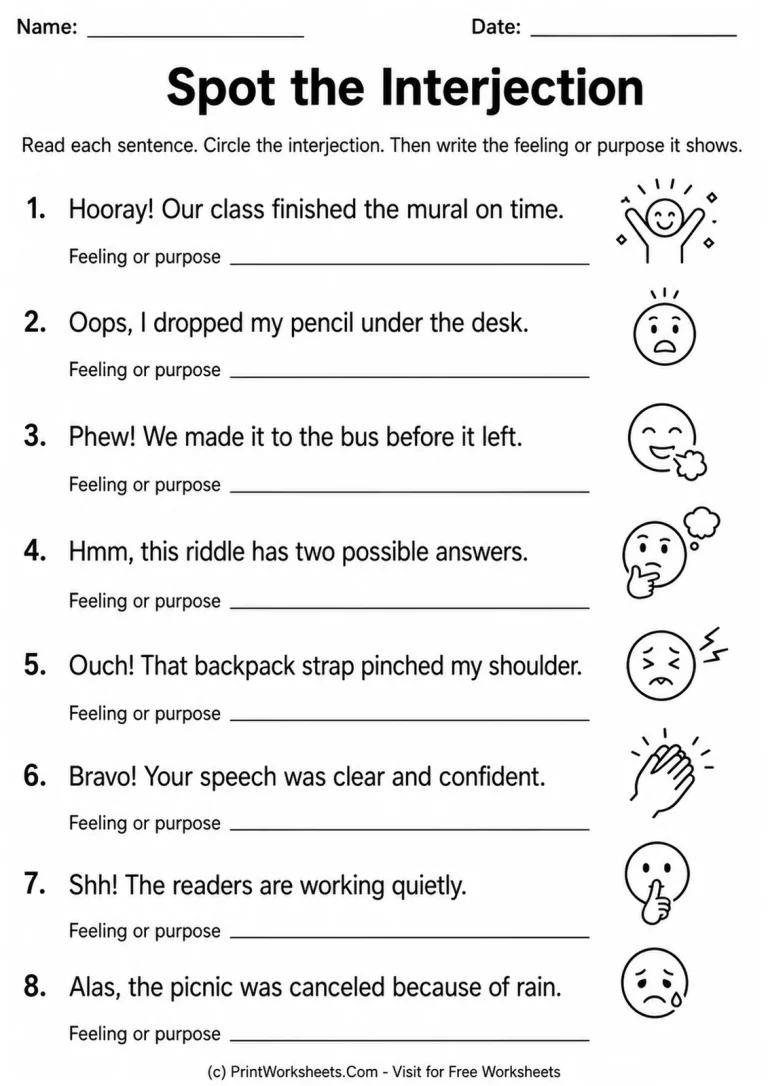
The first activity, Spot the Interjection, builds careful sentence reading. Students read eight complete sentences, locate the interjection in each one, and identify the feeling or purpose it communicates. The examples include celebrations, mistakes, relief, hesitation, pain, praise, requests for quiet, and sadness. This makes the task more meaningful than simply circling a word because students must also interpret why the speaker used it.
That combination of grammar and meaning is especially useful for Grade 5 learners. An expression such as Phew does not serve the same purpose as Bravo, even though both can appear separately from the main grammatical structure of a sentence. Asking students to explain the reaction helps them connect form, tone, and context.
Match Everyday Situations to the Best Reaction
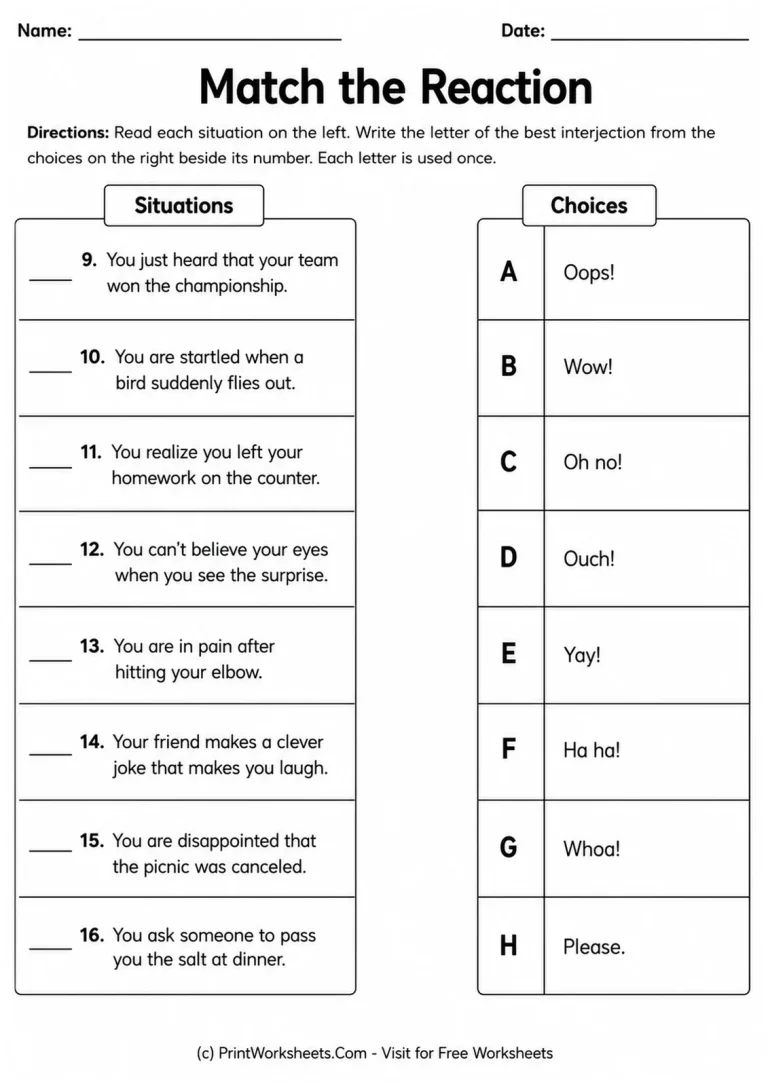
The second printable page shifts from identification to choice. Students read eight everyday situations and match each one to a different reaction from a set that includes Oops, Wow, Oh no, Ouch, Yay, Ha ha, Whoa, and Please. Each option is used once, so students need to compare all of the possibilities rather than selecting a reaction in isolation.
This activity supports close reading because several interjections can sound reasonable until the exact situation is considered. Students must distinguish excitement from surprise, pain from disappointment, laughter from celebration, and a polite request from an emotional reaction. The one-to-one matching structure also encourages students to reconsider earlier choices if a later situation fits an expression more clearly.
Practice Interjection Punctuation
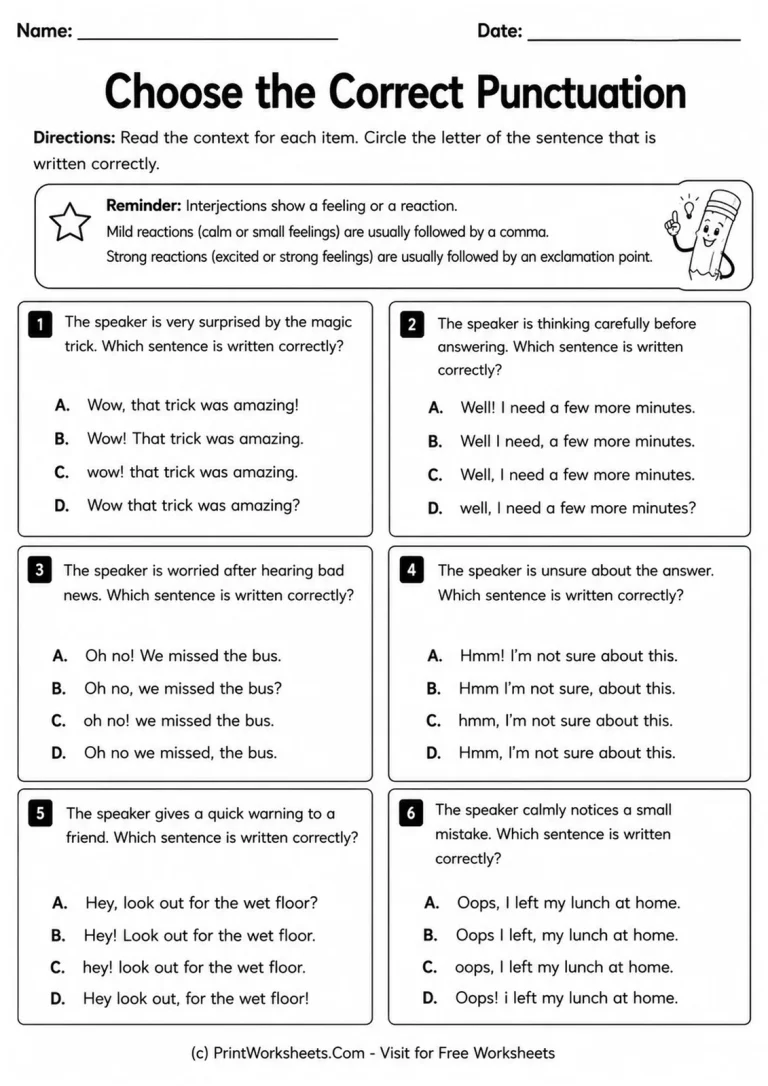
Interjections can also change the punctuation around a sentence. The third worksheet focuses on this skill by contrasting mild and strong reactions. Students are reminded that a mild reaction is commonly separated with a comma, while a strong reaction can be followed by an exclamation mark. They then choose the most appropriate version of sentences containing expressions such as Wow, Well, Oh no, Hmm, Hey, and Oops.
Because the punctuation decision is placed inside a context, students are not asked to apply a mechanical rule without considering tone. They have to think about whether the reaction is restrained or forceful and then select punctuation that represents that intensity. This is a useful bridge between grammar instruction and expressive writing because punctuation becomes part of meaning rather than an isolated editing convention.
Use Interjections in Complete Sentences
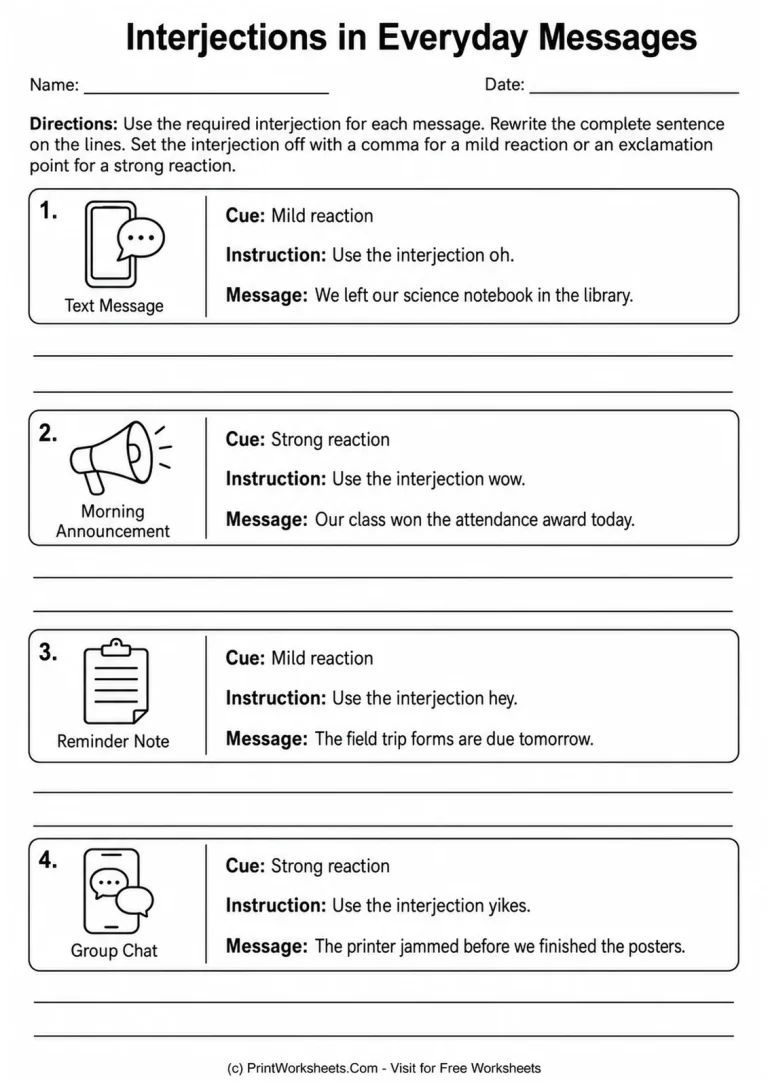
The final student page moves from recognition to production. Learners rewrite sentences in familiar communication settings, including a text message, a morning announcement, a reminder note, and a group chat. Each prompt supplies an interjection such as oh, wow, hey, or yikes and identifies whether the intended reaction should be mild or strong.
Students must then produce a complete sentence while applying the correct punctuation for the reaction. This gives them a chance to use the same concept they practiced on the earlier pages in their own writing. It also shows that interjections appear in many kinds of everyday communication, not only in isolated grammar exercises.
Ways to Use These Grade 5 Grammar Printables
The four-page sequence can be taught from beginning to end as a short grammar unit, or individual sheets can be used separately. Spot the Interjection works well for introducing or reviewing the concept. The matching activity can serve as independent practice once students understand how reactions express different meanings. The punctuation page is suitable for grammar or editing lessons, while the rewriting activity can be used as a transition into sentence writing.
Teachers can also use the pages for morning work, literacy centers, homework, small-group instruction, or a quick review before a broader lesson on sentence conventions. Parents supporting learning at home can begin with identification and matching, then move to punctuation and rewriting after the student can explain what common interjections communicate.
By progressing from noticing interjections to interpreting, punctuating, and using them, this printable set gives fifth graders repeated practice with the same grammar concept in different forms. Students finish the sequence not only recognizing interjections but also understanding how reaction, context, and punctuation work together inside real sentences.