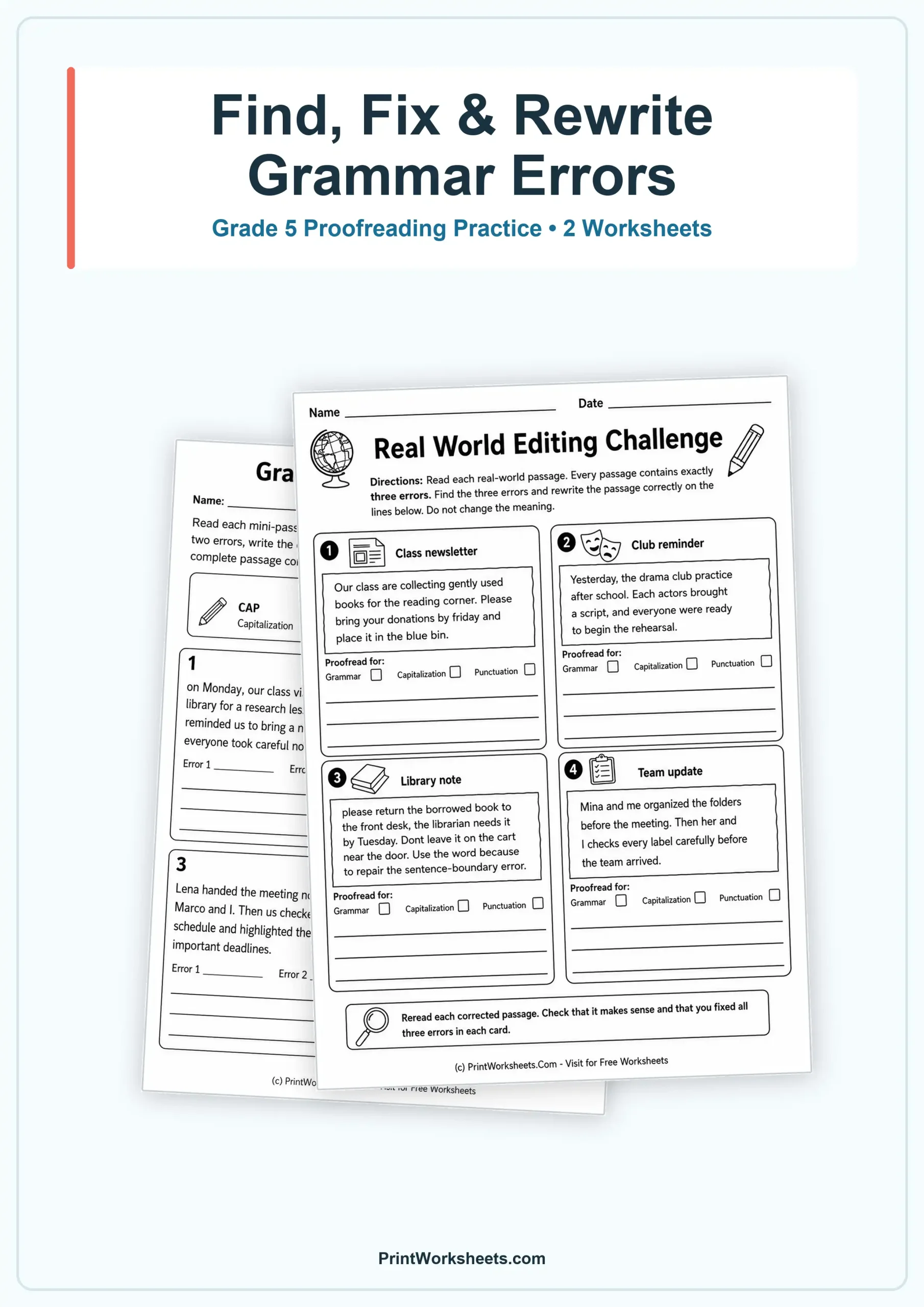
These grammar editing passages give fifth-grade students a practical way to find and correct mistakes inside short pieces of writing instead of working only with isolated sentences. Across the two printable worksheets, learners proofread for capitalization, punctuation, verb forms, pronouns, and overall sentence correctness. The activities begin with tightly controlled mini passages and then move into longer real-world writing tasks that require students to identify several errors and rewrite the complete passage correctly.
Grammar Editing Passages for Grade 5 Proofreading Practice
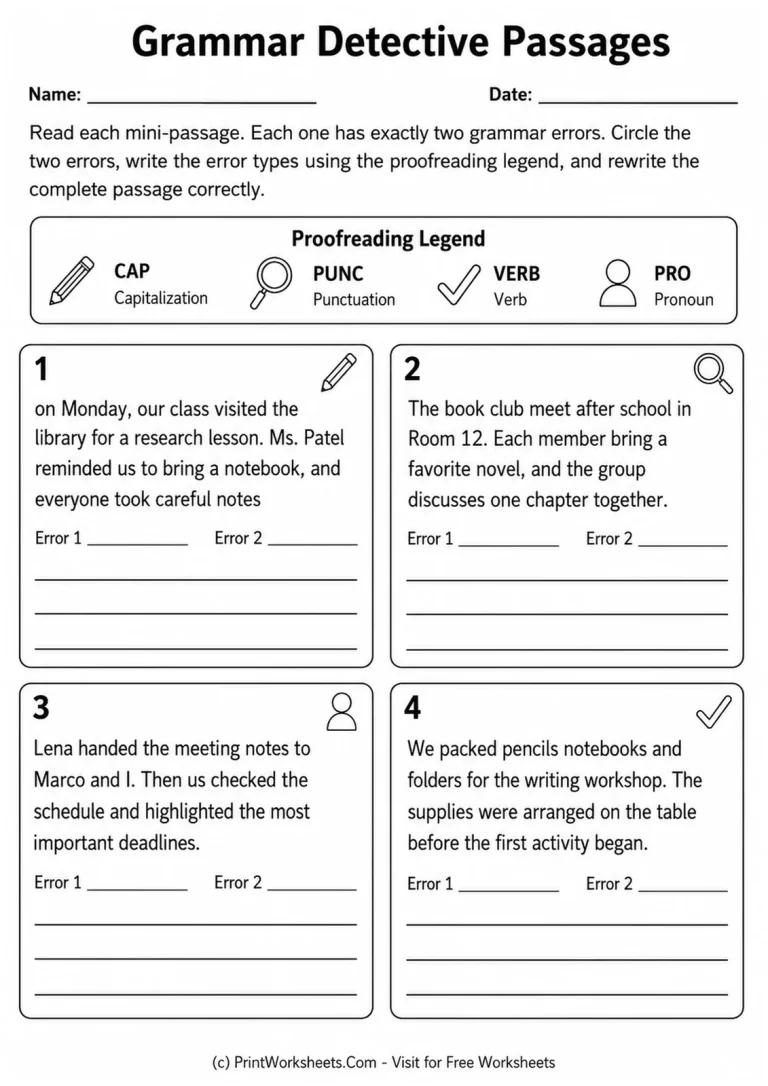
The first worksheet, Grammar Detective Passages, is built around four short passages. Each passage clearly tells students that it contains exactly two errors, giving learners a manageable proofreading target before they begin. Students use a simple proofreading legend with four codes: CAP for capitalization, PUNC for punctuation, VERB for verb errors, and PRO for pronoun errors. This extra classification step helps students do more than simply notice that something looks wrong. They must decide what kind of grammar problem they found before making the correction.
The mini passages include several grade-appropriate editing skills. Students encounter subject-verb agreement in phrases such as “book club meet” and “Each member bring,” where the verb form must agree with the subject. Pronoun practice appears in sentences using forms such as “Marco and I” and “Then us checked,” encouraging learners to consider how pronouns function inside a sentence. Students also proofread capitalization and punctuation, including commas in a series such as “pencils notebooks and folders.” Because the errors are embedded in short passages, students must read for meaning as well as mechanics.
Move from Error Identification to Complete Passage Editing
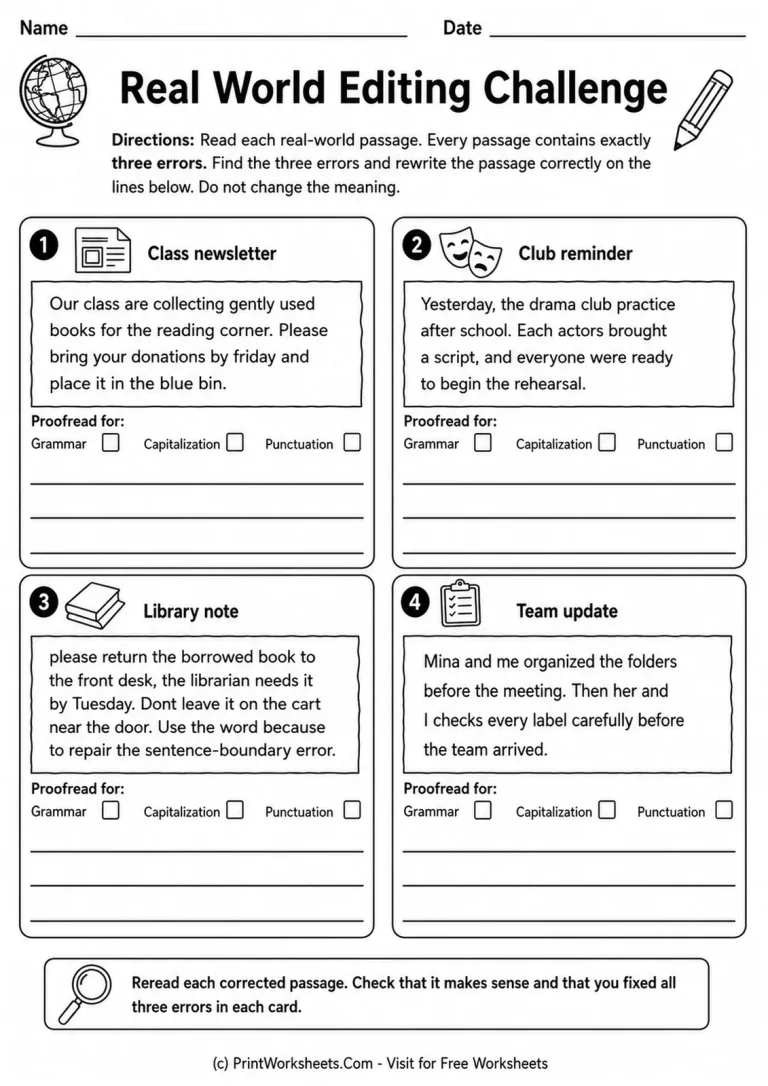
The second worksheet, Real World Editing Challenge, increases the level of independence. Instead of working with very short detective-style passages, students edit four pieces of everyday writing: a class newsletter, a club reminder, a library note, and a team update. Each passage contains exactly three errors. Students are asked to check grammar, capitalization, and punctuation, find the mistakes, and then rewrite the entire passage without changing its meaning.
This format makes the editing process more authentic. In real writing, students rarely receive an isolated sentence labeled with the exact rule they need to use. They must read a complete message, notice what does not fit, determine the correction, and produce a clean final version. Rewriting the whole passage also reinforces correct sentence structure because students see the corrected language as a complete piece of communication rather than as a collection of disconnected fixes.
Skills Practiced in These Grade 5 Grammar Worksheets
The worksheets combine several proofreading skills that fifth graders are expected to apply during writing and revision. Students practice checking sentence beginnings and proper capitalization, adding missing punctuation, correcting commas in a series, selecting verb forms that agree with their subjects, reviewing verb tense, and choosing appropriate pronoun forms. The activities also strengthen careful reading because students need to preserve the original meaning while correcting the mechanics.
The progression between the two pages is especially useful for instruction. The first activity provides structure by limiting the number of errors and supplying proofreading categories. This can help students learn a repeatable editing routine: read the passage, locate the error, identify its type, and correct it. The second activity removes much of that support and asks students to apply the same habits more independently. Teachers can therefore use the pages in sequence, while parents can use the first worksheet as guided practice and the second as a follow-up challenge.
Useful for Grammar Review, Writing Centers, and Home Practice
These printable activities can fit into several parts of a Grade 5 English language arts lesson. They work well during grammar review, writing centers, independent proofreading practice, morning work, homework, or a short editing lesson before students revise their own writing. A teacher can also ask students to explain why each correction is needed, turning the activity into a discussion of grammar rules rather than a simple find-and-fix exercise.
For students who tend to rush through editing, the passage format encourages a slower and more purposeful reading process. The first worksheet builds attention to specific error categories, while the real-world challenge asks students to transfer those skills to more natural writing. Together, the two pages provide focused practice with the kind of proofreading decisions students need when revising classroom assignments, notes, announcements, and other everyday texts.
Use these Grade 5 grammar error editing passages when students are ready to move beyond single-sentence correction and apply multiple grammar and mechanics skills in meaningful context. The combination of error classification, proofreading, correction, and complete rewriting gives learners repeated practice with an editing process they can also use in their own writing.