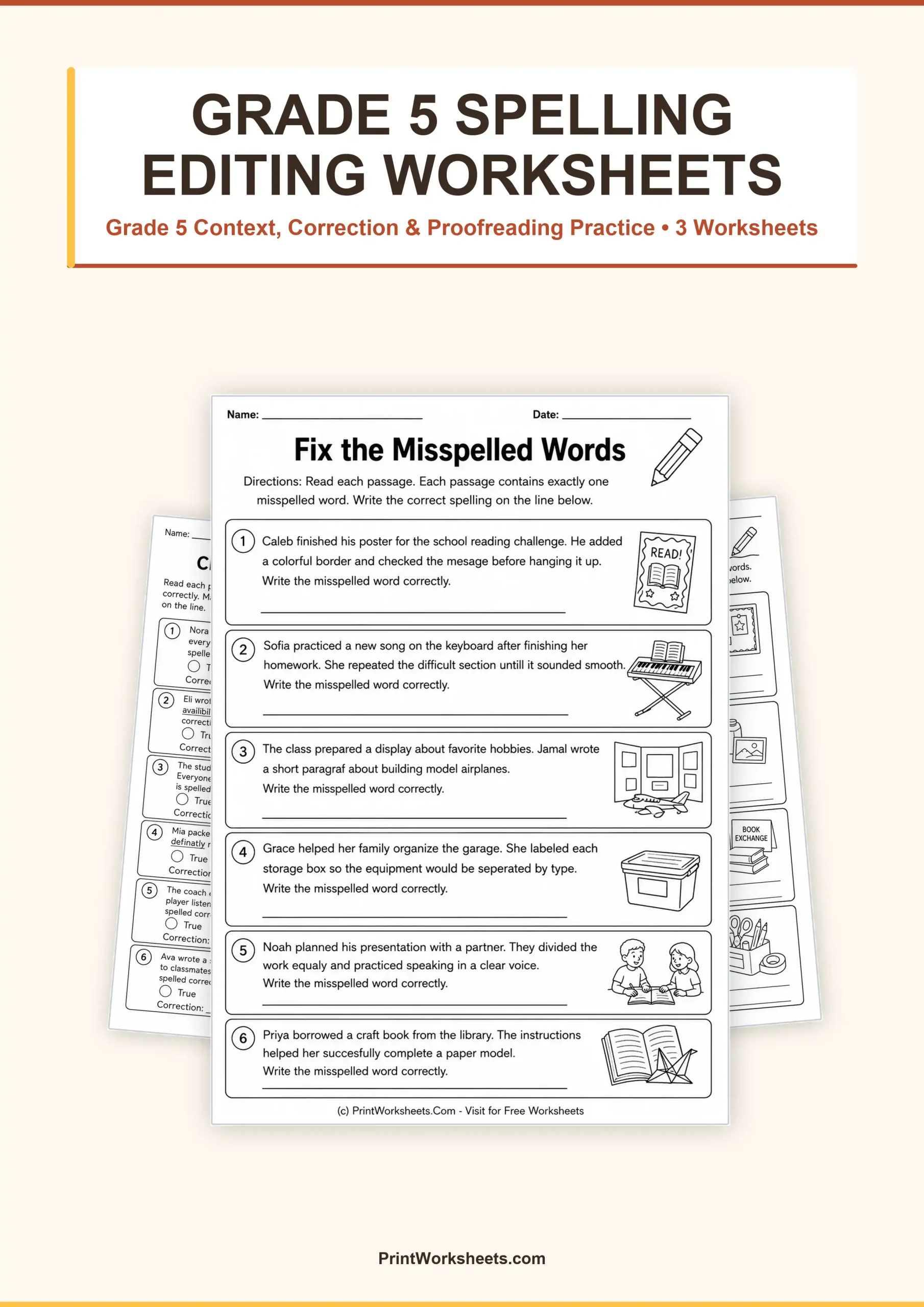
These spelling editing worksheets give fifth graders practical experience finding and correcting spelling errors inside real sentences and short passages. Instead of practicing words only in isolation, students must pay attention to meaning, sentence context, and standard spelling while deciding whether a word is correct and then writing the corrected form when needed. The three printable activities build from guided checking to independent passage editing, making the set useful for spelling review, literacy centers, homework, intervention, or focused editing practice.
How These Spelling Editing Worksheets Build Editing Skill
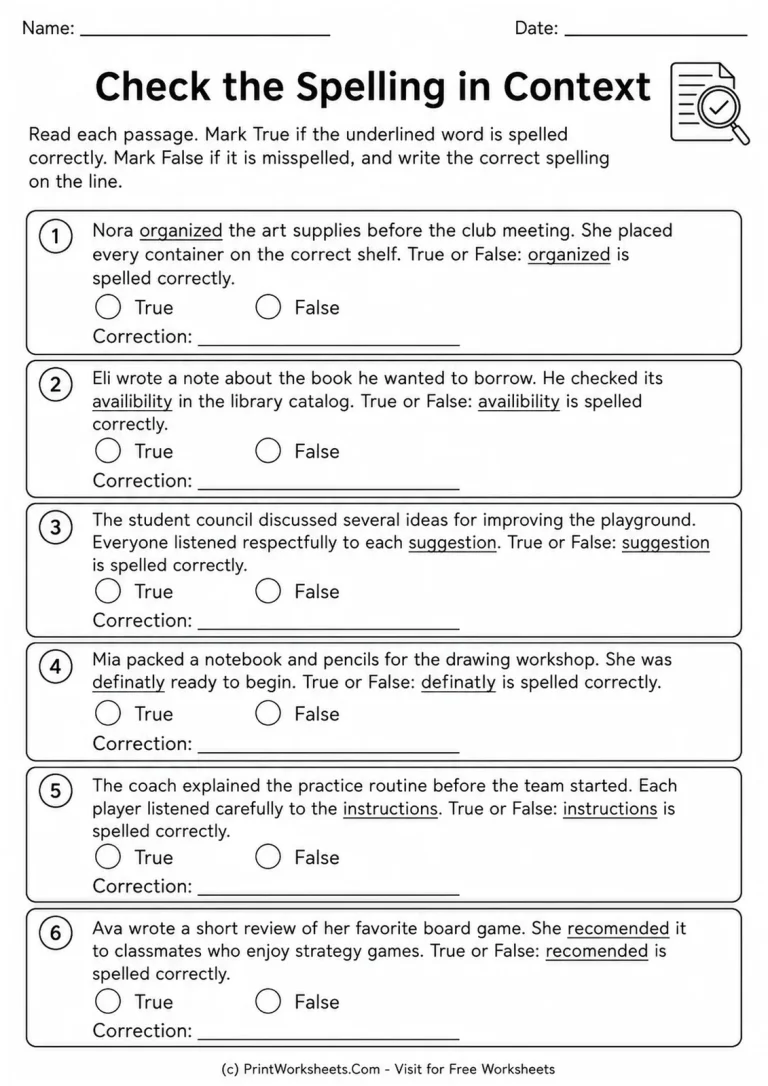
The first activity, Check the Spelling in Context, uses six short passages with one underlined word in each. Students decide whether the spelling is true or false and then rewrite any incorrect word on a correction line. This structure keeps the first step clear while still requiring students to use context instead of relying on a memorized list. Words such as availability, definitely, and recommended provide appropriately challenging practice for upper-elementary learners because they contain letter patterns that are often confused or omitted.
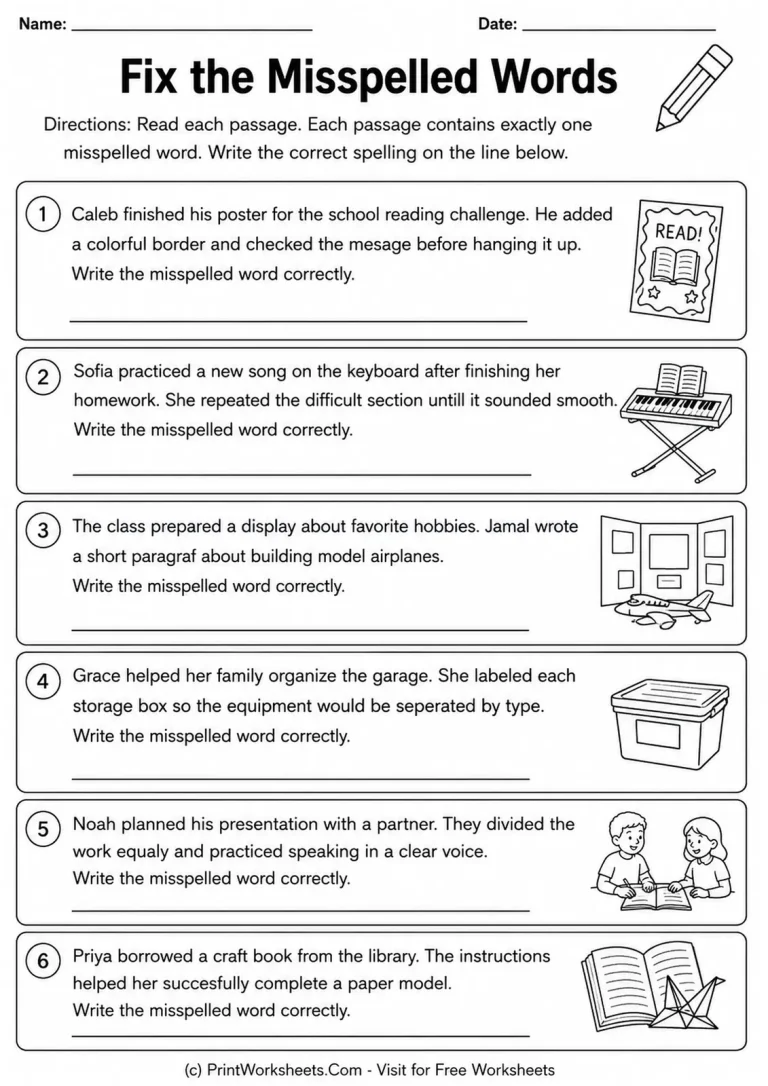
The next worksheet, Fix the Misspelled Words, removes the True/False support. Each of six short passages contains exactly one misspelled word, and students must find it independently before writing the correct spelling. The passages use familiar school and everyday topics, including a poster, music practice, a hobby display, garage organization, a presentation, and a craft book. Target corrections include words such as message, paragraph, separated, and successfully. Because the error is no longer pointed out, students must scan the complete passage carefully and judge every word they read.
Progress From One Error to Multiple Corrections
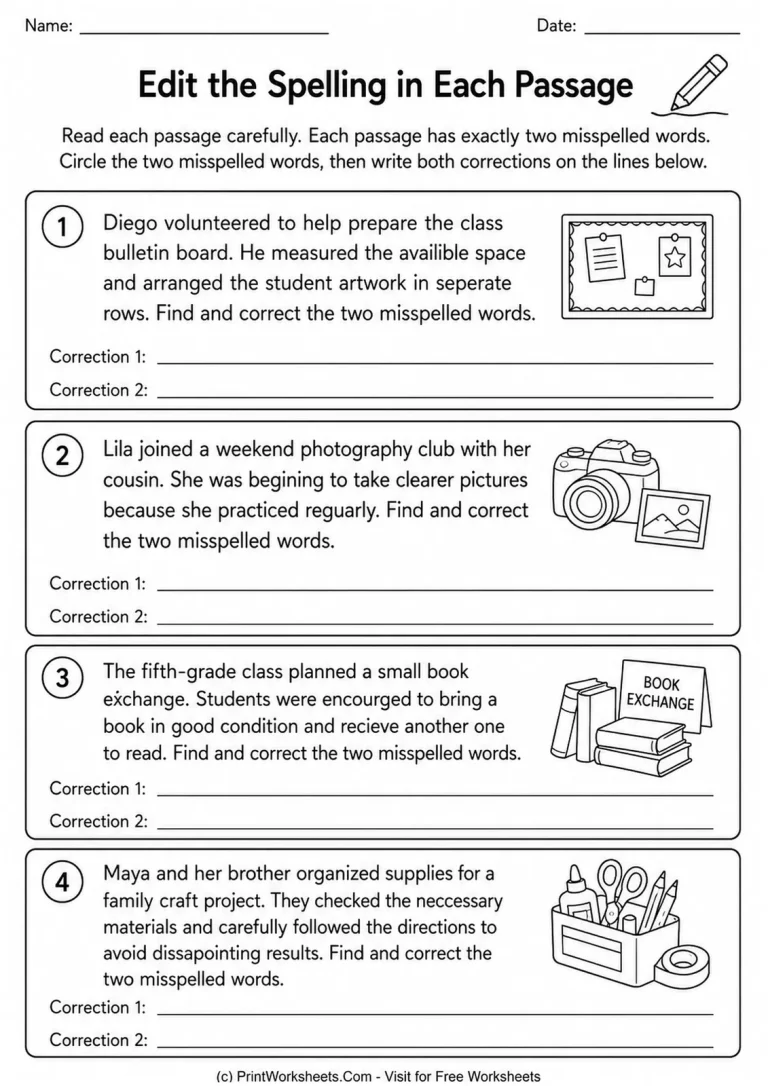
The final approved activity, Edit the Spelling in Each Passage, increases the editing demand again. Students read four longer passages, locate two misspelled words in each one, circle the errors, and record both corrected spellings on separate lines. This format more closely resembles authentic proofreading because students cannot stop after finding the first mistake. They must continue reading, compare possible spellings, and verify that both corrections make sense in context. The activity includes practice with words such as available and separate, reinforcing spellings that can remain difficult even after students recognize them in simpler exercises.
What Grade 5 Students Practice
Across the set, students practice more than copying the correct form of a word. They decide whether a spelling looks right, use surrounding language as evidence, notice missing or misplaced letters, and make written corrections. The gradual change in task structure also supports stronger independence. A student who begins by checking an underlined word eventually moves toward proofreading an entire passage without being told where the errors appear.
This progression can help teachers see where a student needs support. A learner who succeeds when the target word is underlined but struggles to locate an error independently may need more work with visual word recognition and proofreading routines. A student who finds the error but writes an incorrect replacement may need additional spelling-pattern practice. Because the activities separate these demands naturally, they can be used for whole-class practice or for targeted small-group instruction.
Ways to Use the Printable Passage Activities
Teachers can assign one worksheet at a time as a short spelling warm-up, independent literacy station, morning work task, or review before a writing lesson. The pages also work well after students complete their own writing because the same habits can transfer to self-editing: read slowly, check suspicious words, confirm the correction, and keep looking for additional errors. Parents can use the set for focused at-home practice without needing to prepare separate spelling sentences.
For a simple sequence, begin with the True/False context check, continue with the one-error passages, and finish with the two-error editing passages. That order preserves the built-in increase in difficulty and gives students repeated practice with the same core skill in different formats. By the end of the set, fifth graders are doing the kind of careful spelling review that supports both stronger proofreading and more accurate everyday writing.