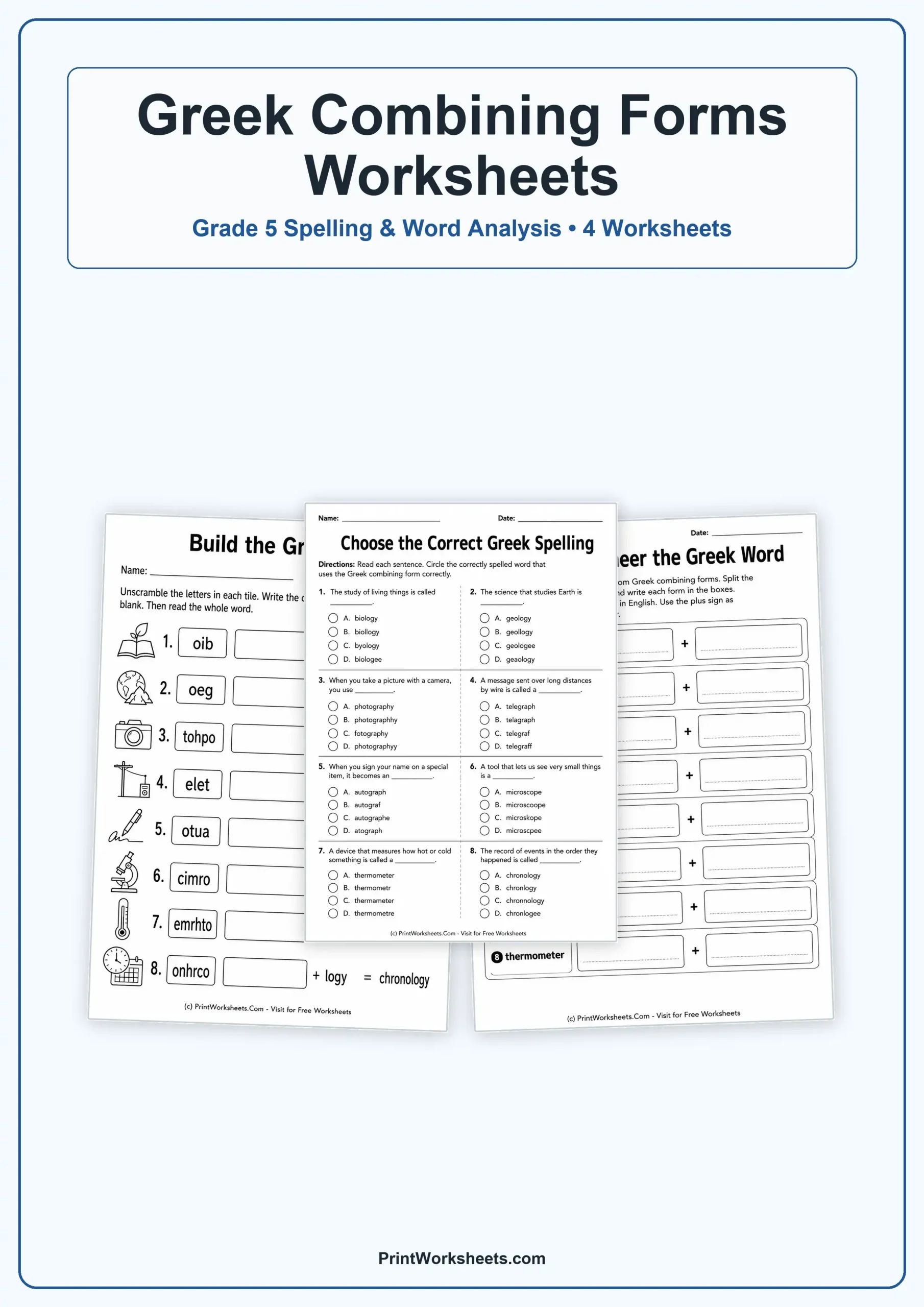
These Greek combining forms worksheets give fifth-grade students a practical way to see how familiar English words can be built from meaningful Greek word parts. Across four printable activities, students work with forms such as bio, geo, photo, tele, micro, chrono, graph, scope, meter, and logy while practicing accurate spelling. Instead of memorizing isolated words, learners build, inspect, split, and proofread words so they can connect spelling patterns with word structure.
Greek Combining Forms Worksheets for Word Building and Spelling
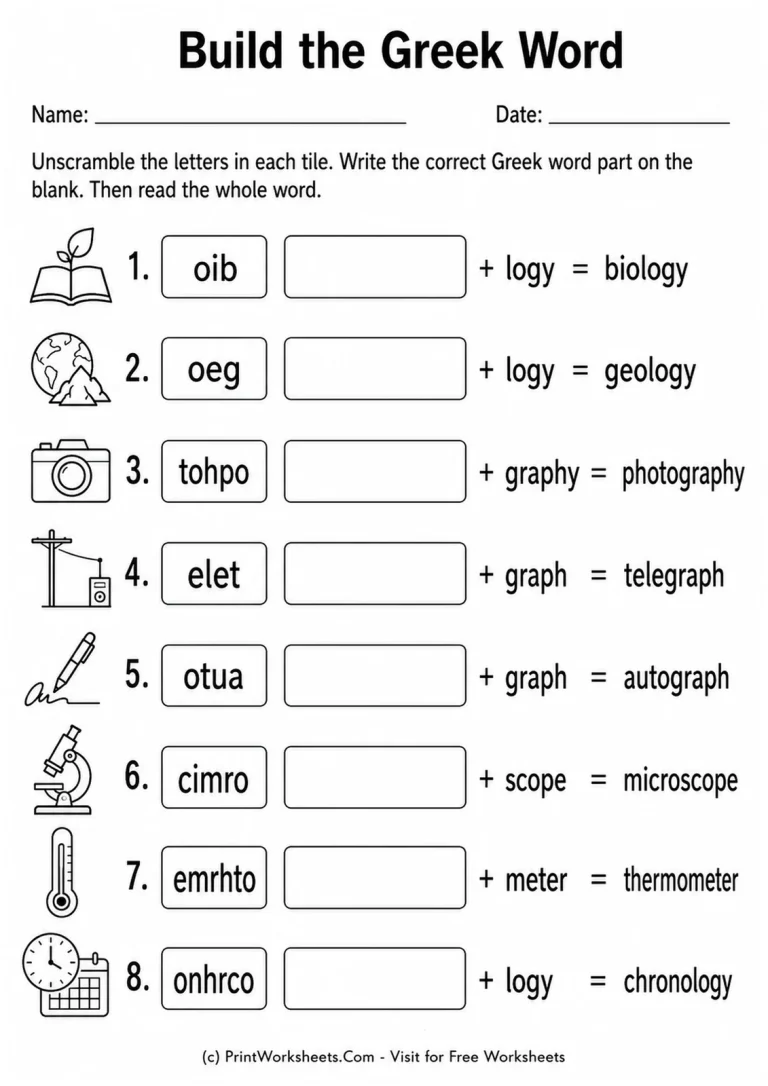
The first worksheet, Build the Greek Word, begins with active word construction. Students unscramble a Greek word part, write it correctly, and combine it with a second form to create a complete English word. The activity includes examples such as bio + logy for biology, geo + logy for geology, photo + graphy for photography, tele + graph for telegraph, micro + scope for microscope, and related combinations. This format helps students notice that longer academic words are often easier to spell when they are understood as smaller meaningful parts.
Word building also gives students a useful strategy for approaching unfamiliar vocabulary. A learner who recognizes photo in photograph or photography can connect the spelling of several related words instead of treating each one as a separate item to memorize. The same principle applies to forms such as tele, micro, chrono, graph, meter, and logy.
Choose Correctly Spelled Greek-Derived Words in Context
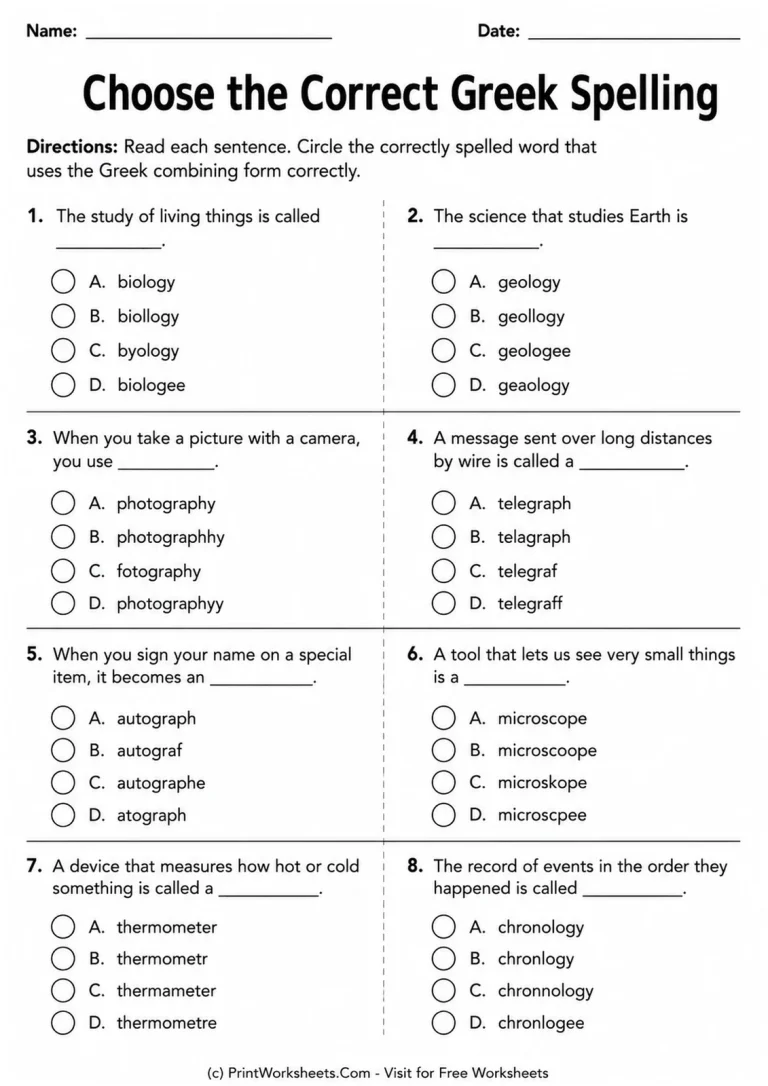
The second page, Choose the Correct Greek Spelling, moves from construction to recognition. Students read eight short definitions or context sentences and select the correctly spelled Greek-derived word. Target vocabulary includes biology, geology, photography, telegraph, autograph, microscope, thermometer, and chronology.
This activity is useful because the choices require attention to both meaning and spelling. Students cannot rely only on what a word looks like. They must connect the sentence clue with the correct word and then distinguish that spelling from plausible-looking alternatives. This makes the page suitable for independent practice, literacy centers, homework, or a short spelling review after students have studied common Greek roots and combining forms.
Break Complete Words into Their Greek Word Parts
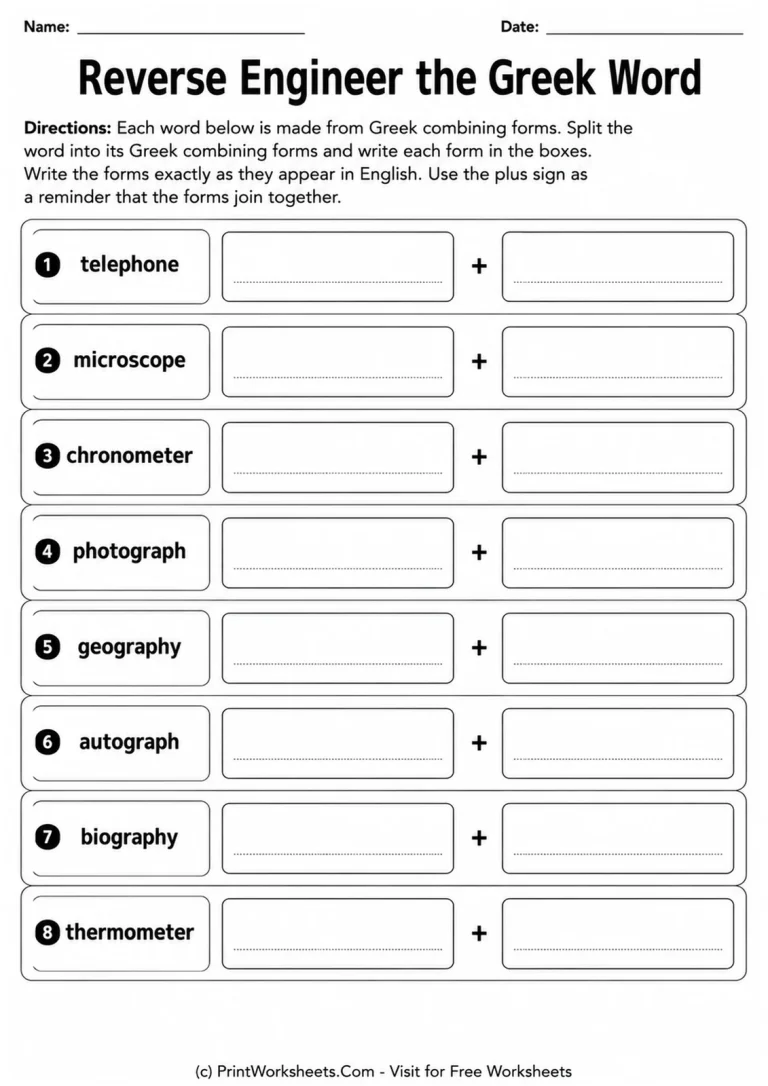
The third worksheet, Reverse Engineer the Greek Word, asks students to work in the opposite direction. Instead of building a word from parts, they examine a complete word and separate it into two combining forms. Words such as telephone, microscope, chronometer, photograph, geography, autograph, biography, and thermometer are presented with two answer boxes divided by a plus sign.
This decomposition task strengthens morphological awareness. Students see, for example, that a long spelling can become more manageable when they locate meaningful chunks inside it. Recognizing chrono + meter or micro + scope supports both spelling and vocabulary because the learner is paying attention to how the word is organized rather than simply copying its letters.
Proofread Greek-Derived Spelling Errors
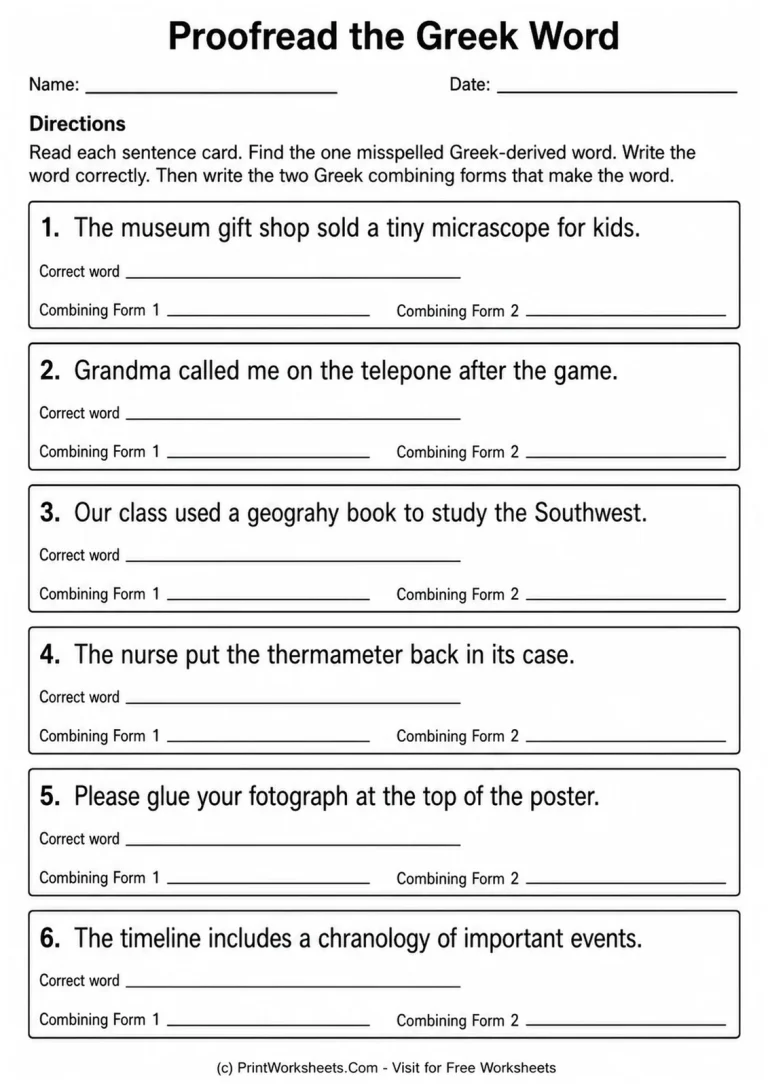
The final student page, Proofread the Greek Word, applies the same knowledge to editing. Each sentence contains one misspelled Greek-derived word. Students identify the error, rewrite the word correctly, and record the two combining forms that make up the corrected word. Examples include misspellings based on microscope, telephone, geography, thermometer, photograph, and chronology.
This final step adds an important editing skill to the set. Students must first detect that something is wrong, then produce the correct spelling, and finally explain the word’s structure through its combining forms. Because the task combines proofreading with morphology, it works well as a cumulative activity after the earlier word-building and analysis pages.
Ways to Use the Four-Page Grade 5 Set
The worksheets can be used in sequence over several lessons or assigned individually. Teachers may introduce Greek word parts with the building page, follow with the spelling-choice activity, move into word decomposition, and finish with proofreading. Parents can use the same progression for home practice because each page changes the type of thinking while keeping the vocabulary theme consistent.
For extra discussion, ask students to explain what they notice about repeated forms across words. They can compare biography with biology, photograph with photography, or thermometer with chronometer and identify which word part stays the same and which one changes. These comparisons help students transfer their knowledge to new academic vocabulary they may meet in science, geography, reading, and writing.
Use this printable Grade 5 set when students are ready to move beyond basic spelling patterns and examine how meaningful Greek word parts contribute to the spelling of longer English words.