These natural selection worksheets give fifth graders a clear path from understanding basic vocabulary to explaining how inherited traits can become more common in a population over time. The four-page set introduces variation, adaptation, inherited traits, environment, population, and natural selection through a short reading passage, matching practice, real-world trait scenarios, and population-level examples. Students repeatedly confront an important science idea: organisms do not simply choose a useful trait because they need it. Instead, inherited differences can affect survival and reproduction under particular environmental conditions.
Natural Selection Worksheets That Move from Vocabulary to Evidence
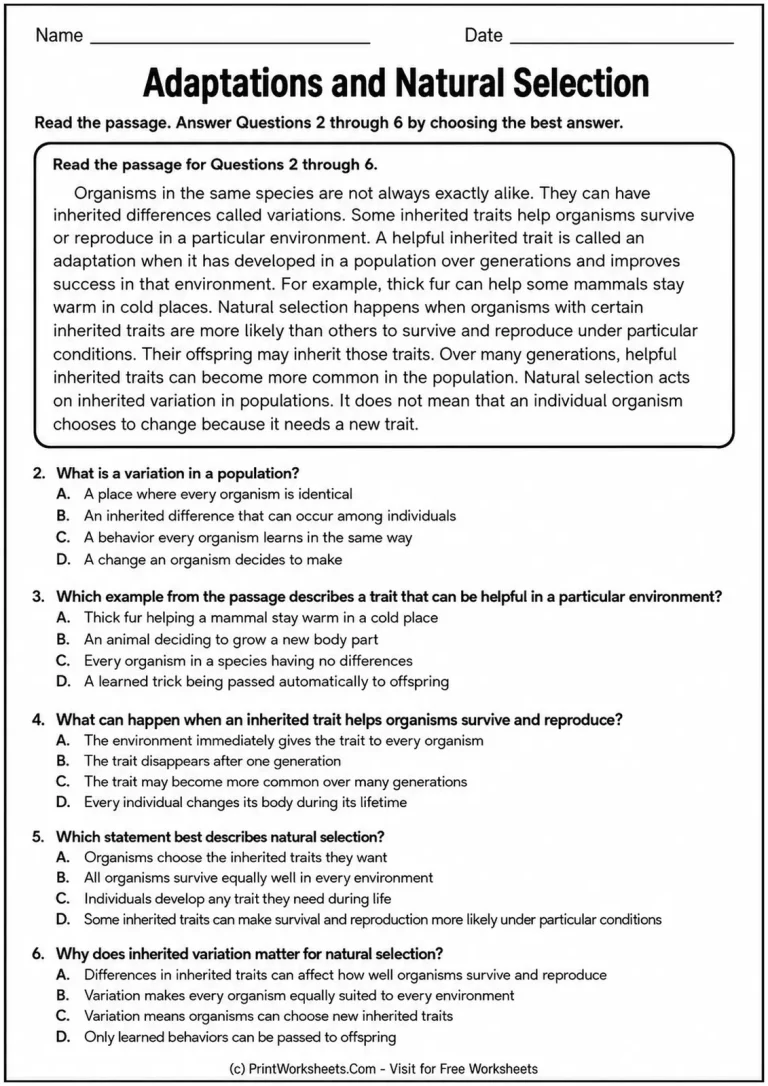
The first worksheet, Adaptations and Natural Selection, begins with an informational passage that defines inherited variation and explains how a helpful inherited trait can improve an organism’s success in a certain environment. The passage uses thick fur in cold places as a concrete example before connecting that idea to natural selection. Five multiple-choice questions ask students to identify variation, recognize an environmentally helpful trait, explain what can happen to a useful inherited trait over many generations, and distinguish natural selection from the mistaken idea that individuals intentionally change themselves.
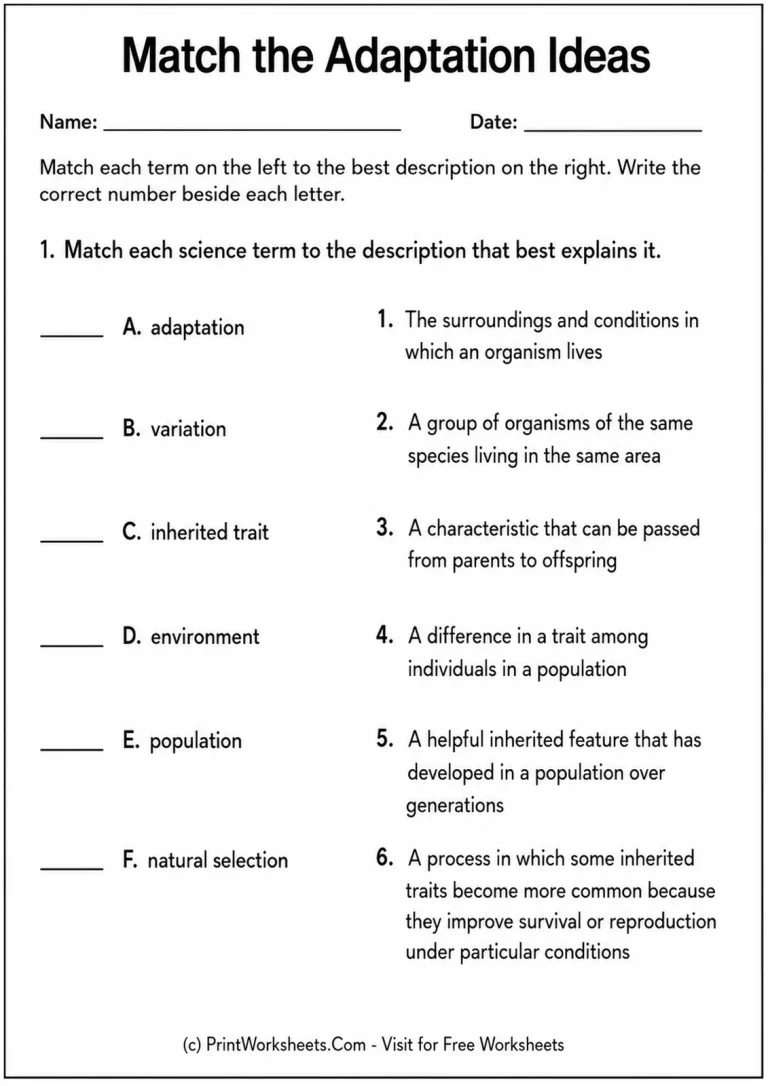
The second page, Match the Adaptation Ideas, provides focused vocabulary reinforcement. Students match six terms—adaptation, variation, inherited trait, environment, population, and natural selection—to their definitions. This activity is useful after the reading because it isolates the academic language students need before they work through more complex scenarios.
Apply Adaptations to Different Environments
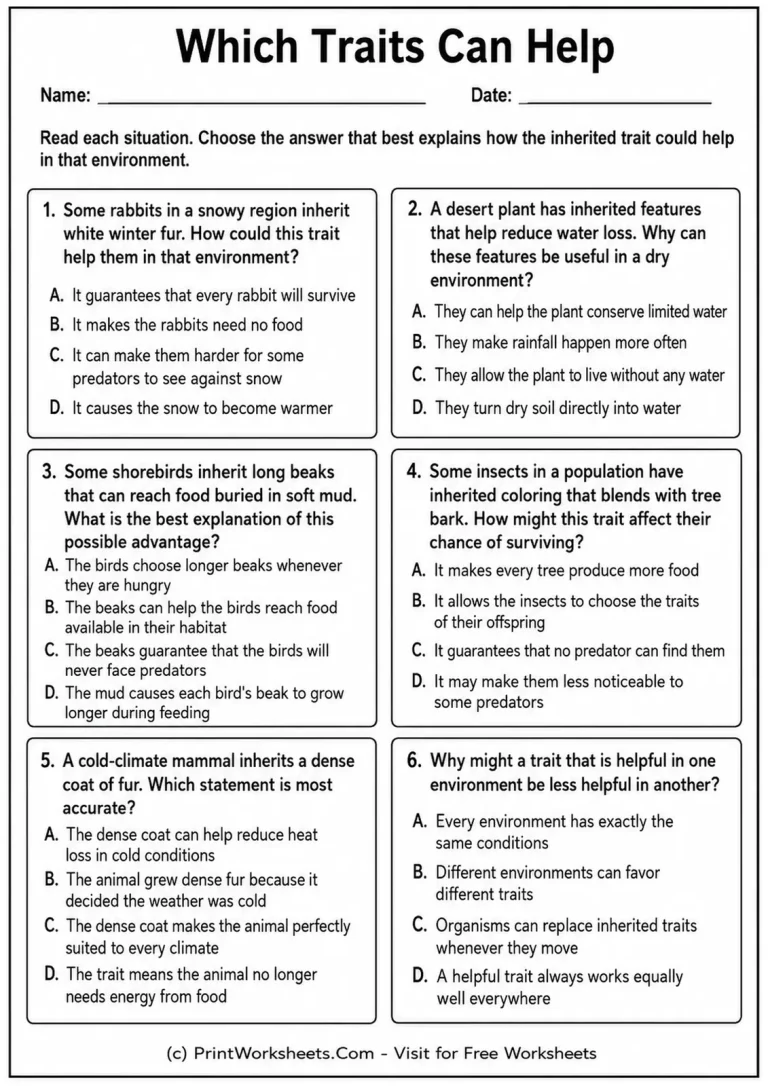
The third worksheet, Which Traits Can Help, shifts from definitions to application. Students consider white winter fur in rabbits living in snowy regions, water-conserving features in desert plants, long beaks that help shorebirds reach food in soft mud, coloring that helps insects blend with tree bark, and dense fur in cold-climate mammals. Each question asks students to explain why an inherited feature could be useful rather than merely identify the trait.
These examples also help students avoid overgeneralizing. White fur does not guarantee a rabbit will survive, dense fur does not make an animal perfectly suited to every climate, and a desert plant does not become independent of water. The final item reinforces that different environments can favor different traits, an essential bridge to understanding natural selection.
See Natural Selection Across Generations
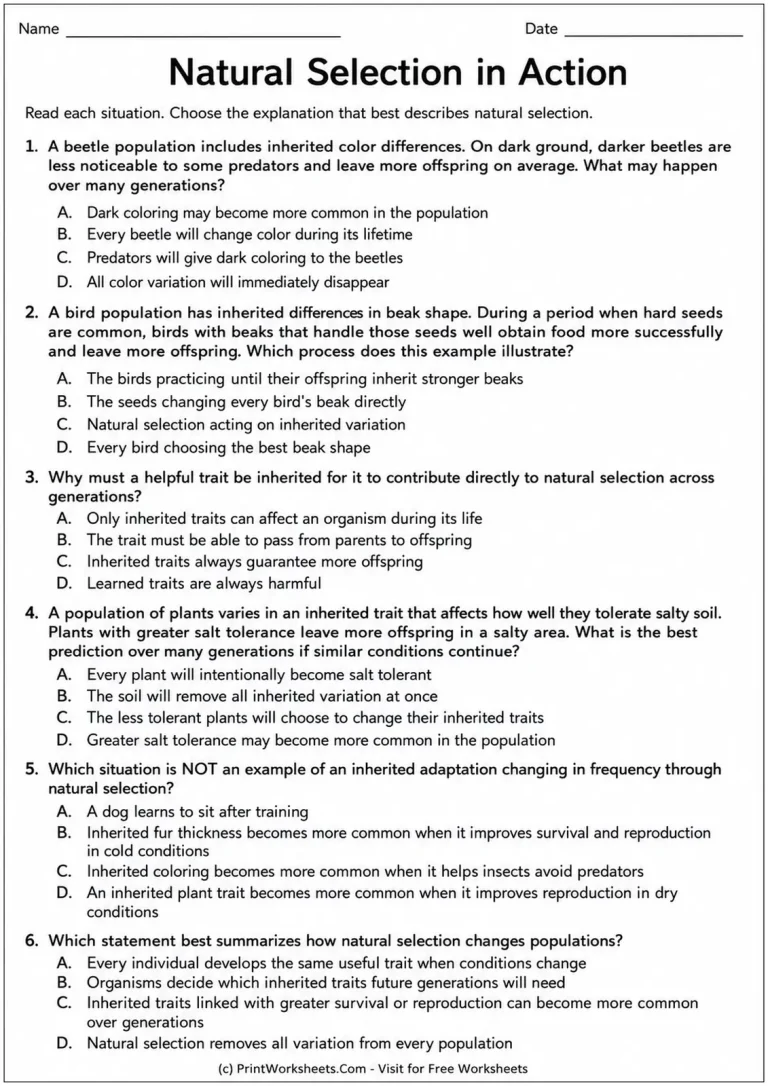
The fourth page, Natural Selection in Action, asks students to think at the population level. A beetle population contains inherited color differences, and darker beetles are less noticeable to some predators on dark ground. Students predict that dark coloring may become more common when those beetles leave more offspring. Another scenario describes birds with inherited differences in beak shape during a period when hard seeds are common. Students identify this as natural selection acting on inherited variation.
The worksheet then extends the same reasoning to plants with different levels of salt tolerance. When plants with greater salt tolerance leave more offspring in a salty area, students predict that the trait may become more common if similar conditions continue. A comparison question asks them to recognize that a dog learning to sit after training is not an example of an inherited adaptation changing in frequency through natural selection. The final question summarizes the central concept: inherited traits associated with greater survival or reproduction can become more common over generations.
Ways to Use the Four-Page Set
Teachers can use the pages as a short instructional sequence rather than assigning all four at once. Begin with the reading passage to establish the core explanation, then use the matching page as a quick vocabulary check. The trait-scenario worksheet works well for guided practice because students can explain why each incorrect choice fails scientifically. The final natural-selection page can serve as independent practice, homework, or a brief assessment after discussion.
For students who need additional support, have them underline words such as inherited, environment, survive, reproduce, and generations before answering. A useful extension is to ask students to choose one approved scenario and explain in two or three sentences how the environment affects which inherited trait may be advantageous. As an exit ticket, students can complete the sentence: “Natural selection can change a population over generations when…” and support the statement with one example from the worksheets.
A Practical Grade 5 Introduction to Adaptation and Natural Selection
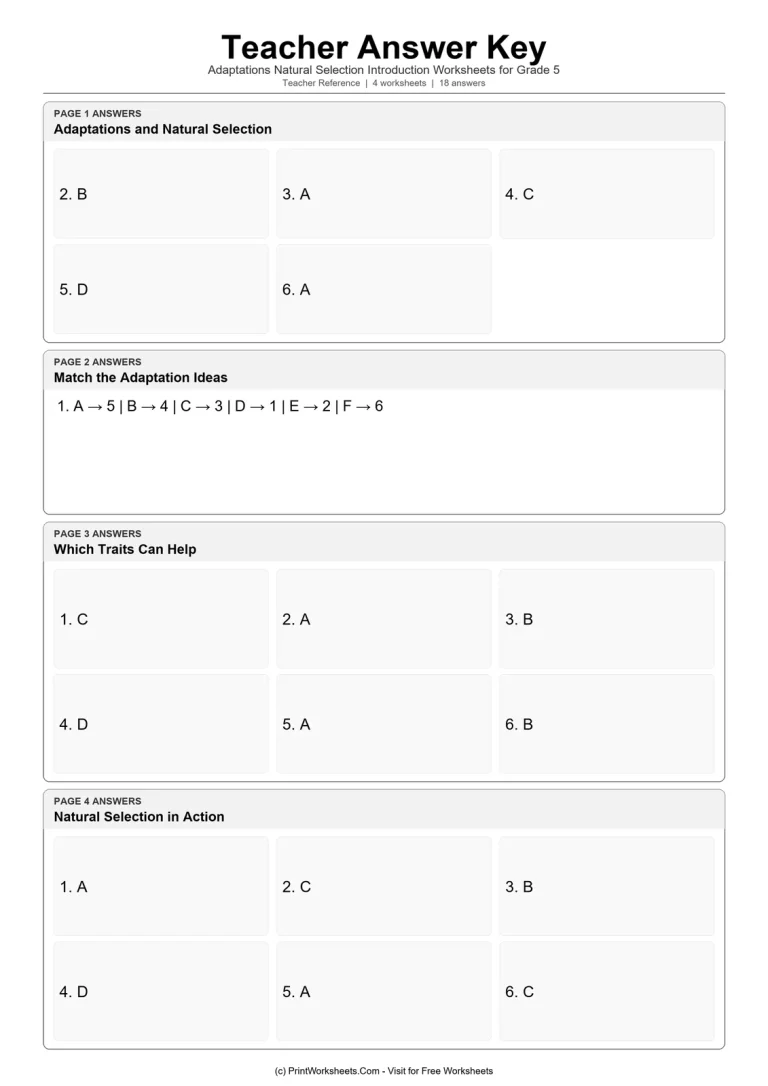
This set is especially useful because the activities progress from basic comprehension to scientific reasoning without requiring students to start with abstract population genetics. Rabbits, beetles, birds, plants, insects, and cold-climate mammals provide accessible contexts for discussing inherited differences, environmental conditions, survival, reproduction, and change across generations. The included teacher answer key covers all four worksheets, making the packet suitable for whole-class instruction, small-group reinforcement, independent practice, or review.