Strong fifth-grade writing about reading depends on more than finding a detail in a passage. Students need to answer the question clearly, select accurate evidence, and explain why that evidence supports the answer. These text dependent response worksheets give students structured practice with all three parts while gradually increasing the amount of thinking and writing they must do independently.
Build a Text Dependent Response Step by Step
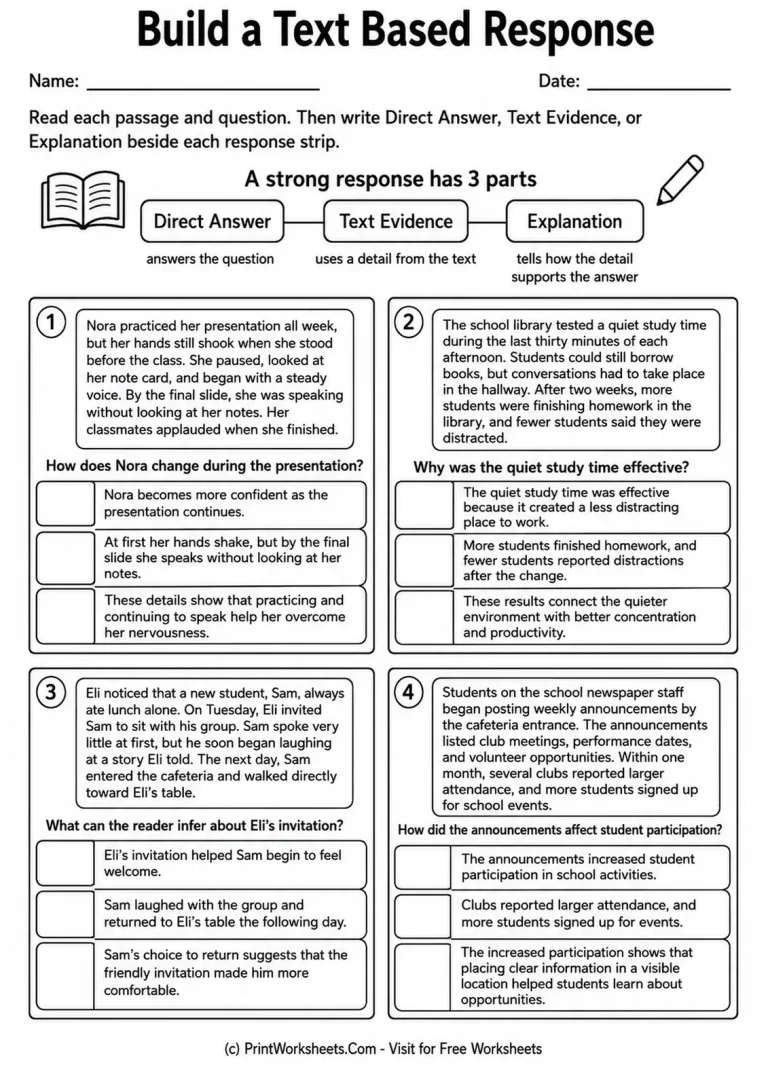
The first worksheet makes the structure of a strong response visible. Students read four short passages and questions, then identify which response strip is the Direct Answer, which is Text Evidence, and which is the Explanation. This format helps students see that a complete response is not simply a copied sentence from the passage. Each part has a separate job.
The passages provide useful Grade 5 reading situations without overwhelming students with long texts. In one example, Nora begins a presentation with shaking hands but gradually speaks more confidently. Another passage describes a quiet study period in a school library that leads to more completed homework and fewer reported distractions. Students also consider how an invitation helps a new student feel welcome and how visible school announcements increase participation in clubs and events.
Choose Responses That Are Actually Supported by the Text
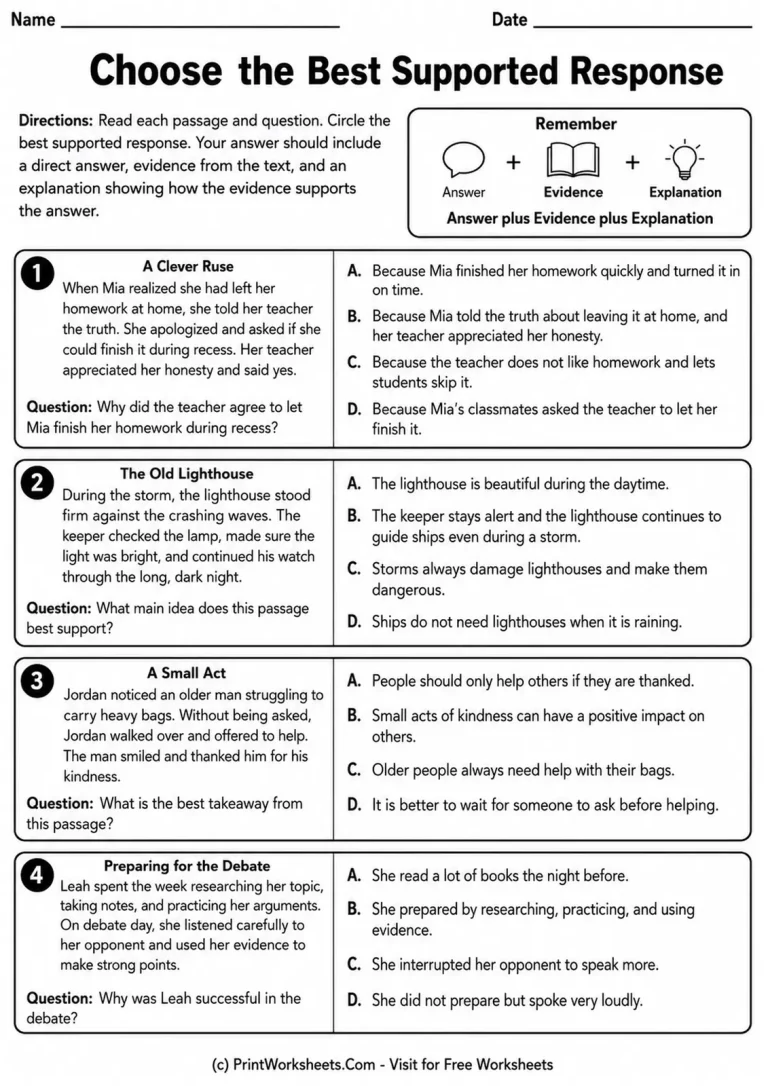
The second printable shifts from labeling response parts to evaluating complete answers. Students read a passage and choose the best supported response from four options. The correct answer must match what the text actually says rather than rely on assumptions or unrelated details.
One passage asks why a teacher allows Mia to finish forgotten homework during recess. The strongest answer connects the decision to Mia telling the truth and the teacher appreciating her honesty. Other questions focus on a lighthouse keeper working through a storm, the lesson shown by a small act of kindness, and the reasons Leah succeeds in a debate after researching, practicing, listening carefully, and using evidence.
This multiple-choice stage is especially useful before open-response writing because students must compare strong and weak reasoning. They can see how an answer may sound reasonable but still fail if it is not supported by the passage.
Move Into Independent Written Responses
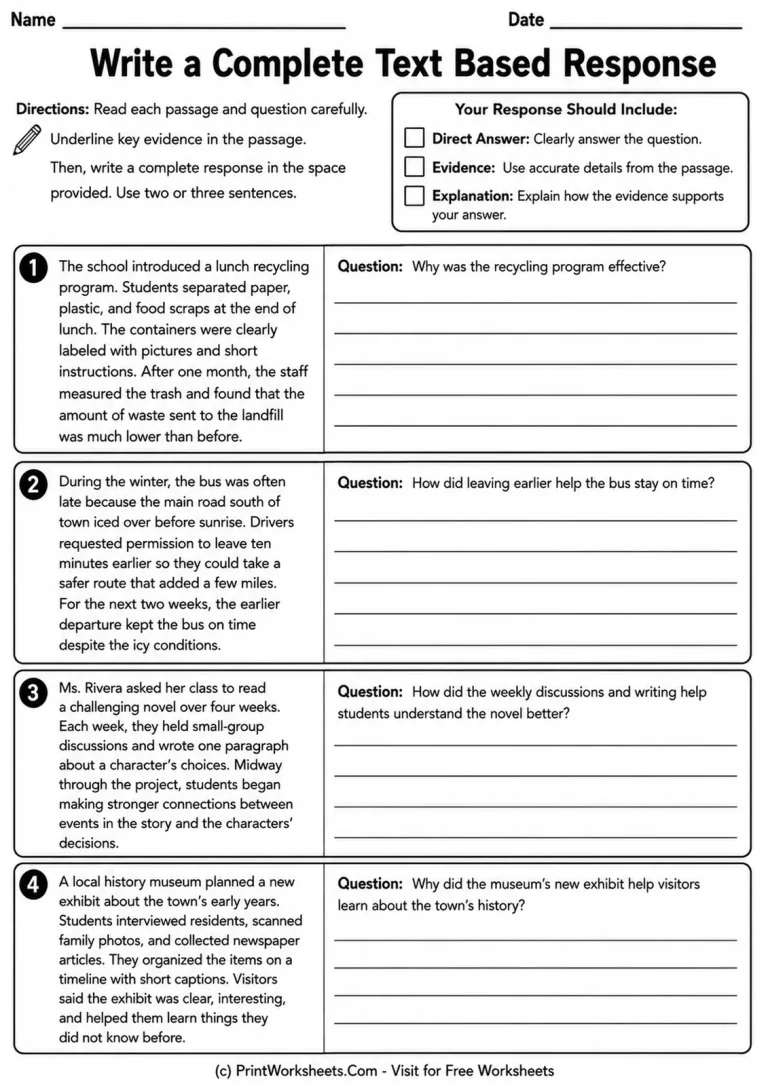
The final worksheet asks students to underline key evidence and write a complete response in two or three sentences. A checklist reminds them to include a direct answer, accurate evidence, and an explanation connecting the evidence to their answer. The writing space is large enough for students to form a concise paragraph without turning the task into a full essay.
The four passages support different kinds of reasoning. Students explain why a lunch recycling program was effective after the amount of landfill waste decreased. They describe how leaving earlier allowed a bus to stay on time while using a safer winter route. They explain how weekly discussions and paragraph writing helped readers make stronger connections between events and character decisions in a novel. A final passage asks why a local history museum exhibit helped visitors learn, using details about interviews, family photographs, newspaper articles, a timeline, and visitor reactions.
Ways to Use These Grade 5 Written Response Worksheets
Teachers can use the pages as a short instructional sequence across several lessons. Begin by modeling how to separate an answer from its supporting evidence and explanation. Follow with the supported-response page so students can discuss why one option is stronger than another. Finish with the independent writing page as classwork, a reading-center activity, homework, or an exit assessment.
For students who need additional support, ask them to highlight the question words first and underline one sentence in the passage that directly helps answer the question. Then have them orally explain the connection before writing. More advanced students can be challenged to include two supporting details or revise a two-sentence answer into a more precise three-sentence response.
Practice Evidence-Based Writing Without Long Passages
Because the readings are short, the main challenge remains the writing skill itself: answer, support, and explain. That makes the set useful for focused practice before longer constructed-response assignments, reading assessments, or content-area writing. Students get repeated opportunities to prove that their ideas come from the text while learning to make the reasoning between evidence and answer explicit.