
These series comma worksheets give Grade 5 students focused practice with using commas to separate three or more words, phrases, or actions in a sentence. Across four printable activities, students move beyond simply adding punctuation marks. They identify exactly where a series begins and ends, count the items in each series, compare correctly and incorrectly punctuated sentences, rewrite sentences with missing commas, and edit short everyday messages. The practice also reinforces the comma before the final and or or, helping students apply one consistent punctuation pattern throughout the set.
Grade 5 Series Comma Worksheets with Step-by-Step Practice
The worksheets are arranged so students encounter the same grammar skill in several different ways. This makes the set useful for teaching, guided practice, independent work, homework, or additional review. Instead of repeating one exercise format, each page asks students to pay attention to a different part of the punctuation process.
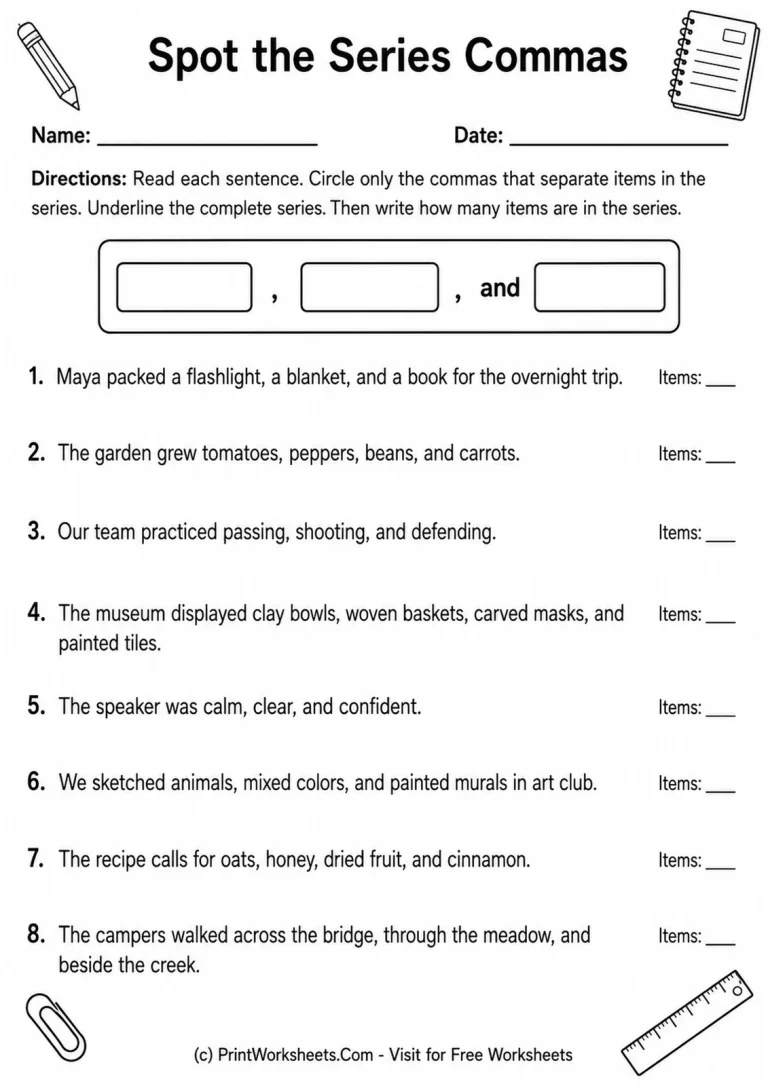
Spot the Series Commas
The first worksheet concentrates on recognition. Students read eight sentences and circle only the commas that separate items in a series. They also underline the complete series and record how many items it contains. This combination encourages students to notice both punctuation and sentence structure rather than treating every comma as interchangeable.
The examples include more than simple lists of nouns. Students also work with adjectives, actions, and prepositional phrases. Because the series vary in form, learners must decide which words or groups of words belong together before they can identify the commas correctly. The item-counting step provides an additional check that they have found the whole series.
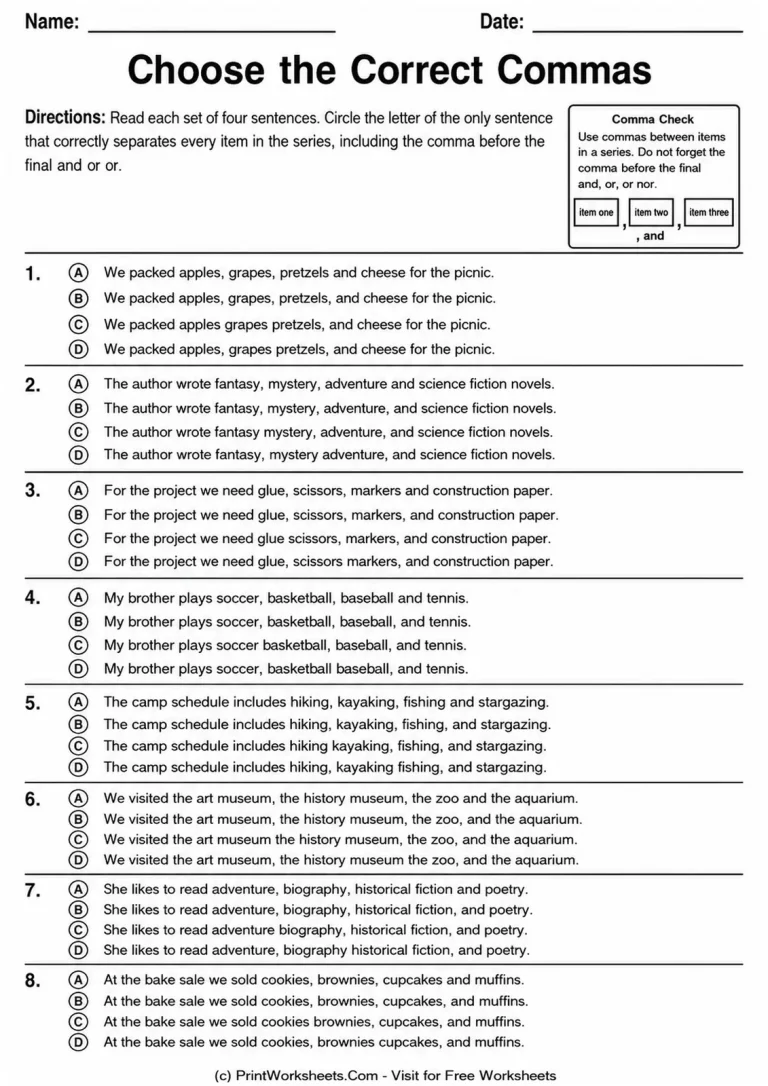
Choose the Correct Commas
The second page uses multiple-choice punctuation discrimination. Students examine eight groups of four nearly identical sentences and select the one version that separates every item in the series correctly. The examples use four-item series in familiar contexts, so the main challenge is the punctuation rather than difficult vocabulary.
This page is especially useful for showing how a missing or misplaced comma changes the correctness of a sentence. It also repeatedly draws attention to the comma before the final and or or. Comparing several close alternatives requires students to inspect the entire series instead of stopping after finding one comma that looks correct.
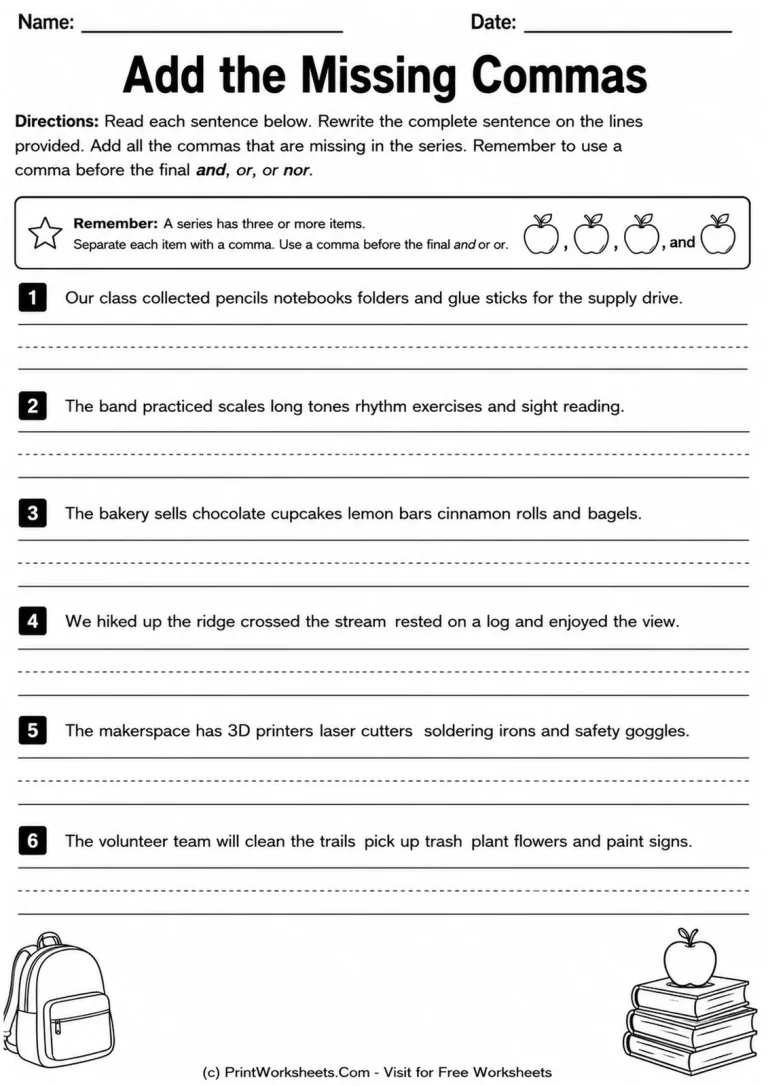
Add Missing Commas and Rewrite the Sentence
The third worksheet shifts from recognition to independent application. Students are given six sentences with missing series commas and rewrite each full sentence with the punctuation added correctly. The sentences include lists of supplies, music activities, baked goods, makerspace equipment, volunteer actions, and other clear series.
Rewriting the complete sentence makes this activity more demanding than inserting isolated marks. Students must preserve the wording, locate every boundary between series items, and produce a finished sentence that reads naturally. Some examples also contain multi-part action series, giving fifth graders practice with structures that are longer than a simple list of objects.
Proofread Series Commas in Short Messages
The final student page places the skill in a practical editing context. Students proofread four message cards, rewrite each complete message with correct commas, and underline the three or more words, phrases, or actions that form the series. The situations include a workshop reminder, library display note, club update, and cafeteria survey.
This editing format helps connect grammar practice with the kind of writing students may see at school. They must first understand the message, locate the series, correct its punctuation, and then identify the actual elements being separated. That sequence makes the task useful for students who are ready to apply comma rules inside meaningful text rather than only in isolated examples.
What Students Practice with Commas in a Series
By working through the four pages, students practice recognizing groups of three or more related items, distinguishing series commas from other punctuation, identifying the complete series, counting its elements, choosing a correctly punctuated sentence, inserting missing commas, and proofreading short passages. The worksheets also provide repeated exposure to series made from single words as well as longer phrases and actions.
Teachers and parents can use the pages in sequence for a gradual lesson or select individual activities according to student need. The identification and multiple-choice pages work well for quick checks and guided instruction, while the rewriting and message-editing pages provide stronger independent application. Together, the set gives Grade 5 learners several ways to demonstrate that they understand not only where commas belong in a series, but also what the commas are separating.